




Looking back at the week just gone, we recall Bitcoin’s new all-time high, the successful launch of Ethereum 2.0 Phase Zero, Sberbank’s initiatives that failed to win regulator support, and other key events.
Bitcoin price hits an all-time high; Ethereum prices at local high
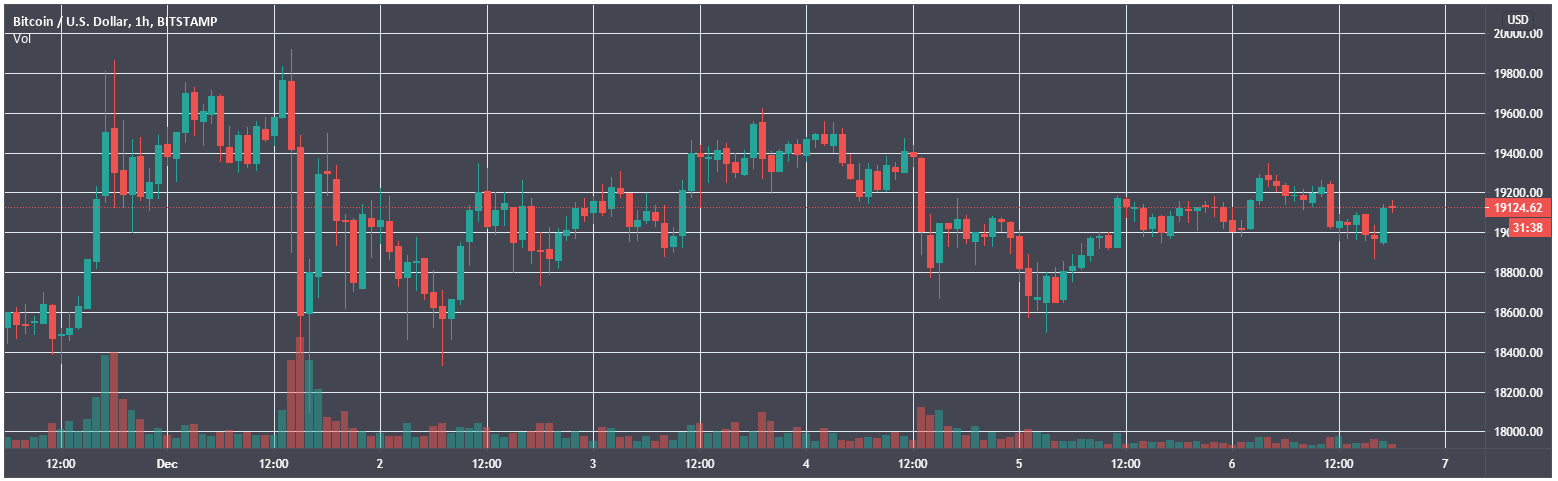
On Monday, November 30, the price of the leading cryptocurrency rose to new all-time highs on several major exchanges. On Bitstamp, quotes surpassed $19,870, compared with the previous record of $19,666.
Bitcoin also topped its all-time high according to data from Binance, Huobi, Kraken, and the cryptocurrency data aggregator CoinGecko.


Data: TradingView.
On the next day, December 1, the price of the leading cryptocurrency reached new records. On Bitstamp it hit $19,918.
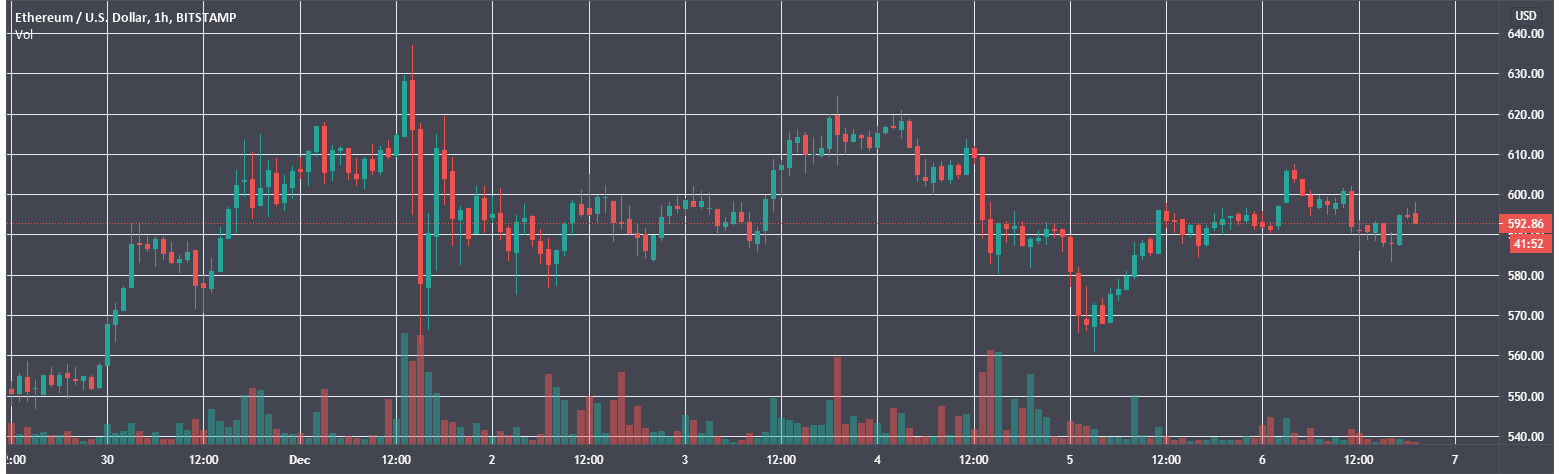
Ethereum (ETH) quotes on the platform rose to $636.58. The coin traded at that level in May 2018.


Data: TradingView.
During the ensuing correction, Bitcoin dipped below $18,200, but by week’s end managed to hold at $19,000. The second-largest cryptocurrency fell below the key $600 and, at the time of writing, trades around that level.
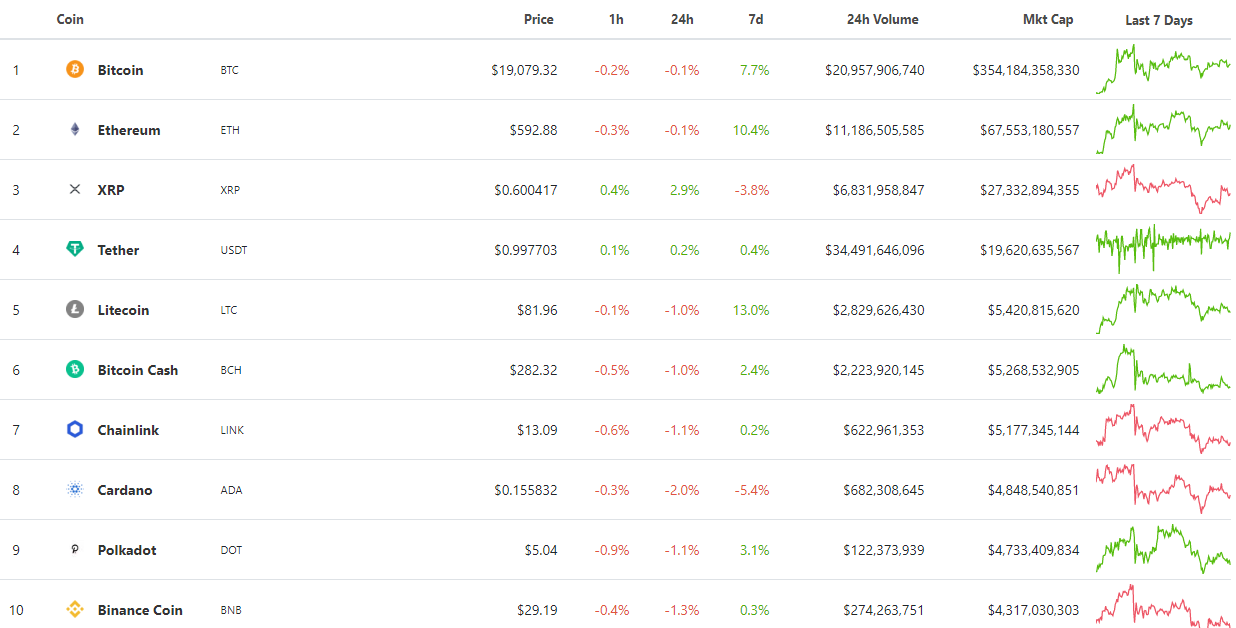
It was Ethereum (ETH) and Litecoin (LTC) that outperformed the top cryptocurrencies over the week—up 10.4% and 13% respectively (data: CoinGecko).


Data: CoinGecko.
The market capitalization of the cryptocurrency market stands at $573.8 billion, and Bitcoin’s dominance index fell to 61.2%.
Ethereum 2.0 Phase Zero launch took place
As planned, on Tuesday, December 1, the Phase Zero launch of Ethereum 2.0 took place.
Congrats on the launch all!
— vitalik.eth (@VitalikButerin) December 1, 2020
The threshold balance of 524,288 ETH and 16,384 validators in the network was overcome a week earlier.
In the first days after the launch, users deposited more than 1 million ETH into the deposit contract, and the number of active validators exceeded 23,000.
The first block on the Ethereum 2.0 network was accompanied by the message “Mr F was here,” which intrigued users.
Developer Hudson Jameson explained that “Mr F” is a nod to Queen’s song “Don’t Stop Me Now” and the autograph that Vitalik Buterin once left for user Mr Fahrenheit.
By the second day, one of the network validators lost a portion of its stake for block tampering. The validator was fined 0.25 ETH. Lead developer Justin Drake noted that at the initial stage sanctions for isolated incidents are softened. Over time, the penalty for violations and malicious actions will revert to 1 ETH.
After the Phase Zero launch, ConsenSys head and Ethereum’s second-largest founder Joseph Lubin expressed the view that the final transition to Ethereum 2.0 will occur sooner than most users think.
ForkLog explained what users can expect from the Ethereum 2.0 launch in a feature:
Launch of Ethereum 2.0 Phase Zero: What will happen and what users should expect
Draft bill on declaring cryptocurrency transactions introduced in the State Duma
The Russian government has introduced in the State Duma a bill titled “On Amendments to Parts One and Two of the Tax Code of the Russian Federation,” regulating the declaration of cryptocurrencies.
According to the document, digital currencies are recognised as property.
Individuals and Russian organisations will be required to report holdings of digital currencies to tax authorities if “the amount of inflows or withdrawals during the calendar year exceeds the amount equivalent to 600,000 rubles.”
Penalties are provided for failing to notify on time about cryptocurrency transactions, for late submission or providing false information.
Head of the State Duma Committee on the Financial Market Anatoly Aksakov noted that recognizing cryptocurrencies as property would help solve inheritance and taxation issues.
In his view, cryptocurrency transactions are a highly profitable business for many and should be taxed as a form of entrepreneurial activity.
ForkLog looked into the specifics of the bill submitted to the Duma together with experts:
When to report Bitcoin: a breakdown of the cryptocurrency taxation bill
Sberbank proposes to make all cashless rubles digital. The central bank disagrees
Sberbank presented its own model for issuing and circulating a digital ruble, which differs from the central bank’s view. This was explained by Sberbank chairman Anatoly Popov at a meeting with the central bank and market participants dedicated to the digital ruble.
In Sberbank’s model, each digital ruble would be assigned a tracking number and “attributes,” and payments would be conducted under smart-contract terms. The latter could solve the problem of misallocation of funds, Popov noted.
«We propose to enable tokenisation of all cashless rubles under a single set of rules established by the central bank», — reads the presentation.
According to the model, “commercial banks do not issue their own currency, they only account for their cashless money differently. The central bank will retain the role of regulator of token circulation, the state will gain “unprecedented tools of control,” and businesses will be able to create new products based on smart contracts, according to Sberbank.
The Bank of Russia, however, stressed that they see the digital ruble as the third form of money, built on distributed ledger technology.
«We would also like to create a new infrastructure that enables seamless digital settlements between all players and helps reduce industry-wide costs», said Olga Skorobogatova, first deputy chair of the Bank of Russia.
At the same time, the central bank is ready to discuss using smart contracts for settlements with digital rubles, she emphasised.
Sberbank also plans to launch a blockchain platform that will allow users to acquire digital financial assets (DFAs). This was announced by Sberbank’s head, Herman Gref, during an online presentation as part of Investor Day.
The new platform is planned to launch after the law “On DFAs” comes into effect.
«From 1 January, the relevant law comes into force. We want to bring to market our new blockchain platform, which will provide services for purchasing DFAs. And from the outset we plan to implement the ability to acquire “green” instruments», said Gref.
He also allowed for the possibility that Sberbank could issue its own stablecoin in 2021:
«We have all the groundwork on this topic and, quite possibly, we will begin experimenting next year with producing our own currency — the so-called Sbercoin».
The Bank of Russia will not allow issuing stablecoins pegged to the ruble
The Bank of Russia spoke out against issuing stablecoins pegged to the ruble. First Deputy Chair Sergei Shvetsov said this.
Developers of smart contracts in Russia should use the digital ruble, issued by the Bank of Russia, as the crypto asset. In its approach, the central bank draws on China’s experience, which, in preparing for the launch of its national digital currency, banned yuan-backed stablecoins.
«We are not far from that. At minimum, anything used as a means of payment will be blocked by us. We assume that the ruble is Russia’s means of payment», he said.
In the future, the central bank plans to involve the Duma in discussions. Initial reaction to the regulator’s initiative was described as positive.
The Verkhovna Rada of Ukraine passed the ‘On Virtual Assets’ bill in the first reading
On December 2, the Verkhovna Rada of Ukraine, in the first reading, approved as a basis the draft law “On Virtual Assets,” regulating cryptocurrency operations within the country.
The document was supported by 230 deputies. One voted against; 68 abstained.
The bill classifies virtual assets (VAs) as intangible property.
The regulator’s role for market oversight is assigned to the Ministry of Digital Transformation, and in some cases to the National Bank and the National Commission on Securities and Stock Market.
One of the bill’s authors, MP Aleksey Zhmerenetsky, said the bill would allow crypto firms to pay taxes and enable foreign firms to cooperate with Ukrainian banks and invest in the industry.
«The document takes a comprehensive approach to virtual assets, not treating them solely as crypto-assets or cryptocurrencies. It defines basic concepts related to virtual assets, lists providers of services in the VA space and the procedure for their registration», said Zhmerenetsky.
The bill complements the FATF-style rules previously adopted to counter money laundering and the financing of terrorism.
It is envisaged that the act will allow the central bank of Ukraine to accelerate work on a digital variant of the national currency.
The National Bank of Ukraine initiated a bill on its right to issue an e-hryvnia
The National Bank of Ukraine continues to study the possibility of issuing a digital equivalent of the hryvnia. This was stated by NBU chair Kyrylo Shevchenko.
For this, the regulator initiated a bill “On Payment Services,” containing a definition of central bank digital currencies (CBDCs) and enshrining the NBU’s right to issue them. In mid-November, the document was submitted to the Verkhovna Rada of Ukraine.
According to Kyrylo Shevchenko, the NBU is focusing on developing a legal framework that would grant CBDCs the status of legal tender, which cryptocurrencies do not have. The regulator outlined several potential uses for the e-hryvnia:
«We are looking at possible use cases and studying the needs of market participants and consumers, taking into account the best global practices», explained Shevchenko.
The launch of the e-hryvnia envisions creating a payment infrastructure for market participants. The NBU is also studying the potential impact of the e-hryvnia on macroeconomic and financial stability of the country.
Anonymous user solved a 7 ETH puzzle
The unknown user received 7 ETH (~$4,200 at the time of writing) for solving a puzzle that started with a metro advertisement board in Warsaw.
An advertisement featuring an Ethereum address and the hashtags #0xPOLAND and #0xPOLANDHEIST appeared at one of the stations. It urged commuters to solve the puzzle to claim 7 ETH.
According to organizers, the contract code required calling the “solve” function and using a secret phrase to withdraw funds. Clues were published on the Twitter account named 0xPoland.
The first contained phrases “Hint: ^[A-Z].*.” and “0x01ccfbfc”. One stated that the message should begin with a capital letter and end with a period, the other — about a checksum part.
In the tweet’s attached image there was a quote. It pointed to the title of a song by the musical project Elffor. The participant was to obtain the first part of the secret phrase — “into the dark forest.”
After a few days 0xPoland published another tweet. The phrase hinted at the work “The Hitchhiker’s Guide to the Galaxy,” and the string of characters required the puzzle-solver to have programming skills. In the end the second part of the code — “into the rabbit hole.”
The final clue appeared in both the print and online editions of Gazeta Wyborcza.
«Many daily newspapers rejected our advertisement, as they could not understand the puzzle concept and preferred to err on the side of caution», said the quest organizers.
The advertisement carried a phone number. The participant received a recorded message with the missing parts of the secret phrase, which in full read: “From 0xPoland. Into the dark forest. Into the rabbit hole. Where adventures await you.”
The correct answer was recorded in the smart contract 21 minutes after the tweet was published.
Organizers explained that this was their way of inviting developers to join their team “in building a decentralized financial infrastructure.”
What else to read and watch
In the traditional monthly review, ForkLog gathered all the key quantitative and qualitative metrics of the crypto market for November.
ForkLog looked into the history of the Russian cloud-mining service CryptoUniverse — why the company was expelled from a sector conference, former partners have to sue to recover money, and customers can only retrieve ASIC miners with the help of law enforcement.
After the US presidential election, the issue of trust in the election results has become global news due to one of the candidates. Many believe that solving it, given its intrinsic properties, could be aided by blockchain technology. In a new piece we study how feasible this is, how feasible this is.
We cover major cybersecurity events in the weekly thematic digest.
A ForkLog episode featured trader and host of the “Gagarin Show” Vladimir Nosov, who talked about the project’s history, what inspires the team’s humor and creativity about crypto and its future plans.

Subscribe to ForkLog’s news on Telegram: ForkLog Feed — all the news, ForkLog — the most important news and polls.