




Bitcoin fell from $109,000 to $100,000, IPO rumours buoyed TRX, the Fed kept its key rate unchanged, hackers hit Iran’s Nobitex platform, and other highlights of the week.
Fed holds rates as crypto endures a bruising week
Bitcoin opened the week on a firm footing, climbing to $109,000 by June 17. It failed to sustain the momentum, however, and after a local peak began a swift descent.


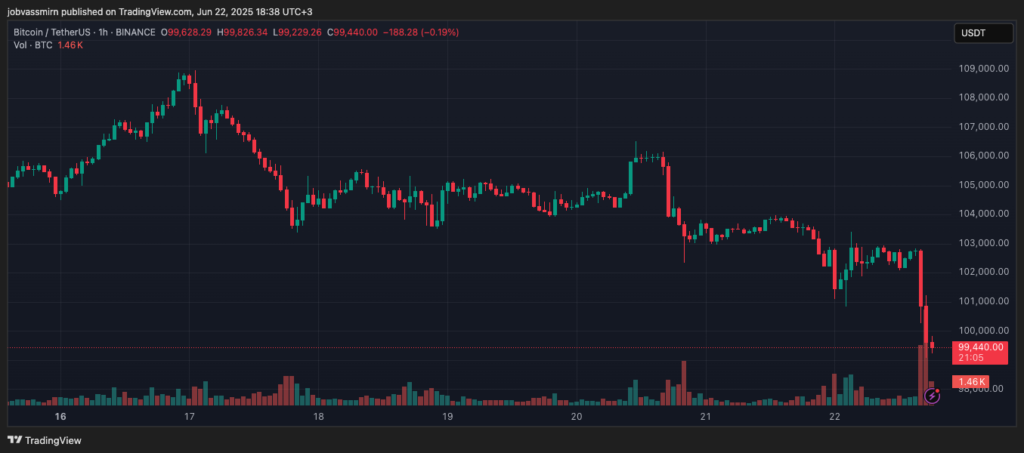
By June 18 bitcoin traded between $103,000 and $104,000. That evening the Federal Reserve System of the United States decided to keep the key rate in a 4.25%–4.5% range.
The move matched market expectations, yet bitcoin still drifted sideways until Friday. On June 20 the digital gold attempted a breakout above $107,000, but heavy selling sent it back to $103,000.
Overnight June 21–22 bitcoin was highly volatile amid a US strike on nuclear facilities in Iran. By Sunday evening the asset slumped below $100,000.
The drop triggered more than $1bn in 24-hour liquidations, according to Coinglass.


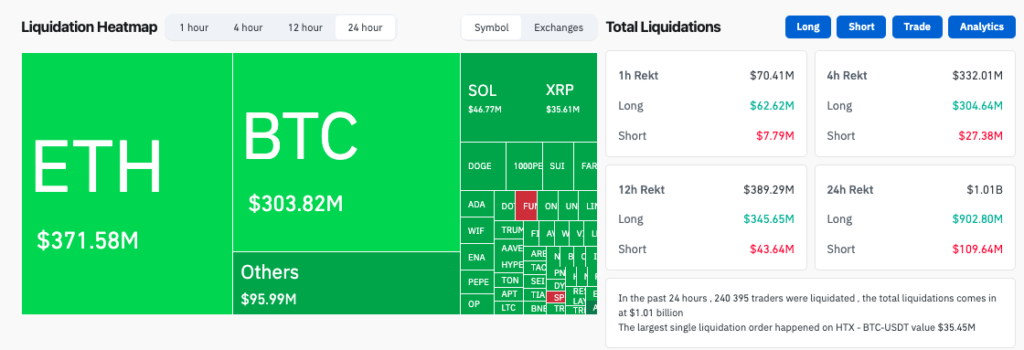
At press time the leading cryptocurrency trades at $99,400, down 6% on the week. Its market capitalisation stands at $1.97 trillion.
Altcoins fared worse. Ether fell 14% to $2200.


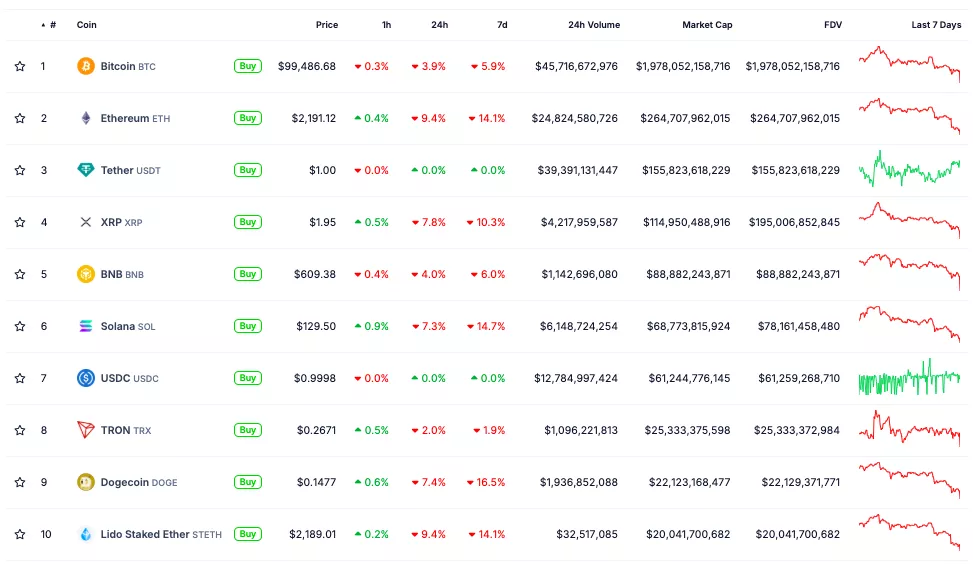
SOL (-14.7%), DOGE (-16.5%) and XRP (-10.3%) were also hit.
“Right now, altcoin capitulation is literally under way,” noted analyst and MN Trading founder Michaël van de Poppe.
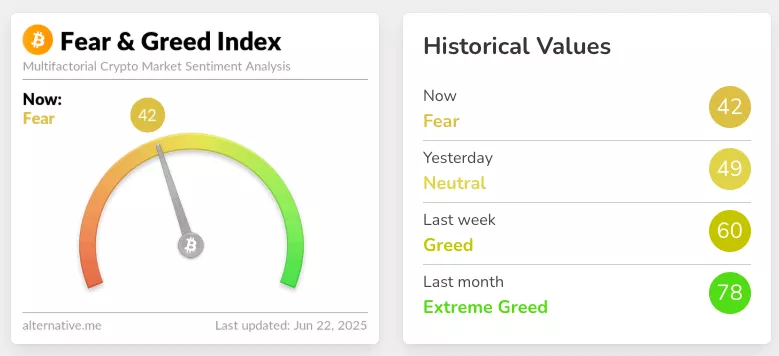
Total market capitalisation slid to $3.19 trillion. The Crypto Fear and Greed Index fell towards 42.


TRON lifted by upbeat listing chatter
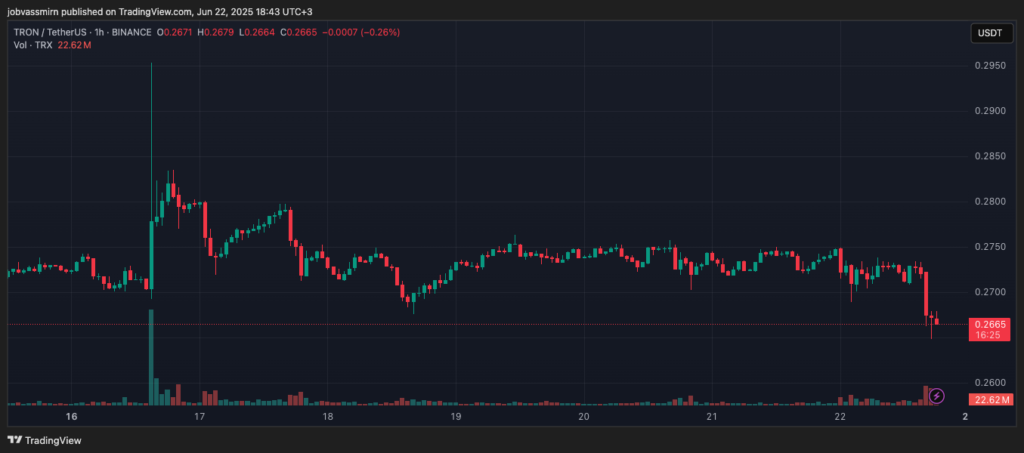
Despite the turbulence, TRX held its ground—down just 2% on the week—likely helped by rumours of a US listing for Tron.
On June 16, FT journalists reported that Justin Sun’s firm would go public via a reverse merger with SRM Entertainment, a Nasdaq-listed company.
After publication, TRX jumped from $0.27 to $0.30, up about 9%. It then corrected, but despite the broader pullback still trades around $0.27.
The merger is being arranged by boutique investment bank Dominari Securities, linked to the US president’s sons: Donald Trump Jr and Eric Trump.
The new venture will buy and hold TRON tokens, mirroring Michael Saylor’s strategy. Sources say Tron has committed $210 million in digital assets to the company.
Eric Trump had been expected to take a role at the firm, but he denied the claims.
“I am the biggest fan of Tron and I love Justin Sun — he is a great friend and an icon in the crypto space. That said, the statements below are inaccurate — I am not taking public involvement,” said the president’s son.
In a press release SRM Entertainment did not confirm the possible merger, but said it had reached an agreement with a “private investor” to purchase 100,000 shares for $100 million. The financing will go towards building a TRX corporate treasury.
Sun also became a strategic adviser to SRM, and the company announced a change of name to Tron.
The news also buoyed the company’s shares, which rose 835% over the trading week.
What to talk about with friends?
- Texas approved a bitcoin-reserve law.
- Glassnode explained the drop in on-chain bitcoin activity.
- Hackers targeted crypto-industry jobseekers via fake interviews.
- Thailand abolished the tax on crypto profits.
Attack on an Iranian exchange
On June 18 hackers attacked the Iranian crypto trading platform Nobitex. Losses are estimated at $90 million to $100 million.
On-chain sleuth ZachXBT was first to flag suspicious transactions from Nobitex wallets. The exchange later confirmed the breach.
Funds were withdrawn from the TRON network and EVM-compatible blockchains. To do this, the attackers used vanity addresses referencing the IRGC.
Responsibility was claimed by the pro-Israeli hacking group Gonjeshke Darande, which accused Nobitex of financing terrorism and helping the Iranian regime evade sanctions. After the attack they published the exchange’s source code.



“The funds remaining at Nobitex are now fully open to the public,” the hackers said.
Chainalysis analysts confirmed the political motivation for the attack. The perpetrators moved funds to disposable wallets without access to private keys. In effect, the assets were destroyed rather than stolen for profit, the specialists explained.
Experts also highlighted Nobitex’s role in Iran’s sanctioned crypto economy. According to them, the exchange serves as a “critically important hub” that gives local users access to global markets.
Also on ForkLog:
- An ethical business dilemma. Coinbase was criticised for sponsoring a military parade in the US.
- Analysts estimated the share of “legitimate” stablecoin transactions at 99%.
- X blocked Pump.fun and 19 more crypto accounts.
- Report: since early 2024 the RWA market has added more than $100 billion.
GENIUS Act and a looming stablecoin bubble
On June 17 the US Senate voted for a revised version of the GENIUS Act. A majority (68 votes to 30) backed the bill. It now heads to the House of Representatives.
“Thanks to the bill, the United States has become one step closer to becoming the world leader in cryptocurrencies. Once the GENIUS Act becomes law, companies of any size and Americans across the country will be able to make payments almost instantly, rather than waiting days, and sometimes weeks,” said the initiative’s author, Senator Bill Hagerty.
Amid active lobbying of the topic and Circle’s successful IPO, former BitMEX CEO Arthur Hayes predicted the start of a “stablecoin mania.” But he warned that most new issuers will fail.
He said the bubble will burst after a listed issuer manages to “separate fools from tens of billions of their capital.” Hayes also cautioned traders against shorting the shares of such companies.
NoOnes CEO Ray Youssef agreed. In a comment to ForkLog he noted that markets have seen a similar pattern before.
“When bankers see a favourable opportunity, they pour in capital and marketing resources, inflating valuations while ignoring real utility or long-term viability. And a Circle listing at an inflated price will attract imitators chasing headlines and venture capital rather than real value,” he said.
Most of these prospects, Youssef added, are not linked to real stablecoin use cases, such as for ordinary people in the Global South.
The NoOnes chief executive believes that only independent structures—not large banking or technology companies—can provide real privacy and security for users.
What else to read?
How Myanmar’s scamming-factory network works — read more about digital slavery.
Is digital immortality achievable, and if so — why? The answer is in the second part of “The Dream of Innocent”.