




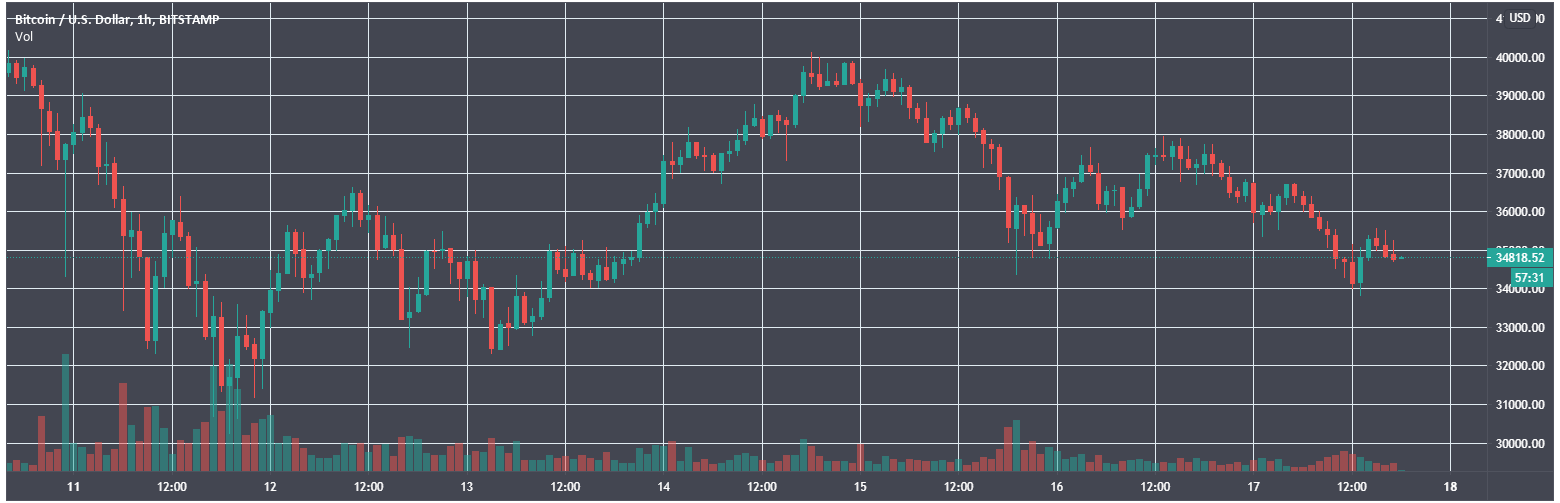
The price of Bitcoin began the week with a drop. On Monday, January 11, Bitcoin tumbled below the $31 000 level. The market-wide response to the flagship cryptocurrency saw its capitalisation fall by more than $250 billion to around $900 billion.
After a rebound, “digital gold” traded in a range of $32 000–$36 000. On January 14, the price surged by $4 000 in 24 hours, breaking the $40 000 mark.


Data: TradingView.
Analysts at Skew noted that the rebound occurred on low spot volumes.
#bitcoin rebounding toward $40k on lower volumes pic.twitter.com/Ux2R4CVAxN
— skew (@skewdotcom) January 14, 2021
During the new wave of correction, Bitcoin’s price fell again and, at the time of writing, the coin traded around the $35 000 level.
Michaël van de Poppe argues that what is happening is a “natural and organic consolidation,” often seen during the 2016-2017 bull run. He says the leading cryptocurrency is on track to reach $200 000, a level he expects to hit “in a few years.”
#Bitcoin is acting organic and natural by this consolidation.
These occurred in the previous bull market more often. The only thing to watch is the 21-Week MA in the coming period.
However, most likely #Bitcoin is on the road towards $200K+ in a few years. pic.twitter.com/KBgBKiUZck
— Michaël van de Poppe (@CryptoMichNL) January 17, 2021
CEO Dan Morehead of Pantera Capital remains confident in his earlier forecast that Bitcoin will be worth $115 000 by August 2021.
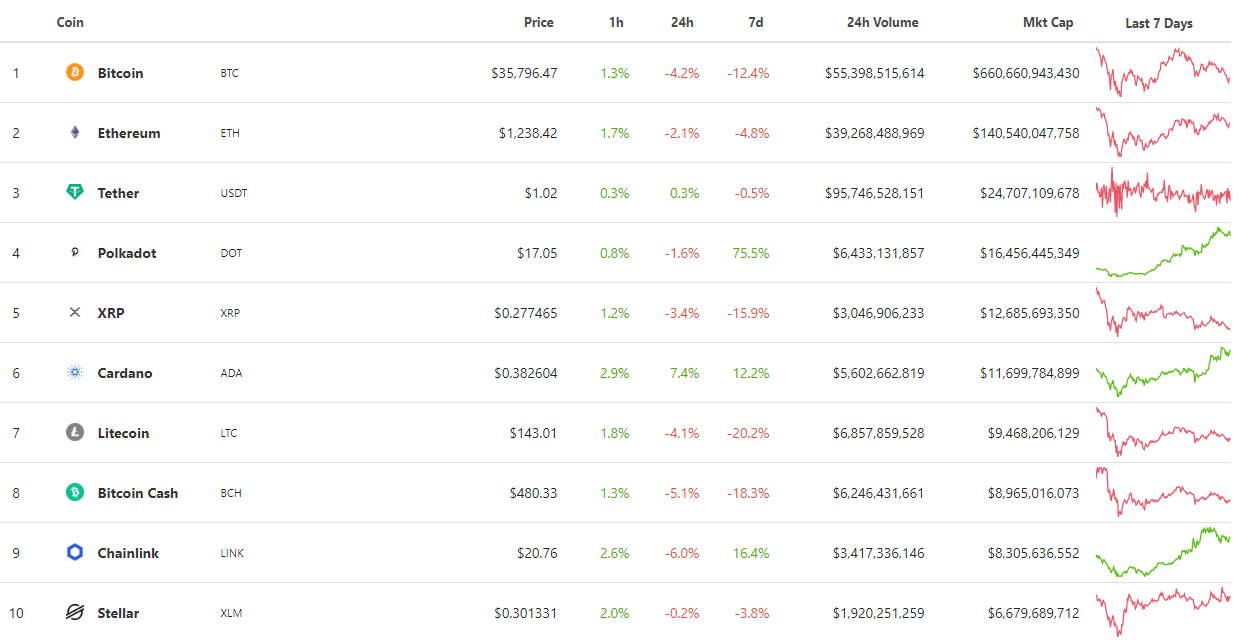
By the end of the week, the market capitalisation of cryptocurrencies had climbed back above $1 trillion. Beyond Bitcoin, the Polkadot project’s DOT token contributed notably; over the past seven days its price rose 75.5% (per CoinGecko).


Data: CoinGecko.
The token displaced Ripple’s XRP from the fourth spot in the market-cap ranking.
A two-digit percentage gain in the top ten over the period was also shown by Cardano (ADA) and Chainlink (LINK).
Bitcoin’s dominance index slipped to 65%.
Pavel Durov denies reports of Telegram seeking external investment and use of third-party cloud services
The Information reported private talks between Telegram founder Pavel Durov and banks and investors, allegedly about raising $1 billion via a convertible debt issue and an IPO. Durov later partially refuted the report.
According to the authors, the convertible-debt deal and a public offering would have funded Telegram’s development and expansion. Details on timing could not be learned.
The Information said such financing would be attractive because it would allow Durov to retain greater control over Telegram.
Durov himself partially refuted the piece but noted that his team had indeed received proposals from financial institutions to provide Telegram with a loan.
“Nеправда, что я встречался с какими-либо «банками и инвесторами» для обсуждения инвестиций или финансирования. Наша команда действительно получала предложения от финансовых организаций о предоставлении кредита Telegram”, – сказал он.
According to Durov, a loan is one of the possible ways for Telegram “to remain fully independent and true to its values in pursuing its monetisation strategy.”
According to The Bell, Durov also rejected an investment offers from a consortium of Western funds made in January 2021.
The talks concerned the purchase of 5–10% of the company, based on a $30 billion valuation.
Earlier in the week, the Telegram founder denied using third-party cloud services to support the messaging infrastructure.
“We do not use external cloud services, such as Google Cloud, Amazon and others. Relying on third parties to store data would be bad for both privacy and efficiency,” — said Durov.
According to him, all servers and routers used to operate the messenger belong to the developers who built the entire infrastructure themselves.
OKEx launches mainnet OKExChain
The cryptocurrency exchange OKEx announced the launch of the OKExChain mainnet. The company invited blockchain developers to participate in building a decentralised apps ecosystem on its base.
OKExChain employs a Bitcoin-like monetary policy with a halving. The initial block reward is 1 OKT and halves every three years. The initial issuance is capped at 10 million tokens. The theoretical supply cap is 72.2 million OKT.
Earlier the exchange distributed OKT proportionally among OKB holders via the Jumpstart platform.
Network deployment is planned in four stages.
From 31 December 2020 to 14 January, the first stage — the genesis phase of OKExChain — took place.
During the second stage, developers will test the stability, security and reliability of OKExChain.
Ledger to pay 10 BTC for information leading to data leaks
The Ledger hardware-wallet maker will pay 10 BTC to users for aiding in the pursuit of cybercriminals responsible for a series of attacks and data leaks.
Recently, we shared news of a data dump. On December 23, we were alerted by our e-commerce provider Shopify about an incident in April & June ’20 where their rogue team members exported merchants’ customer databases. Ledger was included. More details: https://t.co/NHU3IbDL0a pic.twitter.com/DHQQ9arxCu
— Ledger (@Ledger) January 13, 2021
Users may claim payments for information that leads to the identification, arrest and successful prosecution of the culprits.
The company has also hired private investigators and plans to cooperate with other industry participants and law enforcement in the investigation.
To bolster security, Ledger will reduce the number of places where user data is displayed.
“Our goal is to remove your personal data — such as name, address and phone number — as quickly as possible,” the company said in a blog post.
The release also announced the launch of a new technical solution that will enable customers to insure their funds.
Data leak of millions of Ledger users occurred on June 25, 2020. An unknown party gained access to email addresses, names and phone numbers of users.
In late October, an anonymous user going by Polaris posted the database on the hacker forum exploit.in. A Reddit user named hyperdrill purchased the data for 5 BTC.
On December 21, Ledger user data appeared in the open on Raidforums, where anyone could download it.
In December, the e-commerce provider Shopify informed Ledger that the breach they detected also affected Ledger wallet users. An investigation found that it involved 292,000 customers, though only around 20,000 of the exposed accounts were not present in previously published datasets.
Grayscale Investments resumes accepting investments in its funds and closes XRP-based trust
Earlier in the week Grayscale Investments resumed accepting deposits into several of its crypto funds.
At the end of 2020, the asset manager paused new investments in Bitcoin, Bitcoin Cash, Ethereum, Ethereum Classic, Litecoin and the Digital Large Cap Fund.
As of writing, deposits were not being accepted for Ethereum Trust and XRP Trust. On January 13 the firm announced the liquidation of the Ripple token-based XRP Trust. The decision was influenced by a lawsuit by the United States Securities and Exchange Commission (SEC) against the fintech startup.
For the same reason Grayscale in early January excluded XRP from the Digital Large Cap Fund.
According to the firm’s report, in the fourth quarter of 2020 inflows to its funds reached a record $3.26 billion or around $251 million per week.
Speaking on the firm’s new CEO Michael Sonnenshein, he said that on January 15 the amount invested in the trusts reached $700 million — a record daily figure.
Yesterday, @Grayscale raised north of $700 million into its family of products…momentum from Q4 seems to be picking up speed into the new year.
If you haven’t checked out our 4Q20 report yet: https://t.co/SwqBKwvO1S
— Michael Sonnenshein (@Sonnenshein) January 16, 2021
Following the SEC’s lawsuit against Ripple, more crypto firms have shunned XRP. Among the latest is U.S. exchange Kraken. In this context, the Japanese Financial Services Agency (FSA) said that, contrary to the US regulator’s view, XRP is not a security.
Users who lost access to their Bitcoin have had varying degrees of success in recovery
James Howells of Newport, UK, offered about $72 million to the authorities to dig up the city’s landfill where his hard drive containing 7,500 BTC was dumped, The local newspaper reported.
The engineer says he discarded the device in 2013 in a landfill that has a lot number and a designated location on the site.
“If I gain access to the dump’s records, I could pinpoint the exact location of the hard drive,” Howells said.
A press officer for the city council said this is not the first such request; the council’s stance is that diggings are not feasible for legal, economic or environmental reasons.
However, in a new request, Howells said he had secured backing from a hedge fund willing to fund the search.
“The outer shell could rust. But the disk on which the data is stored must still work,” Howells said, hoping for success.
The engineer pledged to donate 25% of the $286.5 million in Bitcoin if the disk is found and the municipality grants permission to search.
The same amount in Bitcoin is sought to be recovered by former Ripple CTO and Coil CEO Stefan Thomas. He has two attempts left of ten to recover the password to a wallet containing 7,002 BTC.
He says he lost the password sheet for his IronKey hardware wallet years ago. After eight failed attempts, he stored the device in a safe, hoping cryptographers will devise a way to crack the password.
A Reddit user going by BitcoinHolderThankU proved more successful, claiming to have recovered access to a wallet containing 127 BTC.
BitcoinHolderThankU noted that he earned the bitcoins in 2011-2012 by watching videos and completing tasks but lost the private keys. Access was restored in December 2020, and the user sold the cryptocurrency for $33,439 per coin via an over‑the‑counter platform.
Anchorage becomes the first nationwide crypto-bank licence holder in the United States
The Office of the Comptroller of the Currency (OCC), within the U.S. Treasury, approved Anchorage’s application for a national “bank digital asset” charter.
This followed the regulator’s decision to allow banks to store collateral for stablecoins and private keys to crypto wallets on behalf of customers.
In early 2021, the OCC granted financial institutions the ability to use public blockchains and stablecoins for settlement. The steps opened the door for institutions to store, custody, manage and trade digital assets.
“Anchorage is a national bank just like any other. The only difference is that we deal with crypto assets,” explained Diogo Monica, president of the organisation.
Apart from Anchorage, BitPay and Paxos have also filed similar applications for national-trust-bank licences.
Gemini and MicroBT announce plans to go public
The Winklevoss twins, founders of the Bitcoin exchange Gemini, told Bloomberg that they are considering a public listing for their company.
“We are definitely considering it and doing everything we can to have that option. We are watching the market and having internal discussions about the timeliness of such a step,” said Cameron Winklevoss in an interview.
State media in China, quoting unnamed sources, said that miner maker MicroBT, which markets Whatsminer, plans an initial public offering on the Nasdaq in the United States.
The Shenzhen-based firm is currently the second-largest producer of mining equipment in the world after Bitmain.
Release of Bitcoin Core version 0.21.0
On January 14, the updated Bitcoin Core client was released. About 100 developers contributed over six months.
Key features include:
- support for descriptor wallets;
- a new block-filtering system for light clients;
- support for V3 Tor addresses;
- updates to Schnorr/Taproot. The code was added to the release, but activation timing is unknown.
The Bitcoin network also gained a new test network, Signet. Unlike its predecessors, Signet is centrally controlled, increasing reliability.
ForkLog also reported:
The Deutsche Börse BTCE exchange-traded product trading volume rose to the level of traditional ETFs.
Chainalysis: Capitol riot participants received financing in Bitcoin.
Pakistan’s province will start mining Bitcoin with state funds.
A German developer chose Stellar for a €20m blockchain-bond issue.
A hidden cryptocurrency miner has been at work on macOS for more than five years.
What to watch?
On January 13, ForkLog hosted an online conference, “Old-year, new-year,” where we discussed with experts the main events of 2020 and forecasts for the future.

Subscribe to ForkLog news on Telegram: ForkLog Feed — the full stream of news, ForkLog — the most important news and polls.