




Bitcoin’s price briefly fell to around $42,000; Vladimir Putin warned of cryptocurrency risks while noting the experiences of other countries in this direction, Jack Dorsey stepped down as Twitter CEO, and other developments of the week.
Bitcoin price briefly fell to around $42,000
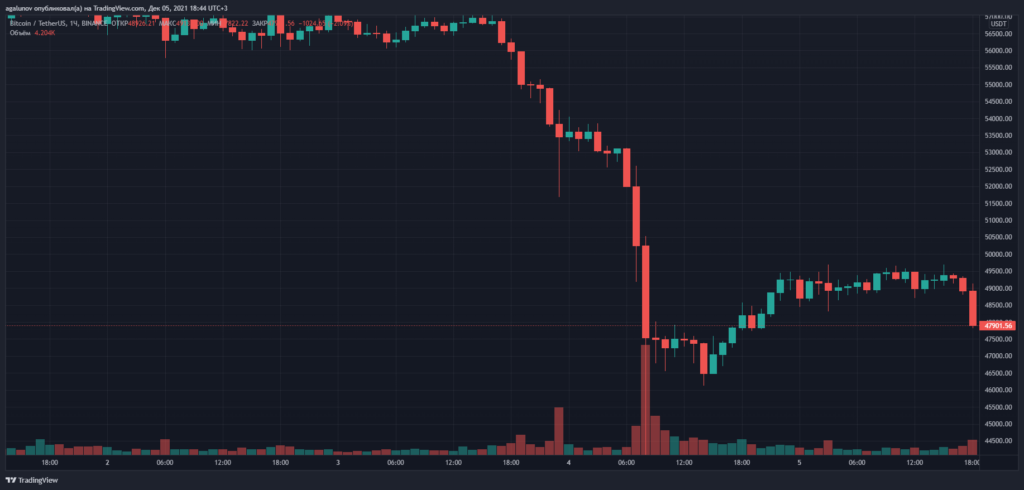
On Saturday, December 4, the quotes for the leading cryptocurrency at one point fell to around $42,000. The decline was accompanied by a large-scale liquidation on the futures market — $1.3 billion on long positions.
At the time of writing, Bitcoin was trading near $47,900.


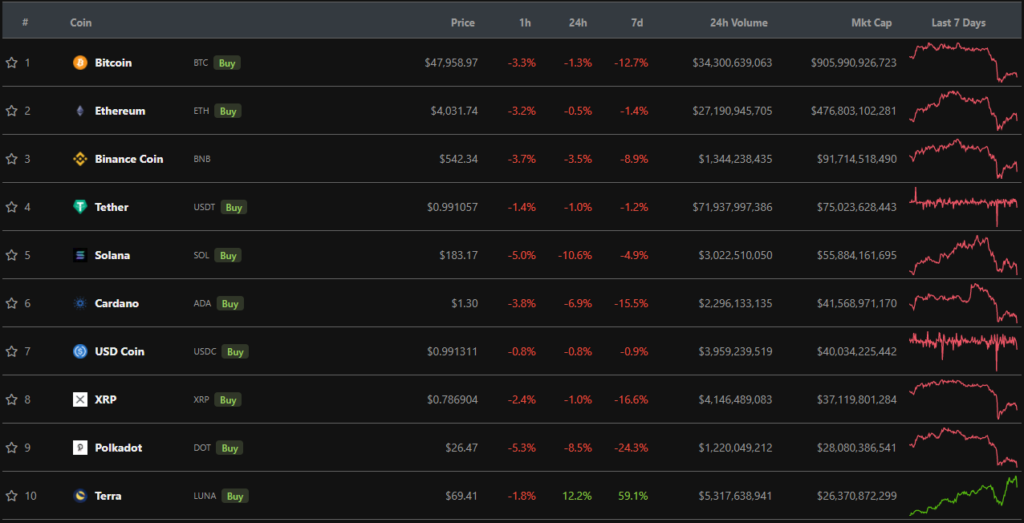
Bitcoin pulled the rest of the market down. According to CoinGecko, nearly all top-10 assets by market capitalization closed the week in the red. The exception was LUNA, the native token of the Terra blockchain protocol. Its price rose by almost 60% over the week.


The bitcoin drop came amid reports about China’s Evergrande, the property developer, with media noting its founder was summoned by the government over warnings that there were no guaranteed funds to meet financial obligations.
Galaxy Digital Research analysts attributed the rout to a general nervousness following the emergence of a new COVID-19 variant dubbed Omicron and statements by the US Federal Reserve System chair Jerome Powell about accelerating the pace of tapering the bond-buying programme.
Earlier investor-biller Louis Navellier allowed for a drop in Bitcoin to $10,000. He said the chart for the leading cryptocurrency signals a potential formation of a “double top,” which could play out as the Fed normalises monetary policy.
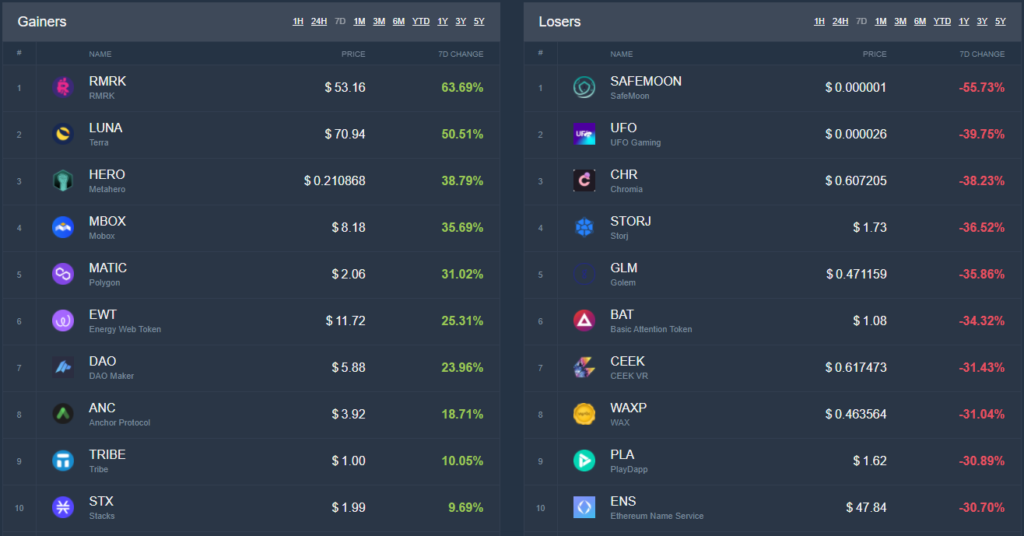
According to the CoinCodex service CoinCodex, over the week the native utility token of the RMRK protocol posted the largest gain among digital assets, rising 63% with a market cap of $500 million.
Among others, the DeFi protocol SafeMoon’s token fell the most, with a 56% drop and a market cap of $819 million, as noted by CoinCodex.


Total market capitalisation of cryptocurrencies stood at $2.38 trillion. Bitcoin’s dominance index declined to 38.4%.
Putin warns of the high risks of cryptocurrencies
Speaking at a plenary session of the investment forum “Russia Calls,” Vladimir Putin warned about the high risks of cryptocurrencies:
“As for cryptocurrency, in some countries it is banned. It is not backed by anything, volatility is high, and the risks are significant. I also believe we should listen to those who talk about high risks.”
He also noted that some countries are indeed broadening the use of digital assets:
“There may be a future in this; we should watch the developments closely.”
Earlier this week Deputy Head of Rosfinmonitoring Hermann Neglayd said that the discussion on regulating digital-asset exchangers in Russia will continue in 2022. He cited proposals by the Financial Action Task Force FATF, noting that the organisation proposes either to classify them as anti-money-laundering entities with identification, or to ban them.
Governor of Irkutsk Oblast proposes sites for industrial mining
Igor Kobzev, head of Irkutsk Oblast, expressed readiness to provide sites for industrial mining with separate distribution lines away from residential areas.
He said this should be done “in a civilized way,” equating the mining of digital assets with entrepreneurial activity and imposing higher electricity tariffs. Incidentally, hints of higher tariffs for miners were dropped in the Ministry of Energy as well.
Jack Dorsey stepped down as Twitter CEO, Square to rebrand as Block
On November 29, Jack Dorsey stepped down from his role as Twitter’s chief executive, though he remained on the board until the end of his term. Parag Agrawal, who had previously served as the company’s chief technology officer, succeeded him.
In the meantime, Dorsey’s Square announced a name change to Block. The move was linked to reflecting the company’s growth and its commitment to blockchain projects.
Miners begin leaving Kazakhstan over power issues
Mining company BitFuFu shut down devices located in Kazakhstan due to power-supply problems and began relocating equipment to the United States. Other industry players decided to take similar action.
The main challenge has been the introduction by local authorities of power rationing for miners amid an approaching energy crisis. Due to equipment downtime, the company decided to relocate it.
Bruno hard fork activated on Binance Smart Chain
On December 1, the Bruno hard fork was activated on the Binance Smart Chain at block 13,082,000.
One of the upgrade’s goals is to accelerate full node synchronization by more than 60%. It envisages the deployment of BEP-95 with a burning mechanism for BNB tokens similar to Ethereum’s blockchain.
Changpeng Zhao’s fortune put at $90 billion by China Caijing
Binance CEO Changpeng Zhao led the list of the wealthiest ethnic Chinese according to China Caijing, with an estimated net worth of 573.3 billion yuan ($90 billion).
This week also saw reports that Zhao bought property in Dubai. Media speculated about opening a bitcoin exchange office in the emirate. And, although Zhao noted sustained interest in opening a flagship office in Singapore, he did not rule out establishing one in France or the UAE.
Badger DAO and MonoX DeFi protocols hacked
Users of the Badger DAO DeFi protocol reported unauthorized withdrawals. The estimated damage from the hack exceeded $120 million. In the incident the centralized lending platform Celsius Network could have lost more than $50 million.
Earlier, an unknown actor withdrew from the MonoX platform on Polygon assets valued at $31 million. Project representatives explained that the hacker used a swap contract to push the MONO price “to the skies,” and then bought all other assets in the pool with it.
Forbes includes 15 crypto-industry figures in US 30 Under 30
Among them are representatives from Alameda Research, CoinList, OpenSea and many others. A new addition was the Hall of Fame, into which they inducted Vitalik Buterin (Ethereum), Sam Bankman-Fried (FTX), Patrick Collison (Stripe) and Vlad Tenev (Robinhood).
Hackers drain BitMart hot wallets for over $150 million
The Cayman Islands-registered crypto exchange BitMart reported a hack of its Ethereum and Binance Smart Chain hot wallets. Its CEO Sheldon Xia said hackers had withdrawn more than $150 million.
Analysts from PeckShield and RugDoc estimate the damage at around $200 million.
Attackers systematically used the 1inch aggregator to swap stolen tokens for ETH. They then transferred the crypto to an intermediate address from which funds were sent to the Ethereum mixer Tornado Cash.
Tornado Cash integrates with Arbitrum; StarkWare launches alpha StarkNet
Tornado Cash’s collaboration with Arbitrum is aimed at delivering Layer-2 benefits, including cheaper and faster transactions. Developers say the tech stack is ready.
StarkWare, which specialises in Layer-2 scaling solutions, announced the launch of an alpha version of the StarkNet mainnet based on ZK-Rollup technology. StarkWare’s solutions are used by dYdX, Deversifi, Sorare, Immutable and other popular protocols.
Tor blocked in Russia
Users and experts reported blocks on access to the Tor network within Russia. Problems with the proxy-server system appeared on December 2.
Roskomsvoboda technical expert Vadim Misbakh-Solovyov said that some providers or equipment ТСПУ in Moscow block access to Tor’s default servers.
“For now, bridging via bridges (bridges raised by users) helps. But their list is public as well, so providers have nothing to stop them from eventually tracking the bridges and blocking them,” he noted.
Also on ForkLog:
- Silk Road founder Ross Ulbricht will release an NFT collection.
- Adidas announced a collaboration with Bored Ape Yacht Club, GMoney and PunksComic within the metaverse.
- SoftBank invested $150 million in the Zepeto metaverse platform.
- 1inch Network raised $175 million from Alameda Research, VanEck and other investors.
What to read and watch next
Bitcoin corrected after hitting an all-time high of $69,000; since the London upgrade, Ethereum has burned more than 1 million tokens; metaverse tokens continued to rise; gaming platforms attracted a large user base.
This and more in the industry overview for October. All the most important crypto market news of the month in one piece.
At the end of November, ForkLog printed a calendar of important events for the coming month.
DeFi indices allow investors to buy diversified portfolios of different asset sets in a few clicks, without resorting to fundamental analysis and periodic rebalancing. They explained how these instruments work.
Metaverse concepts have existed for nearly 20 years, but only now have technologies matured enough for their realisation. ForkLog examined how the advent of virtual worlds will affect society of the future.
We have prepared an educational quiz to help you recall or learn the logos and tickers of the top-100 by market cap.
In our traditional digests we gathered the week’s main events in cybersecurity and artificial intelligence.
The blockchain technology remains one of the hottest trends among financial, governmental and corporate institutions worldwide. ForkLog offers an overview of the most interesting recent initiatives.
On 29 November, ForkLog LIVE discussed the prospects for altcoins, Dorsey’s departure from Twitter, and explored what the metaverse may bring in five years, plus met the new news anchor.
Guest list:
- Alina Mukhina — host of ForkLog’s digest;
- Ton Weiss — trader and ForkLog resident;
- Stepan Gershuni — CEO of Credentia.

In Thursday we again met on YouTube to discuss an NFT drop from Little Big, and to talk about why celebrities need non-fungible tokens and what this NFT boom could bring to creative solutions in the future.
Guests were:
- Kirill Kudryavtsev — Crypto enthusiast, Co-founder of Instigators, Peppermint;
- Vasily Vsevolod — Co-founder of Peppermint;
- Denis Davydov — Media artist, founder of the Instigators group, creative director of N3 Design.

Read Bitcoin news on ForkLog in our Telegram — cryptocurrency news, prices and analysis.