




Bitcoin set a fresh record, the SEC named crypto its top priority, trading on perp-DEX topped $1trn, Poland will tighten oversight of digital assets, and other events of the week.
Uptober begins
The bellwether began gearing up for an October rally at the end of September. On Monday morning it was still trading below $110,000, but it quickly gathered pace and set off towards a new record.
Throughout the week bitcoin was buoyant, with brief pauses for consolidation. On the morning of 5 October, digital gold set a new all-time high (ATH) at $125,708.


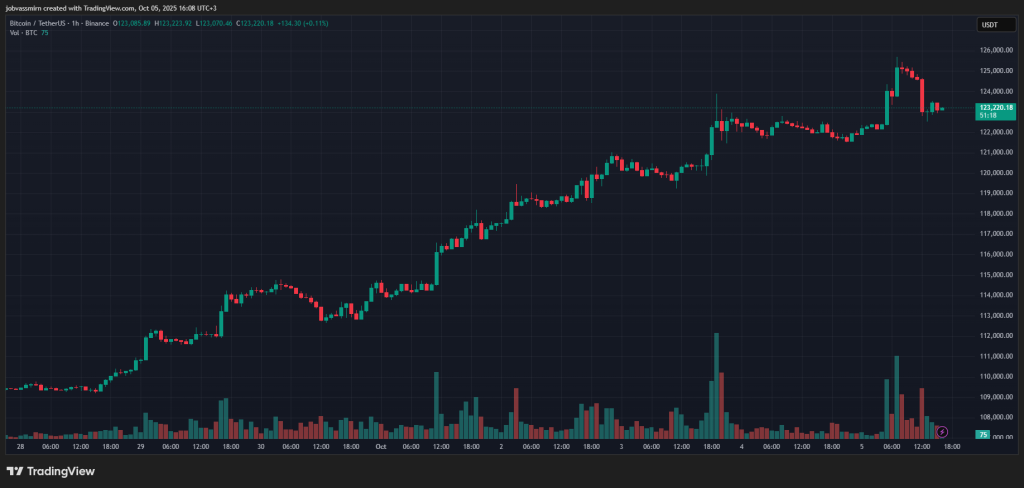
At the time of writing the coin had pulled back to $123,300, with a market capitalisation of $2.45trn. Over the past seven days bitcoin is up 13%.
The main driver is seen as the U.S. government shutdown. On 30 September Washington halted operations for the first time since 2018 after Republicans and Democrats failed to agree on healthcare funding.
Sentiment was also boosted by inflows into spot ETFs based on crypto. Over the past trading week, bitcoin funds notched the second-largest weekly inflow since launch — $3.24bn.


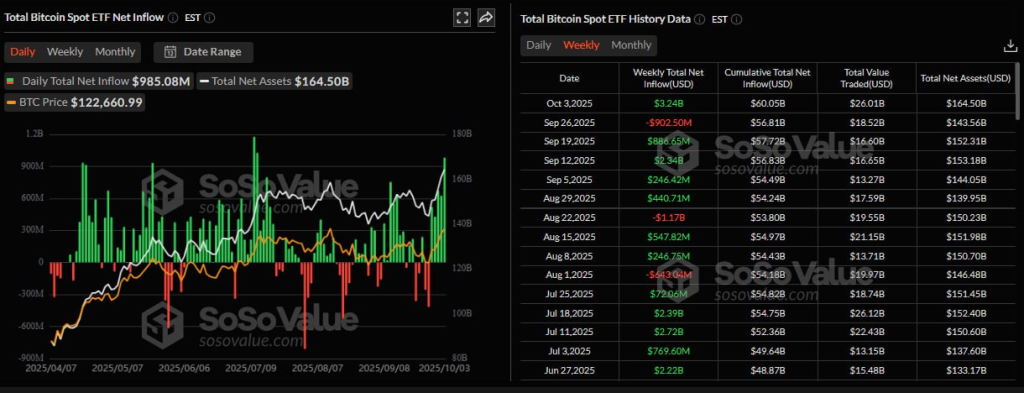
Ethereum-based instruments added $1.3bn.
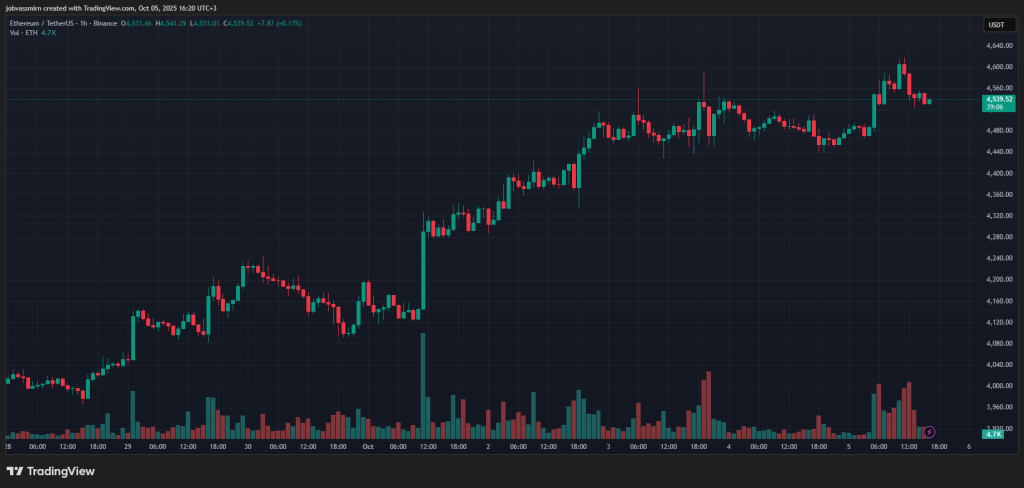
In seven days ETH rose 13.7%, testing $4,600. It now trades near $4,500, roughly 8% below its ATH.
Among the week’s standouts was BNB. The token also set a record above $1,110.


Total market capitalisation surpassed $4.3trn. BTC dominance is 57%, ETH — 12.7%.
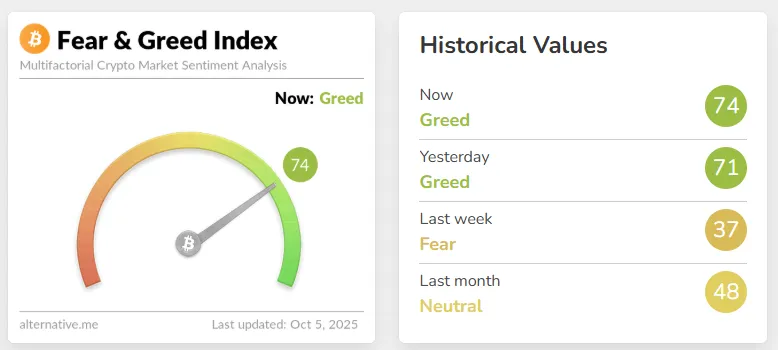
The Crypto Fear and Greed Index reached 74, up from 34 a week earlier.


The perp-DEX wars
In September, trading volume on decentralised exchanges for perpetual futures (perp-DEX) exceeded $1trn for the first time. The niche has clearly caught investors’ attention, sparking a full-on contest among platforms.

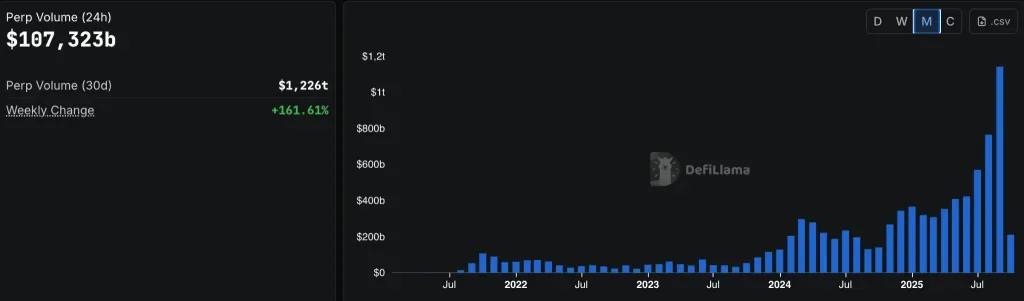
Aster led the segment with $493bn. In second place — Hyperliquid — with $280bn. Lighter rounded out the top three with $165bn.
Launched with backing from Binance founder Changpeng Zhao, Aster continues to hold the top spots since late September. Its total value locked stands at $2.41bn.


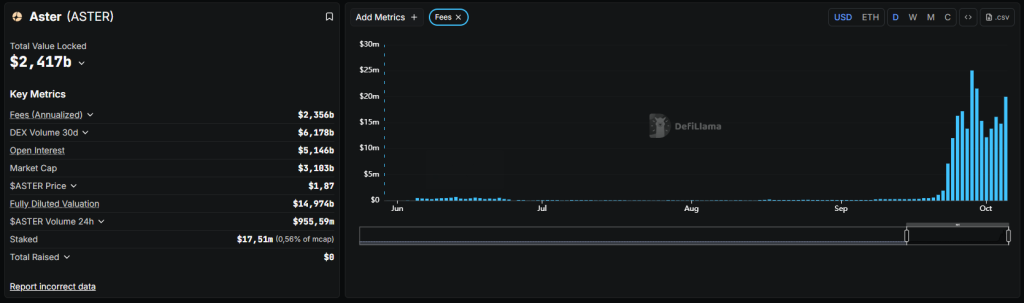
The platform also topped the protocol fees ranking. On 28 September, Aster’s figure exceeded $29m, versus $22m and $7m for Tether and Circle respectively.


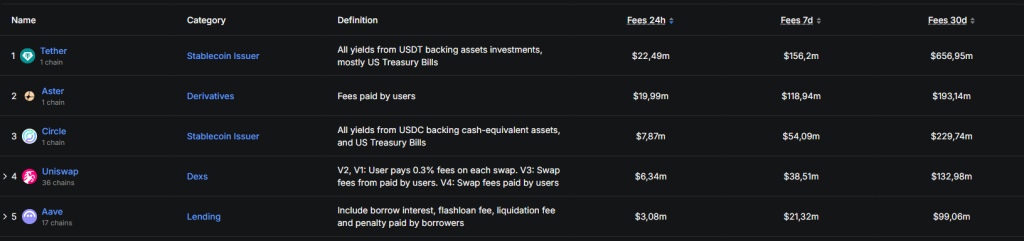
By press time, the exchange had slipped to second place with $193m over the past 30 days.
Also this week, leading perp-DEX Lighter announced the full launch of its L2 network after eight months of beta testing. The TGE is expected by year-end.
Despite Hyperliquid’s share falling from 45% to 8%, the platform remains “the most investable,” believes DeFi analyst Patrick Scott.
In his view, the venue’s key advantage is a resilient business model. A current market-cap-to-revenue ratio of 12.6 “indicates a fair valuation given the project’s earnings”.
What to discuss with friends?
- Firedancer developers called for lifting Solana’s compute-unit limit.
- Bitcoin mining difficulty hit a record 150.8 T.
- Opera launched the AI browser Neon.
- The Plasma team was accused of insider trading amid an XPL crash.
SEC priorities
At a roundtable with the CFTC, SEC chair Paul Atkins said regulating the crypto market is the agency’s “number-one task”. The meeting focused on supervision of the industry and delineation of powers.
The two watchdogs will continue to play a key role in regulating digital-asset markets. The SEC oversees cryptocurrencies deemed securities, while the CFTC’s remit covers most tokens recognised as commodities.
“We must work in unison. The main thing is to create a system in which our agencies will coordinate their actions seamlessly,” said Atkins.
Acting CFTC chair Caroline Pham stressed that “the turf war is over”.
Atkins pointed to the “boundless potential” of tokenisation. He estimates that drafting rules for this activity will take up to two years.
Also this week, the SEC excluded DePIN tokens from its oversight, as it did not deem them securities. The regulator wrote this in a letter to the DoubleZero project.
Michael Seaman, chief counsel of the Commission’s Division of Corporation Finance, said he would not recommend action regarding the planned launch of the 2Z token. In his words, the coin does not require registration as a security.
According to DoubleZero, its protocol gives blockchain systems access to “underutilised private fibre-optic lines” maintained by network participants, who will receive 2Z tokens.
Project co-founder Austin Federa called the SEC’s decision proof that productive dialogue between regulators and crypto projects is possible.
Tech-forward Kazakhstan
As part of a collaboration between Telegram and Kazakhstan’s supercomputer, the messenger’s creator Pavel Durov unveiled an AI laboratory. This took place at the Digital Bridge 2025 forum.



“A year ago, we opened our first regional office in Kazakhstan and are very pleased with the results. I am delighted to announce that today we are launching a dedicated artificial intelligence laboratory in the Alem.ai building,” the entrepreneur said.
According to him, over recent months the company has been working on a new technology at the intersection of blockchain and AI. It will allow more than one billion people to use AI functions privately, transparently and efficiently.
The technology will first be tested on mini-apps in Telegram.
At the event, Kazakhstan’s president Kassym-Jomart Tokayev discussed with Durov co-operation in education, artificial intelligence and cybersecurity.
The president noted Telegram’s contribution to the country’s digital agenda. Durov presented ideas for joint AI projects.
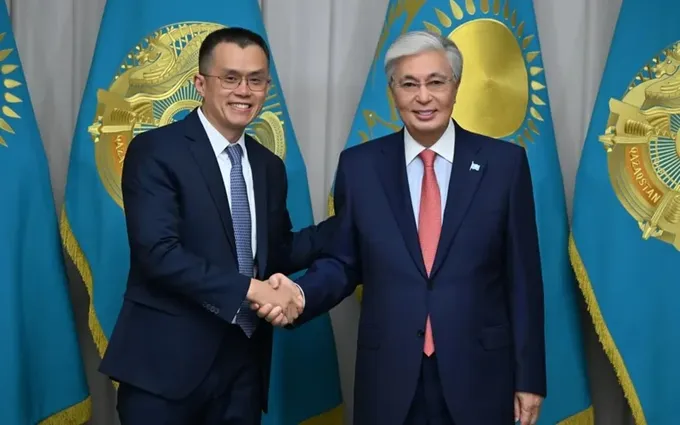
Within Digital Bridge 2025, Tokayev also met Binance founder Changpeng Zhao. The main topics were the development of the crypto industry, licensing the exchange and including BNB in state reserves.

In addition, a new stablecoin, KZTx, was announced, without details.
Also on ForkLog:
- OKX froze an account holding $400,000 due to missing logs from 2020.
- The UK planned to introduce a digital passport.
- Privacy coins led the altcoin rally.
- Wallet will add trading in 60 tokenised U.S. equities.
Polish regulation
Poland’s Sejm approved the “Crypto-Asset Market Act” and sent it to the Senate. The bill introduces industry regulation.
Under its provisions, the primary supervisor will be the KNF. All crypto-asset service providers will be subject to a licensing regime aligned with the EU’s MiCA regulation.
To obtain authorisation to operate in the country, applicants must:
- disclose their corporate structure;
- prove capital adequacy;
- provide information on internal controls and compliance systems, risk-management policy and AML procedures.
Operating without a licence will be a criminal offence, including up to two years in prison and a fine of up to 10m zloty (~$2.74m). If adopted, the bill will grant market participants a six-month transition period to comply.
Opposition MP Janusz Kowalski criticised the implementation of MiCA proposed and backed by the ruling Civic Platform. He called the bill “118 pages of overregulation” and a threat to 3m digital-asset investors.
“KNF is the slowest-acting regulator in the EU: the average application processing time is 30 months,” added politician Tomasz Mentzen.
What else to read?
Writer Paul Kingsnorth — on how people are building a “new Tower of Babel”.
ForkLog examined how two of Sam Altman’s creations — World and ChatGPT — might integrate.