
El Salvador recognised Bitcoin as official legal tender, China tightened crypto censorship and miners’ bans, Donald Trump called digital gold a scam, and other events of the past week.
Bitcoin price held steady as altcoins retreated
The week began with expectations for further moves in the leading cryptocurrency’s price. Fidelity Investments warned of a drop to $30,000 or even $23,000.
Bitcoin began to fall on Monday evening, June 7. ForkLog experts noted that the asset moved down forming a “Triangle” pattern.
On June 8 the price fell below the $32,000 level (on Bitstamp) and on the same day began to recover.


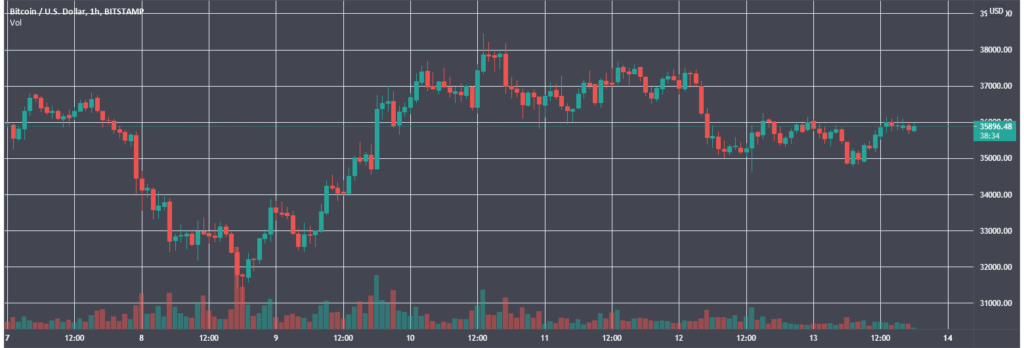
The week ended roughly at the same price level at which it began.
The largest-capitalisation altcoins, unlike Bitcoin, failed to reclaim the levels from which they fell in sync with the market leader at the start of the week. After a bounce, most coins continued to slide. As of writing, Ethereum (ETH) had fallen 10.7% over the past seven days, with the biggest losses among the top-10 by market cap coming from Dogecoin (DOGE) and Uniswap (UNI) — 16.9% and 19.6%, respectively.


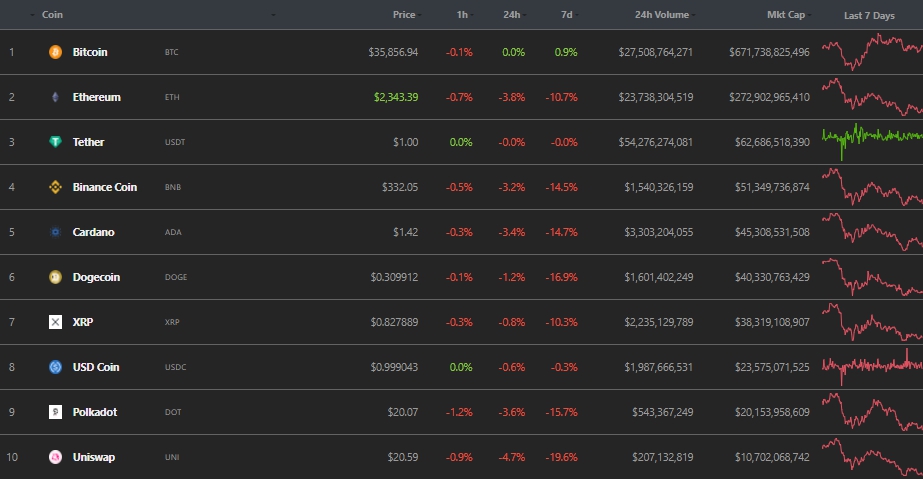
Against this backdrop, Bitcoin’s dominance index rose over the week from roughly 41% to 43%.
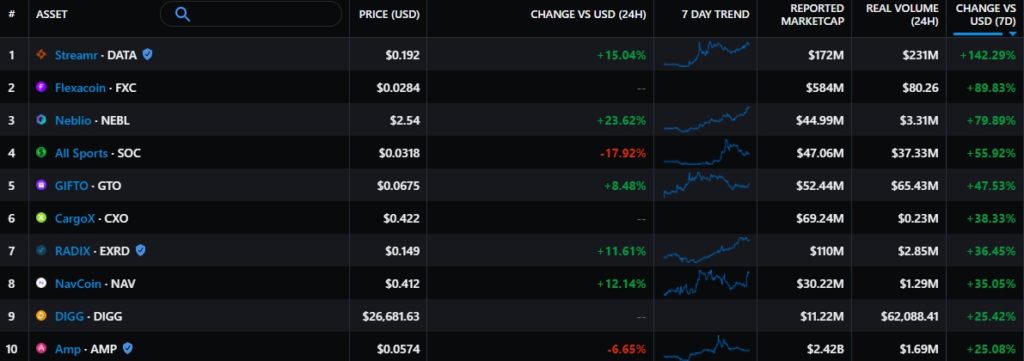
The market downturn did not stop a number of tokens from delivering impressive gains over the past seven days — led by tokens from smaller projects. According to Messari, the biggest gainer was Streamr (DATA), up 142%. Flexacoin (FXC) demonstrated notable volatility, rising 89.8% after a roughly 84% drop in the previous week.


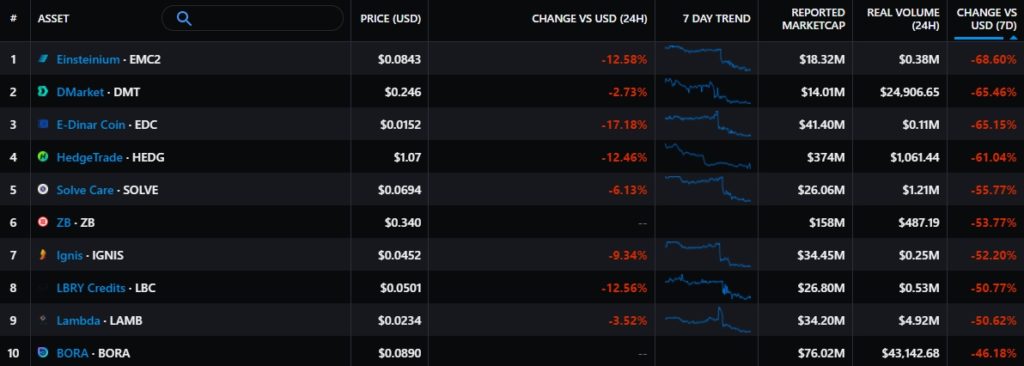
Among the week’s biggest decliners were also small-cap cryptocurrencies. Around 69% was lost by the coin with the ambitious name Einsteinium (EMC2). In the top-10 losers, the highest market cap belonged to ZB — $158 million and 186th in the overall ranking, according to Messari.


El Salvador recognises Bitcoin as legal tender
On June 9, the Legislative Assembly of El Salvador passed a bill recognising Bitcoin as official legal tender in the country alongside the US dollar.
The decision was supported by 62 lawmakers out of 84, with 17 voting against and one abstaining. The bill will take effect 90 days after publication in the Official Government Gazette.
El Salvador will guarantee instant automatic conversion of Bitcoin into the US dollar, which will remain the base currency of the country. Authorities will launch a $150 million trust fund to buy the digital asset from residents. In the future these funds are to be kept on the balance sheet.
The initiative to legalise cryptocurrency came from President Nayib Bukele, who also proposed using volcanic energy for mining. The head of state instructed the geothermally oriented state company LaGeo to draw up a plan to create Bitcoin mining capacity and presented the first potential site.
Experts surveyed by ForkLog expressed the view that recognizing Bitcoin as a payment method could bring both an inflow of investment and outflow of capital.
The IMF said the decision could entail a number of risks and regulatory issues.
JPMorgan analysts questioned whether the adoption of Bitcoin would bring special economic benefits to the state.
JPMorgan finds confirmation of Bitcoin entering a bear market
The formed Backwardation in Bitcoin futures signals the persistence of negative price dynamics for the leading cryptocurrency. This conclusion was made by JPMorgan analysts.
The analysts noted the emergence of a situation where spot prices for digital gold exceed futures quotes. This occurred as a result of the May correction. They say this reflects “weak demand from institutions trading on the Chicago Mercantile Exchange”.
Experts reminded that backwardation was observed for much of 2018.
China tightens pressure on crypto industry and mining
On June 7, the Chinese microblogging service Weibo blocked at least 12 accounts of crypto-influencers. The service accused account owners of violating its guidelines, as well as the “relevant laws and rules.”
According to journalist Colin Wu, media and social networks like Weibo are overseen by the CPC Central Committee’s Propaganda Department. He noted that official media carry out a “collective attack” on Bitcoin, so bans on crypto content are a constant feature.
On June 9 miners at the Shandong Economic and Technological Development Park, based in Changji Prefecture (Xinjiang), received orders from local authorities to immediately cease operations.
Subsequently the Qinghai Province Department of Industry and Information Technology ordered local mining companies to suspend current operations. New projects in this sector were also banned.
In Sichuan, miners were given time to wind down in the region by September 2021.
On June 11, media reported that authorities in Yunnan Province plan to ban mining as well.
Ukraine’s central bank lists crypto-related risks
The National Bank of Ukraine (NBU) considers cryptocurrencies as virtual assets, not money, since they do not perform the “basic functions of money — settlement and store of value.”
She noted that price volatility of many digital currencies creates risks for holders. Widespread use of cryptocurrencies could negatively affect monetary policy by creating a parallel money circulation outside the NBU’s reach, added an NBU representative.
Donald Trump: Bitcoin looks like a dollar-competing scam
Former US president Donald Trump said in an interview with Fox Business that Bitcoin ‘‘looks like a scam’’.
“I don’t like it [Bitcoin], because it is another currency competing with the dollar. […] I want the dollar to become a world currency. That’s what I’ve always said,” noted the former head of state.
Lavrov: cryptocurrencies will inevitably play a significant role in international settlements
Cryptocurrencies will, in time, be actively used in international settlements, said Russian Foreign Minister Sergei Lavrov.
“I think the time will inevitably come when cryptocurrencies will play a very significant role, occupying a very large share in international settlements,” said the foreign minister.
FBI returns 63.7 BTC from Colonial Pipeline ransom
The U.S. Federal Bureau of Investigation (FBI) returned a large portion of the ransom paid to DarkSide hackers in Bitcoin after the attack on Colonial Pipeline.
Authorities seized 63.7 BTC. The return of funds was handled by a specially formed task force against digital extortion and ransomware programs.
The FBI traced the transactions on the blockchain shortly after the ransom was paid from Colonial Pipeline’s address to the hackers. How exactly the private key ended up with the agency is not disclosed.
Fusion’s first halving on July 13
On block #4915200 on July 13, the first halving will occur in the Fusion blockchain.
Block reward will drop from 2.5 FSN to 1.25 FSN. The project team estimates the next halving will occur in two years.
As of publication, Fusion validators earn 18.9% annually, while staking participants earn 17.8% annually.
“The first Fusion halving is a significant economic event for the coin. Lowering the mining reward will reduce inflation and price volatility of FSN. For Bitcoin investors, halvings have become among the powerful factors to consider in long-run trading,” commented Fusion’s chief marketing officer Maks Shulte.
Dogecoin co-founder sells NFT collection featuring the meme cryptocurrency
Dogecoin co-founder Billy Markus sold non-fungible tokens (NFTs) featuring the digital asset’s logo.
The NFTs feature an animation of a spinning coin bearing the Dogecoin logo and the letter “D.” Markus positions the collection as a capped version of the meme cryptocurrency.
“I wanted to try something new, a new platform that allows issuing many copies of the same NFT,” wrote the Dogecoin co-founder.
Also in the growing segment:
- NEAR Protocol developers launched a Green NFT auction.
- Announced collaboration with the Binance NFT marketplace launching in late June: Russian artist Pokras Lemmas, Ukrainian producer and rapper Potap and singer Tina Karol.
- Sotheby’s sold a “COVID-era” CryptoPunk NFT for $11.8 million.
Netherlands calls to ban Bitcoin
The Netherlands should immediately impose a full ban on mining and operations of Bitcoin, said Pieter Hasencamp, director of the Bureau of Economic Analysis at the Ministry of Economic Affairs.
In his piece the official listed a number of reasons why authorities should deem the leading cryptocurrency illegal.
In his view, digital gold has no intrinsic value and the coin does not perform any of the three money functions: unit of account, medium of exchange, and store of value.
Hasencamp also mentioned security issues and fraud risks.
British farmer uses manure to mine Ethereum
A farmer from Denbighshire, England, Philip Hughes mines cryptocurrency using electricity generated from processing cow manure.
The gas produced during the decomposition of waste is burned and converted into electricity. A third of the electricity generated powers the GPUs. The remainder goes to the farm’s own needs.
Hughes described his income from Ethereum mining as “good.”
ForkLog also noted:
- Mike Novogratz: Bitcoin will never become a payment instrument.
- Iran’s president called for a regulatory framework for cryptocurrencies.
- The Basel Committee proposed requirements for banks investing in Bitcoin.
- Media: Bitcoin will be legalized in India as an asset class.
- Vitalik Buterin earned more than $4 million from investments in Dogecoin.
- SEC and CFTC warned about risks of investing in Bitcoin futures.
- Jack Dorsey allowed the integration of the Lightning Network second-layer solution into one project.
What else to read and watch
In new ForkLog educational cards we explain what Polygon MATIC and Cosmos (ATOM) projects are.
The week’s most notable events in cybersecurity and artificial intelligence are collected in our traditional digests.
Overview of notable investment deals in the cryptocurrency industry covers a longer period.
On June 7, in a live ForkLog broadcast, we discussed the Solana ecosystem with Aleksey Yakovенко, Director of Business Development for the project, and with Hacken CEO and co-founder Dmitry Budorin.