




The Ethereum network saw the London hard fork, Brian Brooks stepped down as head of Binance’s US unit, and in the United States debates over the expanded crypto taxation plan persist, along with other events of the week.
Bitcoin price climbs above $45,000 for the first time since May
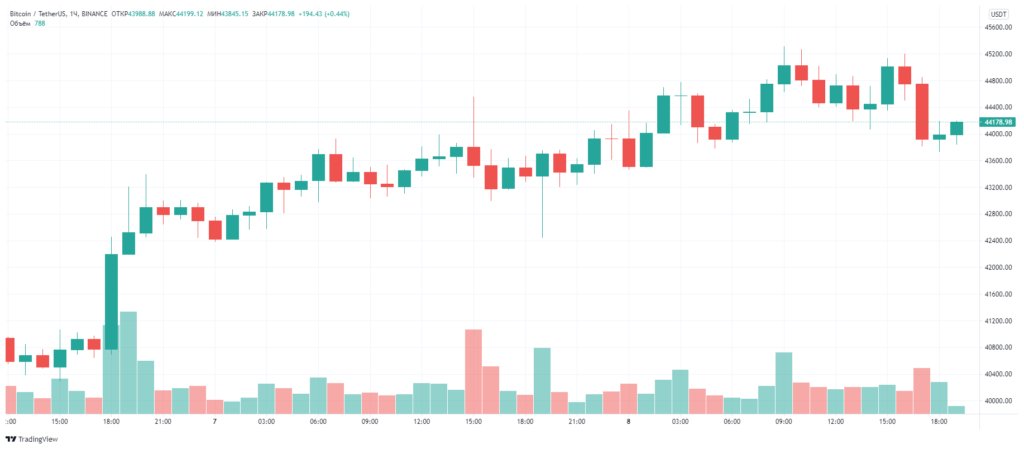
The leading cryptocurrency began the week with a decline. On Monday, quotes fell by almost 2%, on Tuesday by a further 3%. However, by Wednesday the price began to rebound and on Friday surpassed the $42,500 mark.
Over the weekend, the asset tested the $45,000 level several times but failed to hold above it. At the time of writing, digital gold was trading near $44,200.


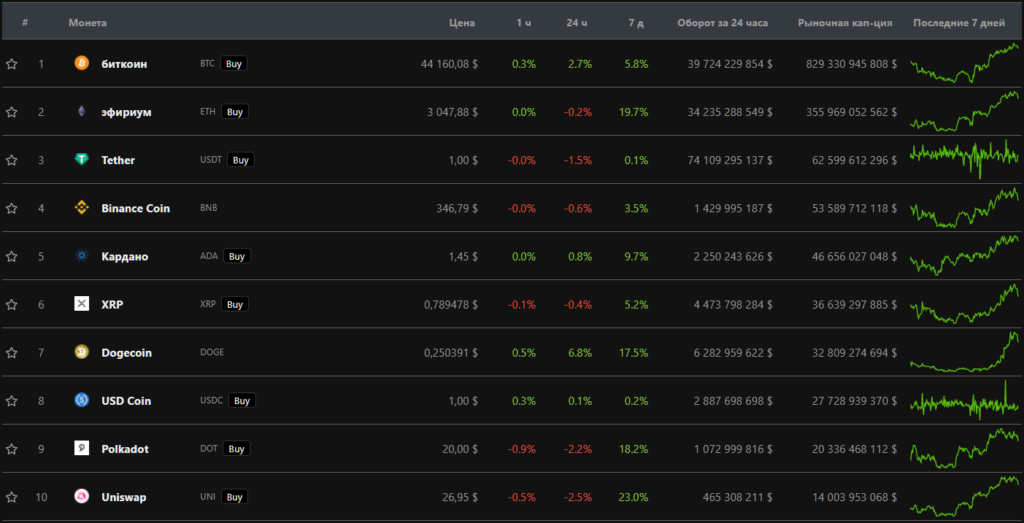
Over the past week, bitcoin rose by almost 6%, according to CoinGecko. All top-10 assets by market cap also finished in the green.


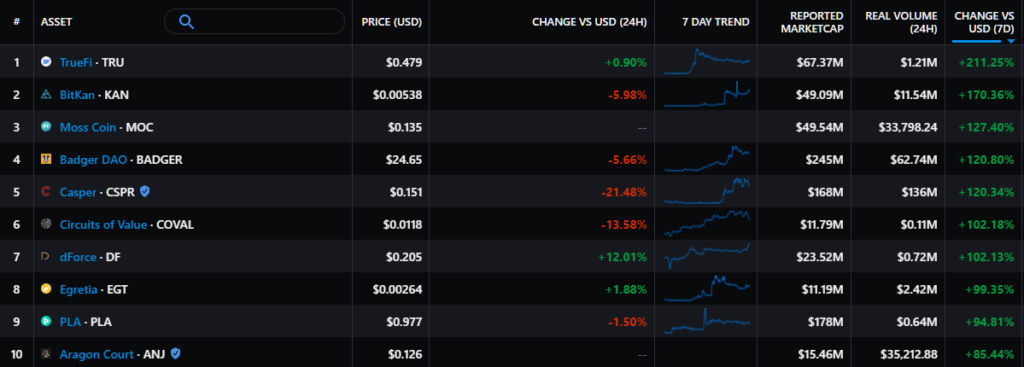
According to Messari, the strongest gain among digital assets over the past week was TrueFi (TRU), a DeFi project, whose price jumped 211% and whose market capitalization surpassed $67 million.


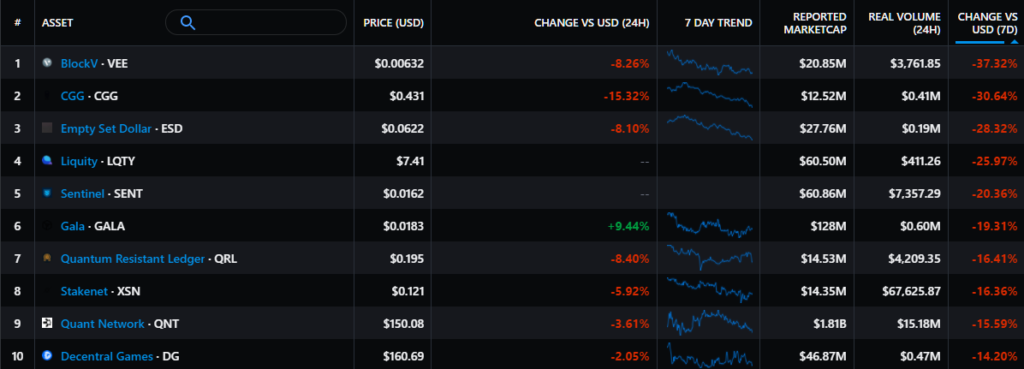
The Swiss blockchain startup BlockV’s token VEE was the week’s biggest loser, dropping more than 37%, with its market capitalization slipping to $20.85 million.


The cryptocurrency market capitalization stood at $1.855 trillion, and Bitcoin’s dominance index remained unchanged at 44.7%.
The London hard fork goes live on the Ethereum network
On August 5, in the Ethereum mainnet at block #12,965,000 the London hard fork took place.
As part of the update, five improvement proposals were activated. The main one was EIP-1559, which envisages burning a portion of transaction fees depending on network load and reducing volatility in gas prices.
Analysts estimate that miners’ revenues on Ethereum will fall by 20-30% as a result of this proposal’s rollout. It is anticipated that price gains will offset the losses.
According to the tracker ultrasound.money, since Thursday the protocol has burned more than 13 800 ETH (~$42 million at current rates). The top burners are led by NFT marketplace OpenSea (1,610 ETH), followed by decentralized exchange Uniswap (1,114 ETH) and NFT game Axie Infinity (895 ETH).
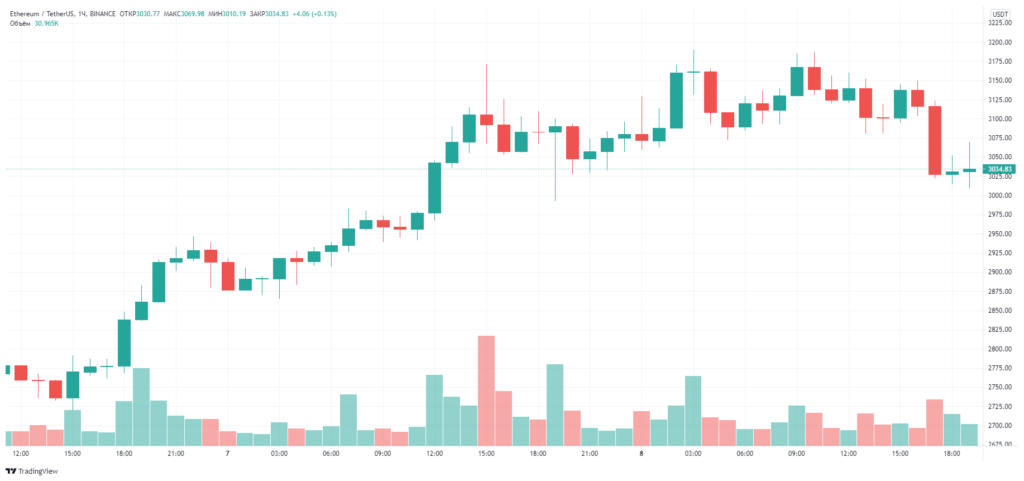
The price on the day of the fork reached a two-month high with levels above $2,800, and on August 7 rose above $3,100 for the first time since the May dip.
At the time of writing, the asset was trading around $3,000.


Bitcoin SV network faced a 51% attack
On August 3, a major block reorganisation occurred on the Bitcoin SV network — the blockchain split into three chains.
According to Coin Metrics analyst Lucas Nucci, attackers had attempted to strike Bitcoin SV before, but only on August 3 did they accumulate enough hash power.
As a result, the coin’s price fell by only 4%, but the hash rate collapsed by nearly 44% to 333 PH/s.
Zcash founder proposed moving the project to a Proof-of-Stake algorithm
Zcash would need to abandon the Proof-of-Work consensus algorithm in favour of Proof-of-Stake. The proposal was put forward by the founder and head of Electric Coin Company, Zooko Wilcox.
He highlighted the reliability of PoS, noting 51% attacks when hash power is seized in PoW networks. Among other advantages, the founder cited energy efficiency, lower costs, and more use cases for the cryptocurrency.
DeFi platform dYdX will launch a governance token and distribute it to users
The non-custodial trading platform will release a governance token, distributing a portion of supply (75 million DYDX or 7.5% of the issuance) via an airdrop. The number of tokens will depend on trading and deposited volumes. The project also announced the creation of the dYdX Foundation.
Hacker drained more than $20 million from the Popsicle Finance DeFi protocol
DeFi-project Popsicle Finance was hacked, losing $20.7 million.
The flaw was found in the Sorbetto Fragola product. It allows users to place assets into the most lucrative liquidity pools. The solution was designed specifically for Uniswap v3, which implemented concentrated liquidity.
The attacker drained about 85% of the Sorbetto Fragola pools, swapped the proceeds for ETH via Uniswap, and then sent the funds to the Tornado Cash transaction-mixer service.
Ex-Monnero developer Riccardo Spagni arrested in the US
US authorities arrested former lead Monero developer Riccardo “Fluffypony” Spagni at the request of South African authorities. He is charged with fraud of $100,000 between 2009 and 2011 while working at Cape Cookies.
Spagni’s lawyers called the arrest “unwarranted.” They say the defendant wrongly believed that his presence was sufficient in the Cape Cookies case. He now faces up to 20 years in prison.
Bitcoin miners’ revenue in July rose for the first time in four months


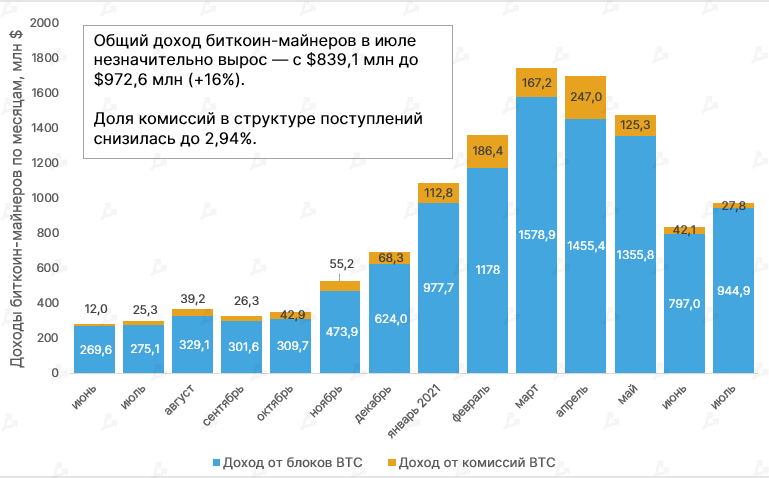
In July, aggregate bitcoin miner revenue totaled $972.6 million, up 16% from June. Ethereum miners earned 2% less than the previous month — $1.08 billion.
Read more about July’s results in ForkLog’s monthly report.
Marathon acquired Bitcoin miners from Bitmain for $120.7 million
The Nasdaq-listed mining company Marathon Digital Holdings agreed to purchase 30,000 Antminer S19j Pro from Bitmain. Shipments are expected from January to June 2022. The deal would raise Marathon Digital’s hash rate by 13.3 EH/s.
The company also said its bitcoin reserves rose to 6,225 BTC — Marathon mined an additional 442.2 BTC in July.
Marathon’s competitor, HIVE Blockchain Technologies, ordered 4,000 ASIC miners from Chinese manufacturer Canaan Creative. Their combined hash rate stands at 272 PH/s. Delivery will occur in two installments of 2,000 units—August and September this year.
The9 invests in a Kazakhstan data centre of 100 MW
The9’s China-based subsidiary NBTC Limited has signed an agreement with Kazakh firm KazDigital to build a data centre with 100 MW capacity.
The first of four stages to bring online 25 MW has already been completed. The9 has sent 1,000 miners to Kazakhstan for a test run of the data centre.
Ripple seeks documents from Binance in SEC dispute
Lawyers representing Ripple CEO Brad Garlinghouse and co-founder Chris Larsen filed in the U.S. District Court for the Southern District of New York a request for documents from Binance Holdings Limited, registered on the Cayman Islands.
Ripple intends to challenge the SEC’s claims that the CEO sold more than 357 million XRP to investors on the public market. The lawyers argue that these transactions should not be considered in the proceedings, as they fall outside the regulator’s remit.
Brian Brooks abruptly left Binance US chief role
The CEO of Binance’s US unit exited the post after three months in the position.
Among the reasons, Brooks cited “different views on strategic direction.” The founder Changpeng Zhao praised his work. The exchange said his departure would not affect customers.
The move comes amid regulatory issues for Binance. Earlier, the platform restricted Hong Kong clients from trading crypto derivatives.
Robinhood shares soar 80% as Nasdaq halts trading thrice
Following a disappointing Nasdaq debut, Robinhood (HOOD) shares surged on Wednesday, August 4. Opening the session around $54, prices climbed to a peak near $85.
As a result, major trading platforms halted HOOD trading. According to Vanda Securities, the rally was driven by retail investors, including WallStreetBets members who spent $19.4 million on the stock. At one point the shares were among the most actively traded and popular stocks.
The next day, prices fell on news of a secondary offering of 97 million shares. On Friday, the shares closed at $55.01.
Gary Gensler comments on regulation of the digital-asset market
The SEC chair said there are at least seven initiatives on the agenda targeting various segments of the digital-asset industry: on ICOs, trading platforms, lending services, DeFi, stablecoins, custodians, as well as ETFs and other crypto funds.
He stressed that regulating crypto exchanges is the government’s easiest way to bring order to the new market and urged others to engage in dialogue.
Meanwhile, former CFTC chair Christopher Giancarlo doubted the SEC’s authority to regulate cryptocurrencies, saying that this role should be performed by the CFTC “because of its experience.”
In the US Senate, discussion continues on the expanded crypto taxation plan
On July 28, US senators approved a bipartisan bill aimed at updating the country’s infrastructure. About $1 trillion would be spent, with part of the funding expected to come from a tighter regime of crypto taxation.
The document drew widespread criticism from industry participants, including Elon Musk and Jack Dorsey. Industry experts argue that the tax-reporting requirements are unworkable for many crypto actors, such as miners and node operators.
Senators Ron Wyden, Cynthia Lummis and Pat Toomey proposed exempting these activities from the bill and not extending broker-like rules to them.
One of the bill’s authors, Rob Portman, agreed with them but offered an amendment that would exempt only miners and vendors of hardware or software that enables individuals to control private keys. The status of PoS validators under that proposal remains unclear.
Portman was supported by Senators Mark Warner and Kirsten Sinema. Their proposal also drew criticism from the crypto community.
On August 7, Warner and Sinema unveiled an updated version of the amendment. It now excludes both PoW miners and PoS validators, but does not touch other consensus mechanisms.
Debates over the final version of the bill continue.
In Russia, a developer for a Bitcoin-tracking service was identified
A module for monitoring and analyzing cryptocurrency transactions in Russia will be created by a company linked to Sber.
The court orders Sberbank to unblock a bitcoin seller’s accounts
The Sverdlovsk Regional Court ordered Sberbank to unblock the cards of a Revda resident who trades cryptocurrency on exchanges.
From May to August 2020, the client’s accounts regularly received deposits from individuals. The bank deemed the operations suspicious and blocked the cards, demanding proof of funds’ origin. After providing information about selling bitcoin on exchanges, the accounts were not unblocked.
Ukraine’s Ministry of Digital Transformation signals impending legalization of crypto payments
Residents of Ukraine will be able to pay with cryptocurrencies “quite legally” upon the adoption of the law “On Virtual Assets.” This was stated by Deputy Minister of Digital Transformation Alexander Borniakov.
According to him, the regulatory framework will allow crypto holders to protect their digital-asset savings, exchange and declare them legally.
Also on ForkLog:
- The Matrixport platform, co-founded by Bitmain, raised $100 million at a $1 billion valuation.
- The founders of the DeFi project will pay more than $12 million to settle with the SEC.
- NCR Corporation of the Fortune 500 acquired the Bitcoin ATM operator LibertyX for an undisclosed amount.
- Users lost 344 ETH trying to buy Mila Kunis NFT show.
- Fidelity Investments acquired a stake in Marathon for $20 million.
- NFT marketplace MakersPlace raised $30 million from Pantera Capital and other investors.
- Australia’s largest crypto exchange launched a Mastercard crypto card.
- Billionaire Steve Cohen invested in Messari in a $21 million round.
- NFT CryptoPunk sold for under $0.01 due to an error. The lucky buyer walked away with more than $75,000.
- Axie Infinity’s daily NFT game audience surpassed 1 million people.
What else to read and watch
FTX sealed the largest funding round in industry history, and NFT marketplace tokens surged; read about this and more in ForkLog’s monthly industry overview .
In our traditional digests, we’ve gathered the week’s major news in cybersecurity and artificial intelligence, artificial intelligence. For the most significant recent DeFi news, see our DeFi Watch newsletter. In ForkLog educational cards we explain what Aave_text and other topics are. On August 2, ForkLog’s YouTube channel hosted Alt Season 2021: Solana, Cardano, Polkadot, Cosmos and Tezos, featuring representatives from the mentioned projects. Follow ForkLog’s bitcoin news on our Telegram — crypto news, prices and analysis.