




The European Union has fully banned providing cryptocurrency services to Russians, hackers breached the BSC Token Hub bridge and withdrew $100 million, and the Zcash network came under a spam attack, and other events from the week.
Bitcoin fails to hold above $20,000
The first cryptocurrency opened the week on a rise — on Tuesday, prices surpassed the $20,000 mark, but could not sustain it. Subsequently the asset repeatedly tested the psychological level — by Friday the price traded in a narrow range from $19,700 to $20,400.
However, after the release of the US unemployment rate data, prices fell to around $19,500. At the time of writing, digital gold traded near that level.


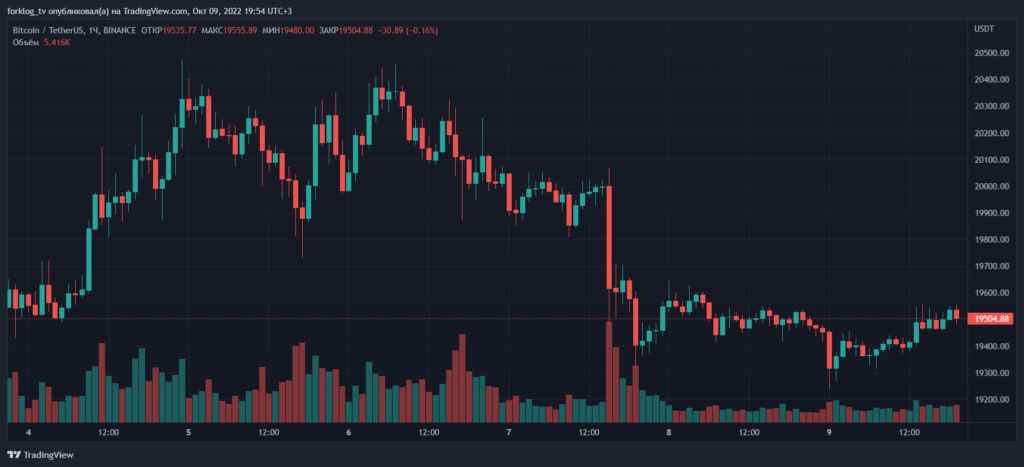
Despite Friday’s price drop, bitcoin rose 1% for the week. Other top-10 by market cap assets finished the period with mixed results. XRP led with +11.5%, the worst was Cardano (-1.7%).


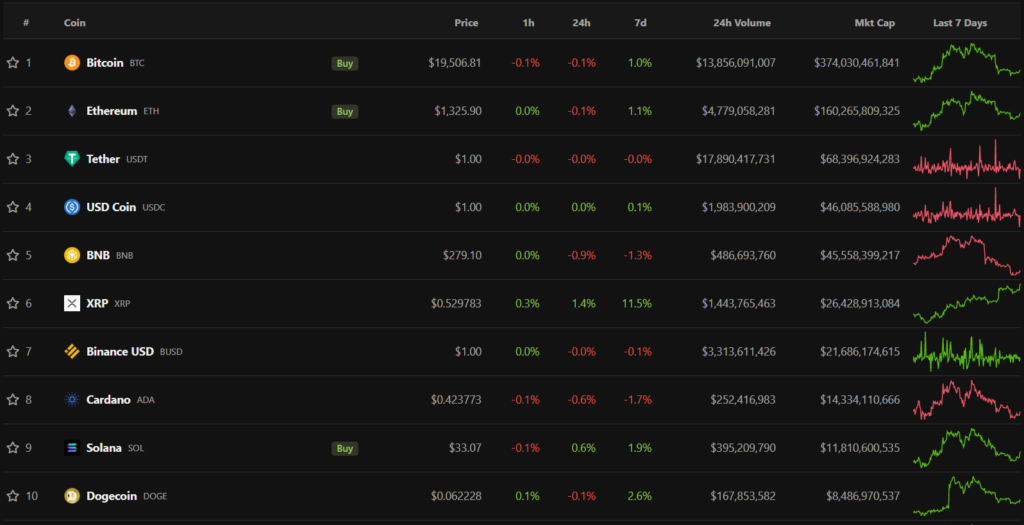
The aggregate market capitalization of the cryptocurrency market stood at $985.36 billion. The Bitcoin dominance index remained unchanged at 38%.
BNB Chain operations paused, then resumed after a $100 million hack
The BNB Chain paused network operations in response to the BSC Token Hub hack — the ecosystem’s cross-chain bridge. Hackers stole digital assets worth more than $544 million, but managed to withdraw only $100 million.
According to Binance CEO Changpeng Zhao (CZ), the attackers exploited a vulnerability that “led to the creation of additional BNB.” He stressed that the “problem is localized,” and users’ funds “are safe.”
Paradigm researcher samczsun explained that the critical vulnerability in BSC Token Hub enabled the attackers to perform a double-spend attack. SlowMist data shows they financed the attack from addresses belonging to the ChangeNOW exchange.
Later the BNB Chain team published a code update and said that after validators confirmed status the network “works normally.” Developers also announced a vote on further steps.
EU fully banned providing cryptocurrency services to Russians
On 6 October the European Union approved the eighth package of sanctions against Russia. Citizens and residents were prohibited from owning crypto wallets in the eurozone, creating accounts or holding digital assets in the EU regardless of deposit size.
ForkLog experts said the ban on European crypto companies serving Russian users is critical for the sector.
However the head of the State Duma Committee on the Financial Market Anatoly Aksakov saw positives in the sanctions. In his view, the decision will positively affect the development of the market for digital financial assets in Russia.
Earlier Aksakov proposed to legally ban the use of cryptocurrencies as a means of payment on Russian soil and bring those who settle in them to account.
Some crypto platforms already restrict accounts linked to Russia. For example, Dapper Labs took that step — the company behind CryptoKitties and the Flow blockchain, which hosts NBA Top Shot, took such action.
EU Council finalised MiCA bill text
On 5 October the Council of the European Union signed the MiCA regulation text without further discussion. The separate anti-money-laundering rule requires custodial service providers to verify customers’ identities.
MiCA covers rules that apply to issuers of unsecured crypto assets, issuers of stablecoins, and trading and custodial platforms.
Zcash network came under a spam attack
On 5 October the privacy-focused blockchain Zcash came under a spam attack that floods blocks with shielded transactions bearing hundreds of outputs.
Experts struggled to determine the attack’s aim. A researcher going by the pseudonym Nick bax.eth of Convex Labs named three possible motives:
- for fun;
- to profit from short positions in Zcash — potential blockchain issues could push the price lower;
- to hamper node bootstrapping, which would ease surveillance of the network and make eclipse attacks more feasible.
In Q3, the crypto industry lost $428.7 million to hacks and scams
For the third quarter of 2022, total losses of the Web3 ecosystem from hacks and fraud amounted to $428.7 million, according to Immunefi.
During the period there were 39 incidents, 30 of which were hacker-driven with a total loss of $399 million. The remaining losses of $29.8 million came from nine scam cases, including rug-pull schemes.
Key targets remain DeFi projects — they accounted for 98.8% of total losses, vs 1.2% for CeFi.
One recent example was the October 2 hack of the decentralised cross-chain exchange Transit Swap, which stole $21 million. The attacker later returned 70% of the stolen amount, and then an additional 2612 BNB (~$750,000). He also made 40 transfers of 100 BNB to Tornado Cash.
Earlier Elliptic found that the attackers used DEXes, cross-chain bridges and swaps to launder illicit crypto proceeds totaling more than $4 billion.
What to discuss with friends
- McDonald’s began accepting bitcoin payments in Lugano, Switzerland.
- The SEC accused Kim Kardashian of unlawful promotion of EthereumMax.
- Experts counted 12,100 “zombie tokens” so far this year.
- Peter Schiff accused Michael Saylor of “pumping” Bitcoin.
Mt. Gox sets a new compensation-claim deadline
Creditors of the collapsed cryptocurrency exchange Mt. Gox must register in a dedicated online system to receive compensation by 10 January 2023.
Users need to submit recipient details and choose a payout method. For those who fail to provide all required information, compensation will be deferred.
A specific date or even approximate payout timelines are not provided.
Sushi DAO selects a new chief executive
Participants in the Sushi DAO selected a new executive director for Sushi — with more than 83.5% in support, Jared Grey won. He previously led the Bitfineon crypto exchange and the DeFi project Eons Finance.
Ethereum staking: community notes
Following Ethereum’s transition to the proof-of-stake consensus, users faced difficulties in launching their own Ethereum staking node. A Reddit thread starter noted that with sufficient tech know-how he spent a weekend setting up a validator node on his own device. Many agreed with him. One commenter emphasised that setting up a node requires “more effort than you might expect from the average person.” Another member said staking was never meant to be public and requires a substantial amount of knowledge.
Do Kwon passport deadline
The South Korean Ministry of Foreign Affairs demanded Do Kwon return his national passport within 14 days. Refusal would see the document cancelled.
The TFL chief refuted earlier reports about his link to $39.6m in crypto assets, access to which prosecutors blocked. He stressed that he “does not understand the purpose of spreading this lies,” and said that he does not use KuCoin or OKEx.
On 6 October the arrest of a Terraform Labs employee who had been on the run in the country was reported. The Korean Prosecutor’s Office asked for an arrest warrant, but the court did not deem it necessary.
Media: Alex Mashinsky withdrew $10m before Celsius operations froze
The Celsius Network CEO Alex Mashinsky withdrew $10m over several weeks before customer accounts were frozen, according to Financial Times sources.
A company spokesperson said that most of the sum went to tax payments. One source said it was $8m. The remaining $2m related to a planned asset-management operation.
On 6 October it was reported that Celsius Network published 14,000 pages of data containing full names and timestamps for all user transactions. The Block editor Frank Chaparro explained the company had urged not to disclose sensitive information, but the judge rejected the motion.
Also on ForkLog:
- In Russia blocked access to the OKX exchange.
- Binance could spend more than $1 billion on deals in 2022.
- Beeple’s Discord server suffered a phishing attack.
- Hugo Boss will release an exclusive NFT collection.
What else to read?
In the analytical ForkLog report they outline the main industry changes for September.
Sponsor of the “Bitcoin Industry in Numbers” section — Bybit, the ecosystem for crypto traders.
In an exclusive piece, they looked into the features and significance of The Merge update, debunked common myths and outlined Ethereum’s development plans for project improvement.
ForkLog AI found out which companies are actively incorporating artificial intelligence into their products and why they invest billions in the technology.
New educational cards cover Lightning Network, Flow, IPFS and post-capitalism.
In traditional digests, we’ve gathered the week’s top stories in cybersecurity and artificial intelligence — cybersecurity and artificial intelligence.
The DeFi sector continues to draw heightened investor attention. ForkLog has gathered the most important events and news of recent weeks in a digest — they compiled.
Read ForkLog’s bitcoin news in our Telegram — news, rates and analysis: Telegram.