




The IMF urged regulation rather than a ban on cryptocurrencies, the Fed pushed back the timing of the final wind-down of its asset-purchase program from June to March, and other events of the week.
Bitcoin trades above $47,000
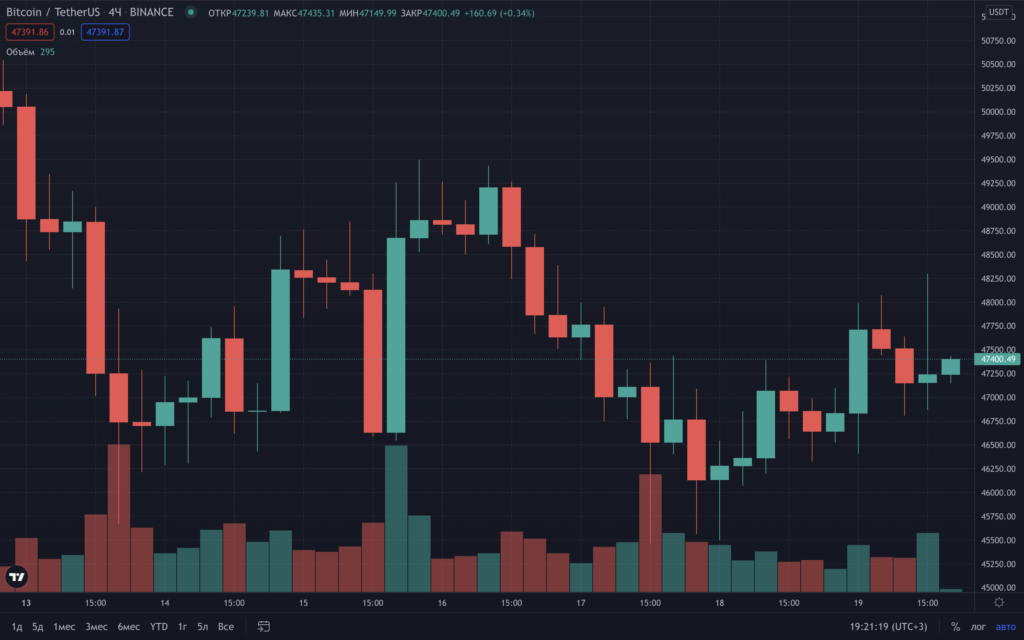
Over the course of the week, the price of the leading cryptocurrency slipped below $46,000 on several occasions.
As of writing, Bitcoin was trading around $47,400. The asset’s market capitalisation stood at $893 billion, according to CoinGecko.


On block #714,000 the Bitcoin network reached a point where only 2.1 million BTC remain to be mined or 10% of the available issuance. It is expected that digital gold will reach the limit around 2140.
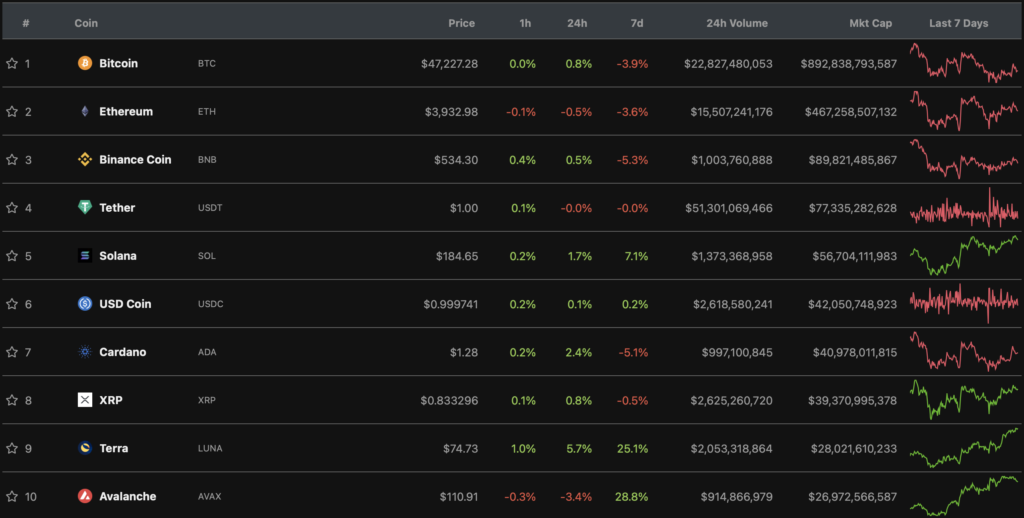
Only three of the top-10 by market cap closed the week in the green: Solana (SOL) — +7.1%, Terra (LUNA) — +25.1%, Avalanche (AVAX) — +28.8%. The Binance Coin (BNB) token fell the most — 5.3%.


Kraken chief calls Bitcoin’s drop a “buying opportunity”
Kraken CEO Jess Powell warned of the onset of a new crypto-winter. He noted that Bitcoin could fall below $40,000 and this should be viewed as a “buying opportunity”.
According to Powell, the Bitcoin market develops in cycles, with halving acting as the starting point for each phase. The previous reduction in miner rewards occurred in May 2020, with the next expected in March 2024.
Despite the prospect of a crypto-winter, the Kraken chief believes the price of digital gold will rebound quickly as investors start buying the asset.
‘I think many people see prices below $40,000 as a buying opportunity. I personally bought when a few months ago we dipped to almost $30,000. Many people are simply waiting to re-enter the market at the lowest prices,’ he said.
Ray Dalio calls Bitcoin “gold for the young”
Bitcoin effectively serves as an alternative to gold for the younger generation. The blockchain revolution is inevitable, but some governments may outlaw it, billionaire Ray Dalio said.
The founder of Bridgewater Associates urged not to hold cash that is eroded by inflation, and to build an “all-weather” portfolio. It should be diversified across currencies, asset classes, countries and sectors.
A portion of such a portfolio could include Bitcoin. Dalio compared it to gold, the “blue chip” relative to fiat.
The billionaire doubted that authorities worldwide will eventually ban Bitcoin. He did not find grounds to expect it to be adopted as a reserve asset by central banks and large corporations.
Dalio called fiat money a problematic asset and the worst investment. He also spoke of buying Ethereum, but did not specify the exact amount — “not very much.”
According to the billionaire, he regards cryptocurrencies as alternative money in real terms as traditional currencies lose value.
Joseph Lubin calls Ethereum gas fees a “measure of the network’s success”
High fees in the Ethereum network are a “measure of the network’s success” and are explained by “growing pains”. This view was shared by ConsenSys co-founder and CEO Joseph Lubin.
‘This is growing pains — the pain you pay when new technology becomes successful and you need to scale. When the technology is thriving, you usually turn to developers to push performance to the max. We are seeing users push the limits of blockchain,’ he said.
According to Lubin, Ethereum 2.0 will help cut both transaction costs and energy consumption. He expects the network’s second iteration to launch in the “second, perhaps third quarter of next year”.
Lubin also noted that the scalability problem is being addressed through layer-2 solutions.
IMF urges regulation rather than ban on cryptocurrencies
In the event of a ban on cryptocurrencies, countries would lose control over the industry, so policy should adhere to regulation rather than repression, IMF chief economist Gita Gopinath said at a conference of the NCAER.
She said it is impossible to ban digital assets, as users would simply move to offshore exchanges not subject to the rules in any given country.
‘Can you really do this [ban cryptocurrencies], given that many exchanges are offshore and do not fall under the norms of any country,’ she said.
She stressed that ‘no single state can solve this problem alone,’ as cross-border cryptocurrency transactions are almost impossible to police.
The official also said that digital assets are not currently a global threat. However, in her view, giving them the status of legal tender would be a major mistake.
Fed signals three rate hikes in 2022 amid inflation risks
At the December 14–15 meeting the Fed pushed back the timing of the end of its asset-purchase program from June to March. The updated forecasts imply three rate hikes over the next two years.
The previous projection in September allowed for only one increase in 2022 and two in 2023.
The pace of reductions in asset purchases was doubled—from $15 billion to $30 billion.
The move to revise policy came as inflation intensified, which in October reached a 30-year high (6.2% year over year).
At the December meeting the Federal Reserve declined to treat rising inflationary pressures as “temporary.” The Open Market Committee raised its inflation forecast—from 4.2% to 5.3% for 2021 and from 2.2% to 2.6% for 2022.
Aksakov: mining lacks social significance, so industry does not need support
Miners do not need industry support, as their activity has no social significance, said Anatoly Aksakov, head of the State Duma’s Committee on the Financial Market.
The official noted that this sector already earns “quite decent money”:
‘What are they, orphans or some sort of downtrodden? Why help mining? What’s the point? Do they produce socially significant products?’
Aksakov said Russian authorities are discussing various regulatory options for cryptocurrencies — from a complete ban on ownership and purchases to legalising Bitcoin exchanges.
He also noted the need to recognise mining as a form of entrepreneurship and to supply miners with electricity at a special price for industrial users.
Swiss crypto bank SEBA launches gold-backed token
The licensed Swiss crypto bank SEBA announced the issue of a token backed by physical gold.
According to the statement, Gold Token will allow investors to own a digital form of the precious metal via a “fully regulated, cost-effective and forward-looking solution”.
Investors can at any time exchange the tokens for gold with partner refineries, avoiding storage and transport fees.
The bank noted that Gold Token can also be used as a stablecoin for trading or as a store of value, “shielding investors from market volatility”.
DappRadar launches RADAR token and announces an airdrop
The analytics service DappRadar, which provides data on decentralized applications (dapps), launched the RADAR token on the Ethereum blockchain and announced the start of an airdrop.
Developers position RADAR as a utility token and governance token for the project’s ecosystem. Users can submit improvement proposals, vote on them, become liquidity providers, and pay for services on DappRadar.
Tokens can be claimed by:
- Users with a DappRadar account and a connected wallet who interacted with at least one Ethereum dapp in the last six months. The dapp must be listed on the portal. These addresses will receive 8697 RADAR.
- Any users who interacted with at least one Ethereum dapp in the last six months and with at least 10 apps across the wallet’s lifetime. All apps must be listed on the portal. These addresses will receive 5798 RADAR.
This is a retroactive airdrop. The service team noted that they want to reward community members who actively used the platform “long before any token announcements”.
The Ethereum network snapshot was taken on 19 October 2021.
To receive tokens you will need to pay a network fee. The airdrop rewards page must be claimed by 14 March 2022.
Total RADAR supply stood at 10 bln. Just over 25% of tokens were allocated to the team and insiders, 24.75% went to the treasury, 10% allocated to the initial airdrop, and the remaining 40% will go to the community.
Goldman Sachs says blockchain will underpin the future metaverse
Goldman Sachs analysts say that blockchain will underpin the metaverse, because the technology allows users to securely own digital assets, moving them between platforms.
The bank’s analysts described blockchain as “one of the most disruptive technology trends since the Internet.” In their view, the distributed ledger will form the basis of the metaverse by enabling the removal of a central intermediary.
‘We believe the metaverse will likely be a confluence of various 3D spaces that users move between regularly. If goods or services cannot travel with their beneficiaries, their value will be more constrained,’ the analysts explained.
In Goldman Sachs’ view, blockchain is the only technology that can uniquely identify any virtual object regardless of the central operator.
‘This capability to identify objects and then track ownership will be crucial to the functioning of the metaverse when it finally materializes,’ the report says.
Overall, analysts expressed optimism about the future of blockchain technology, but stressed that it is still too early to build investment theses around it.
NFT owner accidentally sells token for 0.75 ETH instead of 75 ETH
The owner of Bored Ape Yacht Club NFT #3547, named Max, accidentally sold it for 0.75 ETH ($2,931) instead of 75 ETH ($293,100).
The NFT was bought immediately. The buyer paid an additional 8.5 ETH (about $33,300) to speed up the transaction.
On 30 May 2021, Max bought Bored Ape Yacht Club #3547 for 1 ETH.
Australian teen invests in Bitcoin and becomes a millionaire at 18
Australian Samuel Snell, still at school, became interested in investing in cryptocurrencies and by 18 had earned his first million. He says he initially faced disbelief from adults:
‘I became interested in [Bitcoin and Ethereum] in 2014. Back then, my teachers advised me to stop spending time on cryptocurrency.’
However, at 17 Snell bought his first car, a Mercedes-Benz. A year later he could afford a second car, a G-Wagen, for $350,000 and diamond-encrusted Rolex watches.
Today Samuel Snell is co-founder of the Crypto Gods community, which, he says, is the country’s largest private crypto company. As part of the project, the teenager runs investment courses for 3,000 clients.
What to read and watch next
Algorithmic stablecoins are a relatively new phenomenon in the crypto market. They are an alternative to the time-tested centralised assets like USDT and USDC.
ForkLog looked into the features of various stablecoin technologies, weighing their strengths and weaknesses.
In traditional digests we have gathered the week’s main events in the areas of cybersecurity and artificial intelligence.
For the most significant recent news from the venture-capital sector, see our Institutional Newsletter.
Read ForkLog’s Bitcoin news in our Telegram — cryptocurrency news, rates and analytics.