




The algorithmic stablecoin UST fell to the $26,700 mark, a level reminiscent of late‑2020. The drop was accompanied by significant daily liquidations on the futures market, totalling more than $1 billion.
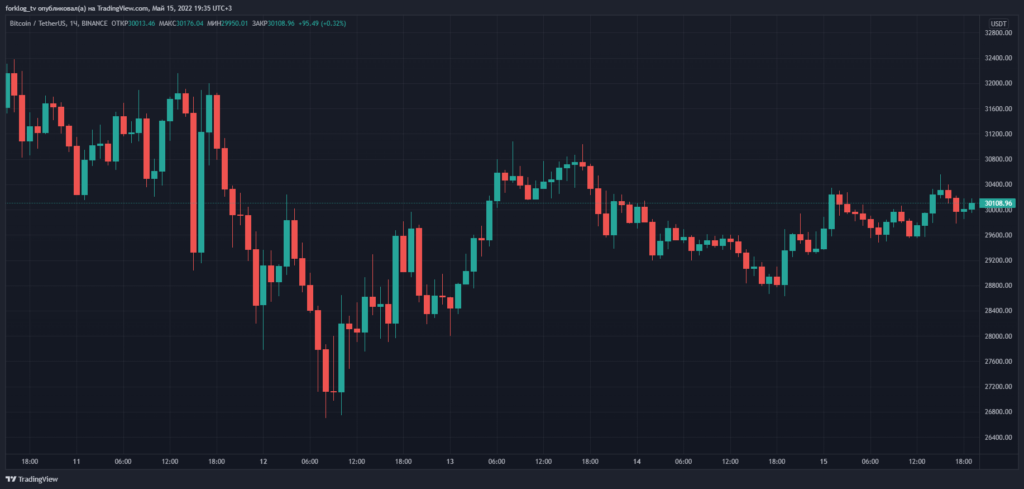
Bitcoin price slid below the $27,000 level
On Thursday, May 12, the price of Bitcoin fell to $26,700, a level comparable to the end of 2020. The decline was accompanied by substantial daily liquidations on the futures market exceeding $1 billion.
By week’s end, prices had retraced some of the losses. At the time of writing the asset was trading near $30,100.


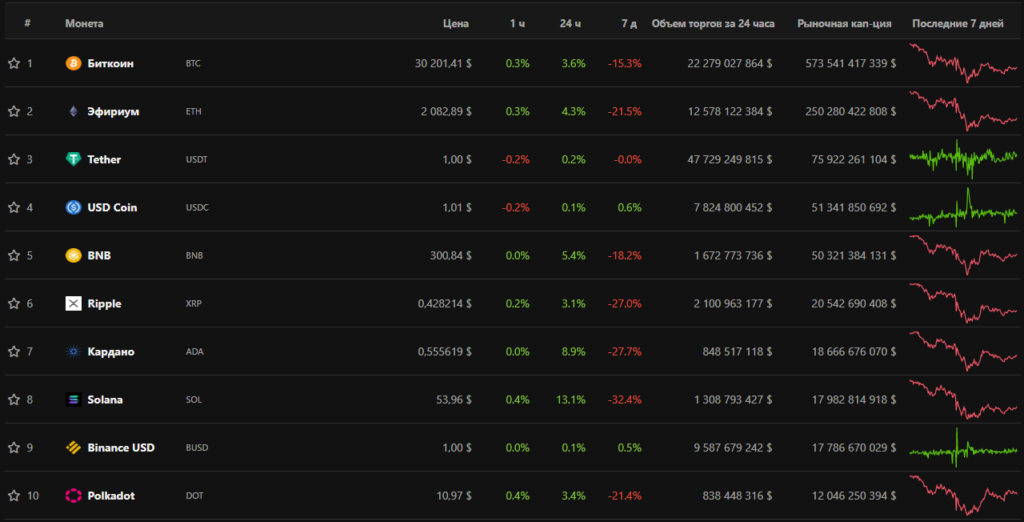
By the week’s end, all top-10 assets by market capitalisation were in the red. The worst performer was Solana (SOL), with a 32% plunge.


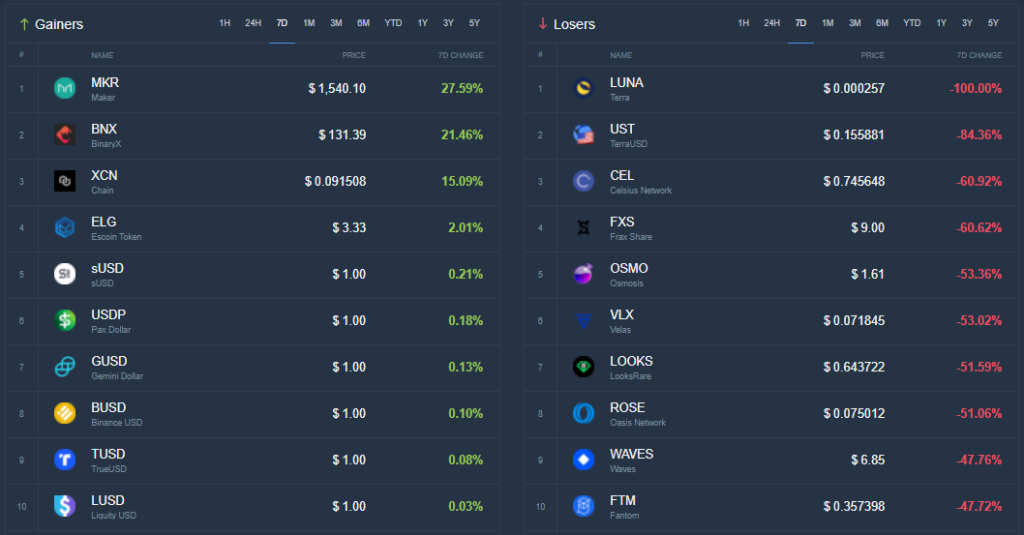
According to CoinCodex, among mid-cap digital assets the governance token MKR rose the most over the week. MKR climbed 27%.
The Terra ecosystem’s native token LUNA fell the most, as the loss of UST’s peg to the dollar eroded its value.


The aggregate crypto market capitalisation stood at $1.4 trillion. Bitcoin dominance rose to 42.4%.
UST loses its peg to the dollar. The incident triggers a sell‑off in LUNA and the broader market
The fall is driven primarily by the Terra USD (UST) and LUNA episode, together with a brief destabilisation of Tether (USDT).
It began over the weekend when UST briefly lost its peg to $1. The Luna Foundation Guard decided to allocate $750 million in BTC and $750 million in stablecoins to OTC desks.
On the night of May 10 the incident recurred, but on a larger scale — UST slumped to $0.62. Major platforms limited trading in pairs with the stablecoin or froze withdrawals on the Terra network. LUNA price began to plunge rapidly.
On May 11 UST fell further — to $0.23, and LUNA to $4. Do Kwon announced measures to stabilise the situation by issuing additional LUNA to absorb Terra USD (1 UST should be exchangeable for $1 in LUNA at any moment). Concurrently, Luna Foundation Guard reportedly sought to raise funds from major market players. By the end of the same day, LUNA traded below $1.
Rumours circulated about BlackRock and Citadel’s involvement in the Terra crash, but the firms denied the rumours. Later GAM Holding joined them.
On May 12 Terraform Labs presented additional measures to stabilise the UST price according to the mechanism proposed by Do Kwon, which involves burning LUNA tokens. Meanwhile the Anchor DeFi community proposed to reduce the yield from 19.5% to 4%.
On Friday the stablecoin slumped to $0.05 while LUNA dropped to well under $0.01. The added LUNA supply exceeded 6.5 trillion tokens. Previously Terraform Labs said validators had suspended network operations at block height #7603700 to defend against potential governance attacks. After a few hours the network was restarted, removing the ability to delegate tokens.
On the morning of May 13 the blockchain halted again. Validators explained the move was to allow for a recovery plan. The community began considering a rollback to the pre-crash state. After a few hours the network restarted with new restrictions.
Do Kwon presented a plan to resolve the situation. He proposed restarting the network with 1 billion tokens to be allocated as follows:
- 40% of the tokens would go to LUNA holders at the time of UST’s depeg from the dollar;
- 40% would go to UST holders at the time of the network upgrade;
- 10% would go to LUNA holders at the time of the network halt;
- 10% would go to the project development fund.
Doge the Terra team’s actions were criticised by Binance CEO Changpeng Zhao. He said the developers had put investors at risk but had not taken responsibility.
Later he also noted that a hard fork of the chain, with a rollback to the pre-crash state, would not work because the new chain would have no value.
Consequences for the sector
Activity in the stablecoin space spilled over to other projects. In the wake of the broad sell-off, Tether (USDT) briefly fell to $0.94 but quickly recovered. However the deviation from the dollar spurred activity in pairs with other stablecoins such as Binance USD (BUSD) and USD Coin (USDC).
The Waves-based Neutrino USD (USDN) also lost its peg — trading briefly as low as $0.63.
The TRON DAO Reserve began buying Bitcoin and TRON tokens to back the algorithmic stablecoin USDD. The first $61 million purchase took place on May 10.
Amid continued market weakness, Tron founder Justin Sun warned of a possible attack on USDD and vowed to allocate $2 billion to prevent loss of the asset’s peg to the dollar, as with UST.
He stated that the Tron ecosystem would not abandon USDD. He argued that Terraform Labs’ product suffered from too rapid growth and an insufficient reserve.
The Terra USD incident drew a response from US Treasury Secretary Janet Yellen. At a Senate Banking Committee hearing she urged the passage of stablecoin regulation by the end of 2022.
Media reported that Do Kwon was one of the anonymous co-founders of Basis Cash (BAC), the failed algorithmic stablecoin. Basis Cash, launched in the second half of 2020, relied on arbitrage from the native BAS token to maintain a $1 price. A similar mechanism was used for UST.
Bitcoin mining difficulty hits a new high
On May 11, following another adjustment, Bitcoin mining difficulty increased by 4.89% to a record 31.25T.
Instagram reveals details of NFT support testing
Beginning this week a limited group of Instagram users will be able to use NFTs as profile pictures. Test participants will need to connect a digital wallet and choose the NFT intended for display on the social platform. No fees are planned.
David Marcus launches a Lightning Network‑focused startup
Former head of Meta’s payments division David Marcus announced the launch of Lightspark, a company focused on expanding Bitcoin usage. In its initial phase the company is assembling a team to study and develop the Lightning Network protocol.
Elon Musk halts Twitter deal
Elon Musk paused the Twitter deal after reports that the social network inflated its audience figures. Reuters, citing the company’s filing, said fake or spam accounts make up not less than 5% of its monetisable daily active users. The billionaire said he remains intent on acquiring Twitter.
PancakeSwap will cap CAKE issuance at 750 million tokens
The PancakeSwap community on the BNB Chain backed changes to tokenomics, a key element of which is a cap on the CAKE governance token at 750 million. In favour, 98.8% of votes were cast.
Candidates in Russia elections to report overseas crypto holdings
President Vladimir Putin, by a decree, included information about cryptocurrencies, tokens and digital financial assets in the list of data to be checked for overseas property of candidates for elections at various levels. They will be verified for accuracy.
Kraken studies trading traditional securities
The Kraken exchange is considering offering shares to clients alongside digital assets and NFTs. According to CEO Jesse Powell, crypto brokers are evolving toward a “super wallets” model that would allow consumers to transact across all assets, including traditional ones.
Also in ForkLog:
- Circle stated that USDC is fully backed by dollars and US Treasuries.
- Chainalysis valued US$8.6 billion following another round of funding worth US$170 million.
- OneCoin founder made it onto Europe’s most‑wanted criminals list.
- KuCoin raised US$150 million at a US$10 billion valuation.
What else to read
We published the monthly industry overview for April, examining the salient topics and metrics.
We released a series of educational cards on the metaverse, stablecoins, custodial and non‑custodial crypto wallets, and MetaMask.
In our traditional digests we collected the week’s key developments in cybersecurity and artificial intelligence.
The decentralised finance sector continues to attract heightened attention from crypto investors. ForkLog has compiled the most significant events and news in a digest.
Read ForkLog’s Bitcoin news in our Telegram — cryptocurrency news, rates and analysis.