


What Are Quantum Computing and Quantum Computers?
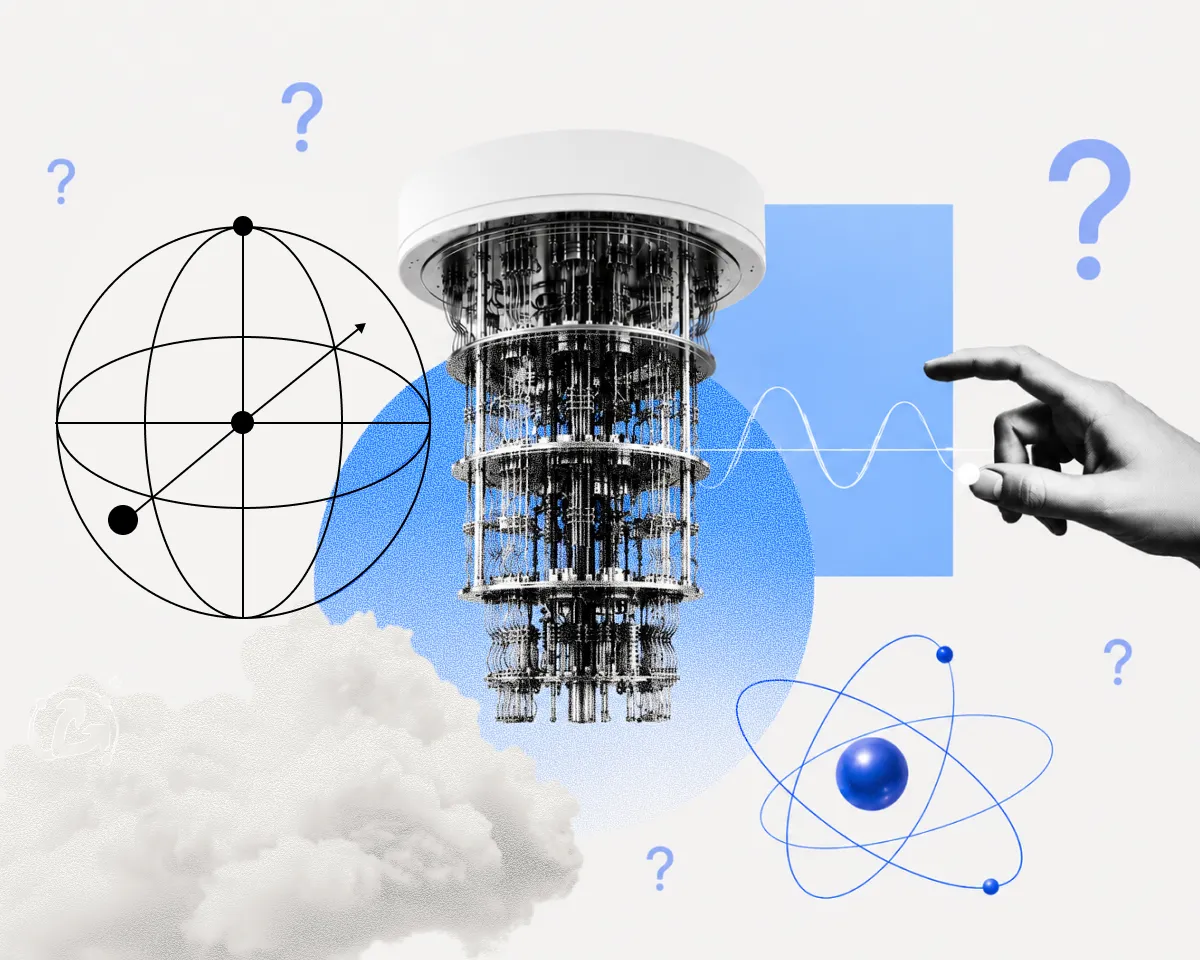
What is quantum mechanics, and why do its laws defy everyday logic?
Quantum mechanics is a fundamental theory in physics that studies the laws of motion, interaction and behavior of microparticles (atoms, molecules, electrons). In this microworld, energy is emitted or absorbed not as a continuous stream but in discrete packets—quanta.
Although the entire universe ultimately obeys quantum laws (they apply at any scale), understanding this “microcosm” through everyday intuition is nearly impossible. At the atomic and subatomic level, classical physics breaks down and reality clashes with common logic—reflected in several principles.
Quantum superposition
In the familiar macroscopic world, objects always have a definite state: a transistor switch is either on or off—“0” or “1.” A quantum system, as long as it is isolated, exists in a superposition—a mathematical combination of all states available to it. This means that until measurement, an electron’s reality has no single definite value and is described only by a spectrum of probabilities.
Wave–particle duality and Heisenberg’s uncertainty principle
Microscopic objects are neither classical solid particles nor classical waves; they can display properties of both depending on how they are observed. According to Heisenberg’s uncertainty principle, the impossibility of simultaneously determining a particle’s position and momentum with arbitrary precision follows from its fundamental quantum nature, not from imperfect instruments.
Observer effect
At the quantum level, “observation” is a physical interaction with the system. While it is isolated, superposition persists. Measurements force particles to assume one of the possible states—manifesting decoherence.
Visualization through probabilities
Quantum objects cannot be observed in the usual optical range, but scientists have learned to “see” them with scanning tunneling microscopes. They visualize not the particle itself, but a “map” of where it is most likely to be in the form of electron clouds, confirming the wave nature of matter.
What is quantum computing?
In the 1920s, physicists Werner Heisenberg, Erwin Schrödinger and Paul Dirac built a theory that explained and linked the observable effects of the microworld to mathematical laws. The main tool was the wave function, which sets the amplitudes of states. On its basis, scientists calculated probabilities and, using an equation, described how they change over time.
Decades later, scientists learned to use quantum mechanics to process data. Quantum computing systems (QCS) operate on qubits (quantum bits).
Classical computers are built on the ordinary bit—a categorical quantity that always has a definite value: either “0” or “1.” A qubit’s key difference lies in superposition, which removes classical rigidity. Until physical measurement, the element is not fixed in any basis state. Instead, it is a complex spectrum where probability amplitudes are mathematically intertwined and can ultimately yield a result of zero or one.
To tie qubits into a QCS, quantum entanglement is used—strict mathematical correlations between particles. Measuring one qubit correlates with the result of measuring another if the system was entangled. This does not allow information to travel faster than light, but it exponentially expands the system’s computational space: each new qubit doubles the dimensionality of possible states.
Scientists have learned to control qubits with microwave pulses and precisely targeted laser shots. Today several hardware platforms are advancing in parallel:
- superconducting circuits (IBM, Google) — microscopic loops made of special metals, cooled nearly to absolute zero;
- trapped ions (Quantinuum, IonQ) — charged atoms “suspended” in vacuum by an electromagnetic field. Data are read out by laser;
- photons (PsiQuantum, Xanadu) — computations using particles of light on optical chips, resilient to noise and able to operate at room temperature;
- spin qubits (Intel, Diraq) — using spin—the intrinsic quantum magnetic property—of a single electron confined in a silicon structure;
- neutral atoms (QuEra, Pasqal) — uncharged atoms (rubidium) captured by lasers (“optical tweezers”). The architecture enables efficient scaling of logical qubits.
What is a quantum computer, and what are its advantages?
Quantum supremacy is a milestone where a quantum computer solves in minutes a task that would take the most powerful classical supercomputer millennia. Achieving it does not mean winning on every task; it applies to specific implementations where the technology prevails.
A classical computer is fast but straightforward. Tackling a hard problem—say, searching for a cryptographic key—it must test possibilities one by one or via deterministic algorithms. In QCS, a fundamentally different mathematics is used: they do not work with fixed digits but manipulate probabilities themselves.
To control this spectrum of probabilities, engineers use low-level programming of particles (ions, photons) with quantum gates. In a conventional processor, a gate is a logical operation realized by a silicon transistor that lets current through or blocks it. In a quantum computer, it is a physical action—a precisely calculated microwave or laser pulse that “rotates” a qubit, changing its state.
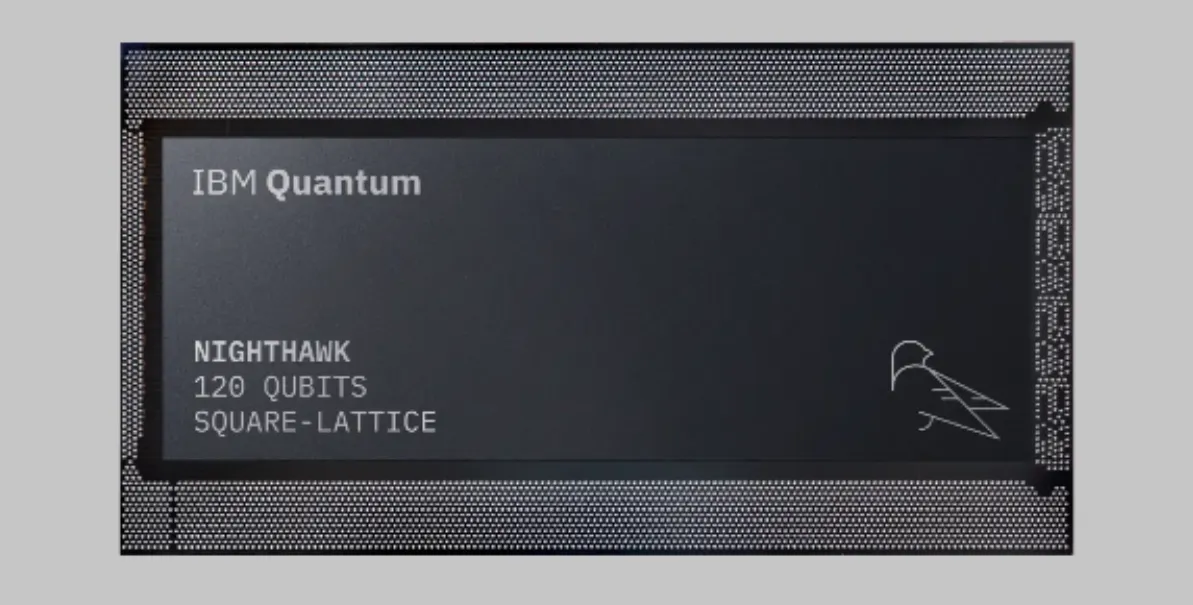
By arranging sequences of such pulses, engineers design algorithms built on two principles:
- a vast search space. A conventional processor works only with concrete bit values at any given moment. In a quantum computer, each added qubit doubles the space. A processor with 300 logical qubits operates over more possibilities than there are atoms in the observable universe. The machine does not “store” all that data, but it gains a gigantic field for intricate algorithmic maneuvers;
- wave control (interference). Quantum algorithms tune the system so that wrong answers cancel out (destructive interference). Imagine stones thrown into water: the resulting waves can collide and cancel each other, or resonate and merge into one large wave. By the time of readout, the probability of the correct answer becomes mathematically higher.
This synergy makes quantum computing unmatched for a narrow but ultra-hard class of problems: from precise simulation of chemical molecules to factoring enormous numbers with Shor’s algorithm. On a sufficiently powerful logical quantum computer, this algorithm is theoretically capable of breaking asymmetric cryptography—specifically the ECDSA algorithm and the secp256k1 elliptic curve that underpins Bitcoin’s transaction signatures.
How is a quantum computer built?
The look of a quantum machine depends entirely on the physical principles its qubits use. Two architectural approaches dominate the industry today:
- cryostats (“chandeliers”). This design is used for superconducting qubits (IBM, Google). The “chandelier” is a dilution refrigerator, with the quantum chip on the lowest stage, where a mixture of liquid helium isotopes cools it to near absolute zero. During operation, the entire assembly sits in a vacuum chamber that shields electromagnetic radiation and external noise;
- optical and ion-based systems. QCS based on trapped ions or photons look different. Their main instruments are laser systems, fiber optics and vacuum chambers. Photonic processors typically do not require extreme cold, so their control electronics can be mounted in standard server racks. However, ion traps need deep vacuum, and superconducting single-photon detectors still have to be cooled to cryogenic temperatures.
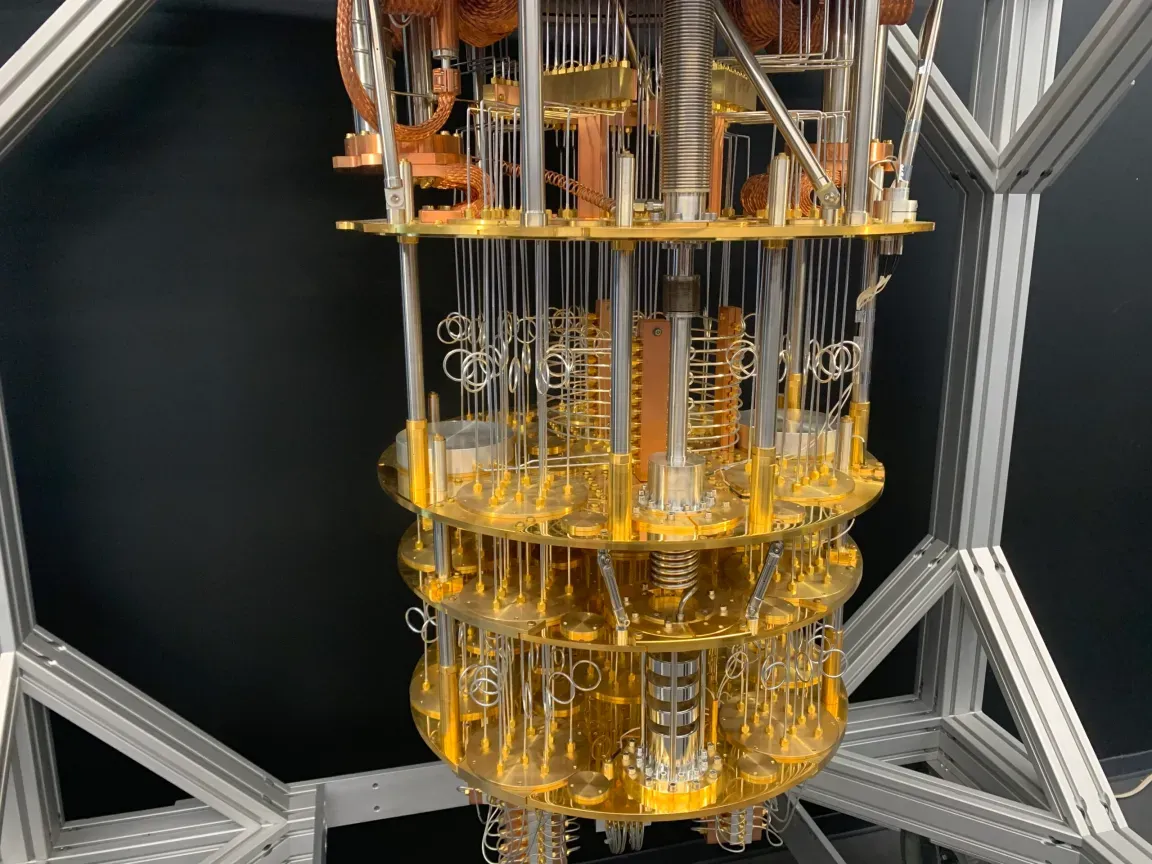
Given the complexity of installation and maintenance, the primary way to access quantum computers remains via the cloud.
With quantum computing accelerating, the industry has moved beyond standalone machines. At Cisco, began developing quantum infrastructure: specialized routers, optical links and a communications system. The goal is to eventually connect disparate QCS into a global network and secure data transmission via quantum key distribution (QKD).
QKD makes networks immune to interception, because any attempt to copy a key immediately destroys its state and alerts the parties to interference thanks to the observer effect.
How do logical qubits address decoherence?
The main barrier to widespread QCS adoption is the extreme fragility of quantum states. Any, even the weakest, interaction with the environment makes a qubit rapidly lose its quantum properties. This fatal-for-computation process is called decoherence. As it progresses, the system loses the ability to interfere, making further execution of a quantum algorithm impossible.
Any external background—physicists collectively call it “noise”—is harmful to a quantum system:
- thermal energy. Heat is chaotic atomic motion. To prevent a superconducting qubit from drifting due to its own fluctuations, the chip is cooled;
- electromagnetic radiation. A random cosmic ray, Wi-Fi background, or changes in Earth’s magnetic field can instantly destroy superposition;
- mechanical vibrations. Microseismic building vibrations can easily knock precision laser mirrors out of alignment in optical and ion-based computers.
Because of decoherence, physical qubits can live only fractions of a millisecond, accumulating errors faster than an algorithm can finish.
To solve this, engineers are developing logical-qubit systems—a hardware–software method of error correction. In this approach, quantum information is distributed across the system: to obtain one reliable (logical) qubit capable of long computations, hundreds to thousands of unstable units must be networked together.
The industry has shifted from the NISQ era to the early fault-tolerant FTQC era, where software error correction has become the key progress metric, replacing the simple race to count “raw” physical qubits.
Building a machine with enough logical elements is the industry’s main goal for the next decade.
Рассылки ForkLog: держите руку на пульсе биткоин-индустрии!