


What are stablecoins?

Key points
- Stablecoins are cryptocurrencies with a fixed or steady value.
- They serve as a universal unit of account, convenient for trading, storing capital and protecting an investment portfolio from crypto volatility.
- Stablecoins can differ by issuer, collateral assets and mechanisms used to hold their value.
- There is no single classification. Researchers group projects by criteria such as issuer centralisation, reserve ratio, class of backing assets and more.
What are stablecoins for?
Popular stablecoins are highly liquid: they are available in size on almost any platform.
They are also a universal medium of exchange and store of value among crypto investors and traders. It is easier to trade them against other cryptocurrencies than against fiat. Unlike fiat, stablecoins can be moved between accounts and addresses more quickly and easily.
They also hedge crypto-portfolio volatility and are widely used in DeFi applications.
Which stablecoins are popular?
Hundreds of stablecoins exist. Here are the top ten by market capitalisation (CoinMarketCap, August 2022):
- Tether (USDT);
- USD Coin (USDC);
- Binance USD (BUSD);
- Dai (DAI);
- TrueUSD (TUSD);
- Pax Dollar (USDP);
- USDD (USDD);
- Neutrino USD (USDN);
- Fei USD (FEI);
- Gemini Dollar (GUSD).
What are stablecoins pegged to?
In crypto, USD‑pegged stablecoins are most common. The best‑known is Tether (USDT). One USDT equals $1, with minimal deviations. There are also coins pegged to other currencies, such as the euro — Stasis Euro (EURS) — and the Singapore dollar — XSGD.
Some stablecoins target a fiat price but use cryptocurrencies as collateral. Stability is achieved via overcollateralisation or a smart arbitrage algorithm. The most prominent example of a crypto‑collateralised stablecoin is DAI by MakerDAO.
You can also buy gold‑pegged stablecoins — notably PAX Gold (PAXG) and Tether Gold (XAUT). Unlike traditional gold instruments such as ETFs, stablecoin issuers do not charge a management fee, and crypto settlements are faster and cheaper. These coins, however, are not very popular.
How do stablecoins differ?
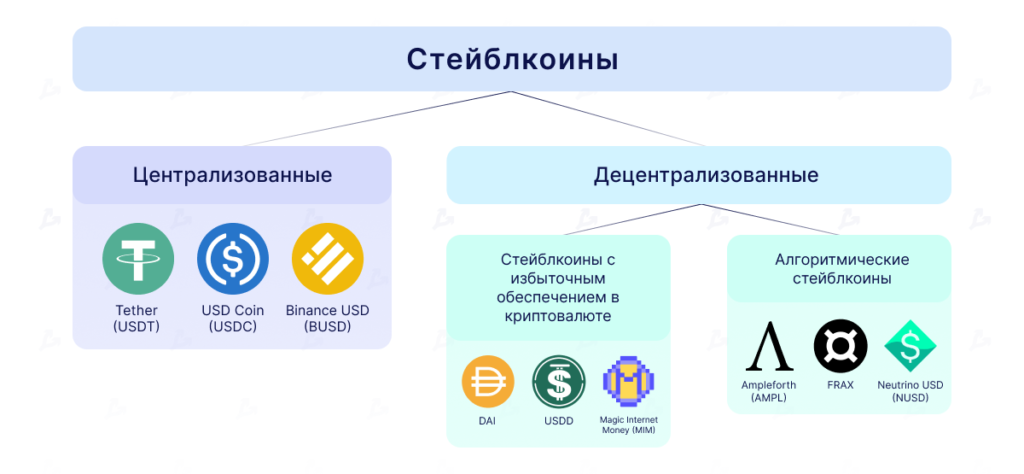
Each stablecoin uses its own system to maintain value. There is no standard taxonomy, but several core criteria set them apart:
- Class of reserve assets — fiat or cryptocurrency.
- Reserve ratio. Reserves may cover only part of the circulating supply, match it, or even exceed it.
- Price‑stabilisation method — reserves only (mostly for centralised projects) or reserves plus an algorithm (used by algorithmic stablecoins).
What are centralised stablecoins and who runs them?
Most popular stablecoins are issued by centralised entities. Each manages a fund holding reserves in various assets and securities. The fund undergoes regular independent attestations to verify its stated size and composition.
The company Tether, which runs the largest stablecoin by market value, USDT, publishes such reports on its website. According to an August 2022 attestation, Tether’s reserves include US Treasury bills, cash, commercial paper and money‑market funds.
Similarly, the accounts of BUSD — a dollar‑pegged stablecoin issued by the Binance exchange — are reviewed.
Stablecoin operators are organisations registered in major jurisdictions. The second‑largest dollar stablecoin, USDC, is managed by a consortium of American firms, Circle and Coinbase. It controls reserves consisting mainly of cash and short‑term US government bonds. The company managing BUSD’s reserves operates in New York state.
Only the issuer controls the supply of a centralised stablecoin, expanding or shrinking it in line with reserve levels.
What are the pros and cons of centralised stablecoins?
On the plus side, centralised stablecoins are resilient because their price is fully backed by low‑volatility assets. They are liquid — available on virtually every crypto‑trading platform. They are convenient for settlements and capital storage and as base currencies in trading pairs.
On the minus side, centralisation is a weak point. Troubles at the organisation controlling reserves — from regulatory claims to manipulated reporting — can ripple through to all holders. It is also unclear how exactly an operator might use reserves.
A telling example is USDT. In early 2019 the New York attorney‑general accused the Bitfinex exchange of using capital from its affiliate, Tether, to cover its own losses of user funds. The case involved $850m that the platform lost access to after transferring them to the Panamanian processor Crypto Capital.
Bitfinex repaid the principal owed to Tether only in early 2021 and soon settled with the authorities. Meanwhile, investors sued Tether, accusing the company of “illegal and deceptive” practices. In April 2022 a Crypto Capital defendant pleaded guilty to all counts, including “shadow banking”.
What are algorithmic stablecoins?
The stability of some coins is maintained not by traditional instruments but by cryptocurrencies.
Because digital‑asset prices can swing sharply, maintaining full backing is difficult. One approach is decentralised governance plus a purpose‑built algorithm that keeps the price near target according to preset rules.
What kinds of algorithmic stablecoins exist?
One way to keep an algorithmic stablecoin steady is overcollateralisation, where collateral value exceeds the total token supply. The most popular example is DAI, a cryptocurrency any user can mint via the MakerDAO protocol.
To do so, a user must lock crypto as collateral worth more than 100% of the DAI they mint. This helps avoid undercollateralisation during sharp crypto sell‑offs. If the collateral ratio falls below the threshold, the position is forcibly liquidated.
DAI is indeed stable, but its clear drawback is low capital efficiency due to high collateral requirements.
In some designs, creators do not control issuance — any user can mint. The price is regulated by market participants rather than a central organisation. Stability is supported by an additional cryptoasset that underwrites liquidity.
The most popular algorithmic stablecoin was UST from the Terra project. Its price was held via arbitrage by holders — a supply‑and‑demand mechanism. The asset that supported UST’s price was the project’s native coin, LUNA.
For a long time UST was the largest algorithmic stablecoin, but in spring 2022, after a chain of events, it lost its dollar peg and the project effectively ceased to exist.
Other unusual models include Ampleforth (AMPL), Fei USD (FEI), Frax Finance (FRAX) and Magic Internet Money (MIM).
How might stablecoins evolve?
After Terra’s collapse, with rare exceptions the crypto market lost confidence in algorithmic stablecoins. The main success story in this niche is DAI by MakerDAO.
Centralised projects such as Tether and USDC remain the dominant players. However, several jurisdictions, including the United States and the European Union, plan sweeping rules for stablecoin issuers that could complicate their use.
Regulators and government agencies regularly criticise stablecoins. In late 2021 the US Treasury released a report on stablecoin risks, highlighting opaque reserves and calling them a threat to investors. The Federal Reserve argues stablecoins pose risks due to potential problems converting them into fiat.
Further reading
What are central bank digital currencies (CBDCs)?
What is decentralised finance (DeFi)?
What is the Austrian school of economics?
What is a decentralised autonomous organisation (DAO)?
What is coin burning and how does it affect price?
What is NEAR Protocol?
Рассылки ForkLog: держите руку на пульсе биткоин-индустрии!