


What is a Bitcoin Improvement Proposal (BIP)?

Key points
- A Bitcoin Improvement Proposal (BIP) is a formally specified proposal to improve Bitcoin’s code.
- The BIP framework standardises how major changes are proposed. Because proposals are stored as text files in a repository, their contents and history are open to all.
- Anyone can suggest a BIP. To be added to Bitcoin’s code and ultimately activated, it must be approved by developers and miners.
- A BIP typically covers a single substantial update to simplify debate. Minor tweaks and bug fixes are excluded. Some BIPs are procedural or informational.
Why are BIPs needed?
Bitcoin is software built on a digital protocol. It is continuously updated: fixing bugs, improving algorithmic efficiency, simplifying code, maintaining compatibility with other software and adding new features.
The first cryptocurrency has no central governing body or development organisation—it is a decentralised, open‑source system. Decisions about upgrades are made by an independent developer community, and BIPs formalise and open up the process.
Each proposal formatted as a BIP is assigned a number. The framework is used mainly for protocol upgrades or other sweeping changes. Not every code change requires it, such as user‑interface tweaks or bug fixes.
When did Bitcoin start using BIPs for upgrades?
The first Bitcoin improvement proposal—BIP1—appeared in 2011, submitted by British‑Iranian programmer Amir Taaki. He was inspired by Python’s PEP process. The BIP process also resembles RFCs used to evolve the internet.
How are BIPs proposed and accepted?
The process unfolds in stages and proceeds only after community consensus is reached.
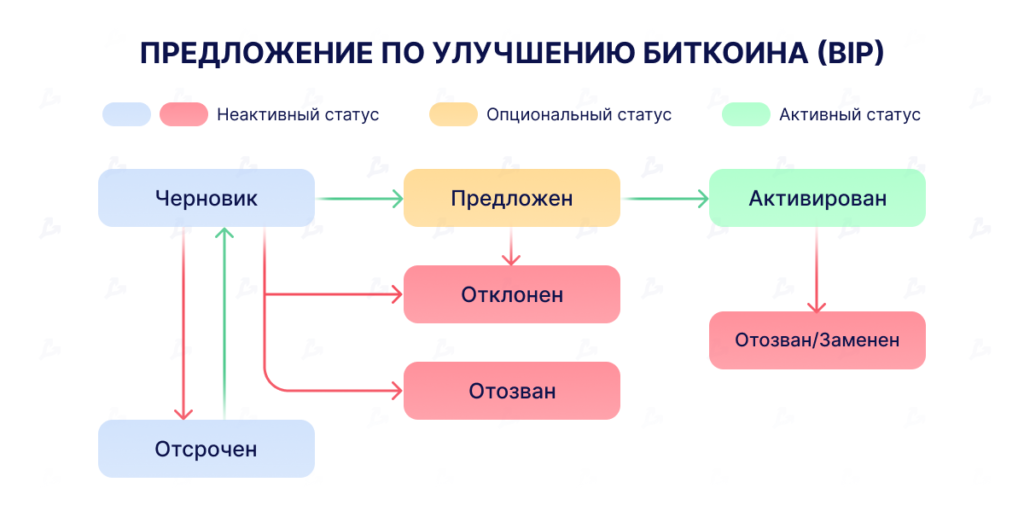
Typically a BIP begins as an informal idea aired via community channels—for example through IRC or Slack. The idea is then debated publicly. Anyone may propose a BIP, regardless of credentials or reputation.
Once a proposal gains meaningful support, the author can move on to drafting a BIP with a concise technical specification and rationale.
A designated editor acts as auditor and administrator. They help shape the proposal to match BIP style and format and ensure it does not duplicate existing ideas.
When the editor deems it ready, the draft receives an official number, such as BIP‑0119. Each BIP should address only one feature to keep discussion focused.
Once the draft is sent to the dedicated repository, handling is transparent and anyone can track progress and testing results. Drafts carry statuses: accepted, deferred, rejected or withdrawn by the community.
How long does it take to roll a BIP into Bitcoin’s code?
Adoption is a lengthy process that can take years.
A proposal typically needs ~95% approval from miners, and node operators must upgrade to the new software.
After a BIP is accepted, it is merged into Bitcoin Core (Bitcoin’s main software) and then activated. A long gap can separate those steps. That was the case with Taproot: the proposal was merged into Bitcoin Core in October 2020 and activated only in November 2021.
As a rule, a BIP can be rejected if no progress is made within three years of submission.
What types of BIP exist?
- Standards Track BIP — proposals that define standards used by software and affect changes to the Bitcoin protocol.
- Informational BIP — non‑binding guidance for the community; it introduces no new feature and does not require consensus.
- Process BIP — proposals to improve foundational processes related to the Bitcoin ecosystem.
Which BIPs are best known?
- BIP‑8 and BIP‑9 — two process BIPs that set the standard mechanism for activating soft fork upgrades on the blockchain.
- BIP‑141 (SegWit) — reorganised how data are stored in blocks, fixed “transaction malleability”, and standardised Segregated Witness (SegWit) address formats.
- Taproot — one of the largest upgrades, bundling BIP‑340, BIP‑341 and BIP‑342. It improved Bitcoin’s scalability and privacy. For more on Taproot, read the Cryptorium article.
Рассылки ForkLog: держите руку на пульсе биткоин-индустрии!