



Key points
- Cardano is a proof-of-stake blockchain platform, implemented in Haskell and designed for building decentralised applications via smart contracts.
- Cardano (ADA) is the blockchain’s native cryptocurrency. ADA can be delegated to the network’s staking pools, including through the popular Daedalus and Yoroi wallets.
- Cardano implements several distinctive architectural choices, enabled by a large research community. Its members publish a significant number of peer‑reviewed academic papers on the project’s development.
Who built Cardano and when
Cardano has several founders:
- Charles Hoskinson — a mathematician and entrepreneur who was involved in BitShares and Ethereum. He is CEO of IOHK and the project’s “spiritual leader”.
- Jeremy Wood — director of strategic development. In late 2013 he served as executive director of the Ethereum Foundation, then acted as a consultant to a number of other crypto projects.
- Aggelos Kiayias — the project’s chief scientist, a cryptographer and a professor at the University of Edinburgh.
In June 2014 Hoskinson left Ethereum over disagreements about the project’s direction. He then founded Input Output Hong Kong (IOHK) with Wood; in 2015 the firm began developing Cardano.
On 7 February 2017 IOHK’s developers presented the whitepaper for the Ouroboros blockchain protocol.
The Cardano platform launched officially on 29 September 2017. Token trading began on 1 October 2017.
The blockchain was named after Girolamo Cardano (1501–1576), an eminent Italian mathematician, physicist, biologist, chemist, astrologer, philosopher, writer and gambler.
Cardano’s creator, mathematician Charles Hoskinson, chose the name to reflect a project aimed at building a flexible, interoperable form of programmable money using scientific methods grounded in mathematical proofs and game theory.
Who develops Cardano
- Cardano Foundation — a non-profit registered in Zug, Switzerland, whose main role is to “standardise, protect and promote the Cardano protocol technology”. It manages relations with financial regulators, government bodies and the public, and forges strategic partnerships with other projects.
- IOHK (short for “Input Output Hong Kong”) — an engineering and technology company founded by Wood and Hoskinson. IOHK develops the cryptocurrency and conducts research. The company is bound by contract to Cardano Foundation, under which it would remain the platform’s primary developer until 2020.
- Emurgo — an investment firm with offices in Singapore, Japan, the US, Indonesia and India. Its mission is to “develop and support commercial ventures and help integrate businesses into the Cardano ecosystem”.
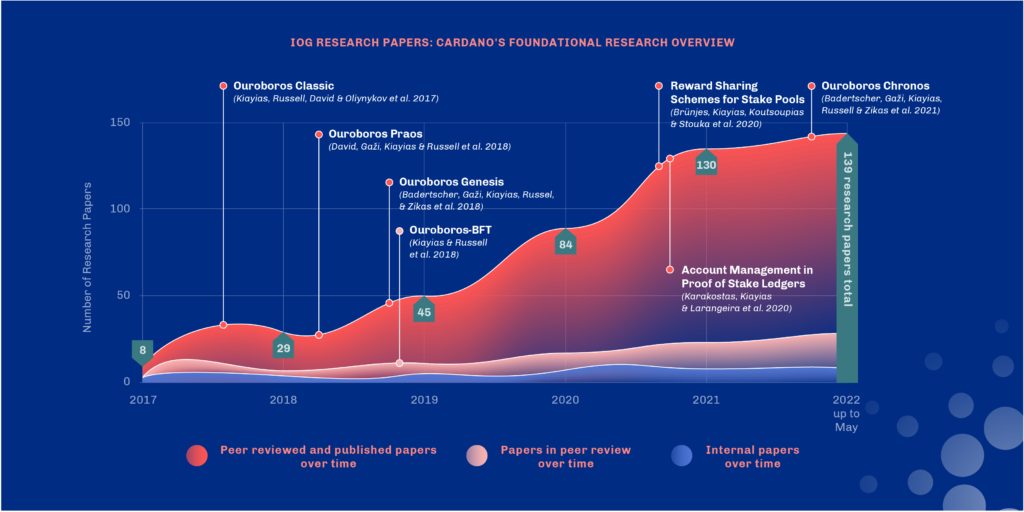
One of Cardano’s distinguishing features is its extensive research community. Solutions to the project’s challenges are proposed in peer‑reviewed publications.


Cardano’s blockchain architecture
Although Cardano adopted a proof‑of‑stake mechanism from the outset, it also used the UTXO model borrowed from Bitcoin. The Shelley era also allowed an account‑based model similar to Ethereum. Addresses of that format are used for distributing rewards. Cardano leverages the strengths of both models.
Inputs and outputs record where funds come from and where they go. Inputs indicate the address from which funds originate; outputs indicate the address to which funds are sent.
To prevent double spending, every node tracks transactions. When a new transaction becomes available (in a block or the mempool), it is checked to see whether it modifies an unspent output associated with any address in the network.
The classic UTXO model cannot optimally support smart‑contract functionality. To address this, Cardano introduced its own adaptation called Extended UTXO (EUTXO).
It splits smart‑contract execution across multiple transactions. Each transaction output contains a data field with arbitrary information tied to a given smart contract. The EUTXO model was deployed after smart contracts went live on Cardano’s mainnet.
How the Ouroboros algorithm works
As claimed by Cardano, Ouroboros (a PoS variant) is the first algorithm with mathematically proven resistance to attacks.
Block production in Ouroboros is divided into epochs and slots. An epoch comprises a number of slots during which a given stake distribution applies. It is either pre‑programmed or, at a later stage, computed from a snapshot of a block.
At the start of each epoch, leaders are chosen, each empowered to process transactions and sign blocks in particular slots. For every slot, a leader is selected at random from among stakeholders to create the next block, which links to the previous one in the chain.
As transactions are recorded, the stake distribution used to elect leaders evolves. In Cardano, the likelihood that blocks become “canonical” increases as more blocks are built on top of them (as in Proof-of-Work).
Leader selection and slot assignment rely on stake distribution and a lottery. But it is not a race to find a winning hash. Instead, the leader for each slot is determined by a number generated from computations performed by stakeholders in the previous epoch. A slot’s chances are proportional to its stake — the share of coins it controls directly or via delegates.
Cardano (ADA): uses and staking
The network’s native cryptocurrency trades under the ticker ADA, after Augusta Ada King, Countess of Lovelace (1815–1852). The daughter of the poet George Byron, Ada Lovelace was a mathematician who described the first computing machine and wrote what is regarded as the first computer program. The smallest unit (0.000001 ADA) is called a Lovelace.
ADA’s primary function is value transfer on Cardano. According to Messari, in September 2022 the average transaction fee was about 0.33 ADA, or $0.15–$0.17.
ADA supports staking. Holders can delegate their coins to node operators running staking pools that participate in consensus. Delegation is built into the official wallets: Daedalus (by IOHK) and Yoroi (by Emurgo). Current yields for delegating ADA range from 3.7% to 4.2% per year.
Staking pools take part in the network’s consensus — there are about 3,200 of them on Cardano (as of September 2022). Besides the amount staked, pool returns depend on other parameters, including:
- Saturation. This depends on a pool’s weight versus competitors and the ratio of total pools to a target value computed by the Cardano protocol. The more “saturated” a pool, the lower its yield. This mechanism curbs centralisation and prevents dominant pools from emerging.
- Desirability index. Calculated from stake size, pool costs and revenues, saturation and performance history. Daedalus and Yoroi use it to help distribute ADA delegated through these wallets.
Scaling the Cardano blockchain
Cardano currently processes around 250 transactions per second (TPS), well below the throughput of projects such as Solana. As noted in an IOHK post, the community is pursuing several approaches to increase speed.
Pipelining
One avenue is adding pipelining to Ouroboros, to accelerate block propagation — the time it takes nodes to relay a new block across the network. The current goal is to reduce propagation time to five seconds.
Input endorsers
Introducing input endorsers into the protocol also targets faster block propagation. These actors track new transactions and arrange them into pre‑assembled blocks. Two sets of blocks are envisaged — one for transactions and another for achieving consensus.
Multi‑tier pricing
Developers also plan to add a multi‑tier pricing mechanism. In today’s implementation, transactions execute sequentially with no prioritisation. Under heavy load, this can delay confirmations and open the door to DoS attacks.
Multi‑tier pricing aims to make fees more flexible by splitting each block into three tiers: fair, balanced and immediate. Different transaction classes, as set by senders, would be included in each tier.
Sidechains
Another set of solutions involves layer‑two protocols that run “on top of” the base chain. This includes sidechains, slated for release in upcoming 2022–2023 updates. IOHK already has an alpha version of the first sidechain.
Hydra
Hydra channels, named after the multi‑headed creature of Greek myth, offer another scaling path. These state channels, akin to Bitcoin’s Lightning Network, let participants transact off‑chain while relying on main‑chain smart contracts.
Mithril
Proposed in 2021, Mithril aims to make data synchronisation between Cardano applications more efficient. It reduces the time needed to validate messages by aggregating multi‑signatures more quickly.
Cardano’s roadmap
Cardano’s long‑term strategy comprises five phases (eras).
Byron
Named after the poet Lord Byron, Ada Lovelace’s father. This initial stage (launched in September 2017) established the core components and prepared the settlement layer for decentralisation.
Shelley
Named after the English poet Percy Bysshe Shelley, a friend of Lord Byron and author of the sonnet “Ozymandias”. Another view is that it honours Mary Shelley, author of “Frankenstein; or, The Modern Prometheus”.
During Shelley, thanks to the Ouroboros Genesis consensus, the platform transitioned fully to a decentralised mode. In July 2020 Cardano added staking, enabling the creation of staking pools to which ADA could be delegated.
Goguen
The current phase, Goguen, is named after the American mathematician Joseph Goguen (1941–2006), a professor at Oxford and the University of California known for work in algebraic semantics and formal verification. Its main goal is to provide the foundation for decentralised applications on Cardano.
Several major upgrades have taken place under Goguen. In autumn 2021 Cardano introduced a native token standard. It also delivered a computation layer for smart‑contract execution, including:
- Plutus — a platform for smart‑contract development and code execution based on the functional language Haskell.
- Marlowe — a domain‑specific language for financial smart contracts. It lets subject‑matter experts without deep programming skills create contracts on Cardano. A dedicated portal for Marlowe developers is available.
In September 2022 the Vasil upgrade was activated on mainnet. It introduced a second, more efficient version of Plutus scripts and a new cost model, lowering smart‑contract execution costs and transaction sizes while improving network speed.
Basho
The fourth stage is named after the Japanese haiku master Matsuo Bashō. Its chief aim is to boost scalability and interoperability. Baseline performance is expected to increase, enabling high‑throughput applications.
A key addition in Basho will be sidechains — autonomous blockchains operationally compatible with Cardano’s mainnet. They can offload traffic from the base chain and serve as suitable testing environments.
Basho will also introduce various account models. While Cardano’s base chain will keep UTXO, it will become possible to move between UTXO and different account‑based models, improving interoperability and enabling new use cases.
Voltaire
The fifth and, for now, final era is named after the 18th‑century Enlightenment philosopher Voltaire (François‑Marie Arouet). It envisages decentralised on‑chain governance (direct democracy associated with the Enlightenment and Voltaire) and a treasury system.