


“1 BTC = 1 BTC”: meme or crypto’s cardinal truth?
“Only when you live with the take ‘one bitcoin equals one bitcoin’ side by side every day do you begin to exist, and then to develop, in the only global economic free zone — the ‘crypto offshore’.”
So says Web3 researcher Vladimir Menaskop, who spoke to ForkLog. He kindly agreed to accompany the author down the little-charted paths of the popular thesis “1 BTC = 1 BTC”.
This article traces how the formula emerged and what it means, compares the first cryptocurrency with cocoa beans, and examines how manipulation through information and grand rhetoric can influence investors and enthusiasts.
A narrative in its infancy
On February 23, 2019, bitcoin evangelist and Riot Platforms vice-president Pierre Rochard published a chart asserting the identity of one bitcoin with itself — “1 BTC = 1 BTC”.
The tautology baffled many in the community and, six years on, still generates frequent misunderstanding thanks to its many facets. In some cases it has even become a tool for manipulation through distorted readings.
This is the ideal stablecoin and store of value.
You may not like it, but this is what peak sound money looks like. pic.twitter.com/xZ5HrzGN6x
— Bitcoin is Saving (@BitcoinIsSaving) February 23, 2019
JAN3 CEO Samson Mow weighed in on Rochard’s thread. The head of the bitcoin-infrastructure company linked the claim to the cap on issuance of the first cryptocurrency at 21,000,000 BTC. He noted, however, that a deflationary mechanism alone is not enough to create sound money — money that can preserve purchasing power over time. Despite the shortcomings, he added, this characteristic enables “digital gold” to measure “other things” too.
Bitsika founder Atsu Davo argued that Rochard’s chart was inaccurate because not all coins had been mined by 2013. Therefore, the relative value of 1 BTC would diminish over time until mining stops — only then would the statement become accurate.
When the money supply is fixed, prices of things depend on demand and on how scarce they appear — the unit of account itself stays stable. But if the money supply expands, goods prices begin to “float” because the very base of measurement changes.
Put differently, the value of goods should be adjusted for growth in the money supply. For example, the price of buckwheat or lobster in bitcoin rests on a constant — BTC’s capped supply — rather than on a fickle variable such as the US dollar.
While a capped currency supply does not by itself guarantee “sound money”, it can soften the effects of inflation and even forestall it.
“Ours” — what does not belong to us
In 2019, during Web3’s formative phase, many struggled to grasp the breadth of the “1 BTC = 1 BTC” thesis. The crypto market was in the throes of a slump that lasted more than a year and a half. Along with the hopes of early crypto traders and short-term investors, the price of digital gold plunged from about $20,000 to roughly $3,500.
For those taking a more systematic, global view, the crypto winter prompted a reappraisal of virtual assets’ value, especially that of their flagbearer. The settled “tautology” became a foundation for an interdisciplinary view of the system and for building robust FOMO filters.
In search of clarity we turned to Web3 researcher Vladimir Menaskop. In 2021 he highlighted ten core principles underpinning the notion “1 BTC = 1 BTC”.
He suggested focusing on three aspects that may help weather the next crypto winter, when institutional appetites will likely grow.
In his words, the thesis “1 BTC = 1 BTC” is neither a mantra nor a meme, but “the whole essence, the essence and even the existence of Web 3.0 and Web3 as an ideology”. It is reflected in the Cypherpunk Manifesto, which speaks of privacy — transmitting the minimum possible amount of information needed solely to complete a transaction:
“This information — and, more precisely, the value being transmitted — is one bitcoin, or any part of it. This approach is the first attempt to transmit value over a network. That is how the paradigm breaks. Today only a few are starting to realise that you do not have to sell 1 BTC to use it. It follows that bitcoin is the reserve currency.”
According to the expert, the thesis also channels the white paper of the first cryptocurrency and the concept of digital cash — indeed, “the first truly decentralised digital money”.
“Have 1 BTC — have cash. It’s easy to verify now: I pledged some bitcoin by wrapping it, then pledged the wrapper and borrowed against it. If everything is done safely and correctly, then I still have 1 BTC, yet it has given me a means of payment,” he explained.
Here an axiological aspect emerges, one that excludes the consumer morality in which “ours” is whatever we possess. The thesis says something else: “ours” is what does not belong to us:
“Herein lies the greatness of Laszlo Hanyecz’s deed: he gave away tens of thousands of coins not just for a few pizzas, but so that the world would take note that the first cryptocurrency is value transmitted within (any) network — an asset that can and should be shared.”
Bitcoin’s basket of goods
In July 2025, bitcoin’s market capitalisation overtook the GDP of Canada and Brazil; digital gold became more valuable than Amazon and silver.
While the asset remains tightly yoked to fiat exchange rates, its “to the moon” moves are easy to flaunt amid the dollar index’s slide. Yet even within that frame, brisker trends are often missed.
In 2024 the first cryptocurrency gained more than 170%. It is likely that only long-term investors and seasoned crypto traders booked such numbers. Their strategies almost always include strict risk management and portfolio hedging.
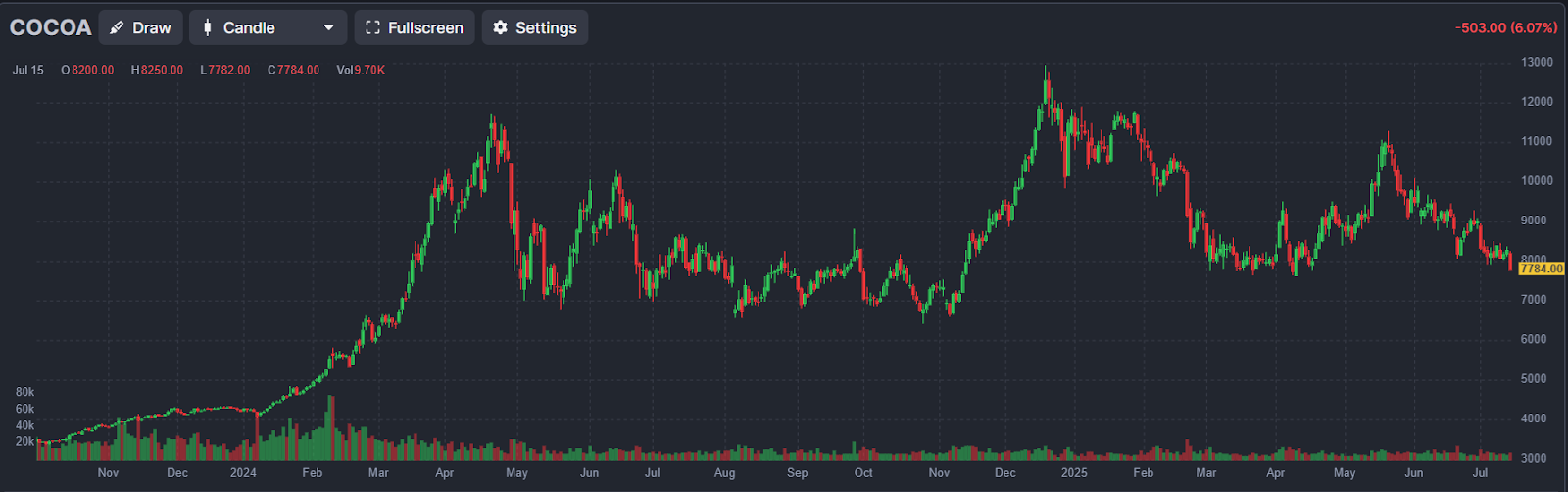
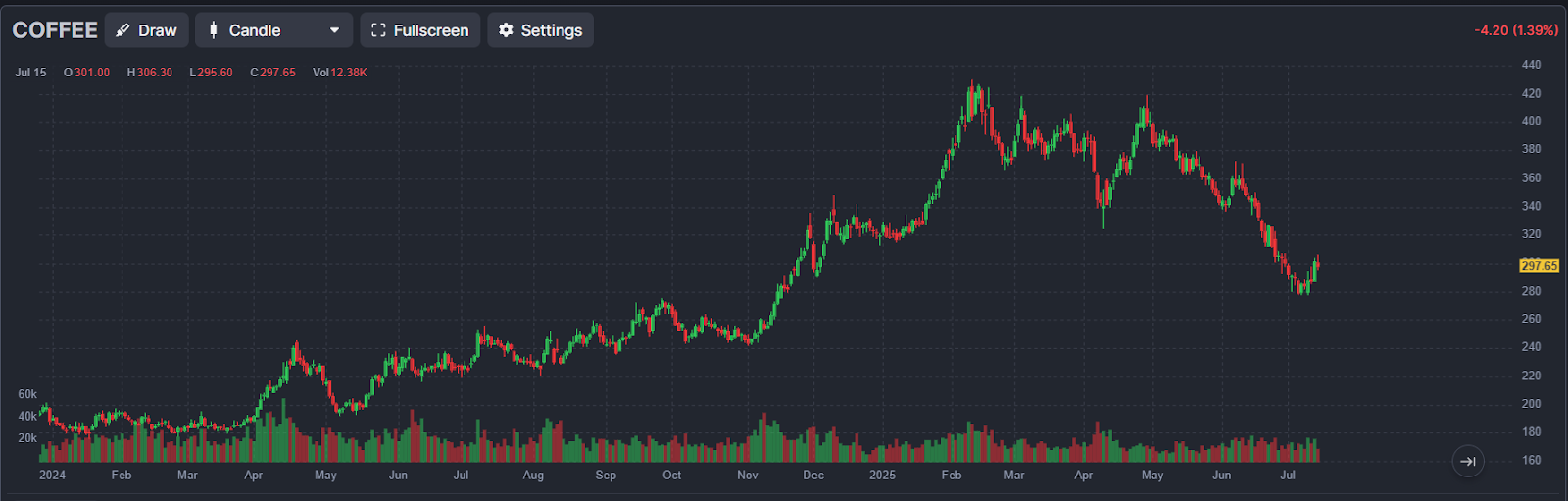
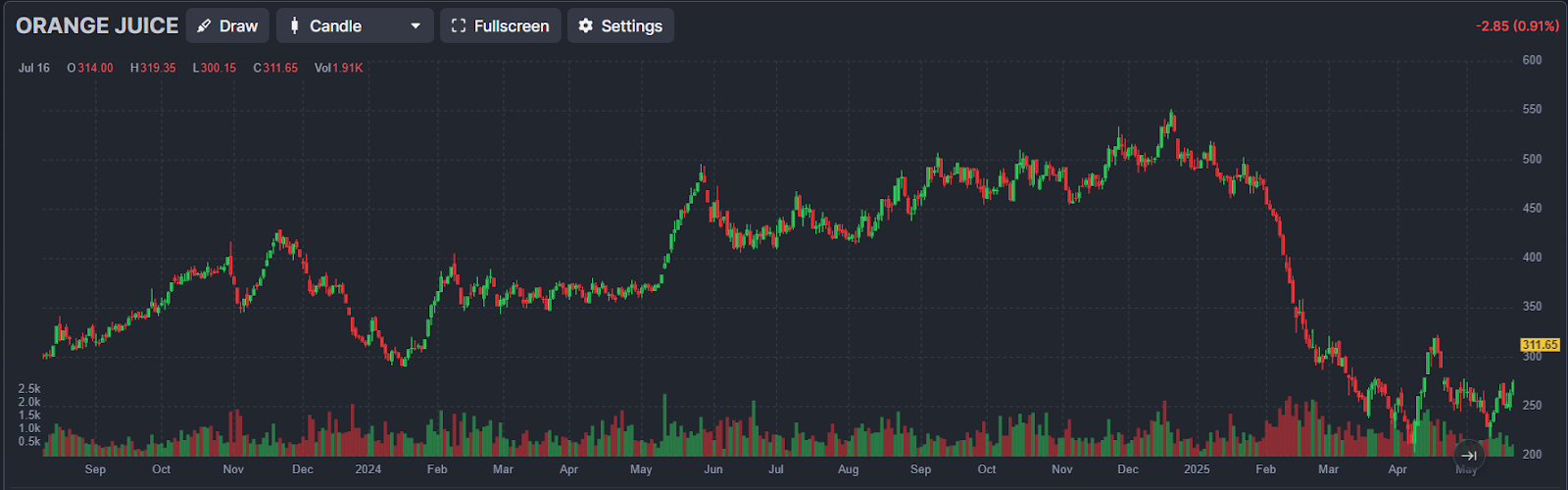
Given the high volatility of digital assets, it may help to keep trading accounts separate from those used for traditional securities. Just look at the goods in a nearby coffee shop — and how their prices moved over the same period.
In 2024, cocoa prices jumped by about 200%.
Over the same span, coffee rose by more than 120%.
Orange juice, now in a recovery phase, climbed by roughly 80% over the same period.
A narrow field of view makes it harder to build a safer future — one in which price and value are diametrically opposed characteristics.
“Only when you live with the take ‘one bitcoin equals one bitcoin’ side by side every day do you begin to exist, and then to develop, in the only global economic free zone — the ‘crypto offshore’. Inside it there are breakthroughs that may happen once in 100, or even 1,000 years. Be it the use of AI agents and smart contracts or ZKP ‘miracles’,” Menaskop believes.
A money-pulative search
Compare bitcoin’s price chart with the frequency of mentions of “1 BTC = 1 BTC”, and a curious correlation emerges.
According to Google Trends, over the past five years, across various iterations of the phrase (“1 BTC — 1 BTC”, “1 BTC equals 1 BTC”, “1 bitcoin — 1 bitcoin”, “1 BTC равен 1 BTC”, “один биткоин равен одному биткоину”), roughly 66% of peaks coincided with bitcoin’s rallies. The remaining ~34% appeared at moments of reversals toward a bull market and possible breakouts through seller resistance.
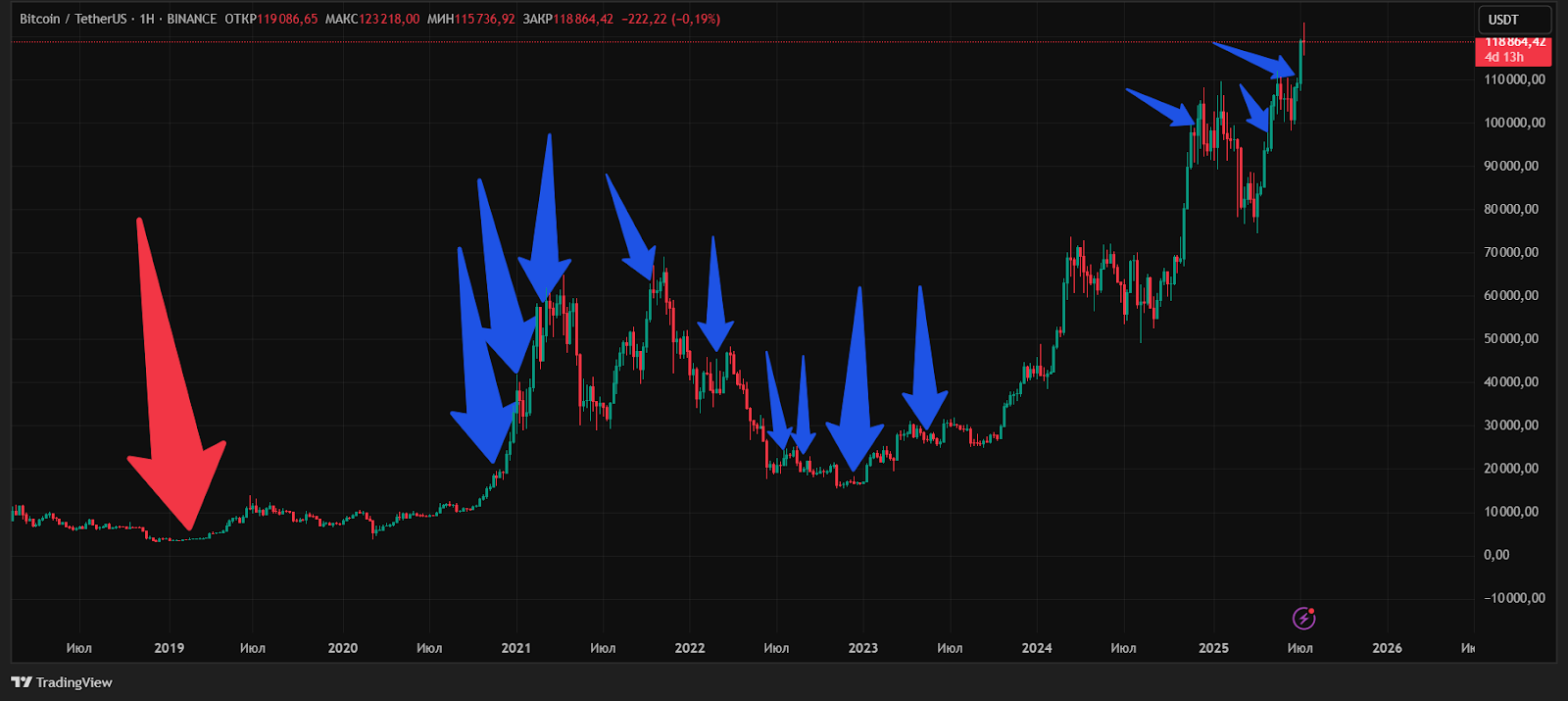
As bitcoin set new highs, the query rose in search. The coincidence is unsurprising: in times of hype, people look more often at cryptocurrencies. Having read or heard the formula, users sought a clear explanation. Where search led them shaped what happened next. For newcomers — as in any industry — low-quality content abounds, worse when it is “educational”. Ambiguous interpretations can dramatically influence decisions, for instance leading to a portfolio of digital gold amassed at peak prices.
In that sense, the “1 BTC = 1 BTC” concept can serve as a kind of signal in the information space, triggering a cognitive chain: if the asset is stable in itself, you can lean on it.
“As for the distortion of information, the brightest example for me — and one believed by the overwhelming majority even inside crypto (999 out of 1,000) — is ICO. Big media chant like a mantra that 80–90% of ICOs were scams. Yet all the data are open, and a meta-analysis showed that actual fraud was only 16.5% by the median — less than in the VC segment or in bank business lending,” Menaskop said.
It is also telling where interest in the phrase sprang up. Using different spellings of bitcoin’s identity, Google recorded search spikes in various countries. Most often they were in Bangladesh, Pakistan, Nigeria, India, Indonesia and Turkey. Activity in regions with unstable economies and hard living conditions may indicate a desire to escape a financial vacuum through cryptocurrencies. In countries rife with bot farms, it may also point to an “invisible hand” nudging people to buy.
“That shilling marketing uses poor countries to flood traffic over everything in crypto is not just a fact but a given. At different times these were Turkey, Iran, Pakistan, Indonesia and other states. Perhaps this all peaked in the tap-to-earn era, when insane traffic in the hundreds of millions converted far below not percentages but fractions of a percent. There is no decentralisation in such approaches,” the researcher noted.
Menaskop also pointed to a positive side:
“The poor, earning like bots for the rich, begin to understand that they are not actually earning but losing money. In the end they themselves become drop hunters, mid-level DeFi users. In many jurisdictions, crypto thus becomes a normal means of payment and of international transfers. You can clearly see this in practice in Argentina, Nigeria and even China.”
He also suggested recalling the recent airdrops — Berachain, Blast, Scroll, ZKsync, Starknet — and looking at the statistics before and after. To the expert it is obvious that TVL and other network metrics are inflated by bots. Menaskop calls it “jumping liquidity”, which typically ranges between $0.5bn and $1.5bn:
“But on the other hand, the small percentage that ultimately settles in the cryptosphere turns out to matter far more than all those bots and their owners. That is why it is worth talking to everyone about the value of one bitcoin, and not only about its price, which always was, is and will be just a derivative.”
Рассылки ForkLog: держите руку на пульсе биткоин-индустрии!