



DeFi Bulletin: TVL up 15% in a month, Curve announces stablecoin
The decentralised finance (DeFi) sector continues to attract heightened attention from cryptocurrency investors. ForkLog has compiled the most important developments and news from the past weeks into a digest.
Key metrics of the DeFi segment
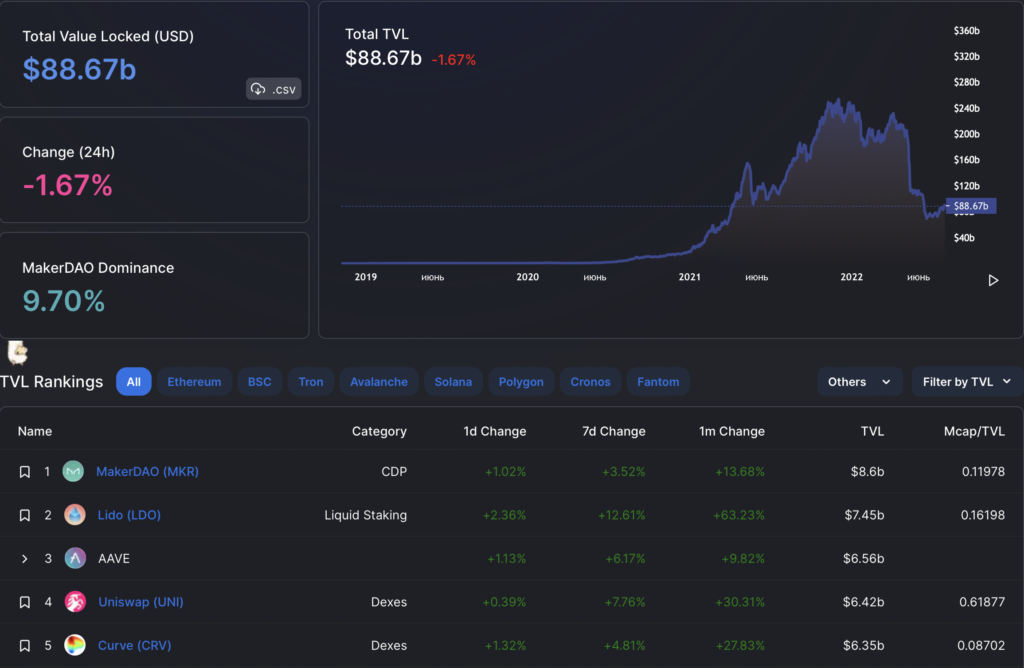
Total value locked (TVL) in DeFi protocols rose to $88.67 billion. The leader was MakerDAO with $8.6 billion, while second and third places were held by Lido ($7.45 billion) and AAVE ($6.56 billion) respectively.
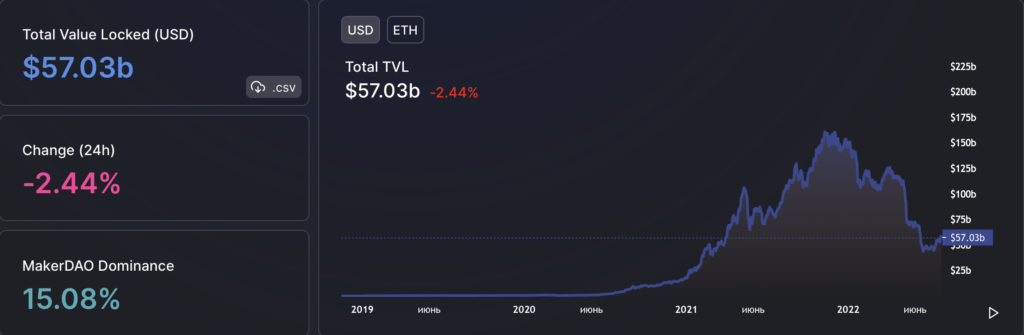
TVL in Ethereum applications rose to $57.03 billion. Over the last 30 days the figure increased by 24% (June 30 value was $46.11 billion).
The trading volume on decentralised exchanges (DEX) over the last 30 days stood at $56.5 billion.
Uniswap continues to dominate the non-custodial exchange market – accounting for 66.6% of total turnover. The second DEX by trading volume is Curve (12.2%), the third is DODO (6%).
Curve Finance to launch its own stablecoin
Curve Finance is preparing to launch its own stablecoin. According to the project\’s founder Mikhail Egorov, “the stablecoin” will be overcollateralised.
He declined to disclose further details.
The prospect of launching the stablecoin drew a strong reaction among CRV holders. The asset jumped 20% in 24 hours.
The Lido Finance team will launch liquid staking on Ethereum in L2 solutions
The Lido Finance announced the launch of a liquid staking service for Ethereum 2.0 on Layer 2 scaling networks.
“For users, this means staking with lower fees and access to a new suite of decentralised yield-boosting applications,” the developers wrote.
The project emphasised that it will not be limited to a single L2 solution. The service will launch on all sufficiently proven Layer 2 networks with demonstrated economic activity. It will start with Arbitrum and Optimism.
The number of decentralized applications on the Polygon network exceeds 19,000
The developers of the Ethereum network second-layer solutions Polygon reported on the project\’s achievements in the first half of 2022 and outlined plans for the next six months.
By July the number of DApps operating on the network reached 19,000, the average monthly transactions stood at 90 million, and the total number of smart-contract creators exceeded 153,000.
The project paid $2 million in rewards for participation in hackathons and grants via the Gitcoin platform.
The team also created a free online school, Polygon Academy, and expanded the capabilities of PolygonDAO.
Investments in DeFi
The decentralised trading platform Hashflow closed a $25 million Series A round, valuing the company at $400 million.
Participants in the round included Coinbase Ventures, Kraken Ventures, Electric Capital, Dragonfly Capital Partners, LedgerPrime, Jump Crypto, Wintermute Trading, GSR, Kronos Research, Altonomy, Fabric Ventures, Evernew Capital and others.
The funds will be used to “continue scaling regardless of market conditions”.
Founded in 2021, Hasfhlow plans to launch on the Solana blockchain and offer structured products by the end of 2022.
The decentralised oracle network Empiric Network raised $7 million in a seed round based on the StarkNet Layer 2 scaling solution.
It was led by Variant, with participants including data partners Alameda, CMT Digital, Flow Traders, FTX and Gemini, the team behind StarkNet, StarkWare, and a number of other companies and business angels.
Empiric noted that blockchain oracles are needed to provide smart contracts with external data. Traditional oracles are centralised and rely on autonomous infrastructure that delivers the final result without a way to verify.
The funds will be used to hire new staff.
Hacks and scams
On July 23, an unknown extracted about $6 million in digital assets from the treasury of the decentralised streaming platform Audius.
The attacker altered the smart-contract configuration and initiated a malicious governance proposal.
According to security firm CertiK, the attacker modified the platform\’s smart contract configuration, allowing them to assign a “guardian” status to their address and change the voting period.
After this, the attacker posted a governance proposal that would transfer 18 million AUDIO to a third-party wallet, and voted in its favour.
At the time of the attack the market value of the stolen assets was around $6 million, but due to significant price slippage the hacker sold them for 705 ETH (about $1.14 million). According to Etherscan, the attacker transferred the funds to a Tornado Cash mixer address.
Analysts at PeckShield noted that the attacker managed to access Audius’s treasury due to “inconsistencies” in certain elements of the project’s storage governance.
The Solana-based yield-farming protocol on the Solana blockchain Nirvana Finance came under attack using a flash loan. The attackers drained the project’s treasury of digital assets worth $3.49 million.
Representatives of Nirvana Finance asked the hacker to return the funds and switch to white-hat status. For the disclosed vulnerability, the project offered to leave $300,000.
According to a statement, the developers managed to locate the attacker’s wallet on an unnamed centralised platform, and are now working to identify it.
According to Solana.fm block explorer, the hackers used a Solend flash loan of 10 million USDC to manipulate the protocol’s price oracle.
The proceeds allowed them to mint a large number of ANA utility tokens, whose value from these actions exceeded $10 million.
Also on ForkLog:
- OTC marketplace Marsbase added support for more than 1,000 tokens.
- The Lido community voted against the sale of 10 million LDO to Dragonfly Capital.
- Curve Finance applied for a grant of 1 million OP from Optimism.
Read ForkLog’s Bitcoin news in our Telegram — cryptocurrency news, prices and analysis.
Рассылки ForkLog: держите руку на пульсе биткоин-индустрии!