




- The market has shifted to a mode where spending and profit-taking are the dominant price formation mechanisms.
- Approximately 1.875 million BTC (9.5% of the total in circulation) changed hands at prices above $60,000.
Long-term Bitcoin investors are successfully executing a distribution cycle, realizing profits and activating “dormant” coins to meet new demand, according to Glassnode.
As the #Bitcoin Spot Price consolidates below the new ATH of $73k, the Long-Term Holder cohort has entered their distribution phase, selling to new investors at higher prices.
This represents an injection of new capital into the asset class, driving the realized cap up to new… pic.twitter.com/gGECO2oyyt
— glassnode (@glassnode) April 2, 2024
Surpassing the previous ATH has led to a revaluation of spent bitcoins at higher prices. Analysts suggest this process can be seen as an influx of new demand and liquidity.
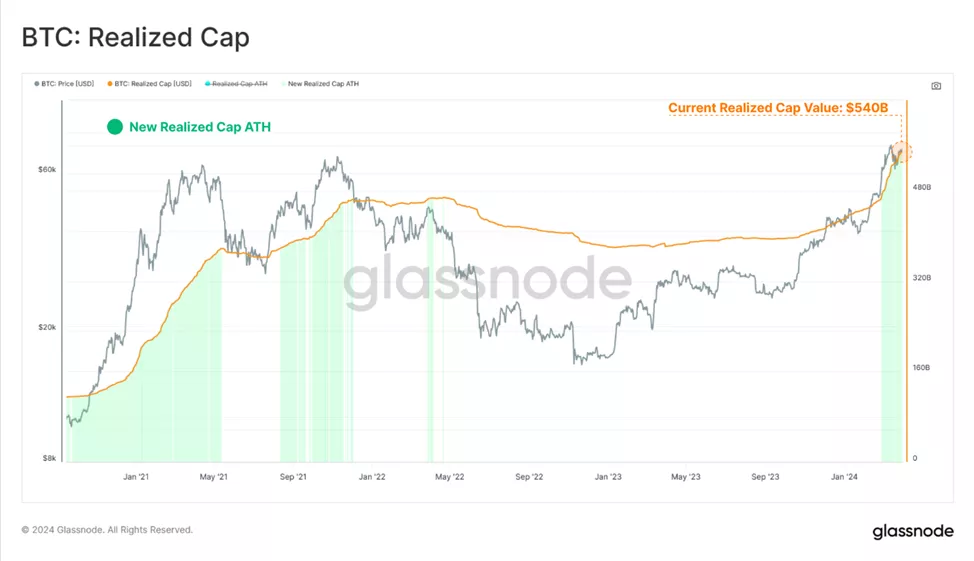
This mechanism is reflected in the realized capitalization indicator. The metric has reached a new ATH of $540 billion and continues to grow at unprecedented rates — over $79 billion on a monthly basis.


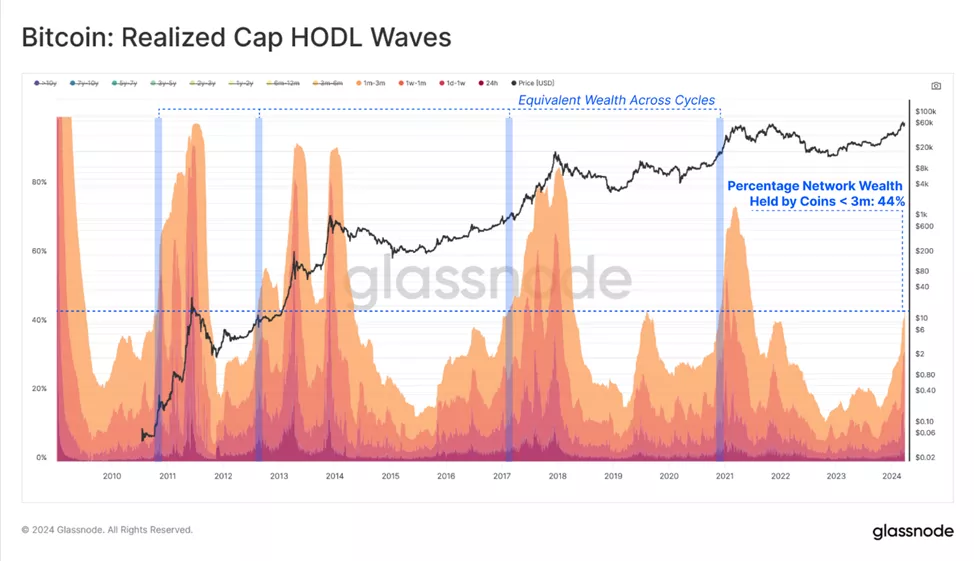
Analysis of HODL waves showed that coins less than three months old now account for 44% of the dollar-denominated “wealth.” This surge is a direct result of hodlers spending bitcoins at higher prices to satisfy growing demand.
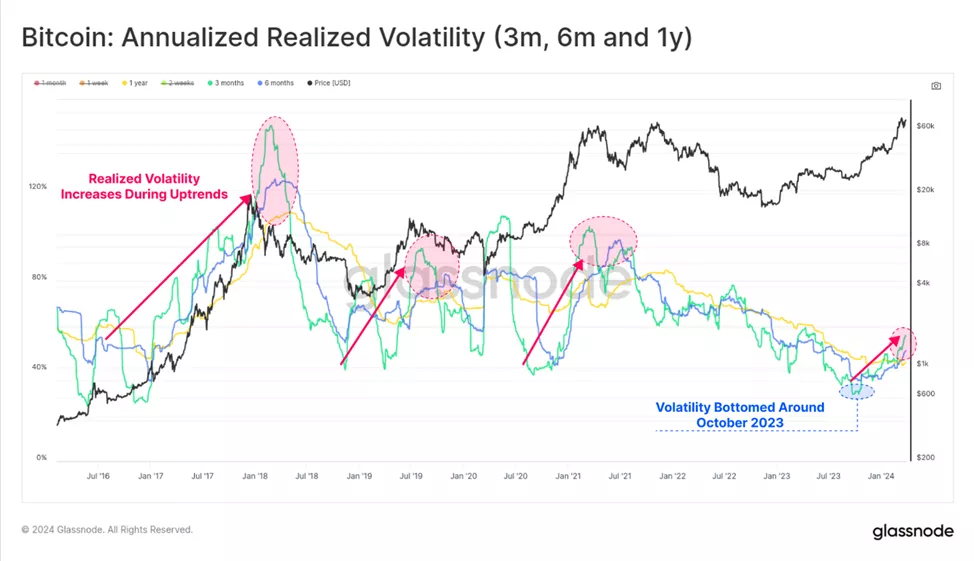
According to experts, in previous cycles, the influx of new buyers led to a spike in price volatility. The current situation is no exception — since October 2023, realized volatility over 90 days has nearly doubled, from 28% to 55%. This coincided with the beginning of the rise in realized capitalization.
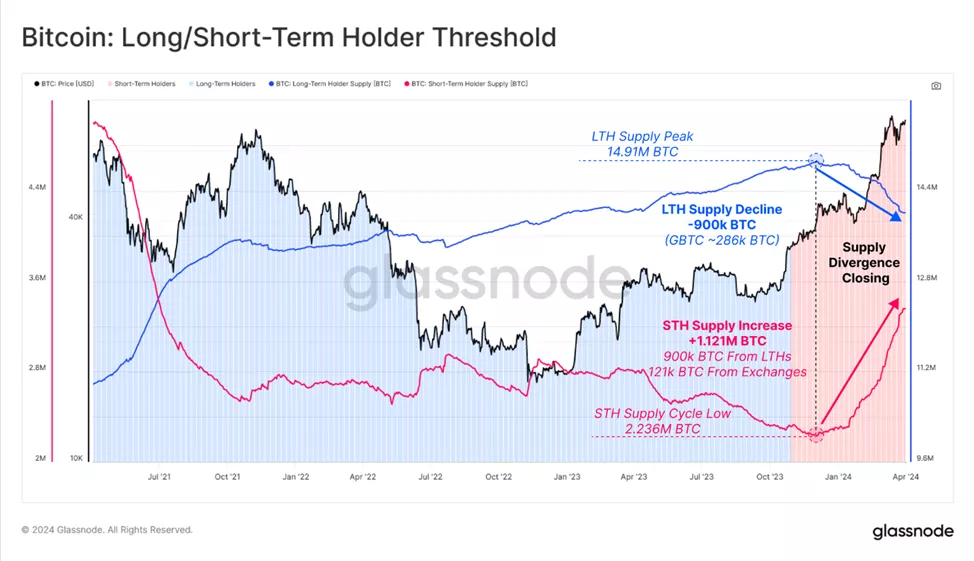
Another feature of the current phase is the transfer of coins from hodlers to speculators. The first category retains 14.01 million BTC (-900,000 BTC since December 2023, including 286,000 BTC associated with GBTC), while the second now holds 2.357 million BTC. An additional 121,000 BTC have moved to wallets on CEX.
Approximately 1.875 million BTC (9.5% of the total in circulation) changed hands at prices above $60,000. Of this amount, ~508,000 BTC are linked to purchases by clients of “new” spot Bitcoin ETFs (excluding GBTC).

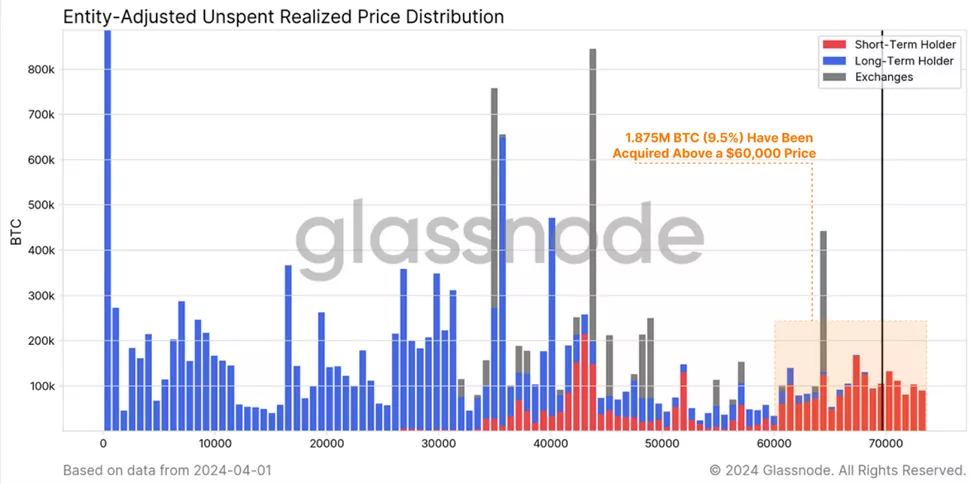
Experts also highlighted the dynamics of the Livelines indicator, which characterizes the overall balance of “hodling” held in cold wallets of the first cryptocurrency.
The growth of the metric indicates that the spending of long-inactive coins collectively outpaces the accumulation of “holding time” for bitcoins transitioning to “long-term storage” status.

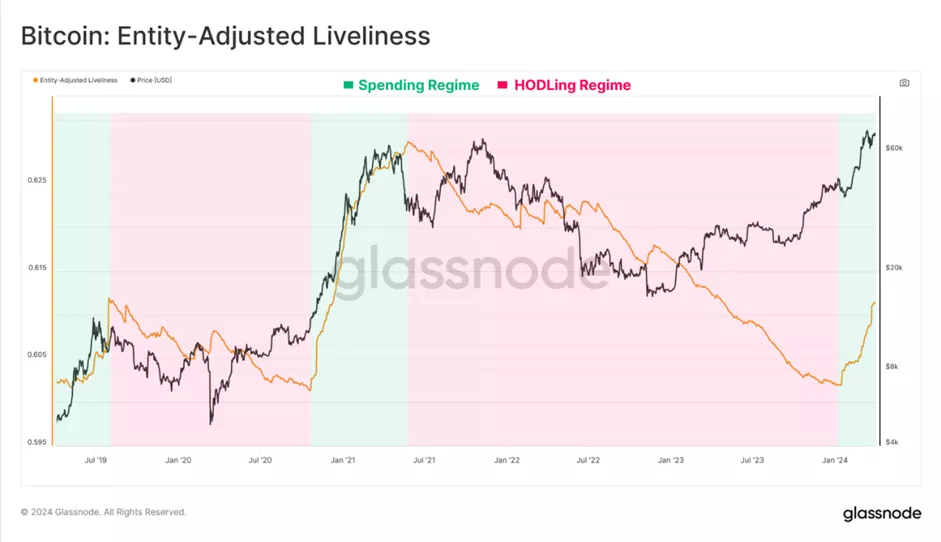
“This confirms the thesis that the market has shifted to a mode where spending and profit-taking are now the dominant price formation mechanisms,” concluded the experts.
Earlier, the analyst known as CryptoJelleNL predicted a consolidation of the digital gold rate at $65,300 support followed by a breakthrough to $69,000 and a return to a growth trajectory.
Previously, Bernstein considered a correction to around $63,000 as a good buying opportunity “at the lows” before the halving. Subsequently, experts revised their Bitcoin forecast — from $80,000 to $90,000 by the end of the year.