




Those seeking to prematurely withdraw ETH from staking are participating in a Ponzi scheme of enormous scale that could collapse at any moment, HashEx specialists said.
“In fact, there is a much more dangerous problem with the new Ethereum staking. In this article, we will talk about one of the largest Ponzi schemes in history…”
Interesting new article on @hackernoon by #HashEx CEO & founder Dmitry Mishunin
Read more: https://t.co/53Ztq7o6m9
— HashEx DeFi Intelligence (@HashExOfficial) November 25, 2022
In a conversation with ForkLog, Konstantin Lomashuk, a member of Lido DAO and founder of P2P Validator, refuted HashEx’s conclusions. He called the analysts’ remarks about liquidity imbalance in the stETH/ETH pools a “manipulation” and emphasised that after the activation of the Shanghai upgrade in the Ethereum network, synthetic assets can be exchanged for the “originals” one-to-one.
«For now, while withdrawals are not available, there is a market that buys, understanding that later one can exchange one-for-one. […] The price of stETH before withdrawals can be below one, as it is market-driven and that is absolutely normal», — added Lomashuk.
To become a validator, a user must stake 32 ETH under a deposit contract. The ability to withdraw will open only after the Shanghai upgrade, the timeline for which has not yet been determined.
As not everyone can earmark such a large sum, various liquid staking services offer delegated funds to earn yields. In particular, these include Lido, Rocket Pool, StakeWise, StaFi, Ankr Staking and others.
They also allow exchanging Ethereum for various derivative assets, such as sETH, stETH, rETH and rETH2. However, redeeming the token back is possible only on the secondary market.
«ETH locked in staking, issued by Lido, is backed by ETH collateral deposits at a 1:1 ratio. But the problem is that the token trades on decentralised platforms, such as Curve, where 68% of the liquidity reserve consists of 397,000 stETH», — HashEx said.


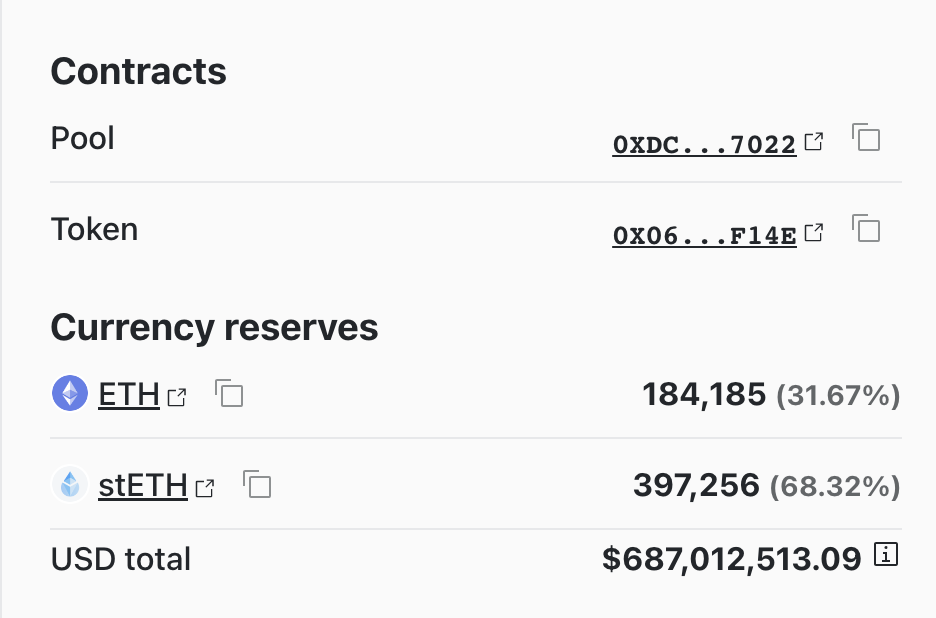
On the Curve Finance pool example, there are only 184,185 ETH backing 397,256 stETH. This means that if someone wanted to swap stETH for the equivalent of 100,000 ETH, the remaining ETH in the pool would be 869,140 stETH for just 84,000 ETH. Such coin ratios will exert a significant influence on the price.

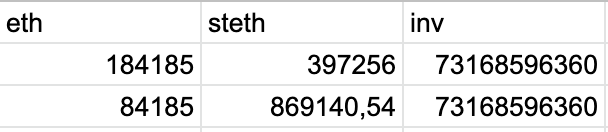
According to these data, analysts forecast that in the best-case scenario only 40% of more than 120,000 stETH holders will be able to recover their money in full.

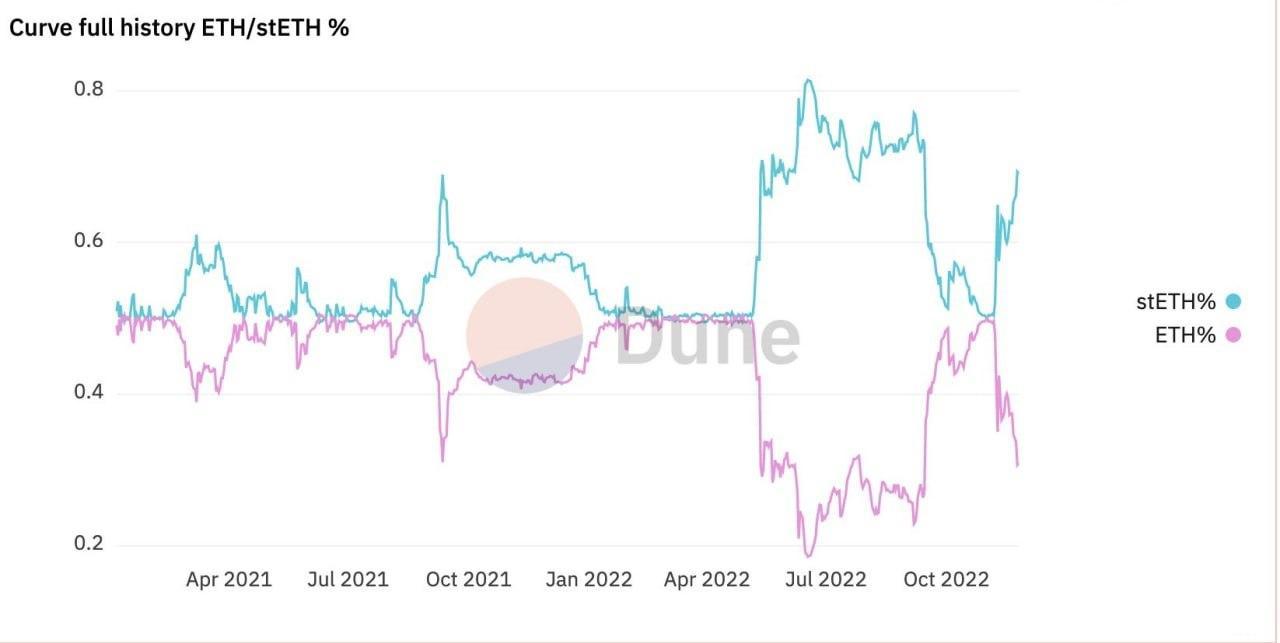
According to Dune Analytics, the stETH/ETH imbalance on Curve has already reached 70% to 30%.
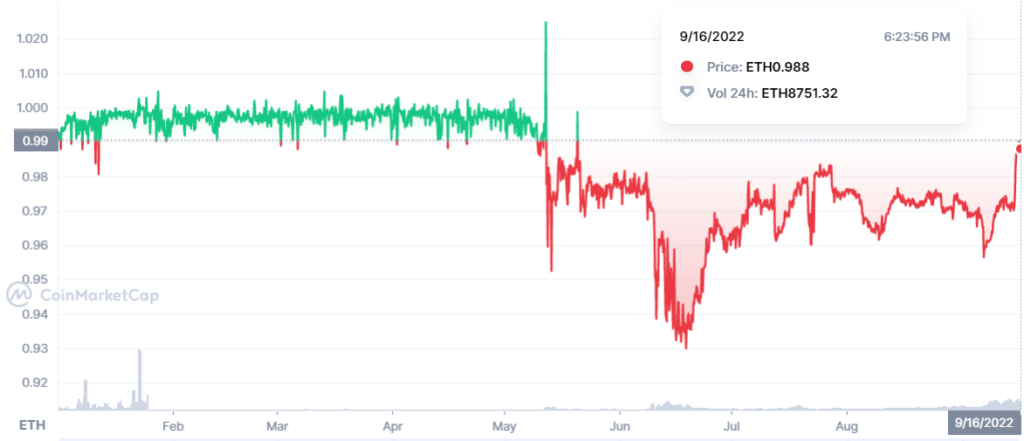
In the backdrop of the TerraUSD crash in June 2022, stETH fell by 7.6% — from 0.99 ETH to 0.92 ETH, triggering a panic sell-off.

According to Nansen, more than 70% of stETH was bought above ETH’s price of $1,425. This means that only 18% are in profit territory.
«Most illiquid players may close their market positions and trigger a wave of selling, as happened with the Terra protocol», — HashEx warned.
They are convinced of an imminent collapse of liquid staking, which could occur even before the actual implementation of the Shanghai upgrade.
«In the current macroeconomic environment, any event could trigger the decoupling of stETH, sETH, and rETH from native ETH, which would lead to panic, asset sell-offs, the collapse of a ten-billion-dollar Ponzi scheme, and the loss of funds for about one hundred thousand depositors», — the experts concluded.
In late November, the Terra withdrawal crisis led WBTC and stETH to lose their peg to the original assets, amid the collapse of the FTX exchange and Alameda Research.
Read ForkLog’s Bitcoin news on our Telegram — crypto news, prices and analysis.