



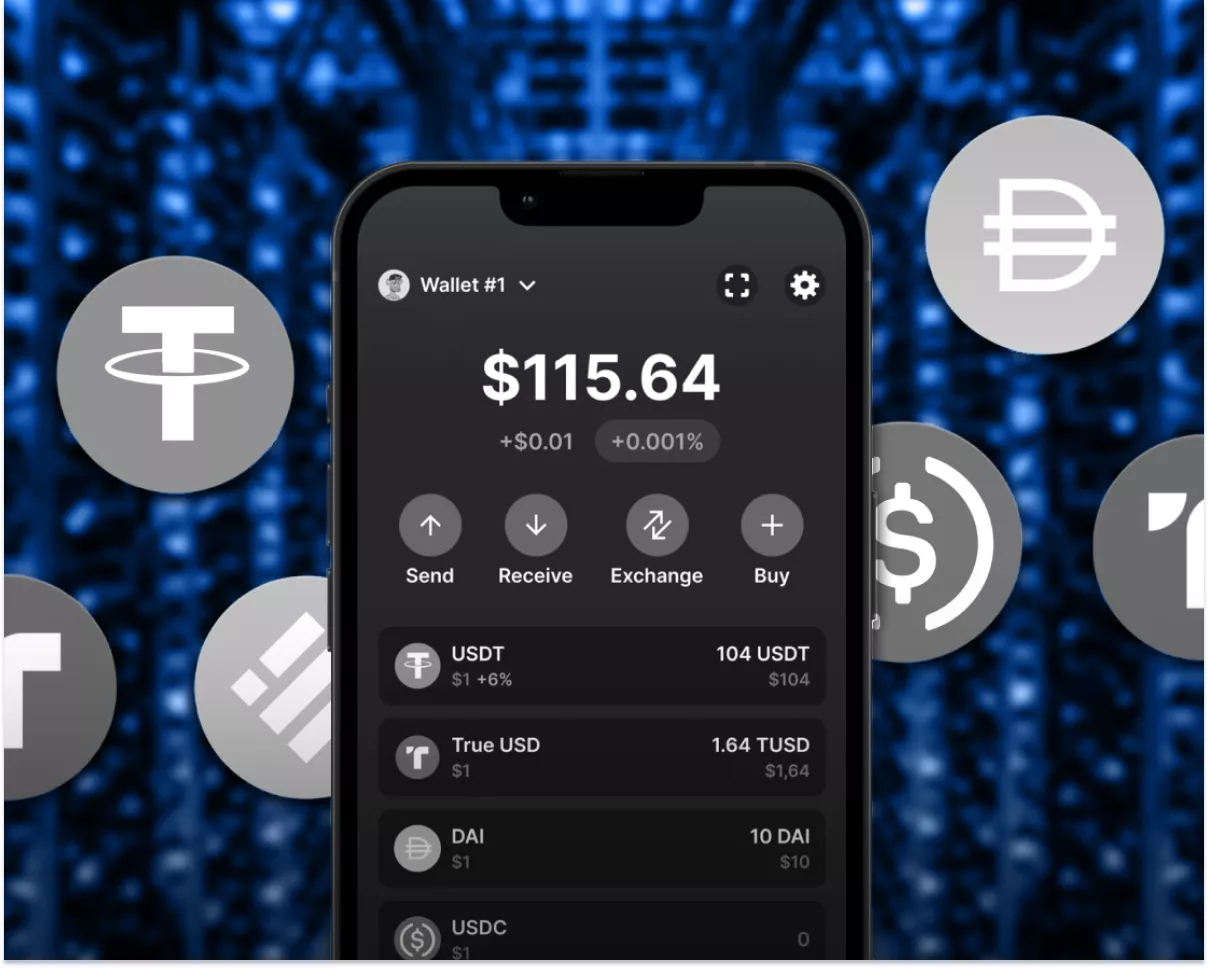
The market capitalisation of stablecoins in early June 2025 surpassed $250 billion. The segment leader is Tether (USDT), with capitalisation above $153 billion, followed by Circle’s USDC at $61 billion.
Stablecoins have evolved from a niche tool for crypto traders into a fully fledged alternative to traditional banking. Together with the open-source wallet team at Gem Wallet, we examine how this transformation occurred and what users should know about storing digital assets safely.
The evolution of stablecoins
Stablecoins such as Tether (USDT) first emerged to meet traders’ needs: locking in profits from trading bitcoin and altcoins and moving capital quickly between exchanges for arbitrage.
They served as a “digital dollar” within crypto when banks shunned exchanges and fast, direct crypto–fiat conversion was constrained.
In 2024 a large share of stablecoin transactions was still driven by bots and big traders. A study by Visa and Allium Labs found that of $2.2 trillion in total volume only $149 million was “organic payment activity”.
“This suggests that stablecoins are still at an embryonic stage of their evolution as a payment instrument,” said Pranav Sood, then a regional manager at Airwallex.
Yet the advantages of stablecoins are becoming clearer to a broader audience. Among them:
- speed and low fees. International payments with stablecoins are far faster and cheaper than traditional bank transfers;
- 24/7 availability. Stablecoin transactions can be made at any time, including weekends and holidays;
- control of assets. Stablecoins enable transactions even amid currency and other regulatory constraints;
- financial inclusion. Stablecoins have opened access to international markets and payments for people without bank accounts or in regions with underdeveloped banking infrastructure.
The rise of decentralised finance (DeFi) in 2020 played a key role in popularising stablecoins.


DAI, USDC and USDT became the “fuel” of DeFi protocols, powering lending, borrowing, liquidity provision and yield strategies. This symbiosis created steady demand for stablecoins and spurred further growth in their capitalisation.
“In 2025 stablecoins are being used more actively for everyday financial operations. Companies like Meta are exploring integrating them into their platforms, and within crypto more participants now use USDT and USDC solely for business and personal transactions,” Gem Wallet says.
Investment opportunities with stablecoins
Over the past five years stablecoins have moved beyond acting as a “fiat substitute” for transfers between exchanges and users. Today they can offer yields that outstrip traditional bank products and provide an alternative route to invest in assets such as gold.
“If, for example, EURT is a straightforward analogue of the euro, then Ondo US Dollar Yield (USDY) is a more complex financial instrument with a built-in mechanism delivering over 4% per annum,” Gem Wallet comments.
Another draw is passive income via DeFi platforms such as decentralised exchanges (DEX) and lending projects. In May, lending protocols overtook DEXs by volume.
Apollo Capital founder Henrik Andersson attributed this to lending being the only sustainable income stream in DeFi. Liquidity pools on DEXs, he said, are losing appeal owing to impermanent loss and rising competition.
The yields from these uses of stablecoins often exceed rates on traditional bank deposits.
“Even simple flexible USDT deposits on CEX such as Binance can yield up to 7% a year,” Gem Wallet notes.
By comparison, dollar deposits at banks in developing countries often offer lower yields of around 1% or less.
In the United States, according to data for June 2025, the average rate is about 0.42% APY, though some high-yield savings accounts reach 5% a year. In CIS countries, dollar-deposit rates can be higher but come with local economic and regulatory risks and often require conditions such as large sums or long terms.
“It is important to understand that higher yields in DeFi come with higher risks, including smart-contract vulnerabilities and bad-faith developers. The difference between stablecoin yields and bank deposits is not a ‘free lunch’ but compensation for risk.
Moreover, the barrier to entry in DeFi is higher. Opening a bank deposit can be done in a couple of clicks, whereas buying or swapping stablecoins is more complex for novice crypto investors,” Gem Wallet emphasises.
Beyond fiat-pegged stablecoins there are tokens backed by real-world assets such as gold. A prominent example is Tether Gold (XAUt), whose capitalisation exceeded $830 million in July.
Each XAUt token represents ownership of one troy ounce of physical gold stored in a vault in Switzerland. The token offers several advantages over the traditional analogue:
- divisibility. Unlike bars, XAUt tokens can be split into fractions (down to 0.000001 troy ounce), making gold investment accessible to those with smaller sums;
- portability and storage. Like any digital asset, XAUt is easy to move and keep in a crypto wallet, avoiding the costs and risks of storing and transporting physical gold;
- availability. Unlike the limited trading hours of precious-metals markets, XAUt can be traded around the clock on Bybit, OKX, Bitfinex and other crypto exchanges;
- no custody fees. XAUt is stored like any other digital asset. Only a one-off fee is charged when buying or redeeming tokens from the issuer.
“The appeal of Tether Gold, PAX Gold and other similar tokens lies not so much in the abstract idea of ‘gold on the blockchain’ as in solving the real problems of owning the metal. They democratise access to this asset class, making it more convenient, liquid and accessible to everyone,” Gem Wallet notes.
Stablecoins offer not just an alternative to bank deposits, but a fundamentally different approach to managing money. Users can calibrate risk and potential return—actively participating in DeFi or choosing more conservative stores of value such as XAUt.
That approach, however, demands greater financial literacy and competence. Choosing a reliable crypto wallet is crucial to keep digital assets safe and easy to use.
Custodial and non-custodial wallets
All crypto wallets fall into two types: custodial and non-custodial. The choice directly determines how much control you retain over stablecoins.
In a custodial wallet a third party (for example, a crypto exchange) holds and manages private keys on the user’s behalf. The user trusts that party with safekeeping, just as they trust a bank with fiat deposits.
Advantages of custodial wallets:
- ease of use. Simple to set up and require no technical knowledge or key management;
- account recovery. Access to funds can usually be restored via support if a password is forgotten or account access is lost;
- integrated services. These wallets are typically tied into other services (trading, staking, fiat on-ramps), making them an “all-in-one” solution for beginners.
Disadvantages:
- “not your keys—not your coins”. The crypto adage captures the core drawback. Because a third party holds the private keys, users lack full control. Assets can be frozen or confiscated by the platform, regulators or courts;
- platform risk. User funds can be lost through platform hacks;
- reduced privacy. Most custodial services require identity verification (KYC).
In a non-custodial wallet private keys are controlled solely by the user. No third party has access; the user bears full responsibility for asset security.
“In English, the term self-custody is used, which underscores the ideology of such wallets: ‘Only you are responsible for your assets.’ In Russian-speaking contexts, the term ‘non-custodial’ has gained currency, which does not emphasise the asset owner,” Gem Wallet notes.
Advantages of non-custodial wallets:
- full control of funds. Only the wallet owner can access and dispose of assets. No one can freeze or restrict use without those keys. It is worth noting that centralised stablecoins can block funds at the smart-contract level;
- enhanced security. Counterparty risk tied to trusting a third party is eliminated. Security depends on the user’s own precautions;
- high privacy. Non-custodial wallets do not require KYC, a phone number or even an email.
Disadvantages:
- responsibility for key storage. Losing private keys or the seed phrase means irretrievable loss of access to all funds in the wallet;
- some technical know-how required. Setting up and using non-custodial wallets safely can be challenging for newcomers;
- the human factor. Users of non-custodial wallets are more vulnerable to phishing, malware and social engineering if they do not take proper precautions.
Examples of non-custodial wallets include Gem Wallet, MetaMask and hardware wallets such as Ledger and Trezor.
“The choice between custodial and non-custodial wallets depends on the user’s needs; there is no one-size-fits-all solution. Custodial wallets and CEX accounts are ideal for P2P trading, microtransactions and participating in exchange promotions. As experience and capital grow, however, a non-custodial wallet becomes preferable, offering stronger security and access to new assets.
For example, the token TRUMP appeared on DEXs earlier than on CEXs, allowing non-custodial users to buy it at a better price,” Gem Wallet comments.
How to store stablecoins safely in a non-custodial wallet
The Gem Wallet team offers the following tips:
- secure storage of the seed phrase. This is the “master key” to all funds in the wallet. Write the seed phrase on paper or engrave it on metal and keep copies in multiple places, inaccessible to others.
- “free cheese”. Be wary of unexpected NFT transfers or large stablecoin deposits. Anyone can create a token or coin, and because some apps poorly filter spam you may receive “fake” assets. They have no real value but may prompt rash actions that grant scammers access to your funds.
- caution with phishing and suspicious links. Never click links from dubious emails, messenger posts or social networks. Do not connect your wallet to unknown or questionable decentralised apps (dapps) or websites;
- regular software updates. Keep your wallet software and device operating system up to date;
- use hardware wallets for large sums. For significant holdings, use hardware (“cold”) wallets. They store private keys offline, making them virtually immune to online attacks;
- separate funds. Use different wallets for different purposes—for instance, one for daily spending and another for long-term storage. A hardware wallet can be used on its own or paired with a non-custodial software wallet.
- $5 wrench attack. In your quest to protect assets with strong passwords and hardware wallets, do not neglect physical safety. Avoid unnecessary publicity and share information about your holdings only with those you trust most.
Gem Wallet is a wallet for Android and iOS designed for everyday use. It supports over 60 blockchains and thousands of tokens, including popular stablecoins. The developers plan to add Ledger support at the start of next year.
Core security principles built into Gem Wallet:
- open-source code. Anyone can inspect it for vulnerabilities or hidden functions;
- privacy. The wallet does not track IP addresses, wallet addresses or user balances, and does not require KYC.
The Gem Wallet team has implemented several features to minimise human error, a common attack vector. These include:
- smart asset search. Users need not know the exact token ticker or network name. Enter a common label—such as USDT TRON or USDT TRC20—and the wallet suggests suitable options. Results consider market capitalisation, holder counts, trading volumes and other parameters, reducing the risk of mistakes or selecting fraudulent assets;
- filtering suspicious transactions and tokens. Gem Wallet includes multiple anti-fraud mechanisms, including filtering microtransactions from lookalike addresses, blocking multisig scam on TRON, and flagging malicious smart contracts and scam addresses;
- adding custom tokens. Advanced users can manually add new or lesser-known tokens by contract address.
Conclusions
Since 2014 stablecoins have evolved into a multifunctional financial asset that can offer genuine alternatives to traditional banking services. Their market capitalisation reflects substantial adoption and trust by companies and ordinary users alike.
As stablecoins grow in popularity, secure storage becomes ever more important. The choice between a custodial and a non-custodial wallet is a key decision for every user, shaping both security and convenience.
Non-custodial wallets such as Gem Wallet give users full control over their funds—while placing full responsibility for private-key storage on them.