



Some investors and analysts tend to believe that the bear market has either already arrived or is approaching. JPMorgan are convinced that Bitcoin’s fair value is below $40,000.
The case for a continued downtrend is supported by the following factors:
- Bitcoin trades at almost 40% below ATH;
- The price since the start of the year sits below the 200-day moving average — a de facto boundary between bulls and bears;
- some on-chain indicators signal deteriorating market sentiment and oversold conditions for Bitcoin and other crypto assets.
Bear-market culminations are often preceded by periodic deep price drawdowns, alternating with dead-cat jumps. In a downtrend, many short‑term investors are filled with despair and are ready to sell the digital gold at fire-sale prices, realising substantial losses.
To avoid missing the opportune moment to buy Bitcoin cheaper, prudent market participants should hold reserves of stablecoins. And to prevent assets from simply gathering dust while awaiting the coveted sale, they can be placed in AMM-pools, lending services and platforms like yEarn to earn passive income.
- Centralised platforms and DeFi services offer market participants a multitude of ways to earn passive income.
- A bear market is an inevitable phenomenon. However, one can prepare by accumulating stablecoins for buying cheaper “blue chips”.
- There are many tools in the market capable of delivering 10% per year or more on invested “stablecoins”.
Binance
Binance — the largest centralized exchange by trading volume. It supports P2P trading, fiat in/out for a wide range of currencies and helps users easily transfer funds to Web3 wallets such as MetaMask and Trust Wallet to interact with various DeFi applications.
Many may not realise that Binance itself offers tools for earning passive income, including analogues to AMM liquidity pools. They can be found under the Earn tab.


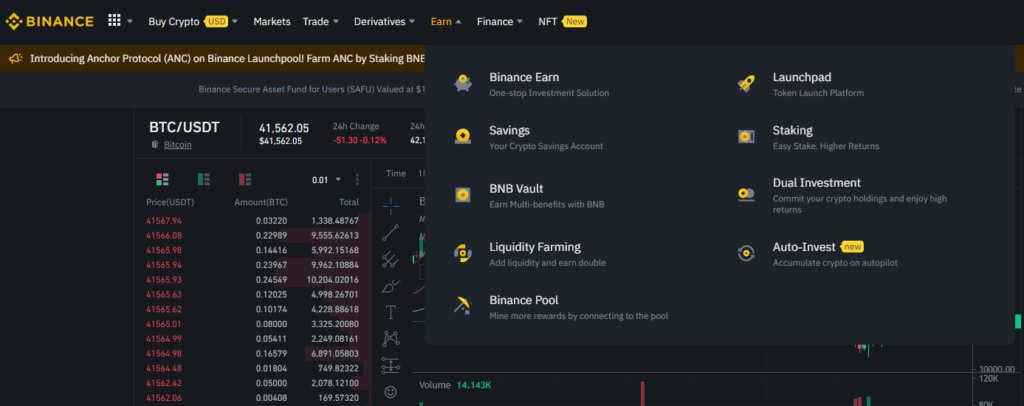
In the Savings section of this tab there are subsections Flexible Savings and Locked Savings.


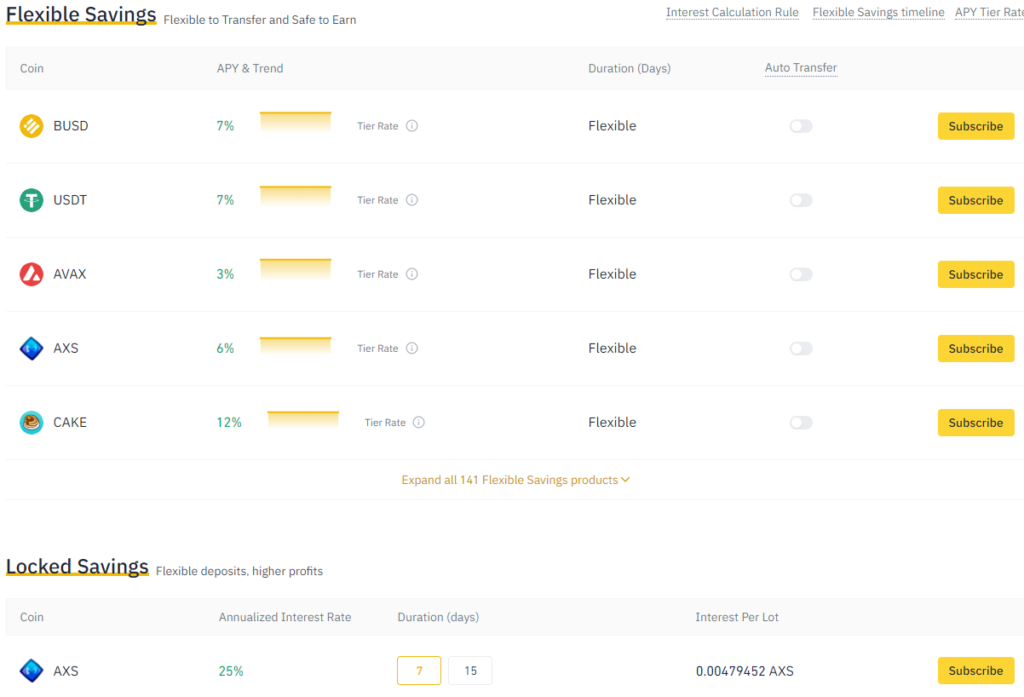
The Flexible Savings instrument is similar to demand deposits — it allows you to place stablecoins and other crypto assets at relatively modest yields.
BUSD and USDT can yield up to 7% per year if you deposit fewer than 500 coins. If you deposit between 500 and 20,000 coins, the yield is 1%; more than 20,000 — 0.4%.
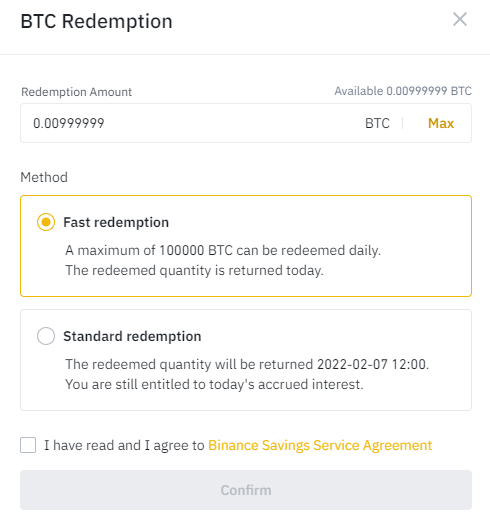
You can withdraw funds at any time. The accrued income is not lost if you choose the Standard Redemption method, whereby coins are credited to the spot account within a day.
If you choose Fast Redemption, funds are credited instantly but without the accrued interest.


Comparable yields on stablecoins are offered by the Locked Savings service. The difference is that funds are locked for a fixed term — typically 30 or 60 days.
At the time of writing (6 February 2022) term deposits in stablecoins were unavailable — the service shows Sold out. This means the contracts have sold out.



In the Earn tab you can also find another productive use for stablecoins — Liquidity Farming. This service lets you contribute funds to liquidity pools of two assets, as on AMM exchanges in the DeFi space.


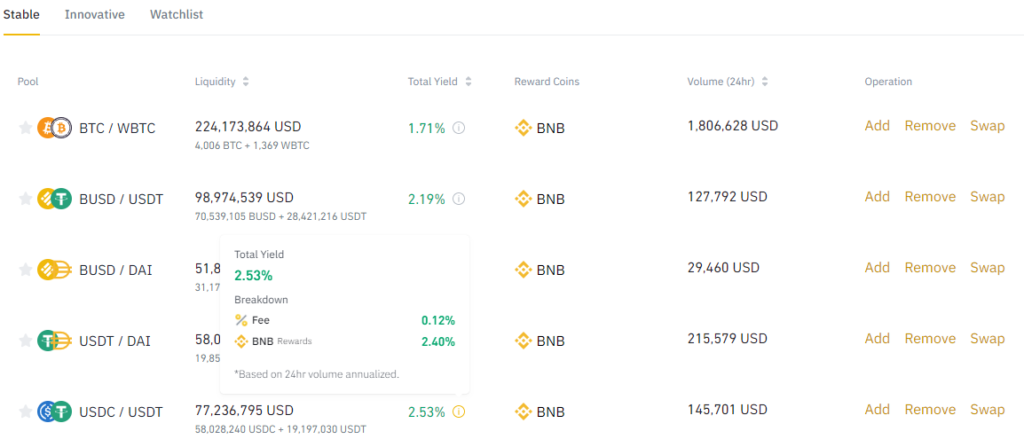
As shown in the screenshot, pool yields are not high. Most of the rewards are paid in BNB.
In the Innovative tab there are “mixed” pools such as DOT/USDT or MANA/USDT, comprising stablecoins and highly volatile assets. These pools have relatively high APRs and significant risks of impermanent losses.
Interesting and high-yield instruments are the Dual Investments contracts. They are similar to futures, as they have a strike price and expiry date.


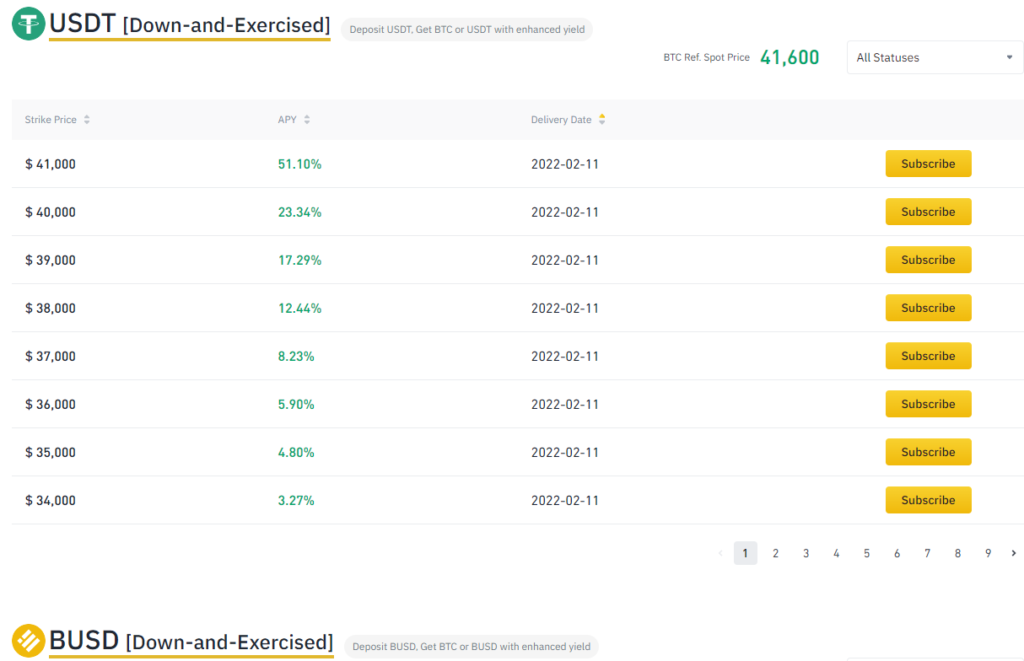
Suppose we select the first contract. Its strike price is $41,000, and the annual yield is 51.1%. The BTC price at the time of writing (6 February 2022) is $41,625.
Suppose we invest $1,000 in this contract by pressing Subscribe. The funds are locked until the contract expires and cannot be withdrawn earlier.
If on February 11 the BTC market price is above $41,000, we will receive 1006.69 USDT (i.e., we will get back the principal plus just over $6 in profit). If, at expiry, Bitcoin’s price is below the threshold, we will receive the equivalent of $1,000 in Bitcoin plus the interest — 0.02455365 BTC.
The result is a predictable return or something like a near‑guaranteed lottery. The risk lies only in alternative costs or foregone opportunities. For example, if Bitcoin drops to $30,000 in a few days, we would not be able to withdraw the $1,000 from the contract to buy crypto at a good discount.
DeFi platforms
PancakeSwap
This AMM platform has long dominated the Binance Smart Chain (BSC) ecosystem, known for fast and inexpensive transactions.
PancakeSwap lags significantly behind Uniswap (v3) in daily volume and TVL, but in these and many other metrics it surpasses other popular DeFi platforms.
There are pools with stablecoins on PancakeSwap. Their annualised yields (APR) can vary substantially.


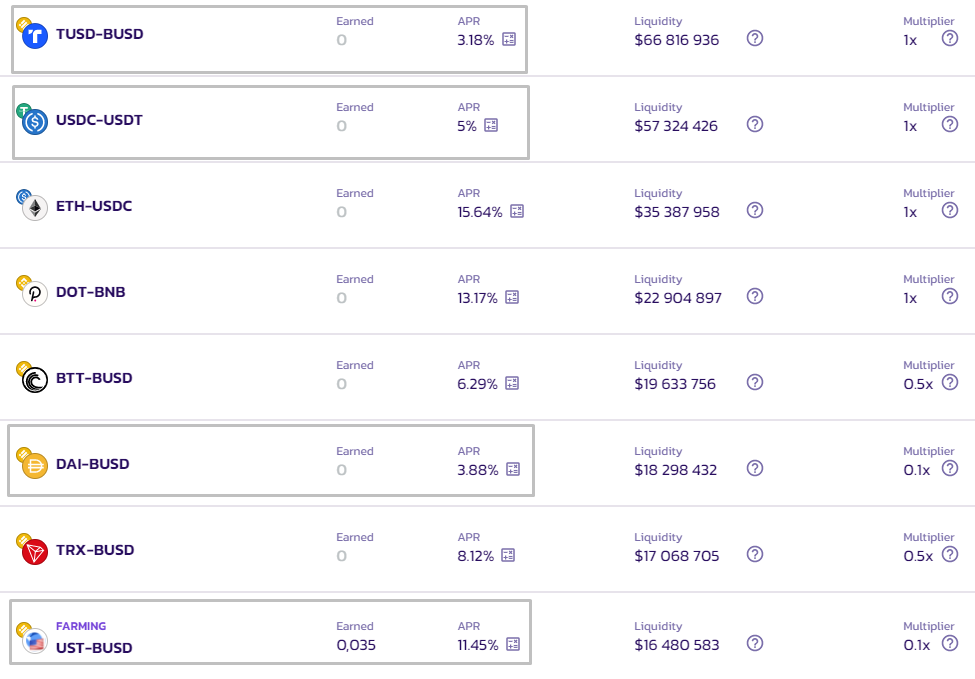
For example, the TUSD-BUSD pool yields 3.18% APR, and the UST-BUSD pool yields 11.45%. The sizable difference stems from the relatively high volatility of the algorithmic stablecoin UST from Terra.
Investors should carefully select pools to maximise the passive income paid out in CAKE tokens. Accrued tokens can be periodically claimed, then swapped and reinvested back into stablecoins, or placed into “syrup” pools and earned through staking. The staking reward will be the pool’s native coin. For example, if you invest in Auto CAKE, you will receive CAKE. As of 6 February 2022, the yield of such a pool stood at 62.58%.


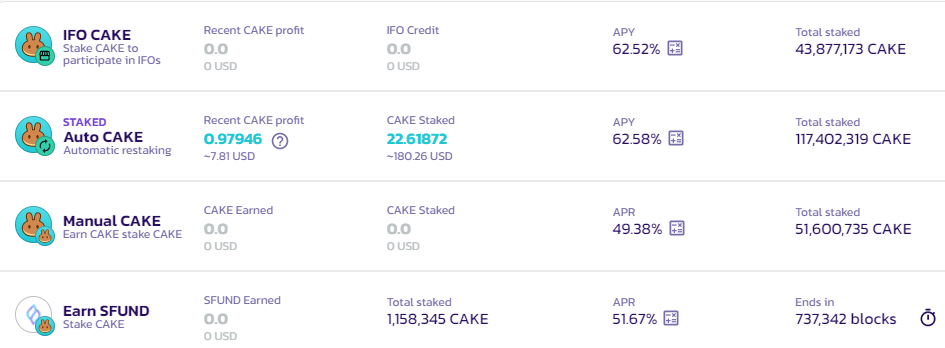
As an option, the CAKE harvest can be periodically swapped for BTCB, following the Dollar Cost Averaging (DCA) strategy.
If the market suddenly collapses, as in November 2018 or March 2020, you can withdraw some of the stablecoins from the pool to buy Bitcoin and other liquid crypto assets cheaply.
Purchased “blue chips” can be placed in suitable pools at a conservative yield or simply held, following the Buy&Hold strategy. Sooner or later the market will turn and crypto assets will reward patient investors with multiples of unrealised gains.
Venus
As an alternative or complement to PancakeSwap, Venus is the leading lending platform in the BSC ecosystem.
The annual yields on Venus stable pools generally do not exceed 4% and for many may seem overly conservative. However, during periods of market revival the APR on stablecoins can reach 10% or more.


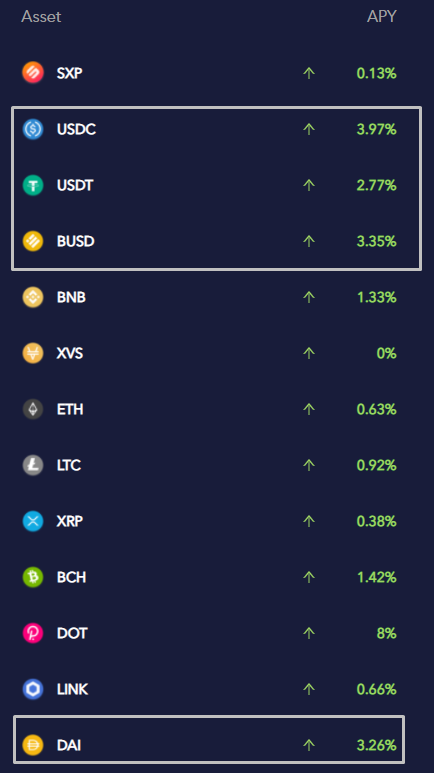
In periods of higher yields they tend to be short-lived, with metrics soon returning to the normal 3–4% range. The higher yields still prevail in PancakeSwap’s stable pools.
In the screenshot above are Venus yields including XVS farming. You can harvest this native token in the Vote tab.
yEarn
The service from the infamous Andre Cronje also enables earning a passive income through stablecoins and other crypto assets.
Besides Ethereum, yEarn supports the Fantom network. The latter, like BSC, is known for fast and cheap transactions.
To move stablecoins from BSC or another ecosystem to Fantom, you can use cross-chain bridges such as Multichain or xPollinate — the operation takes only a few minutes.
You can also move FTM from Binance to MetaMask by selecting the appropriate network. For converting Fantom’s native token to stablecoins, the exchange SpookySwap is suitable.
On yEarn there are Vaults. They generate income using a variety of farming strategies that change over time.
The service’s strength lies in its simplicity. All that a user needs to do is deposit funds into the chosen Vaults. Nothing else is required — income will accrue automatically thanks to yEarn’s integration with various services, harvest automation and reinvestment.
Funds are not locked for a fixed term — you can withdraw partially or completely at any time by clicking Withdraw.
Consider how the protocol works, taking as an example a Vault based on the stablecoin DAI from MakerDAO. According to information on the site the site, the algorithm performs these operations:
- deposits and borrows DAI on the lending service Scream;
- harvests the SCREAM tokens;
- the harvested assets are sold for DAI, which are then redeposited into the Vault.
In the screenshot below you can see that yields of stablecoin Vaults on the Fantom network significantly exceed PancakeSwap and Venus.


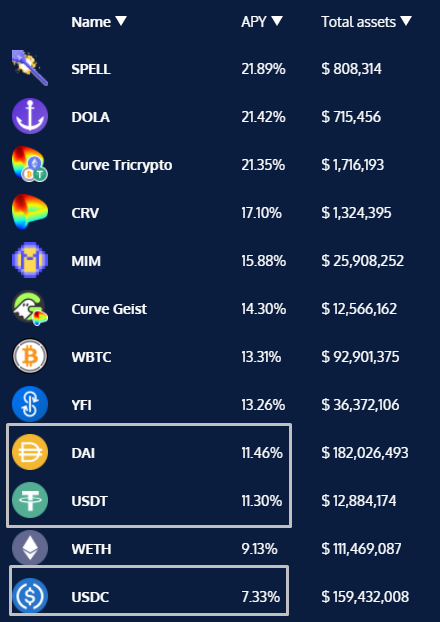
At the start of January, Vault yields based on stablecoins on Fantom exceeded 40% for a time. This high figure was linked to the integration with the platform 0xDAO, where the APR of the OXD-USDC pool exceeded 2500%. Later, the farming yield fell below 1000% and yEarn shifted its strategy in favour of Scream.
Autofarm Network
Similar automation algorithms to maximise APR are employed on Autofarm Network, which supports multiple networks. The service also features Vaults.
In the screenshot below are the yields of some stablecoin Vaults on the Polygon network. The figures are higher than on Venus and PancakeSwap and nearly match the APY of yEarn Vaults.


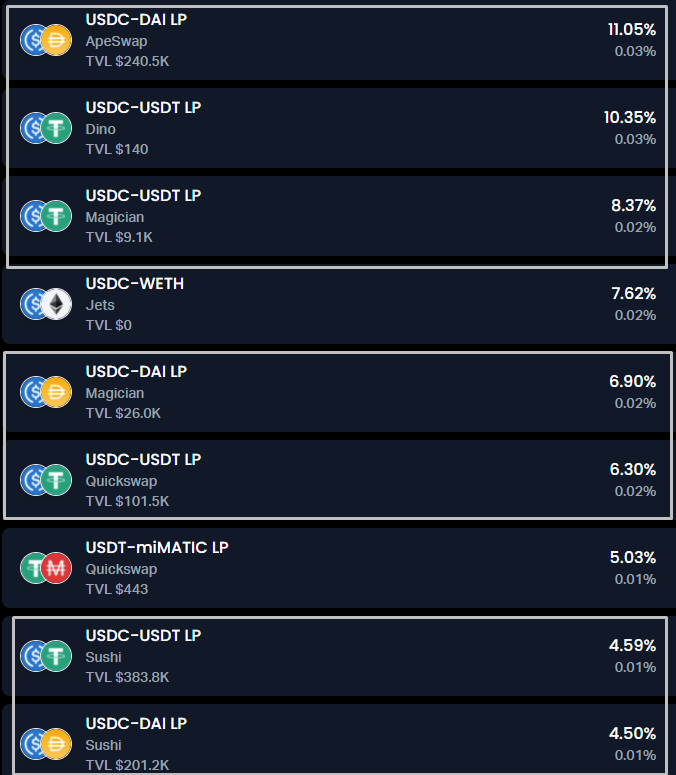
Autofarm Network is also straightforward to use — to use a chosen Vault you deposit assets into the related platform’s liquidity pool. The LP tokens then appear in the Vault’s menu, after which you simply press Deposit.
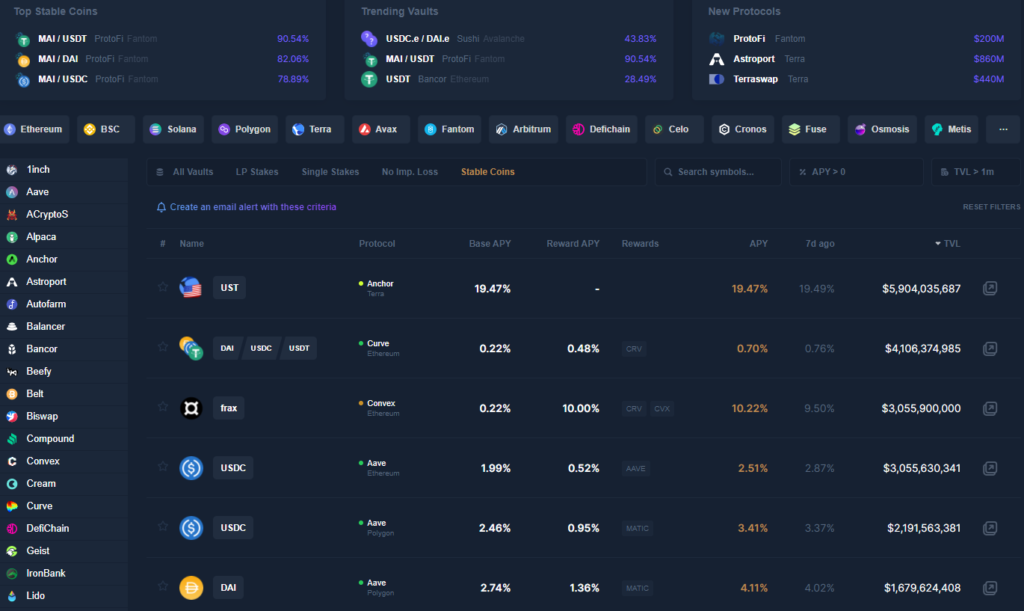
To avoid getting lost among a sea of protocols, pools and APYs, there are dedicated aggregators like Condix, which help locate, compare and sort farming opportunities by different parameters.


Conclusions
The cryptocurrency market and the DeFi ecosystem in particular offer numerous ways to earn passive income. The relevance of many of them will only grow with the inevitable arrival of a bear market.
During this period the path of least resistance for prices of many crypto assets will be downward. It is not impossible that Bitcoin will find a bottom around $20,000 — a level corresponding to the peak of the previous bull cycle (December 2017).
To buy digital gold at the bottom, investors need to accumulate stablecoins. Help in this comes not only from self-discipline but also from various DeFi protocols that generate reasonably attractive returns on invested funds.
The undeniable advantage of services such as yEarn and Autofarm is the high APY figures. However, the risk is that all of them are built on top of other platforms, like LEGO.
For example, yEarn relies on Scream, Autofarm integrates with many other platforms. The complex architecture of such systems creates additional vectors for hacker attacks, including the use of instant loans. For example, in February last year an unknown attacker void $2.8 million from the v1 yDAI pool of the yEarn project.
Therefore, users should not concentrate all their digital wealth in one pool and/or protocol, even given high yields — diversification remains prudent. It comes down to not putting all eggs in one basket and investing in instruments with a mix of risk and return profiles.
Subscribe to ForkLog news on Telegram: ForkLog Feed — the full news feed, ForkLog — the most important news, infographics and opinions.