




In December 2024, following a rebrand, the Sonic mainnet was launched—an EVM-compatible layer-1 (L1) blockchain. The ‘father of DeFi’, Andre Cronje, has taken the helm of the new direction for the old Fantom project.
In February 2025, attention to the Sonic ecosystem and token rose sharply. Several forces are at work: users’ anticipation of a future airdrop, competitive network metrics, and management’s promise to bring back the era of the “DeFi summer”.
This ForkLog piece revisits Cronje’s path and his contribution to the industry, and examines Sonic’s technology, incentive programme and ecosystem.
Inside the ‘father of DeFi’s’ workshop
“I agree: even if our technology is superior, by itself it means little these days—distribution and usability matter. That is exactly what we are focusing on, building a horizontal, composable DeFi stack across all our projects”, wrote on X the creator of Yearn Finance and Sonic’s chief architect, Andre Cronje.
He was replying to an investor under the nickname kook, who argued that in today’s crypto industry technology has become merely a means of selling a product.
Cronje is known for his bluntness. From the outset of his work in cryptocurrencies he criticised its downsides—an abundance of misinformation, hype-chasing and a toxic community. Acknowledging these problems did not stop him from remaining a blockchain enthusiast.
By training Cronje is a lawyer, a graduate of Stellenbosch University in South Africa. He continued his studies at the private Computer Training Institute there, where he later taught.
From 2006 to 2018 Cronje held roles from programmer to CTO across several South African IT firms. He then took his first steps into digital assets, working as a code analyst on various ICOs for CryptoBriefing, and later as an adviser to a number of venture funds and crypto start-ups: Wanchain, Fusion and Fantom.
The protocol that brought Cronje real fame—and the title of the “father of DeFi”—was Yearn Finance. Launched in 2020, the yield aggregator used Vaults—repositories that automatically allocated deposited stablecoins across lending services—offering users passive income with relatively high APY.
According to the founder, Yearn cost $42,000 to launch, and twice that for audit and hosting. Cronje had to take a loan secured against his house and raise an additional $20,000.
Immediately after launch the project was hacked, but it survived the attack (every subsequent start-up by the DeFi architect seemed to attract hackers like a magnet).
The token’s release in June 2020 marked a fresh phase for Yearn. Cronje then made an unexpected statement:
“We have released YFI: a completely useless token, which is backed by nothing. We repeat: it has zero financial value. No premine, no ICO, you will not be able to buy it, it will not be on Uniswap, there will be no trading. We don’t have these tokens either”.
Sincere or shrewd, those words were followed by a 35,000% price jump within a week of trading on Balancer, from $3. The asset appeared on Uniswap too and soon set an altcoin record, peaking at around $77,000. As of February 26, 2025, YFI trades near $5,700.
At that stage Cronje had laid the groundwork for the further development of decentralised finance. Despite frequent criticism directed at him—and his own sharp remarks about the industry—he built effective mechanisms that earned trust.
Yet in 2022 Cronje declared that DeFi would inevitably come under regulation, and that he was leaving the industry. To many decentralisation enthusiasts, this sounded like a betrayal.
For two years the “father of DeFi” stayed out of the public eye, surfacing only a handful of times in the news. Finally, in early 2025, already as Sonic’s chief DeFi architect, Cronje shared the “real reason” for his disappearance. Since 2021 he had been under pressure from the SEC. At first it requested information about Yearn Finance’s investors and beneficiaries; later it turned into investigations targeting Cronje himself.
“After two years of having to deal with this every month, enduring endless sleepless nights and stress, I chose [an official departure from the industry]. I am sure many here would say I shouldn’t have given up, but I also believe anyone who says that has never been in a similar situation. You get all the negativity, but you get none of the benefits”, he admitted.
In the same post Cronje reaffirmed his commitment to DeFi and said his comments about the need for regulation had been misunderstood.
“I simply could not be public, but all these years I kept working tirelessly, and that is why I am finally close to releasing my new primitives. […] My last posts before ‘disappearing’ were about regulated DeFi. Most people didn’t even read those articles, they just saw the words ‘crypto regulation’ in the title and decided I had become a government agent,” he fumed.
Clarifying his 2022 statement, the DeFi architect drew a distinction: regulation aimed at decentralised smart contracts is simply impossible in natural conditions and only drives developers out of the industry—as in his case—whereas off-chain third parties (exchanges, brokers) can indeed fall under oversight.
Fantom ‘hit a technical ceiling’
With regulatory pressure easing in the United States, particularly a softer stance on tokens, experts point to a possible DeFi renaissance. Analysts at Bernstein, for instance, expect liquidity to flow from memecoins into decentralised finance, NFTs and gaming tokens.
This made for a timely backdrop to the rebrand and technical overhaul of Cronje’s creation, Fantom.
Fantom Foundation Ltd. was registered in early 2018 in South Korea. The project’s founder and CEO was Ahn Byung Ik, known domestically for creating the restaurant-rating app SikSin. Initially, the Fantom Foundation team was predominantly South Korean developers, and early partnerships focused on the local foodtech industry.
The Fantom Foundation later moved to the Cayman Islands, and the leadership became international. Australian Michael Kong took the CEO and CIO roles, with Cronje as lead DeFi developer.
Mainnet launched in December 2019, and by autumn 2021 Fantom had entered the top ten projects by TVL.
The network belongs to the family of blockchains built on a DAG architecture. Its hybrid DAG-BFT consensus enables parallel transaction processing with fast finality and keeps the network functioning even when up to a third of nodes are faulty. Similar models are used by projects Aptos, Sui, IOTA and Hedera Hashgraph, but Fantom was the first to implement DAG-based smart-contract support.
Each node maintains its own local DAG of event blocks containing transactions. Nodes do not forward blocks to each other to reach consensus, as in linear blockchains. Instead, validators periodically exchange transactions and events, synchronising them within a single epoch.
The team cites the difficulty of further upgrading Fantom as the main reason for launching Sonic. If the stated throughput at the start was about 4,500 TPS, later a more realistic ~2,000 TPS, Sonic promises up to 10,000 TPS. Transaction finality is under one second at a cost below $0.01. Such figures put it in contention with new L1s—Monad and Berachain.


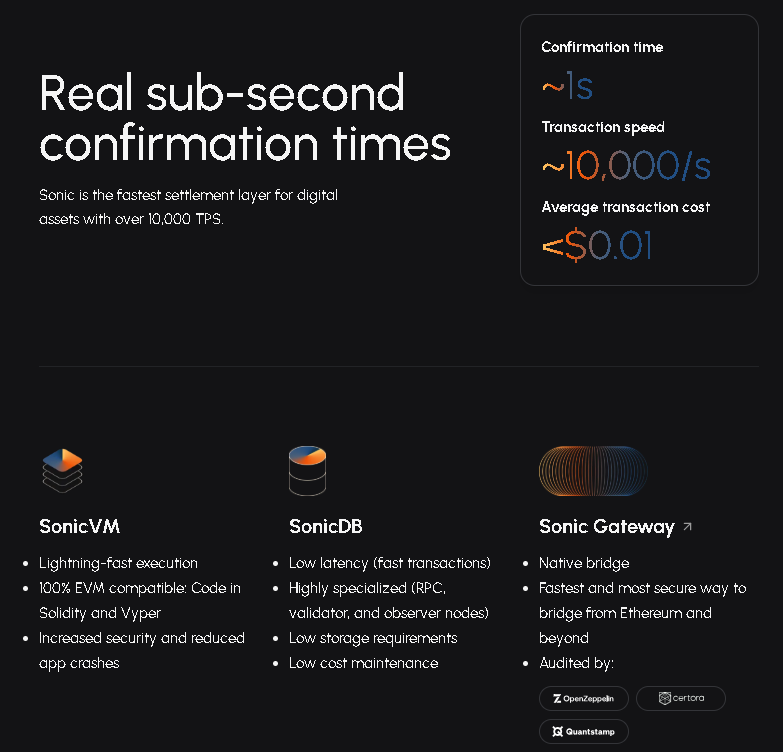
The goal of Sonic Labs, which is responsible for Sonic’s development, is to provide a platform for fast, cost-effective transactions with a tilt toward DeFi and gaming mechanics.
The Sonic developers envisaged liquidity unification with Ethereum. The native cross-chain bridge Sonic Gateway allows ERC-20 tokens to be transferred between Sonic and the network of the second-largest cryptocurrency by market value.
Gateway includes a failover mechanism that protects users’ assets. If Gateway goes down, funds can be recovered on Ethereum after 14 days.

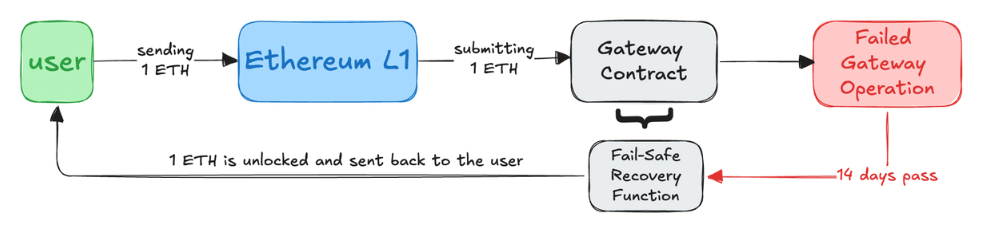
Asset movements take place at set intervals—“ticks”—to use gas efficiently: every ten minutes from Ethereum to Sonic and every hour in the opposite direction. The Fast Lane function lets you accelerate a transaction by paying a higher fee.
SonicVM is fully EVM-compatible and supports the Solidity and Vyper programming languages.
Another important part of the upgrade is the Carmen solution. This system manages data according to the network’s actual needs, cutting validator node storage requirements from 2,000 GB to 300 GB.
Optimisation lowers operating costs for nodes, enabling more of them to participate in validation. Historical data that no longer require frequent access can be compressed or moved. Carmen also reduces archival-node storage from 11 TB to under 1 TB.
Staking, farming, airdrop
According to Andre Cronje, once the missing DeFi mechanics are implemented in Sonic, the network will look “like one big high-frequency trading platform”. The following functions and incentives are planned:
- fee switch for dapp developers set at 90%;
- custom transaction-cost settings for app owners;
- free transactions for new users;
- account abstraction with walletless access.
In a tweet published on mainnet day, Sonic’s chief technology officer said:
“I will launch my dapps in stages, bringing back ICOs, ‘fair launches’ and retroactive airdrops to show what Sonic can really do”.
Many of these elements have already been implemented on Fantom. Back in August 2021, the Fantom Foundation announced a new incentive programme for DeFi developers. In October it expanded it to GameFi projects.
FTM holders can convert their tokens into S tokens at a 1:1 ratio after mainnet launch.
Growing interest in a future airdrop, backed by nostalgia for the “DeFi summer”, has reinvigorated the ecosystem. The new campaign for forthcoming rewards uses a tried-and-tested playbook: a DeFi tilt, mini-games, NFTs and, of course, “meme mania”.
The late-February 2025 pullback across crypto echoes the familiar script from Arbitrum airdrop farming in 2023. Then, despite a choppy market, tokens of DEXs, lending platforms and other derivative ecosystem elements posted firm gains.
According to Sonic’s documentation, roughly 200m S will be distributed to those who hold and use whitelisted assets in various DeFi applications on Sonic, thereby deepening liquidity.

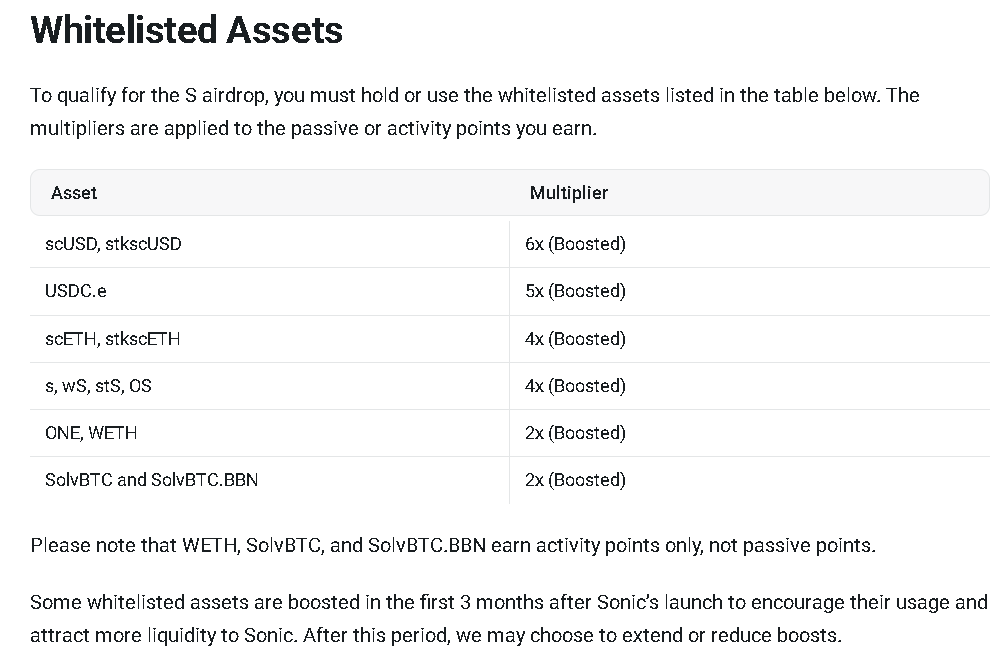
There are three main dynamics for airdrop farming:
- passive actions—holding whitelisted assets;
- active use of approved tokens in DeFi mechanics;
- developer rewards—Sonic Gems.
On February 7, 2025, the Meme Mania Competition incentive programme was launched, running until March 8. One million liquid Origin Sonic (OS) tokens will be distributed among the 125 largest holders of eight winning memecoins as rewards for loyal community participants.

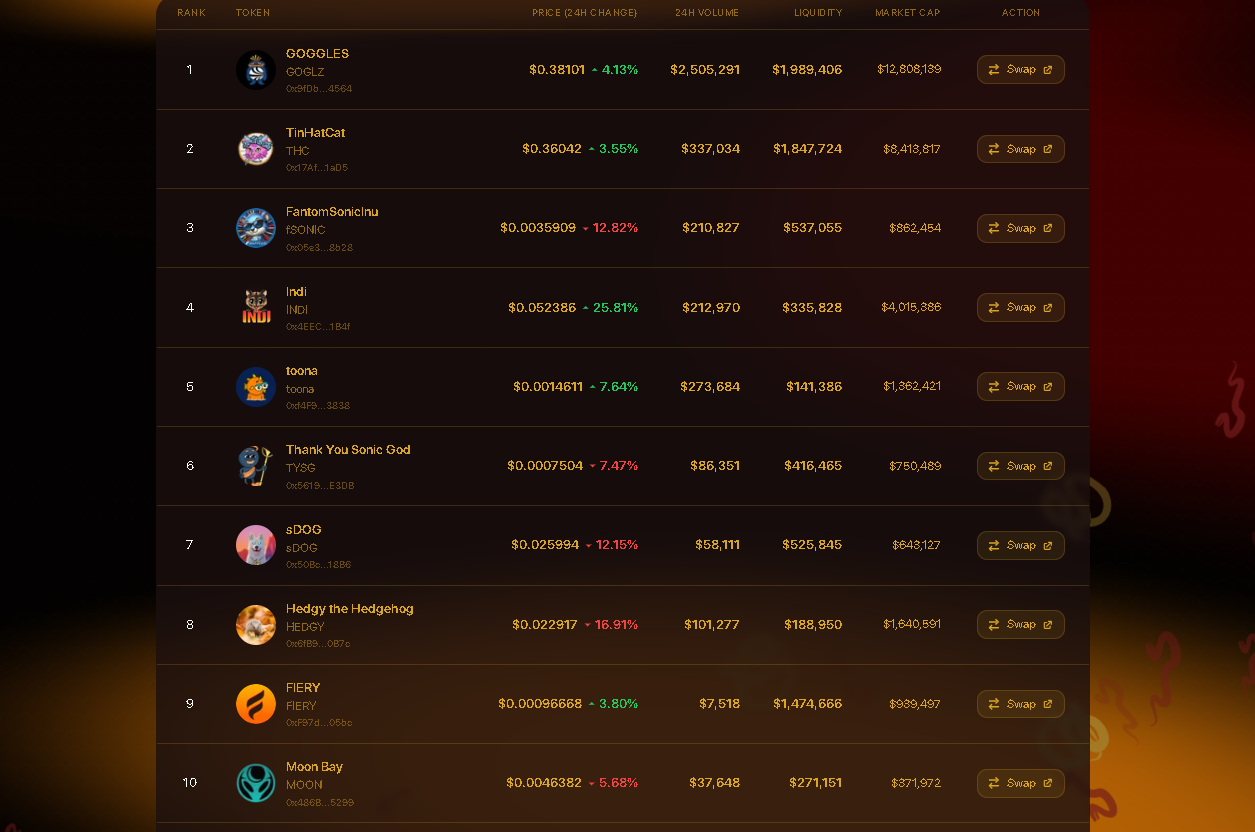
Thanks to an active community, the ecosystem is growing. Leading DEX Shadow Exchange has shown standout price action, with monthly gains of ~1,400% and TVL near $140m.
It is followed by the decentralised trading exchange SwapX, which has doubled in a month and has TVL of around $45m.

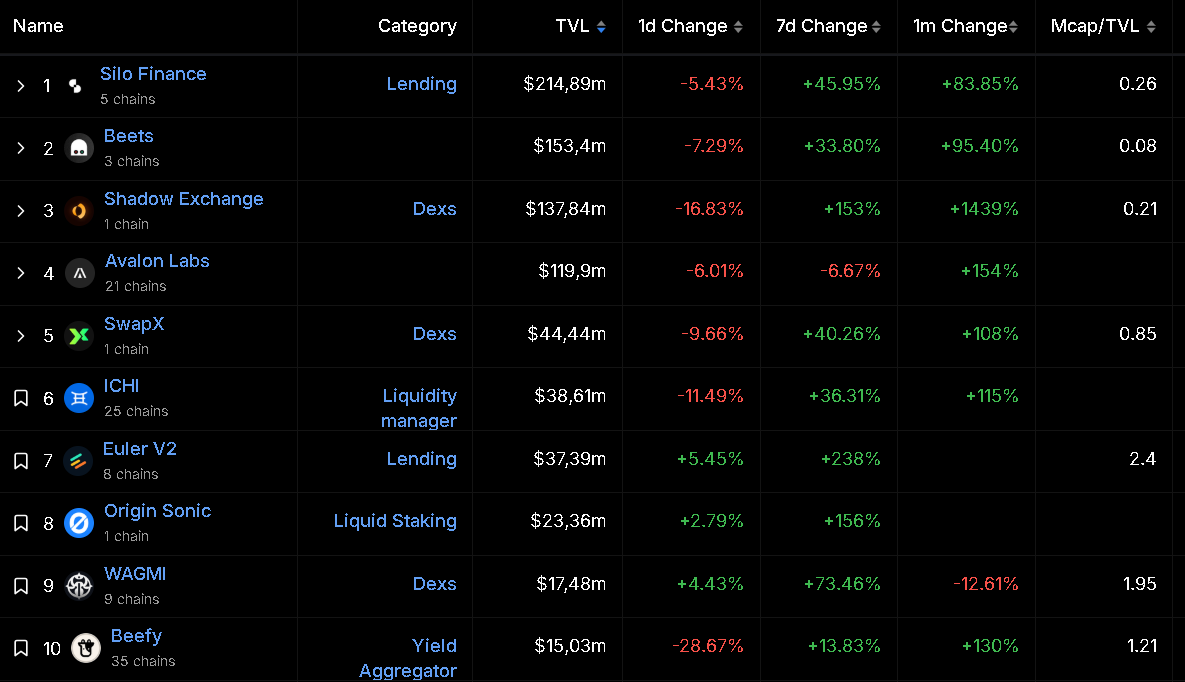
Among derivatives exchanges for futures trading, Navigator leads. According to CoinGecko, the NAVI token is up roughly 500% in 30 days.
Conclusions
With the arrival of new projects such as Monad, Berachain and an updated Sonic, L1 competition is intensifying. In the rapidly expanding array of blockchain and cryptocurrency use cases, each network can carve out its niche. Sonic is betting on high speed, low fees and liquidity aggregation, which strengthens its standing in the DeFi segment.
The approaching summer airdrop will show how the leadership of the revamped blockchain has adapted to the new realities of incentive programmes and tokenomics.