


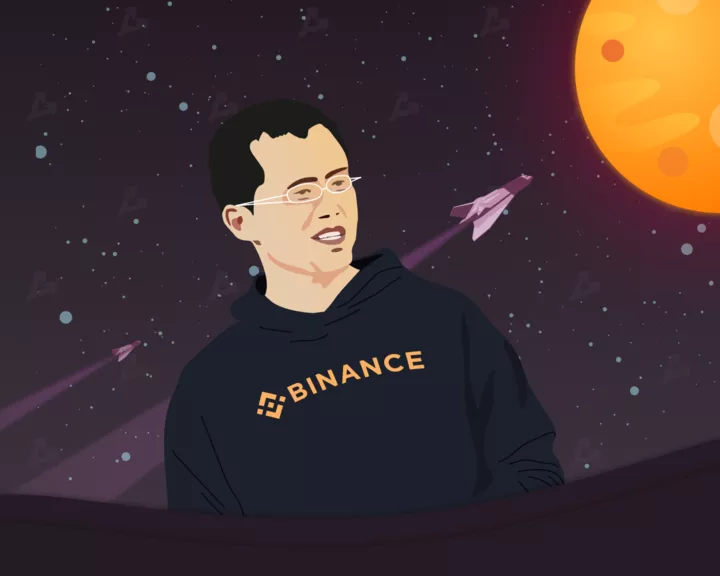
CZ on NFTs, a failed startup and Binance’s investment appetites — interview
In four years, the cryptocurrency exchange Binance has established a dominant position in the industry. It leads in spot and derivatives markets, and the DeFi ecosystem under its brand is already breathing down Ethereum’s neck. The company actively invests in the ecosystem and engages in philanthropy. It is often likened to the Amazon or Google of cryptocurrency.
In an exclusive interview with ForkLog editor-in-chief Nikita Shteringard, Binance founder Changpeng “CZ” Zhao spoke about his failed startup from the early 2000s, his views on vaccination against COVID-19, and a previously unknown co-founder of the company. The conversation also touched on the successes of Binance Smart Chain, Tesla investments, and a world without a state.

ForkLog: On the day Coinbase listed on Nasdaq you compared BNB to COIN and Ethereum, and asked a rhetorical question about the asset’s potential value. Do you think BNB’s price should reflect the success of Binance’s centralized business and the growth of the Binance Smart Chain ecosystem?
Math quiz.
If $COIN = $400, then #BNB = X
If $ETH = $2300, then #BNB = Y#BNB = X + Y + …#BNB = ?— CZ 🔶 Binance (@cz_binance) April 14, 2021
CZ: I think so. Many believe that a coin can have only one use case, but in truth utility can be defined by many properties. Look at Ethereum — it can be a means of payment or a store of value, but it also powers DeFi and NFTs. A token can have multiple applications.
BNB is the native currency of Binance Smart Chain, so it shares all of the above properties, but it also has use on a centralized exchange. It allows traders to receive trading fee discounts, VIP statuses, and allocations on the Launchpad. In my view, it is utility that drives value, and BNB has plenty of it. My stance is that how to value a coin should be left to the market.
ForkLog: If value flows from utility, does that mean BNB’s market cap should exceed COIN’s?
CZ: [laughs — editor’s note here and hereafter] I don’t know… It seems to me that BNB’s market cap is larger than Coinbase’s right now. I think growth is being driven by the Binance Smart Chain’s development, and the community is pricing it accordingly.
ForkLog: Binance Smart Chain is successfully attracting liquidity due to low fees. You sacrifice decentralisation, but people don’t seem to care. They want maximum yield here and now, not decentralisation. Does this not mean that cryptocurrencies are still about speculation, just like in 2017?
CZ: It seems to me that there are different conclusions. Some share your view. And that’s normal. In a world of decentralisation, everyone has a right to an opinion.
But I think that when it comes to centralisation vs decentralisation, you need to consider more factors. I’m not deeply involved in the development and growth of BSC, but Vitalik Buterin, for example, is deeply involved in the architecture of Ethereum 2.0. In this respect Ethereum seems more centralised to me, as it revolves around one person. Look at Bitcoin; its founder is not identifiable, and that makes it more decentralised.
There are more nodes on the Ethereum network, yes. They say it’s a computer that cannot be stopped, and that software can be run from a laptop. But let’s be honest: if you run a node on a laptop, you probably won’t be able to do much else on it.
BNB has a limited number of validators, but Binance does not control it entirely. We control only a few. We cannot control the network, we cannot freeze user assets, we cannot reverse transactions. In this respect decentralisation exists.
Everyone views decentralisation differently. I think BSC is less decentralised than Ethereum by most logical criteria, and there is nothing wrong with that.
In my view, users care about security, ease of use and low fees. BSC delivers all of that. We are simply trying to satisfy people’s demands.
ForkLog: Sam Bankman-Fried suggested that BSC isn’t about competing with Ethereum for the title of the most decentralised network. Do you agree?
12) It would be easy to be angry at BSC, for taking yield from more decentralized chains.
But I’m not. Because BSC isn’t stealing governance, and it’s not stealing the pillars of a decentralized future.
It’s stealing yield.
It’s making DeFi compete for its yield.
— SBF (@SBF_Alameda) March 8, 2021
CZ: It’s a choice story. Some pick Bitcoin, some Ethereum, and some Binance Smart Chain. I think Bitcoin is king right now; Ethereum is not.
We’re not attacking Ethereum; we’re aiming to complement it and help address adoption. Are we stealing users by offering higher yields? We don’t control projects on BSC. Pancake, Venus, and so on — they make their own decisions. To correct: Venus is affiliated with us, but all decisions are theirs.
These projects use low fees to offer higher yields. Does that mean we’re stealing users? It depends on how you define “stealing.” Users come because they want low fees. Is that theft? You can call it whatever you like, but the fact remains: people choose Binance Smart Chain. So I don’t worry much about what label is attached.
ForkLog: Coinbase dominates the richest market in the world — the United States. Binance dominates many other parts of the world, but both companies in 2020 disclosed comparable or even nearly identical revenues, though your user base is clearly larger and volumes higher. How can you explain this? Is it all due to fee differences or to the wealth of the user base?
CZ: Hm… I think a bit of both. Coinbase has a large share of the US market, the world’s leading economy. And there are more affluent clients there. Their fees are five to ten times higher than ours. In some cases even more than ten times, depending on the services you use. Users pay more; Coinbase can attract retail customers who don’t worry about this. And that is a strong side for them. It’s especially noticeable over the past year.
ForkLog: How many verified users does Binance have?
CZ: Honestly I don’t recall the exact figure. I think somewhere between 50 and 100 million, depending on how you define a verified user.
ForkLog: Why are institutions buying? What is driving demand?
CZ: I identify three main categories of institutional and corporate buyers of cryptocurrency.
First are MicroStrategy. They view Bitcoin as a safe asset, a so‑called “safe haven.” They hedge inflation and quantitative easing risks to preserve the value of corporate assets. Their stance is to hold crypto for the long term. Michael Saylor even promised they’ll HODL for 100 years. They are very bullish.
The second group is active traders from the stock market looking to profit. They are our largest clients — high‑frequency traders.
The third group comprises mid‑term investors. They don’t trade aggressively but hedge risks. Tesla is one of them. They bought Bitcoin for $1.5 billion, but sold 10% to realise some profits.
Reasons vary. Some invest for tech, others to preserve wealth.
ForkLog: Don’t you find it odd that some Twitter influencers criticized Tesla for selling Bitcoin and even called it a betrayal? I think it’s perfectly normal for a company to buy an investment asset and want to profit from it. What do you think?
For 12) It’s not that I’m angry at BSC. It’s that they steal yield.
It’s making DeFi compete for yield.— SBF (@SBF_Alameda) March 8, 2021
CZ: This is a matter of choice. Some people choose Bitcoin, others Ethereum, and some choose Binance Smart Chain. I think Bitcoin is king right now; Ethereum isn’t.
We’re not aiming to attack Ethereum; we’re aiming to complement it and help address adoption. Are we stealing users by offering higher yields? We don’t run projects on BSC. Pancake, Venus, and so on — they make their own decisions. I should add that Venus is affiliated with us, but all decisions remain with them.
These projects use low fees to provide higher yields. Does that mean we steal users? It depends on how you interpret the word ‘steal.’ Users come because they want low fees. Is it theft? You can call it whatever you like, but the fact remains — people choose Binance Smart Chain. So I don’t worry much about the label attached.
ForkLog: Coinbase dominates the world’s wealthiest market — the United States. Binance dominates many other parts of the world, but both companies in 2020 disclosed comparable or even nearly identical revenues, although your user base is clearly larger and volumes are higher. How can you explain this? Is it all due to fee differences or the wealth of the user base?
CZ: Hm… I think a bit of everything. Coinbase has a large share of the US market, which is the world’s leading economy. And there are more affluent clients there. Their fees are five to ten times higher than ours. In some cases even more than ten times, depending on the services you use. Users pay more; Coinbase can attract retail customers who aren’t overly concerned. This is a very strong side for them. This has been especially noticeable over the last year.
ForkLog: How many verified users does Binance have?
CZ: To be honest, I don’t recall the exact figure. I’d say somewhere between 50 and 100 million, depending on how you define a verified user.
ForkLog: Why are institutions buying? What drives demand?
CZ: I identify three main categories of institutional and corporate buyers of cryptocurrency.
First is MicroStrategy. They view Bitcoin as a safe asset, a so‑called “safe haven.” They hedge inflation and quantitative-easing risks in an attempt to preserve the value of corporate assets. They take a long‑term view on crypto. Michael Saylor even promised they will hold for 100 years. They are very bullish.
Second are active traders who came from the stock market to earn profits. They are our largest clients — high‑frequency traders.
Third are medium‑term investors. They don’t trade actively, but hedge risks. Tesla is one of them. They bought Bitcoin for $1.5 billion, but sold 10% to realise some profits.
Reasons vary. Some invest for technology, some to preserve wealth.
ForkLog: Do you find it odd that some Twitter influencers criticised Tesla for selling Bitcoin and even called it betrayal? I think it’s perfectly normal for a company to buy an investment asset and want to profit from it. What do you think?
CZ: For me this is normal too. I agree completely with you. Any company or person can buy any asset and sell it with whatever frequency suits them. Tesla has never promised not to sell. They have every right to sell.
We see millions of users and thousands of organisations buying and selling every day, and that is perfectly normal behaviour. I don’t understand why some expect companies to simply buy and never sell.
It may be that Musk tweeted about buying but not about selling. But again — he is not obliged to tell everyone about every move, so that’s normal.
ForkLog: You once told me that Binance conducts between 30 and 50 M&A deals per year. What are you looking for now? Where are you ready to invest?
CZ: In anything that helps the industry grow, including infrastructure providers. We are currently considering several projects in DeFi and NFT, as well as a few wallets.
We have already acquired Trust Wallet, and it is now the most popular mobile wallet in the world by downloads and monthly active users.
We would like to invest in payments services, fiat gateways and even traditional banks that work with cryptocurrencies.
Most of our investments are connected to cryptocurrencies in some way. We do not overlook information services. CoinMarketCap is a good example.
Most deals are not public, but the number is indeed large.
ForkLog: In the NFT boom, do you think it’s reasonable that pixel GIFs are sold for millions of dollars?
CZ: Yes, NFTs are an interesting thing. I think many people ask why pixels suddenly started selling for millions, but look broader.
Yes, anyone can find and download Beeple’s works; moreover, in the original resolution. People buy not because these works cannot be reproduced or copied. In the traditional art world, there are many reproductions with high quality and likeness to the original.
But behind every work and every creator lies a story. For example, TIME wrote about Metakovan buying Beeple’s work. And you’ll be written about if you simply click and save it? That is value, to you and to others.
I met him two weeks ago, but I won’t meet everyone who simply downloads artwork from the internet. This guy bought a work for $69 million, — clearly he has something to tell. I was interested in meeting him in person.
There is a fundamental aspect to NFT ownership. By buying a work for millions of dollars you are supporting the artist — you would agree that it is not simply downloading something from the internet.
There is also a commercial dimension. NFTs allow you to use works for commercial purposes; you have rights. Not all benefits are obvious immediately, but the value is there.
ForkLog: Do you own any NFTs?
CZ: No, not really. I think I have 3 or 4 Binance NFTs. But I’m not an artist or a collector. I don’t create NFT and I don’t seek them; it’s not the best use of my time.
So I don’t personally use NFTs, but we will launch a marketplace. I’m not even a trader; I don’t trade to earn money, I build platforms.
Yet I understand why people see value in NFTs. If one or two people in the world are willing to buy it, it already has value.
ForkLog: Not a NFT collector and not a trader. You also stated that you do not consider yourself a libertarian or an anarchist. Do you believe that some industries require government oversight? If yes, which ones and why?
CZ: I have many hardcore anarchists among my friends. They believe we should live without government and everyone should fend for themselves. Personally, I cannot imagine how that would work. I don’t think we are at a stage in civilisation where we can run our lives without rules and the people who enforce them.
Who will build roads, who will provide clean water? What about police and fire departments? How would we organise all this ourselves? Will we build bridges for ourselves and pay for them? Honestly, I’m not sure such a world would work better than today.
Yes, some governments are poorly run, but there are effective ones too. There are those that protect their citizens and put their interests first. But yes, there are those that abuse power. However this is not a black-and-white issue.
In general, I believe we need governing rules for living in harmony. I am not against governments.
ForkLog: Do you agree that governments should not have a monopoly on money issuance? This is the view of many Bitcoin and Austrian-school advocates.
CZ: Yes, I think so. The right of governments to unlimited money issuance does not bode well for the economy.
I am sure we should not permit the existence of companies whose life depends on fear of systemic risks. If a company dies, let it die; new entrepreneurs will take its place.
I believe subsidised companies are already running the wrong business. This concept was described by Adam Smith in The Wealth of Nations. I also recommend Henry Hazlitt’s Economics in One Lesson, which explains why any government intervention harms the economy.
It may seem that governments try to prop up business with money, but in reality our taxes flow into the pockets of non‑competitive organisations. There are exceptions, such as healthcare, but they only prove the rule.
So I’m not fond of printing presses. They print 10% of the issuance and you become 10% poorer. It is the same as simply confiscating 10% of your savings from bank accounts. In the latter case there would be more protests, but the result is the same — you become poorer. And every government does this.
ForkLog: Final question about the state. Do you think governments will tighten controls and abuse power under the pretext of fighting COVID-19 or other infections?
CZ: This is not a black-and-white issue either. Some will, no doubt. One must understand that every government is a huge organism with many departments and many people. Some will go to regulate to advance themselves up the career ladder. This is more about human nature, which we cannot escape. I think there are those who will tighten the screws in every government, but does that mean it will happen? No. There are procedures to monitor the rationality of any processes and decisions.
ForkLog: You are seen as a public figure, so I have a socially important question for you. Will you get vaccinated?
CZ: Yes, unequivocally. I believe in new technologies. There are risks, but millions are already vaccinated. Sooner or later this will become a mandatory condition for travel. If you are not vaccinated, you cannot travel, and this is not a matter on which I can influence. There is no room for arguing with the government, so yes — when it is my age group’s turn, I will be vaccinated.
Generally, many medical innovations are being promoted with extreme caution. Let us suppose we need to test a drug. 0.1% or even less would experience serious side effects; some might even die, but it would genuinely help safeguard the remaining 99.9%. Today we do not even explore such medicines if there is that dilemma. In my view, such an approach does not help people.
If I were to become seriously ill, I would seek out all possible experimental treatments. Give me the newest you have, even if not fully proven. Because modern medicine is already highly developed and contains many safeguards; the safety of even not fully proven things is fairly high. So I am willing to take the risks.
ForkLog: Let’s return to Binance. Brian Armstrong of Coinbase sought a co-founder on Reddit and met after many meetings. And how did you meet your partners?
CZ: The earliest founding team members were friends of friends and people I had worked with for more than eight years.
When we were launching Binance in 2017, we interviewed people from all over the world. One guy messaged me on Telegram, sent a resume and a cover letter. He wanted to work in any role, and he understood our business very well. We hired him after two interviews, and he went on to lead the Listings department, which is a very influential position given the impact of listings on Binance. This person is not public, and we never disclosed his name.
ForkLog: But does he have co-founder status?
CZ: He joined early on, yes.
ForkLog: And how did you meet He Yi?
CZ: It happened in 2013–2014, when I first heard about Bitcoin. I was in Shanghai. The entire crypto topic was discussed on WeChat. Each chat group was capped at 500 participants. She was added to one of them; there were many influential managers there. I was then working at Blockchain.com, and she was CMO at OKCoin.
We met in person at a conference in Guangzhou a month later, and she lured me to OKCoin as CTO. So we worked together on management, but our paths later diverged.
When we started Binance in 2017, we had a strong technical team, but marketing and support were lagging. My team had B2B sales experience, but in retail, especially globally, we understood little.
So He Yi is likely the strongest marketer I know. I think she is among the top ten professionals in China, and China is a hyper-competitive market. If we speak of women professionals, she is probably number one. I did everything to persuade her to join the team, and luck smiled on me.
I’m convinced this helped us a lot in our growth. She is a very well-known figure in the Chinese internet scene, but she does not engage with an international audience very often.
ForkLog: What is the key to strong relationships between partners? What would you advise aspiring founders?
CZ: I think the most important thing is mutual respect. I’m the CEO, I own slightly more shares, my vote carries a bit more weight, but respect is paramount. I don’t tell co-founders what to do. Each of them is better than me in their areas. And in marketing she [He Yi] is clearly stronger than me.
The same goes for the tech team. Despite my IT background and general understanding of technical concepts, I’m not a great developer or technologist. I don’t know and don’t understand many architecture questions. When our team discusses caching servers or cloud solutions, I don’t always understand what they’re talking about. So, respect, and more respect.
ForkLog: You just said your stake is larger than others’ founders’. Forbes values it at about 30%, and your net worth at $1.9 billion. This confuses me. In October 2019 you told me your net worth exceeded $2 billion, and there was a crypto winter. Now there is a bull run, BNB is almost in space, and Forbes gives you a lower valuation. What’s wrong with their calculations?
CZ: Personal wealth is a highly subjective measure. It’s not money in a bank account. I personally don’t hold dollars in the bank. When people talk about a founder’s wealth, it refers to their stake or crypto portfolio, and there are many exceptions.
Binance is a private company; we differ from Coinbase, where founders’ stakes are public and can be estimated quickly. The status of a private company also affects the valuation downward, but perhaps we will never go public. Perhaps we’ll become a decentralised organisation.
As for the allocation of BNB to our team, I own a significant stake, probably. It’s likely a large sum, but we will still burn these tokens. Should they be counted? I think Forbes did not count them. I also have not disclosed details of my crypto portfolio to them.
I understand you expected a larger figure than Forbes’s valuation, but which of us is right, I don’t know.
ForkLog: My calculations are based only on your words and simple logic. If you had more than $2 billion during the crypto winter, you should definitely have more after the bull run.
CZ: I think we spoke to Forbes before the BNB bull run — earlier in the year. I don’t remember exactly, but I think the coin traded around $30–$40 then. In the first quarter Binance’s trading volumes also rose significantly. It seems Forbes valued it before all of this.
I don’t fuss over valuations of my wealth. I don’t count it, and I’m not bothered by rankings; it’s not interesting.
I have financial freedom; I’m not burdened by ordinary living expenses. I lead a very simple life. And I can maintain it without working; that matters. If the market crashes again by 90%, I think I can preserve this freedom. So it doesn’t bother me.
And in general I don’t like when people are judged by how much money they have. Contribution to society is what matters. It’s not about money, but about what you can achieve. Money is merely a tool.
I’m glad Binance’s finances are in good shape, and I have no obvious constraints on growing the business and the ecosystem. Money is no longer the limiter. The only limiter is finding talented people to join the team. We want to contribute as much as possible; that is our goal. We want to help people.
As for Forbes, I answered their simple questions and they gave me that valuation. $1.9 billion sounds like a large sum. It works for me.
ForkLog: If you could go back to 2013 and play that poker game with Bobby Lee, what would you change about your subsequent actions? Is there any decision you would reverse?
CZ: In retrospect, I realise there are many things I would have done differently. I should have bought Bitcoin more aggressively. I shouldn’t have used Mt. Gox; I still have funds left there. If I knew then what I know now, I would have been more active in the startup world. I have far more experience now than six or seven years ago. Much could have been done better. I should have studied more, read more, learned more about success and failure stories. I would probably have learned more.
I still feel I was too relaxed and could have worked much harder. I was younger then, full of energy, but I spent it on less important things like skipping a drink with friends. If I knew then what I know now, I would have been more focused.
But that does not mean I would have been more successful or even as successful as today. Much depends on luck; we should not underestimate its role.
ForkLog: After Binance’s launch you don’t miss the drinks anymore?
CZ: I wouldn’t say so. I relax with my team, with friends. I’m an ordinary person, but there is much less of all that in my life now. I’m more focused on what we want to build.
ForkLog: Do you think you will have another business someday? Or is Binance forever?
CZ: Nothing lasts forever. I hope Binance will exist for 50, 100, or even 200 years, or more. It’s unlikely I’ll be needed by the organisation that long. I think a CEO who runs a company for ten years should hand the baton to someone else. Your eyes will get tired; that slows the company’s momentum. Your vision gets cemented and diversity suffers.
I have been running Binance for four years, so I’m thinking about succession and passing the CEO role. There are several scenarios. If we find a replacement, I could become chair and focus on developing Binance Smart Chain. I’ll likely stay on the board, so I probably won’t have time for a new startup. I could become an investor in other companies or, for example, invest only in Binance. That is one scenario.
There is another scenario. Suppose Binance doesn’t survive and we go back to square one. I think I could easily start a new business and raise funds. I think my reputation would persuade investors. In that situation I might start a startup, but there are many intermediate scenarios between these two.
I would like to run Binance up to the point where, in people’s view, I stop delivering value to the organisation. But it’s good to have a potential successor. I would theoretically move to the board, and then perhaps leave it.
I still hold a lot of BNB and I will do everything to help Binance grow.
ForkLog: Prefer a successor from the inner circle or from outside the organisation?
CZ: Both paths are acceptable; there is no opposition. It depends on the person who aspires to take the role. But the CEO successor should spend a few years at Binance. Binance has a unique culture, its own path and strategy. It will be quite difficult to understand from the start.
Our founder team is young and ambitious. We have a whole reservoir of talent seeking exponential growth for their careers. So there are candidates from this group.
ForkLog: Many successful people have faced failures and dead ends along the way. Can you recall such situations — before or after founding Binance?
CZ: I think Binance got very lucky at the start. The first six months gave us exponential growth. The main task was to satisfy the demand that flooded onto us. We did not worry about whether the topic would take off.
But in 2017 industry regulation worldwide was far less transparent. It was unclear whether governments would ban Bitcoin or exchanges. Some did ban, including China. But now our crypto exchanges go to Nasdaq, so on that front things have improved. There were times when we seriously worried about these regulatory risks, but in Binance’s history there have never been existential threats.
In other ventures where I was a founder, we often faced a shortage of users or money. I have a whole wagon and a small cart full of such experiences. Binance has been very lucky in this respect.
ForkLog: Tell us about one failure in detail.
CZ: It was around 2006–2008. A friend and I, who now works at Binance, decided to launch a social media project, specifically an image-rating service similar to Hot or Not. We thought it a brilliant idea to monetise in the fashion industry. But both of us had primary jobs and didn’t want to quit, so we worked on the project in our spare time, not full-time.
I already had connections in the venture capital world and arranged a few meetings. Each told us: “either you work on this full time, consistently, or it won’t take off.”
We decided to do it our own way. We raised a bit of money from family and friends. We hired developers, rented an office for them and visited it for a few hours a day. It seemed enough to build a startup, but of course the final product wasn’t very good, to put it mildly. And when the launch was nearing, we finally admitted to ourselves that it wouldn’t take off, and decided to close the project. At that point we had spent about 40% of the raised money, around $50,000. So if we had launched, the remaining money would have evaporated very quickly.
I raised around 70% of that amount, my partner 30%. I promised to return every penny to family and friends over a few years. It happened: it took four years.
What lesson did we learn? Never start a startup as a part-time project. If founders tell me they are building a business as a side project, I immediately set that aside. I will not invest in such.
ForkLog: Recommend three books: fiction, business and non-fiction. Adam Smith can count toward business.
CZ: Let it be Sapiens by Yuval Noah Harari. It’s about human evolution, how we got here, and helps understand human nature, which is vital for success.
In fiction I like The Dragon Defeated by Peter Hamilton. Technology and interplanetary travel.
ForkLog: Do you think hypothetical artificial general intelligence poses a threat to humanity?
CZ: No, I don’t think so. We’ll find a way to deal with potential problems. The important thing is to recognise that technological progress is inevitable, whether we fear it or not. We simply have to accept it as a given.
ForkLog: Do you think humanity should colonise space?
CZ: Yes, certainly. I am convinced we need to develop capabilities for interplanetary travel. Earth is too small to understand the entire Universe. We need stronger economies to finance all this. And it’s odd that only a few private companies are tackling such an important task.
The economy must enable our civilisation’s expansion, but today it is not geared toward that goal. Perhaps a better form of money could finance such initiatives, possibly even via blockchain fundraising.
Interviewed by Nikita Shteringard, 28.04.2021.
Subscribe to ForkLog news on Telegram: ForkLog Feed — all the news, ForkLog — the most important news, infographics and opinions.
Рассылки ForkLog: держите руку на пульсе биткоин-индустрии!