


From hackers and cypherpunks to online freedom advocates — five software manifests of the Internet
According to a recent report by the rights advocacy organisation Freedom House, the coronavirus pandemic has negatively affected global freedom on the Internet. For ten years running, users have faced a broad erosion of their rights, and this trend is contributing to a crisis of democracy worldwide.
Experts have identified three trends indicating a decline in freedom on the Internet:
- Governments are using the pandemic as a pretext to restrict access to information.
- Under the same pretext, surveillance powers are expanding and new technologies are deployed to digitise, collect and analyse individuals’ personal data, without adequate safeguards against abuse.
- The race of “cyber sovereignties” — countries are imposing their own Internet rules to restrict information flows across national borders.
How the pandemic is killing freedom on the Internet: a Freedom House report
As is well known, every action invites countermeasures. This is especially true for the Internet, for many users whose principles of open access to information and free expression are foundational to the development of civil society and to economic prosperity.
The history of the World Wide Web is also the history of the struggle for fundamental human rights, whose realization has grown immeasurably as technology has advanced.
We have collected five of the most well-known software manifestos published online that remain timely, including for cryptocurrency supporters.
The Hacker Manifesto
The first significant attempt to explain the philosophy of hackers was written in January 1986 and later published in the electronic journal Phrack as an essay titled «The Conscience of a Hacker». It was written by the Texas-based hacker who went by the alias The Mentor (The Mentor) Lloyd Blankenship.
At the time of writing the document, which is also often called the “Hacker Manifesto,” Blankenship was only 20, and shortly before that he had been arrested by the FBI. The reasons for the arrest remain unclear; Blankenship claimed that “I didn’t do anything wrong — I just accessed a computer I wasn’t supposed to access.” The most probable explanation is his involvement with the iconic hacker group Legion of Doom, which is regarded as one of the most influential organisations of its kind in the history of technology and was most active from 1984 to 1991.
Addressing the collective image of the world of adults, including teachers who think in conventional templates, Blankenship writes:
«You, with your three-element psychology and 50s-era tech brain, have you ever looked a hacker in the eye? Have you ever wondered what drives him, what forces shaped him?»
«Today I made a discovery. I opened the computer. Wait a moment… this is wonderful! It does what I want. If it makes a mistake — it’s because I messed up. Not because I don’t like it… Or because it fears me… Or thinks I’m too smart… Or doesn’t like to learn and shouldn’t be here…»
«Are you ready to swear by your butt that we are all the same? In school we were all fed baby food with spoons, while we longed for a steak… Those pieces of meat we got were chewed and tasteless».
«Now this is our world… The world of electrons and switches, the world of the beauty of bots. We use existing systems, not paying for what could have been cheaper with dirt if not governed by dirty speculators, and you call us criminals. We explore, and you call us criminals. We seek knowledge… and you call us criminals. We exist without skin colour, without nationality, without religious rifts… and you call us criminals. You build atomic bombs, you wage wars, you kill, cheat and lie to us, trying to make us believe that all this is for our own good».
«Yes, I am a criminal. My crime is curiosity. My crime is judging people not by how they look, but by what they say and think. My crime is that I am far smarter than you. This is something you will never forgive me for.»
«I am a hacker. And this is my manifesto. You can stop one of us, but you cannot stop us all… after all, we are all the same»
Blankenship’s work is widely regarded as the starting point of the online activism movement’s clash with the real world, which later evolved into a broader struggle against governments. It was noted by the makers of the film “Hackers”, featuring Angelina Jolie, who included a revised excerpt of the “Hacker Manifesto.”
Lloyd Blankenship on the history of writing the Hacker Manifesto. H2K2 conference in 2002.
Blankenship later worked at the Austin-based company Steve Jackson Games, which develops tabletop role-playing and card games. He was the author of GURPS Cyberpunk, a rule-set for cyberpunk worlds that the U.S. Secret Service seized from the company’s offices in 1990 after a raid, calling it “a manual for cybercriminals.”
In 2014, after working as a programmer, technical writer and game designer at various firms, Blankenship became a private information-security consultant, and since 2016, according to his profile on LinkedIn, has worked at McAfee, where he heads the design department for user interfaces of applications and corporate products.
The Crypto-Anarchist Manifesto
In the 1970s, as the first working prototypes of the Internet emerged, the question of protecting data in an open environment became pressing.
In 1978 the American cryptographer David Chaum developed the method of blind digital signatures — an open-key encryption model. It made it possible to create a base of people who could maintain anonymity while guaranteeing the authenticity of information about themselves.
Genesis archives: David Chaum’s eCash and the birth of the dream of cypherpunks
Chaum also dreamed of verifiable digital voting, a process that could be verified without revealing the voter’s identity, but primarily about digital cash.
In the mid-1980s he succeeded in creating a model in which users paid while preserving anonymity and guaranteeing the existence of funds. From these developments the movement of cryptographers advocating computer technologies as a means to dismantle state power emerged.
The movement’s principal ideologue was former Intel senior research fellow Timothy May.
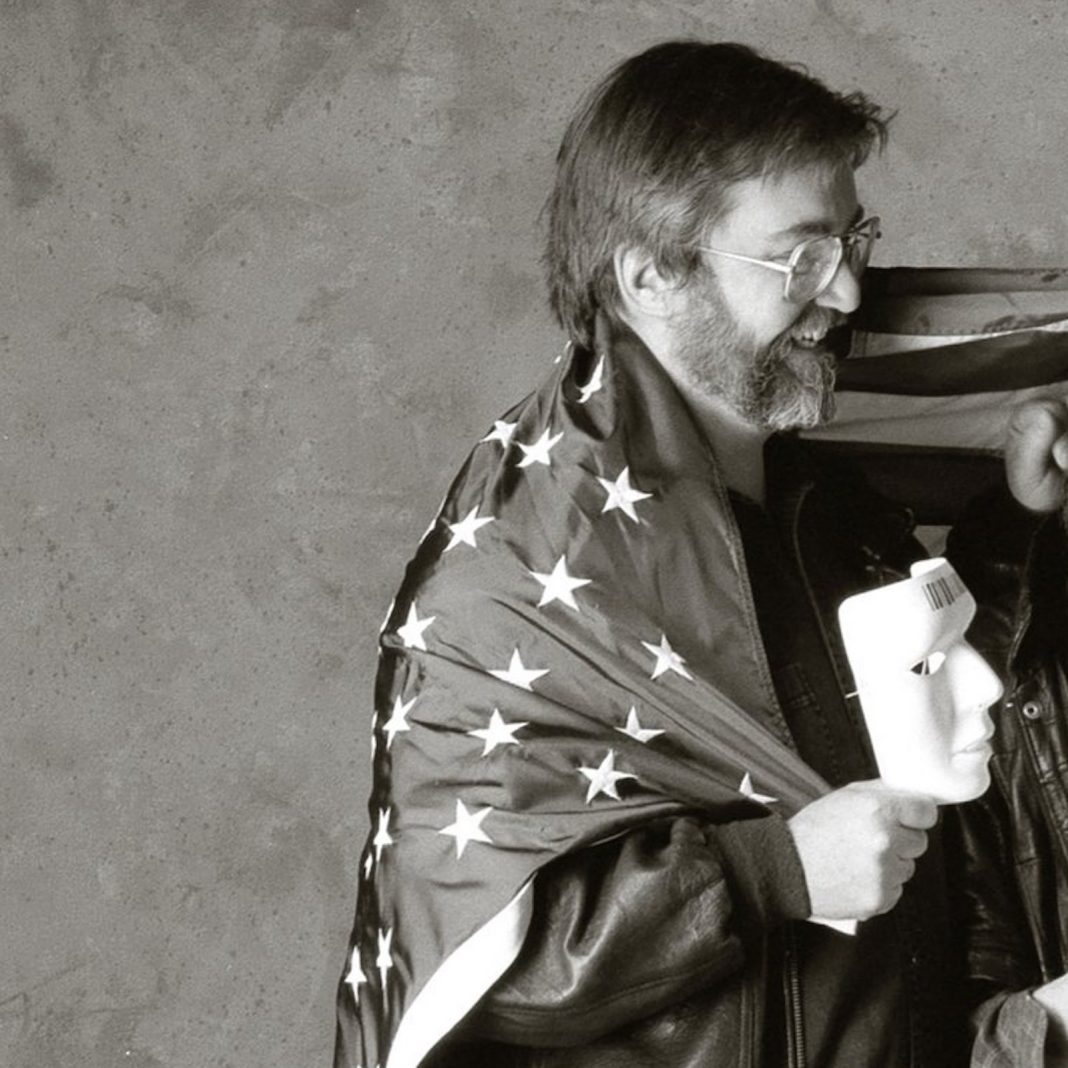
Timothy May
Inspired by Chaum’s 1985 article “Security Without Identification: A Transaction System That Would Make Big Brother Obsolete,” which described a cryptographic method that hides the buyer’s identity, May began studying cryptographic protection with public-key cryptography. He was firmly convinced that, when combined with networked computing, this technology could “destroy the structures of social power.”
In 1988 May published «The Crypto-Anarchy Manifesto», an essay written by him inspired by Karl Marx’s Communist Manifesto.
“A ghost walks through the modern world, the ghost of crypto-anarchy.”
It asserts that information technologies will allow people to govern their lives without governments, and through cryptography, digital currencies and other decentralised tools, anonymity will be catalysed to drive profound social change.
“Computing technologies have come close to enabling individuals or groups to communicate and interact completely anonymously… This will fundamentally alter the nature of government regulation, the ability to collect taxes and control economic interaction, the ability to keep information secret, and even alter the nature of trust and reputation,” — Timothy May wrote.
The manifesto argued that anarcho-capitalism—an offshoot of anarchism that emphasises voluntary transactions and free markets—underpinned the movement.
What is crypto-anarchy?
His essay partly inspired the creation of Bitcoin’s earliest prototypes, and many cryptocurrency proponents regard Timothy May as one of those who laid substantial groundwork for its ideological foundation.
However, in 2018, on the tenth anniversary of the Bitcoin white paper, May stated that, observing events, he felt “some interest, a certain astonishment and strong disappointment,” and that “Satoshi would be nauseated” if he saw the hype and the calls for “to the moon” and “HODL,” as well as the tightening regulation.
«I cannot know what kind of future Satoshi wanted for his creation, but I do not think his vision included cryptocurrency exchanges with their draconian know-your-customer and anti-money-laundering laws, freezing of accounts and mandatory cooperation with intelligence agencies on matters of “suspicious activity.” There is a high likelihood that all this talk about governance, regulation and blockchain will yield a society of total surveillance and control, where every person will have a personal file», May said.
In his view, attempts to “befriend” regulators would likely kill key cryptocurrency use cases that should not resemble PayPal or Visa.
Timothy May coined the term “Four Horsemen of the Infocalypse”, denoting drug trafficking, money laundering, terrorism and pedophilia, used by governments to intimidate and justify restrictions on cryptography and, consequently, on privacy and anonymity.
In December 2018, at the age of 66, Timothy May died of natural causes at his home in California.
The Cypherpunk Manifesto
Timothy May was also a founder of the cypherpunk movement, established in 1992 with John Gilmore and Eric Hughes, and championing privacy for individuals and openness of technology. The movement is said to have emerged at one of the informal gatherings organized by May, Hughes and Gilmore.
Such gatherings became regular; to enlist others who shared the movement’s values, an electronic mailing list called “Cypherpunk” was created. It rapidly drew hundreds of subscribers who tested ciphers, exchanged ideas and discussed new developments. Communication was conducted using cutting-edge encryption methods of the time, such as PGP.
Bitcoin and Privacy — How Cypherpunks Realize the Dream of a Free Internet of the Future
Participants in the cypherpunk mailing list debated political and philosophical questions, which, combined with the study of computer science, cryptography and mathematics, gave rise to The Cypherpunk Manifesto. The document, outlining the movement’s core ideological positions, was published in 1993 by the aforementioned Eric Hughes.
«Cypherpunks write code. We know that someone must continue writing code to protect information, and since we do not see another way to defend our data, we keep writing code. […] Our code is available to anyone on Earth. We do not much care if some people dislike what we do. We know that our programs cannot be destroyed, and an ever-growing network cannot be stopped».
«Privacy is essential to an open society of the digital age. […] Privacy in an open society requires the use of cryptography. […] We, cypherpunks, are bound to create anonymous systems. We defend our privacy with cryptography, anonymous remailers, digital signatures and electronic money. […] Cryptography will inevitably spread across the world, and with it the systems of anonymous transactions that it enables».
The manifesto stressed that privacy and secrecy are not the same.
«Private matters are those that, in a person’s view, the world should not know about; but secrecy is something that nobody should know about at all. Privacy is the ability to decide what information about yourself to reveal to the world».
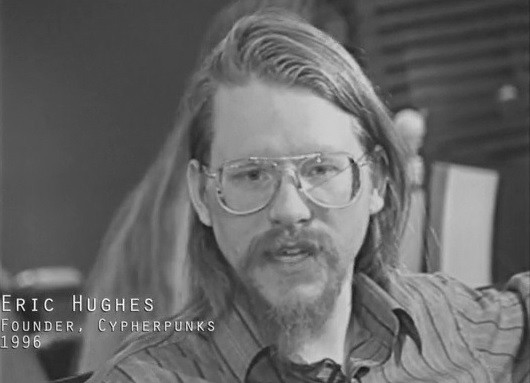
Eric Hughes
And the cypherpunks’ ideas later found partial realisation in cryptocurrencies. Among the mailing list’s members were the creators of the Proof-of-Work algorithm Adam Back, the authors of b-money Wei Dai and Bit Gold Nick Szabo; the movement also influenced Bitcoin’s creator, Zooko Wilcox-O’Hearn (Zcash).
And it was on the cypherpunk mailing list that in October 2008 someone using the pseudonym Satoshi Nakamoto published the famous white paper “Bitcoin: A Peer-to-Peer Electronic Cash System.”
Declaration of the Independence of Cyberspace
In February 1996, the founder of the Electronic Frontier Foundation (EFF) John Perry Barlow published the iconic document titled “A Declaration of the Independence of Cyberspace”, which remains a classic of Internet libertarianism.
The document consisted of hard and uncompromising statements directed at world governments, and it was a response to the telecoms “Concert of Decency” act signed by then-US President Bill Clinton, under which authorities sought to introduce censorship on the Internet.
Barlow argued that if states remain capable of restricting the spread of “seditious” ideas in traditional media, they are powerless on the Internet, which is by its nature immune to sovereign power.
“Governments of the Industrial World, you have grown fat and old; my home is cyberspace, the new home of the Mind. From your future I address you, those of you who are still living in the past — leave us alone. You are obsolete among us. You do not possess sovereignty here where we gather.”
“We did not choose governments, and we are unlikely to ever have one, so I address you with no greater power than that with which freedom itself speaks. I declare that the global social space we are building is inherently not subject to the tyrannies you seek to impose on us. You have neither the moral right to rule over us, nor the means to coerce us that could really scare us.”
“True power for governments comes from the consent of those they govern… You claim that there are problems we must solve. Many of these problems do not exist. Where real conflicts and deficiencies exist, we will identify and fix them by our own means. We establish our own Social Contract. This form of governance will arise according to the terms of our world, not yours. Our world is different.”
“You fear your own children because they feel at home in a world where you will always be immigrants. Because you fear them, you cowardly pass your parental duties to the bureaucratic machine. … Your increasingly outdated information industry would like to perpetuate its dominance by pushing laws—both in America and elsewhere—that claim ownership over speech across the world.”
“These increasingly hostile colonial measures place us in the position once occupied by advocates of freedom and self-determination, who were forced to repudiate the authority of distant uniform power. We must proclaim the freedom of our virtual ‘selves’ from your dominion, even if we agree that you continue to wield power over our bodies. We will spread our ‘selves’ across the world so that no one can arrest our thoughts.”
“We will mould a civilization of the Mind in cyberspace. May it be more humane and honest than the world your governments have created.”
Although the act signed by Bill Clinton was later found unconstitutional by a federal court in the same year, the struggle between advocates and critics of online freedom continues, and Barlow’s Declaration remains highly relevant.
Governments still practice blocking resources, seizing servers, and even making arrests, but cyberspace resists. New means of encryption, anonymity tools and circumvention techniques are emerging.
«I can speak to Edward Snowden completely freely at any time I want, despite the fact that the guys at the NSA would like to know when and what we talk about», said John Perry Barlow in 2016 in an interview with Wired, calling it another proof that governments in the physical world do not hold real power over the Internet.
On 7 February 2018 John Perry Barlow, who also wrote lyrics for the legendary rock band the Grateful Dead, died at the age of 70 in his home in San Francisco. As Wired’s Steven Levy noted in his obituary, Barlow was the Internet’s bard.
Guerrilla Open Access Manifesto
Time, like water, flows and changes. The history of the fight for fundamental rights on the Internet was confirmed when, in 2008, the world saw Aaron Schwarz’s Guerrilla Open Access Manifesto.
According to Schwarz:
«Information is power. But, as power tends to do, there are those who want to possess it single-handedly. All of the world’s scientific and cultural heritage, published for centuries in diverse books and journals, is being rapidly digitised and closed off from sight by a handful of private corporations».
«I agree, — many say, — but what can we do? Corporations own copyright and make huge money. And that is completely legal. We cannot stop them».
«But all these moves occur in a dark underground. This is theft or piracy. […] But sharing information is not immoral. It is a moral imperative. Only those blinded by greed disagree with this».
«Big corporations are undoubtedly blinded by greed. The laws under which they operate require this. Their shareholders will revolt if profits are not there. And politicians bought by corporations will cover for them by drafting the laws they need».
«We need to take information wherever it is stored, make our own copies, and share them with the world. We need to take materials that are not subject to copyright and add them to the archive. We need to buy secret databases and put them into free access. We need to download scientific journals and publish them on file-sharing networks. We must fight for ‘Guerrilla Open Access’».
«With enough of us around the world, we will not only send a compelling message opposing the privatization of knowledge, we will leave this system in the past.»
Born in 1986 in Chicago, Schwarz led a short but bright life, bursting onto the other side of the information space much like Jim Morrison did in the 1960s.
By 14 he was a co-author of the RSS 1.0 specification, after which he worked under Tim Berners-Lee at W3C. Schwarz joined Y Combinator’s first program with the Infogami startup, which later merged with the popular Reddit site, and later worked on projects such as Open Library, Creative Commons and watchdog.net.
Another notable contribution to the Internet’s history was the creation of DeadDrop, later renamed SecureDrop, a platform for anonymously leaking information used by major media outlets. Schwarz’s list of projects is long.
On January 11, 2013, aged 26, Aaron Schwarz committed suicide. Shortly before, he faced charges of hacking into MIT’s computer network, which carried up to 35 years in prison.
*****
Recently, many commentators say that the coronavirus pandemic will alter life indefinitely. In part this may be true. But one thing remains constant: the need for fundamental rights and, particularly, a global network where most activity now takes place.
This implies the inevitability of new technologies, and with them new efforts by the state to bend them to its purposes.
And the emergence of new manifestos outlining the future’s agenda is only a matter of time. Indeed, they are already appearing.
Subscribe to ForkLog’s news on Telegram: ForkLog FEED — the full stream of news, ForkLog — the most important news and polls.
Рассылки ForkLog: держите руку на пульсе биткоин-индустрии!