


Unknown actors in Russia sent bomb-threat letters impersonating a cryptocurrency entrepreneur
The name of Indefibank CEO Sergey Mendeleev was used in a series of false bomb-threat messages across various regions of the Russian Federation. The entrepreneur said this in his Telegram channel.
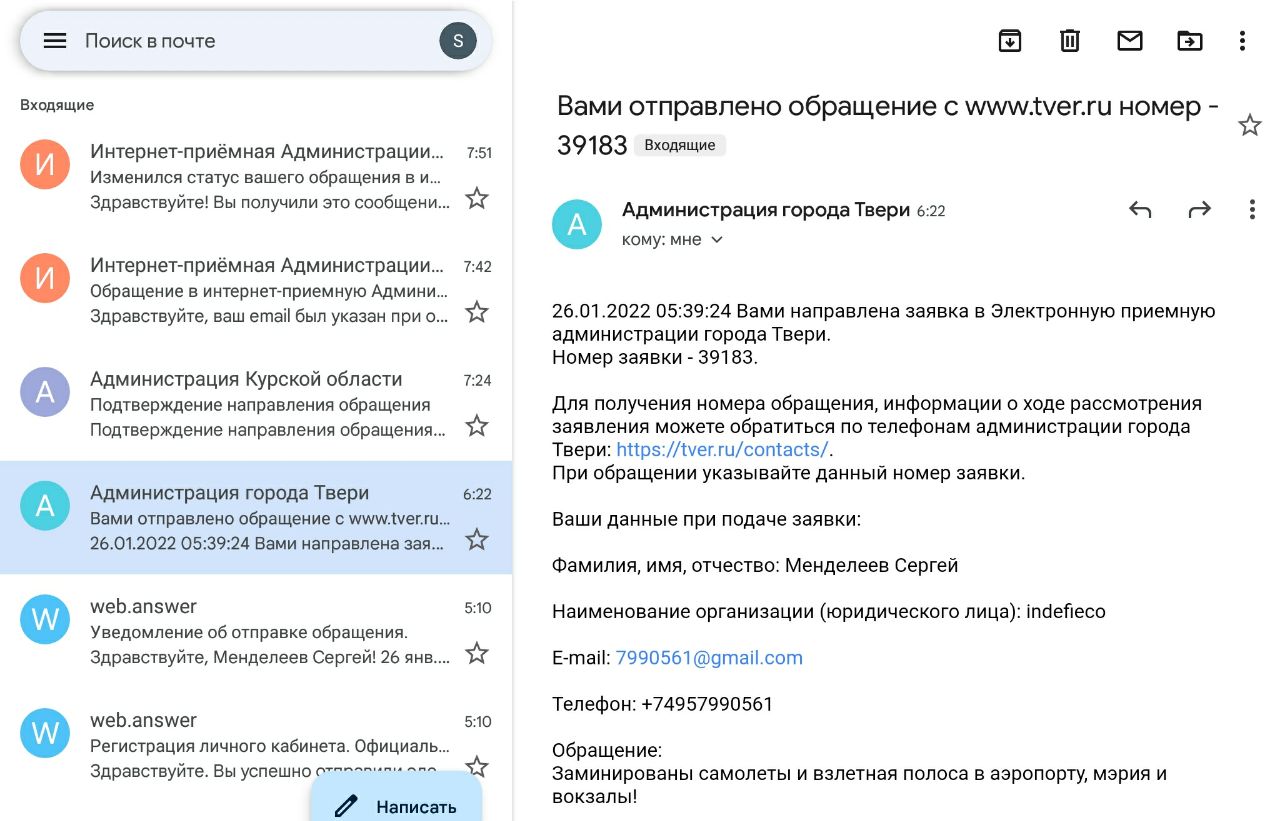
On January 26, Mendeleev’s email inbox received several messages from automated city administration mail bots alleging bomb threats carried out in his name against various infrastructure facilities.
According to available data, the letters were sent to Arkhangelsk, Murmansk, Kemerovo, Tver, Vladimir, Nizhny Novgorod, Kursk and Chelyabinsk, however responses continue to arrive.
In the messages crafted by the attackers, the real email address and phone number of the entrepreneur are included.
According to Mendeleev, attackers reacted to his investigations this way. In particular, he mentioned ForkLog material about the transfer of part of bitcoins from a wallet calling itself a WEX “miner” client to the Binance exchange.
“There’s no need to be Sherlock Holmes to draw the appropriate conclusions about the connection between this provocation and my investigations into the billions of dollars stolen from WEX. By providing real data, the criminals aimed not to destabilize the situation, as recipients called back to verify information, but to turn my downtime into an infernal celebration,” the businessman said in a ForkLog interview.
He added that the incident “is not like schoolyard pranks,” since it is a criminal offense, and is aimed at thwarting its investigations.
“Although the criminals did not reach out to me, I can say only one thing: you won’t get away with it; now I know for sure I am on the right track,” said Mendeleev.
Earlier, a series of false bomb threats across Russia began in November 2019, soon after a BBC investigation reported possible involvement by entrepreneur Konstantin Malofeev and FSB officers in the theft of user funds from the WEX exchange (the successor to BTC-e) totaling $450 million. An unknown “miner” demanded payment of 120 BTC stolen from the exchange.
Since its creation, the miner’s wallet at кошелек «минера» has received 0.11 BTC (a little over $4100 at the time of writing). The latest deposit was in June 2021.
Subsequently, the funds moved to exchange addresses with mandatory user verification, namely Binance, Kraken and Kucoin. In his investigation, Mendeleev indicated that this could potentially help Russian law enforcement identify the perpetrator.
Read ForkLog’s bitcoin news on our Telegram — cryptocurrency news, rates and analytics.
Рассылки ForkLog: держите руку на пульсе биткоин-индустрии!