


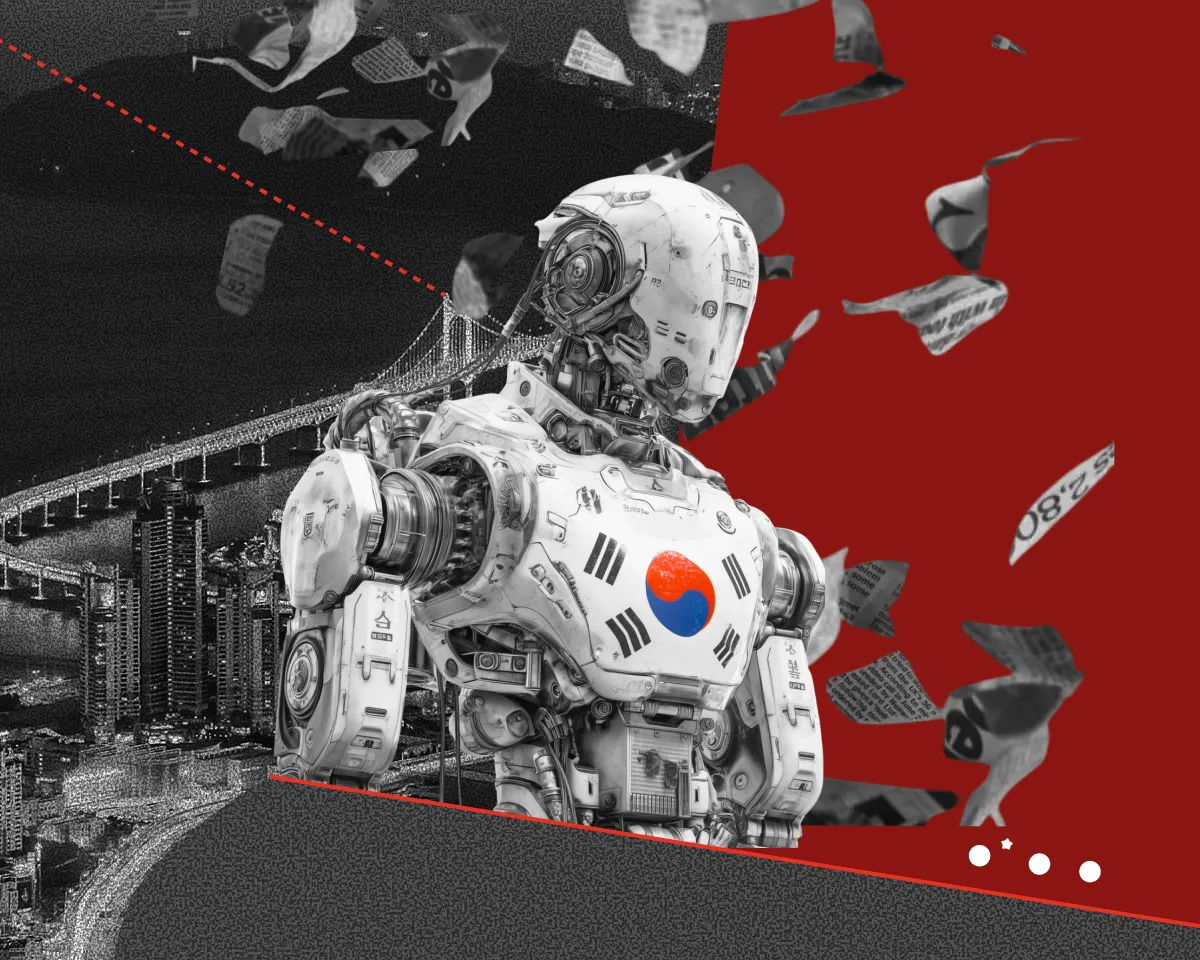
South Korea to develop a sovereign AI
South Korea has tasked several of its largest companies and promising startups with building a national foundation AI model using predominantly domestic technology, CNBC reports.
The project will use South Korean semiconductors and software. Seoul aims to create a largely self-sufficient artificial-intelligence industry and compete with China and the United States, journalists wrote.
ForkLog examines how and why South Korea plans to achieve “AI autonomy”.
Strengths
Nick Patience, head of AI at The Futurum Group, told reporters that South Korea’s approach differs from that of other countries and regions.
“The country aims to combine its dominance in memory-chip manufacturing with the development of its own artificial intelligence,” he said.
The Ministry of Science and ICT announced that five consortia were selected to develop the technology. One is led by telecoms giant SK Telecom and includes the gaming firm Krafton, chip developer Rebellions and others.
Other teams are led by LG and Naver.
“We are going through an important period in terms of our technological development. That is why Korea, at a national level, is placing particular emphasis on building the technical foundation to ensure competitiveness,” said Kim Tae-yun, head of the office for foundation models at SK Telecom.
Strengths
The initiative seeks to leverage the strategic advantages of several South Korean companies and the technologies they are developing that are critical to AI:
- SK Hynix makes high-bandwidth memory, which is vital for Nvidia’s products;
- Samsung is also a major memory player and has its own chipmaking business;
- SK Telecom is expanding in data centres;
- Rebellions develops chips to handle artificial-intelligence workloads.
“The country has the entire AI stack — from chips to cloud computing and models — and a strong community of cutting-edge researchers who actively publish and obtain patents,” Patience noted.
Despite high autonomy, the consortium will still rely on GPUs from the American company Nvidia. SK Telecom will train the models under development on its Titan supercomputer, which consists of advanced Nvidia graphics cards, as well as in a joint data centre with Amazon.
Roadmap
SK Telecom plans to release the first model by year-end. It will initially target the South Korean market and be open source.
“Our first goal is to build a very strong, state-of-the-art open-source neural network, and we already have examples of such solutions that match the performance of big tech players like OpenAI or Anthropic,” Kim said.
A national open-source AI model could benefit businesses across the country, giving them access to cutting-edge technology without having to rely on foreign tech giants.
“Beyond domestic benefits, a proven sovereign LLM has significant export potential. Just as Korea has excelled in memory-chip manufacturing, such a neural network could become a valuable product for other countries seeking alternatives to American or Chinese systems, strengthening Korea’s position in the global AI landscape,” Patience said.
Sovereign AI
The initiative is rooted in the concept of “sovereign AI”, which is gaining traction in many countries.
The idea is that models and services governments deem strategic should be built domestically and run on servers located within national borders.
“All major countries are increasingly worried about AI sovereignty as the United States and China vie for dominance in the field. Given the technology’s growing influence on critical sectors such as healthcare, finance, defence and public administration, governments cannot afford to cede control of digital intelligence to foreign organisations,” Patience stressed.
Other countries are taking different approaches. The United Arab Emirates and Saudi Arabia largely rely on American technology in AI development. In Europe, much hope is pinned on the French startup Mistral AI, which has become the region’s leading company in AI.
AI in South Korea’s military
War has long driven the development of cutting-edge technology, and artificial intelligence is no exception. In recent years South Korea has been actively integrating AI into the military sphere. The government views LLMs as a key element of strengthening defence in the face of contemporary challenges — from North Korea’s nuclear and missile threat to manpower shortages caused by demographic decline.
In the national AI strategy adopted back in 2019, special attention was paid to defence — in particular, to using and processing big data with AI. The South Korean army created an AI R&D centre to plan deployment of the technology in command-and-control, intelligence and firepower systems, among others.
In 2023, President Yoon Suk Yeol’s administration launched the large-scale programme Defense Innovation 4.0 (“Defence Innovations 4.0”), focused on bringing fourth-industrial-revolution technologies into defence.
One of the initiative’s flagship projects was the opening in April 2024 of the Ministry of National Defense’s AI Centre. It was developed over about a year with experts from the defence ministry, the Korea Advanced Institute of Science and Technology (KAIST), universities and private companies.
The centre develops technologies for teaming piloted and unpiloted systems with AI elements, situational awareness on the battlefield and other AI-based applications for the armed forces.
A major emphasis is on so-called on-device AI — intelligence embedded at the device level that works autonomously without constant cloud connectivity. The defence ministry believes on-board AI will ensure reliability and security in combat conditions where connectivity to a central node may be absent.
Another government initiative is the creation of a unified defence cloud and opening military data to industry. In July 2025 it emerged that the government intends to share large troves of classified military information with private defence companies to accelerate the development of AI-enabled weapons.
Funding
South Korea is placing major emphasis on funding AI initiatives, including in defence. President Yoon has set the goal of making the country a global leader in neural networks and announced that roughly 9 trillion won (~$6.94 billion) will be invested in the sector by 2027.
An additional $1 billion fund has been created to support domestic AI microprocessor developers, which are also important for military applications.
Research and development spending in the defence budget is set to rise significantly: by 2027 its share should exceed 10% of total defence spending. The funds will focus on around 30 priority military technologies across ten areas, including artificial intelligence, robotics, quantum computing, hypersonics and others.
In August 2024 the government also adopted a five-year “technological sovereignty roadmap” providing for roughly $23 billion of investment across 12 strategic areas, including AI.
The defence industry itself is seeing a surge of activity, backed by public funding and policy. Large corporations are forming partnerships and investing in military AI. For example, the leading defence-electronics firm Hanwha Systems in 2025 signed agreements with 11 leading universities and IT companies to co-develop sovereign LLM technologies for the military.
The aim is to build a domestic defence-AI ecosystem and reduce reliance on foreign software and algorithms in sensitive applications. Hanwha and partners, in particular, are developing a battlefield situational-awareness model based on technology that will detect and analyse threats in real time and help commanders make decisions in air-defence systems.
Applications
In practice, AI is already beginning to be used across several areas of South Korea’s armed forces. First among them are unmanned and autonomous systems — from aerial drones to ground vehicles.
Several years ago the South Korean army announced the creation of so-called “dronebots” — combat units equipped with swarms of drones and robotics for reconnaissance and strike operations.
After an incident in December 2022 when several North Korean drones violated South Korean airspace, Seoul markedly raised the priority of developing its own drones.
In 2023 a dedicated Unmanned Operations Command began work, using compact reconnaissance drones and strike UAVs. In developing tactics it is studying foreign experience, including the successful use of Turkish Bayraktars in Ukraine.
South Korea is now producing several types of military drones with AI elements. The startup Nearthlab unveiled the XAiDEN strike drone in 2025, capable of carrying 60 mm mortar munitions and operating in a swarm with autonomous coordination. The system is equipped with its own “thinking” based on artificial intelligence, enabling a group of ten drones to conduct synchronous reconnaissance, pursue and hit moving targets without constant operator control. One leader with a communications link is sufficient; the other nine follow algorithms and continue the mission even under GPS and radio jamming.
If one drone drops out, another instantly takes its place. According to the developers, this ensures a near-100% probability of mission success.
Beyond small UAVs, South Korea is developing larger autonomous systems. Korea Aerospace Industries (KAI), in collaboration with the Agency for Defense Development (ADD), is working on a “loyal wingman” for the KF-21 fighter. The prospective “Boramae” aircraft would be accompanied by a group of drones that could penetrate dangerous zones first, identify and attack targets, while the piloted aircraft remains at a safe distance.
AI technologies are also being embedded in the latest ground systems. Hyundai Rotem, together with DAPA, is exploring a next-generation K3 main battle tank (targeted for the 2030s) with a wide range of AI-based solutions. The tank is expected to feature a 130 mm automatic gun with an autoloader in an unmanned turret, and a fire-control system augmented by AI that will handle autonomous tracking and engagement.
AI is also planned to assist the crew in decision-making, sensor management, sighting systems, navigation and overall situational awareness.
Command and communications are likewise in focus. South Korea has begun developing the next generation of its integrated force-management system, with AI playing a central role. According to the defence ministry, it will unify communications and information systems across all branches, turning them into a single, controllable command-and-intelligence loop.
AI is being used more actively in cybersecurity and intelligence. South Korean security services report rising risks involving neural networks and are deploying the technology themselves to analyse cyberthreats and large volumes of intelligence data.
The national intelligence service has been designated the coordinator for AI threats, and a group within the government’s security apparatus has been established to monitor AI risks.
Military research organisations such as ADD are also working on projects where AI helps process satellite imagery, forecast adversary actions and model combat scenarios. Although details are classified, Seoul aims to use the technology to improve the speed and accuracy of decision-making in defence.
There is also discussion of using generative models for training and simulation — creating virtual adversaries and scenarios for soldier training, which has already been partially implemented at augmented-reality ranges.
Key players
The state plays a determining role in advancing military AI in South Korea. Under government auspices a “triple helix” of defence agencies, high-tech private industry and academia is taking shape.
The defence ministry and other government bodies (DAPA, ADD) act as customers and coordinators, setting priorities — whether unmanned systems, command-and-control or cybersecurity. The largest corporations — Hanwha, LIG Nex1, Korea Aerospace Industries, Hyundai Rotem and others — have become the main industrial partners, committing resources and expertise to government programmes.
For example, Hanwha Systems has demonstrated prototypes of AI-enabled naval combat systems — at exhibitions the company presented shipborne combat information and control systems capable, with the help of LLMs, of identifying targets faster and allocating threats.
LIG Nex1 is developing fire-control systems and precision weapons that use computer-vision algorithms for guidance. KAI, as noted, is responsible for avionics with AI elements.
Major telecommunications and IT companies are also joining in. Naver, operator of the largest cloud platform, is involved in projects for the military cloud and intelligence-data processing algorithms, while KT and Samsung SDS are certified as cloud-service providers for the armed forces.
Academic institutions — KAIST, the Korea Institute for Defense Technology and leading universities — receive state grants for research in military AI and train specialists for the field.
In July, the government of India backed the startup QpiAI under the National Quantum Mission.
Рассылки ForkLog: держите руку на пульсе биткоин-индустрии!