



This week in crypto: Bitcoin primed for a breakout as Ethereum 2.0 final testnet launches
As the week draws to a close, we recall Pantera Capital’s optimistic forecast, the New York regulator’s ‘green list’ of cryptocurrencies, attacks on Ethereum Classic and other events.
Cryptocurrency markets
Throughout the week, bitcoin’s price remained within a narrowing range, rebounding somewhat after a sudden correction from the $12,000 level.
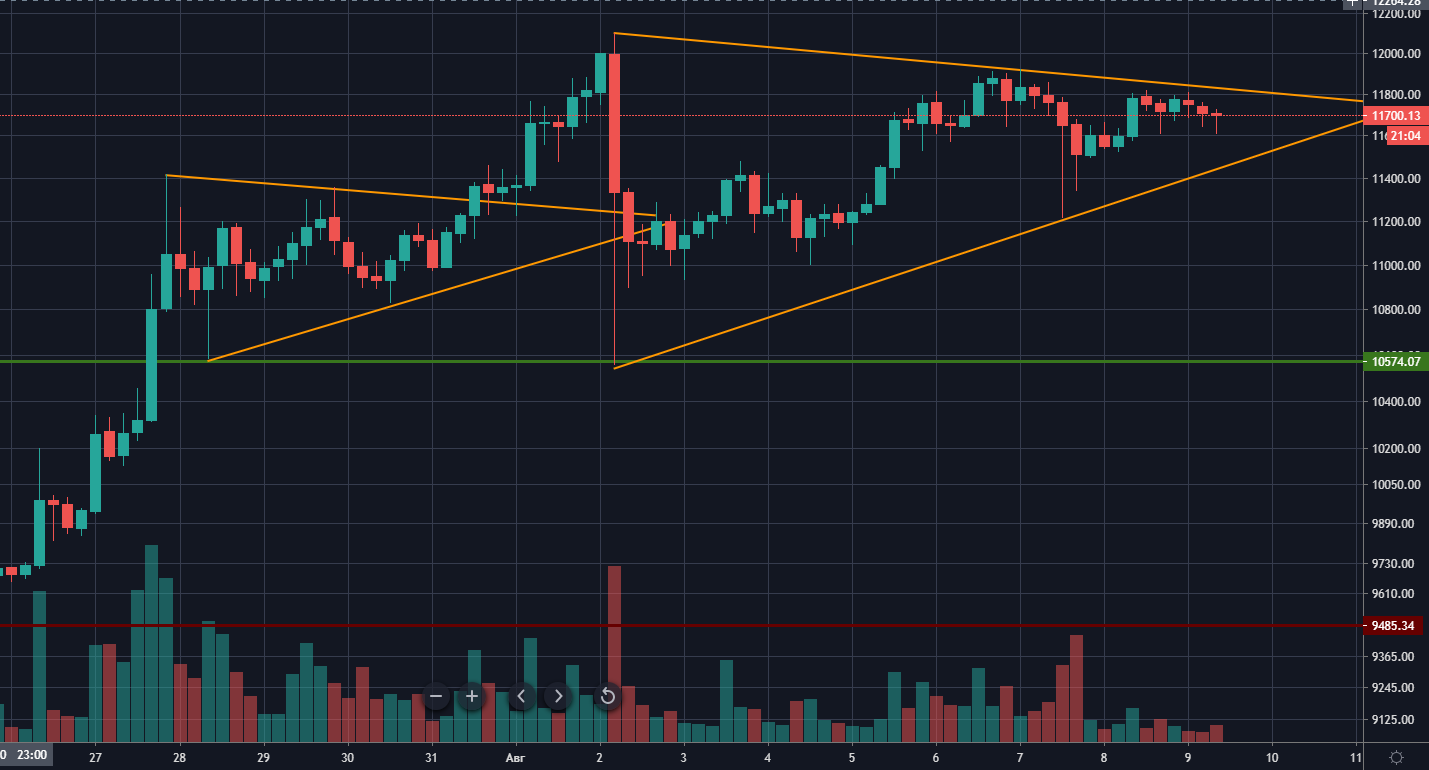
Four-hour BTC/USD chart from Bitstamp on TradingView
The price of the leading cryptocurrency is once again confined within a symmetrical triangle. Given the uptrend preceding the formation, a breakout above the upper boundary of the pattern is most likely, followed by an impulsive rise. However, for that breakout to occur, it should be accompanied by a surge in trading volumes.
A breakout below the lower boundary of the triangle cannot be excluded either. In that scenario, the price would likely find support near $10,570.
Among the top ten by market capitalization, Chainlink demonstrated the greatest volatility, its price reached an all-time high. The token is now fifth by market capitalization, according to IntoTheBlock.

Bitcoin’s 30-day volatility stands at 34.24%.

At the current price, 93% of BTC holders are in profit. In general, IntoTheBlock’s on-chain metrics show bearish signals. ByteTree’s data, meanwhile, indicate the asset is overvalued by 44%, and its fair value would be $8,076.
Total cryptocurrency market capitalization stands at $357 billion, and Bitcoin’s dominance index is 60.4%.
Pantera Capital chief makes optimistic bitcoin forecast
The CEO of the well-known crypto hedge fund Pantera Capital, Dan Morehead, is confident that within two years Bitcoin will be worth more than $100,000.
In his view, investors should allocate capital to the leading cryptocurrency but not more than they are prepared to lose. Positions should be held for 10-15 years.
Morehead drew attention to custodial services, which have created conditions for institutional investors to enter the industry. However, he asserts that whales are unlikely to line up; the process of institutionalization will be gradual.
All told, Pantera Capital manages about $600 million in assets, part of which belongs to Morehead himself. According to him, Ethereum, Polkadot, Filecoin, Augur and 0x constitute a substantial share of the firm’s portfolio.
Developers launch Ethereum 2.0’s final testnet
On August 4 at block #1596546008, the Ethereum Foundation launched the final testnet of Ethereum 2.0 named Medalla. A day after the launch, Medalla attracted 20,349 validators.
The testnet does not use real ETH and does not permit earning real rewards. It is designed solely to prepare the second-largest cryptocurrency for the transition to a Proof-of-Stake consensus mechanism.
To launch, the condition of depositing 524,288 test ETH for staking fulfilled the requirement.
“The launch of Medalla is a tremendous milestone in ETH 2.0 development. If it remains stable, the next step will be the launch of the mainnet. This is the result of years of hard work by a huge number of engineers, researchers, and participants in the community,” said Ethereum Foundation developer Danny Ryan.
Initially, the network is supported by five clients: Lighthouse, Nimbus, Prysm, Teku and Lodestar. Cortex and Trinity are expected to be supported later.
Adam Back compared Ethereum to Bitconnect and Onecoin
CEO of Blockstream Adam Back placed Ethereum in the same category as fraudulent projects OneCoin and BitConnect.
Back’s words were uttered in an interview with journalist Laia Heilpern, who raised the question of which coins investors favor in the crypto market. The statement sparked a wave of criticism in the crypto community.
Besides Ethereum, the pioneer of the bitcoin industry also mentioned Ripple, Cardano and Stellar. The list of comparisons also included Bernard Madoff, founder of a $64bn Ponzi scheme, and Charles Ponzi, as well as Block.one’s CTO Dan Larimer.
“My respect for you has faded, since you are willing to judge me the same as others. I thought you were more prudent, civilized and educated,” Larimer replied.
The disparaging critique of Back did not go unnoticed by Ethereum co-founder Vitalik Buterin, who noted the significant progress in the development of the second-largest cryptocurrency.
Ethereum Classic attacked twice in a week
Ethereum Classic experienced a second 51% attack in a week. The damage from the first attack amounted to 807,260 ETC (~$5.6m), according to Bitquery analysts’ estimates.
As a result of the second attack, a segment of the network depth of 4,236 blocks was reorganized. This allowed the attacker to perform double-spends worth $1.68 million.
The attacker is believed to have rented the compute power on the NiceHash marketplace to execute the attack.
The address to which the attacker sent part of the stolen coins (143,000 ETC in several transactions) was linked by Bitquery to the Bitfinex exchange. The other portion (95,650 ETC) was sent to a wallet at an as-yet-unidentified service.
Ethereum Classic developer ETC Labs announced a partnership with investigation-focused law firm Kobre & Kim and analytics service CipherTrace. Together they aim to locate the attacker and hold him accountable.
New York regulator publishes a ‘green list’ of cryptocurrencies
The New York State Department of Financial Services has published a ‘green list’ of digital assets that licensed firms can operate with without additional permissions.
The coins are divided into two categories: those permitted for custody and those permitted for listing.
The regulator lists Bitcoin, Ethereum, Litecoin, Ripple, Bitcoin Cash, Ethereum Classic, Binance USD, Gemini Dollar, Pax Gold and Paxos Standard among the first category. The second category includes the same assets, except Ethereum Classic and Ripple.
Any licensed organization may use coins from the ‘green list’ for ‘permitted purposes’, but must inform the NYDFS in advance.
Researchers estimate how much electricity altcoin miners consume
About a third of the electricity used for mining cryptocurrencies is attributable to altcoins. This is evidenced by data from a study by the Technical University of Munich, which examined the 20 largest-cap cryptocurrencies by Proof-of-Work.
Ethereum accounts for 11.46% of total energy consumption, Bitcoin Cash (BCH) is at 2.44% in third place. The smallest share among the coins studied is Bytecoin at 0.01%. BTC and ETH together account for 79.85%.
ForkLog exclusives:
- CoinMetrics developed an original approach to assessing the trustworthiness of exchange-volume data. It shows that data from slightly more than a dozen exchanges are worthy of trust.
- Researchers from Anicca Research explained what options exist for those looking to invest in mining beyond buying and connecting hardware to the network.
- ForkLog gathered current information on China’s BSN, intended to be the ‘internet of blockchains’.
ForkLog Live
Renowned trader Tone Vays shared his Bitcoin price forecast for autumn 2020.
Max Bit spoke with consensus protocol designer Andrey Sobolev about Ethereum 2.0 prospects amid Medalla’s launch.
A meetup focused on the Cosmos ecosystem recently took place.
Follow ForkLog on YouTube!
Рассылки ForkLog: держите руку на пульсе биткоин-индустрии!