




Bitcoin and Ethereum updated local lows after the Federal Reserve meeting, hackers stole $160 million from Wintermute, Cardano developers activated the Vasil upgrade, and other events of the past week.
Bitcoin and Ethereum updated local lows
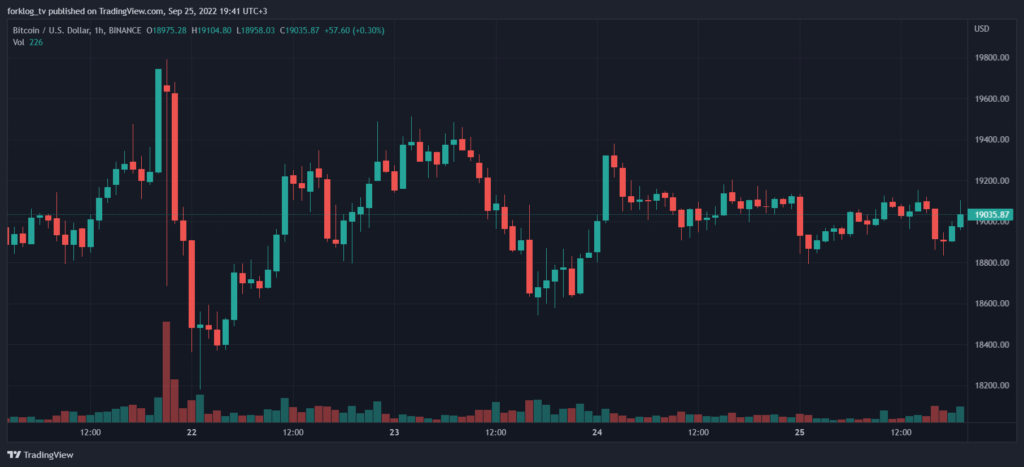
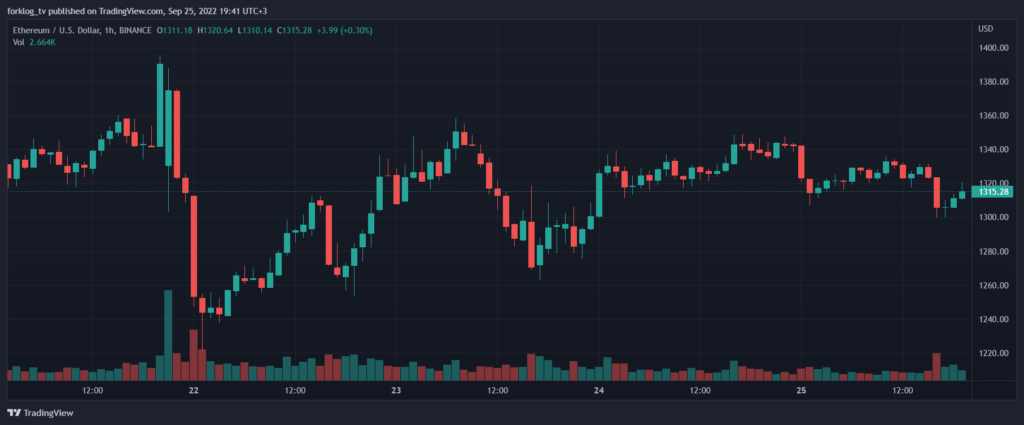
This week the leading cryptocurrencies updated local lows since June. On Thursday, September 22, Bitcoin dropped to $18,125, and Ethereum to $1,220.
The backdrop was the U.S. Federal Reserve meeting on September 21. The regulator raised the target range for the federal funds rate by 75 basis points, to 3–3.25%.
As of writing, Bitcoin traded near $19,000, Ethereum around $1,315.


The flagships led the rest of the market. Almost all top-10 cryptocurrencies by market capitalization were in the red. The exceptions were XRP (+33.9%) and Dogecoin (+0.5%).


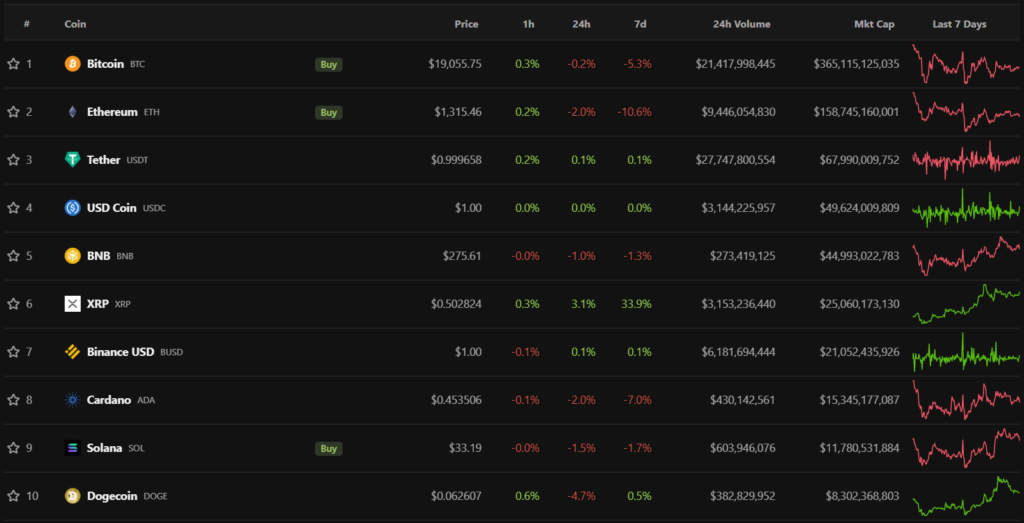
The total market capitalization of cryptocurrencies stood at $974.75 billion. Bitcoin’s dominance index fell to 37.5%.
Hackers stole assets worth $160 million from Wintermute
On September 20, market maker Wintermute suffered assets worth $160 million as a result of a hacking attack. The platform’s CEO, Evgeny Gaevoy, stressed that the targets were DeFi operations, while OTC and CEX modules continue to operate as before.
Later it emerged that the attacker exploited a vulnerability in the Profanity tool to generate vanity addresses containing words, names or phrases. The issue had been flagged earlier by 1inch researchers.
Almost 20% of blocks on the upgraded Ethereum were MEV-boosted
After Ethereum’s shift to Proof-of-Stake (PoS), 18% of blocks in the network were generated using MEV, providing validators with additional rewards for staking. By leveraging MEV-boost, participants using it could earn 122% more profit. The blocks they produced contained 41.4% more transactions.
According to Glassnode, in the four days after the network’s transition to PoS, daily issuance of coins fell from 48,400 ETH to 3,893 ETH. The increased network activity led to higher fees, making Ethereum deflationary for a short period.
Cybersecurity firm BlockSec discovered an exploit related to the Ethereum PoW fork (ETHW). Researchers found that the OmniBridge smart contract for Gnosis Chain incorrectly checked the chainID parameter. This allowed attackers to obtain an additional 200 ETHW by sending an equivalent amount in WETH. The PoW fork developers stressed that the issue lies in the contract, not in the new blockchain.
SEC and Ripple seek a resolution in XRP status case
SEC and Ripple Labs filed motions for a decision on whether XRP’s status falls under securities laws. The plaintiff and defendant said the judge has sufficient information for a ruling.
Later, CEO Brad Garlinghouse stated the case would not be sent to a jury trial, as the dispute primarily concerns the application of the law.
Cardano network activates the Vasil hard fork
On September 23, Input Output Global successfully activated the Vasil upgrade on the Cardano mainnet. The upgrade will significantly boost the network’s throughput and potential by increasing capacity, enhancing script performance and efficiency, and reducing costs.
MicroStrategy adds 301 BTC for $6 million
Analytical software provider MicroStrategy bought an additional 301 BTC for $6 million. Founder and former CEO Michael Saylor said the purchases were made between August 2 and September 19 at an average price of $19,851. To date, MicroStrategy and its subsidiaries hold 130,000 BTC, having spent about $4 billion.
FTX chief hints at another $1 billion for crypto acquisitions
FTX founder Sam Bankman-Fried, in an interview with CNBC teased a willingness to spend “roughly $1 billion” on crypto companies and projects.
Later, reports citing sources close to the exchange said that FTX intends to raise $1 billion and to confirm the $32 billion valuation of the prior funding round. Terms have not been finalised, and talks continue.
Media: Binance faces xenophobia in Voyager Digital asset bid
Binance’s participation in the auction for Voyager Digital assets faced scrutiny over national security concerns. A exchange spokesperson said that the discussions of a potential blocking by the Committee on Foreign Investment are rooted in xenophobia, despite Binance being a Canadian company fully owned by a citizen of that country.
It was also disclosed that Alameda Research, affiliated with FTX founder Sam Bankman-Fried, will pay down $200 million to Voyager Digital. It will pay 6,553 BTC, 51,204 ETH and smaller sums in other tokens. The deal is expected to close by September 30.
What to discuss with friends?
- Binance paid out 4.8 million HNT to users for $19 million.
- FT learned of South Korea’s request to Interpol regarding Do Kwon.
- SEC charged YouTube blogger Yan Balina with involvement in an unregistered ICO.
- WhiteBIT became a cryptocurrency partner of Netflix.
Jess Powell to step down as Kraken CEO
Kraken co-founder Jess Powell will step down from the CEO post and take the chair of the board. He has led the platform since its 2011 inception and remains its largest shareholder. The company will be led by Chief Operating Officer Dave Ripley.
US lawmakers consider bill to block sanctions evasion via bitcoin
The U.S. House of Representatives passed the Russia Cryptocurrency Transparency Act, intended to prevent Russia and Belarus from evading sanctions through cryptocurrencies.
The U.S. Treasury and State Department must report to Congress on any attempts to use digital assets to circumvent sanctions by Russia and sanctioned individuals, as well as their interactions with exchanges, wallets, exchangers and DeFi platforms.
Binance to charge Terra Classic交易 tax after trader quorum
Binance will introduce a transactional tax on Terra Classic (LUNC) trades. If the trading volume of program participants reaches 50% of the asset’s total on the platform, the levy will be extended to all customers, said CEO Changpeng Zhao.
Binance will begin taxing subscribers once their trading volume with LUNC reaches 25% of the asset’s total on the platform. After the 50% threshold is reached, the levy will apply to all traders on the exchange interacting with Terra Classic.
Also on ForkLog:
- Michael Saylor predicted a new Bitcoin high within four years.
- In the United Kingdom proposed to simplify and speed up crypto withdrawals.
- Binance added the ability to verify via “Diia”.
- JPMorgan chief labelled cryptocurrencies as “decentralised Ponzi schemes”.
What else to read?
We explored how the global financial crisis will affect the cryptocurrency market, how long the downturn might last and how severe it could be.
ForkLog examined the nuances of the founder’s controversial plan to decouple the DAI stablecoin from $1. It highlighted the main opposing forces within the project and weighed the risks associated with the proposal.
New cards were released on Tornado Cash and the reasons for its blocking, the Filecoin blockchain, and the gaming platform Chilliz. It also explained what MEV is in the Ethereum network and how it will change after the shift to PoS.
In traditional digests, we compiled the week’s main cybersecurity and artificial intelligence news in one place and and.
The DeFi sector continues to attract heightened attention from crypto investors. ForkLog has compiled the most important events and news of recent weeks in a digest.
Read ForkLog’s bitcoin news in our Telegram — cryptocurrency news, prices and analysis.