
As the week draws to a close, we recall Bitcoin’s new price record, the upcoming Ethereum 2.0 launch, new questions surrounding the identity of Satoshi Nakamoto, and other key events.
Market Rebounds as Bitcoin Rises Above $19,000
On Monday, November 23, Ethereum breached the $600 level. The last time the coin traded at such levels was June 2018. On the next day a new yearly high was set and Bitcoin—its price rose above $19,000, with a market capitalization exceeding $350 billion.
Equally impressive gains were posted by other alts, notably XRP and Stellar. The XRP price updated a two-year high above $0.70, and the XLM price surpassed $0.22.
Market activity led to a revival in the derivatives market—open interest in Bitcoin and Ethereum options reached an all-time high at $4.5 billion, and a day later превысил $5 billion. The 2020 record trading volume was also registered on spot platforms — the metric surpassed the levels seen during Bitcoin’s March crash.
Against this backdrop, the number of large investors holding more than 1,000 BTC on addresses rose to a historical maximum, approaching 2,000.
Days later the leading cryptocurrency faced resistance. As a result, on November 26 the price fell by $3,000, briefly reaching $16,200. The total futures liquidations reached $1.3 billion. Following the drop, Ethereum briefly fell below $500.
Nevertheless on Saturday the market rekindled: Bitcoin moved back above $18,000, Ethereum trades above $550.


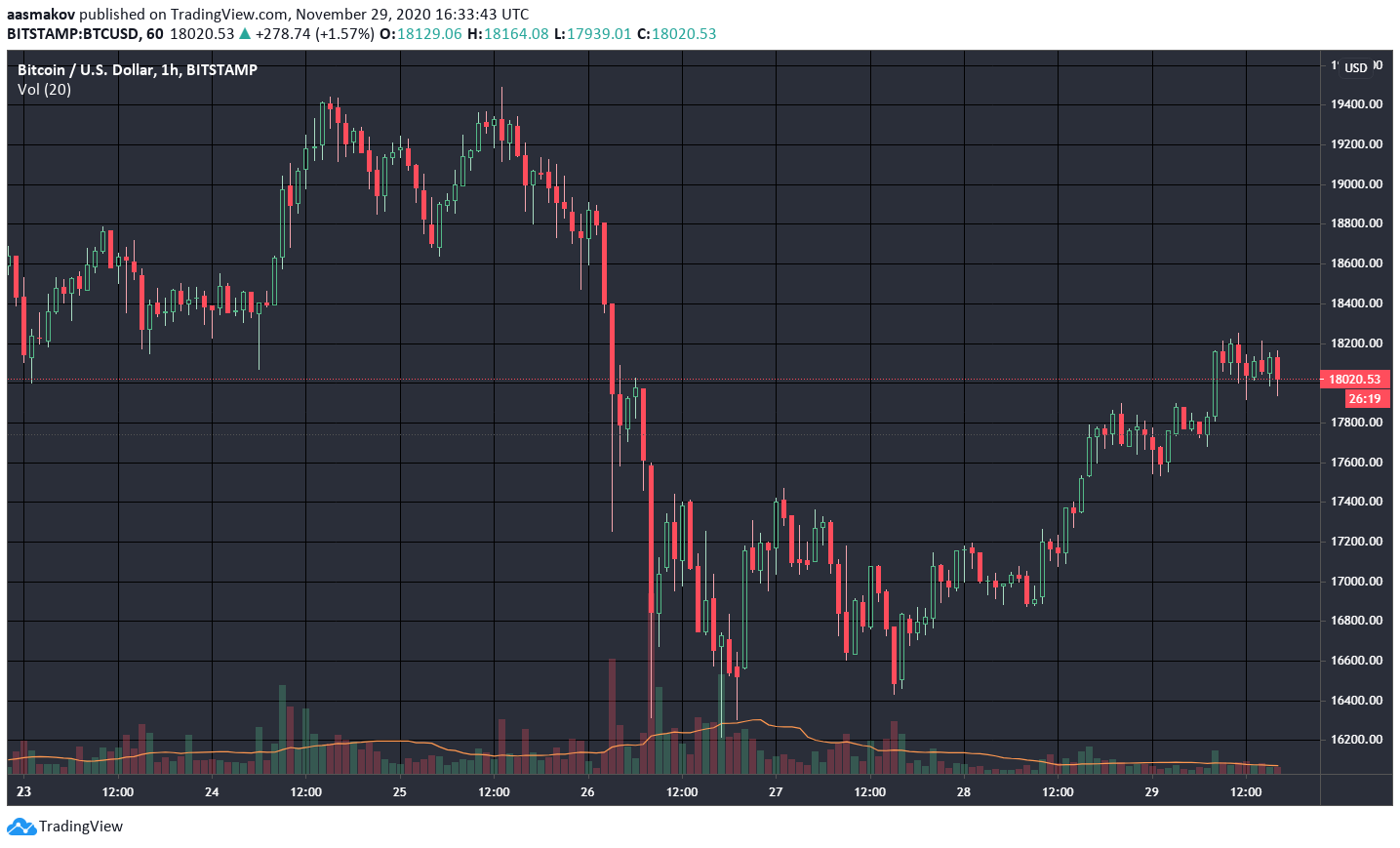
Hourly BTC/USD chart from Bitstamp on TradingView.
The deposit contract for Ethereum 2.0 has surpassed the required threshold
On Tuesday, November 24, the balance of the deposit contract, which enables transferring ETH from the existing network to ETH2, exceeded the required threshold of 524,288 ETH and 16,384 validators. This means the launch of Ethereum 2.0 Phase 0 will take place on schedule – December 1.
Over the past weekend, the deposit contract balance surpassed 50% of the required amount, after which deposits began growing at an accelerated pace. The latest 25 000 ETH were deposited by Celsius Network, a cryptocurrency lending service.
As of Sunday, November 29, the balance of the contract exceeded 800 000 ETH, and the number of validators rose above 26,000.
Note that in the run-up to the launch of Eth2 Phase 0, the mining difficulty of the second-largest cryptocurrency, as well as its total hash power reached historical highs.
Thanos hard fork occurred on the Ethereum Classic network
On Saturday, November 28, the Ethereum Classic saw the planned Thanos hard fork. Its goal is to improve the security of this cryptocurrency after a series of 51% attacks.
The Thanos update (ECIP-1099) will double the Ethash (Etchash) epoch length from 30,000 to 60,000 blocks, effectively reducing the size of the directed acyclic graph (DAG). This will allow GPUs with 3GB and 4GB to resume mining Ethereum Classic.
In October, the Ethereum Classic Core and Ethereum Classic Labs teams implemented in the Mordor testnet the Exponential Subjective Scoring (MESS) solution. The new finalization algorithm nearly 31 times increased the cost of block reorganization, removing, it is claimed, the incentive for 51% attacks.
What about institutional players?
Guggenheim Partners, which manages assets above $200 billion, announced plans to allocate part of its portfolio to the Grayscale Bitcoin Trust (GBTC).
Under the plan, the firm intends to invest 10% of the assets of its Macro Opportunities Fund into GBTC. Estimates put Macro Opportunities Fund assets at around $5 billion. Investments in GBTC in this manner would amount to about $500 million.
In addition:
- Gazprombank (Switzerland) Ltd launched test trading of bitcoins.
- VanEck announced the addition of physically backed bitcoin exchange-traded notes (ETNs) to the list of traded instruments. Trading started on Xetra, the German exchange operated by Deutsche Boerse.
- MicroStrategy earned nine times more from Bitcoin investments than in 2019—the value of its cryptocurrency holdings rose from $425 million to $735.2 million.
- Galaxy Digital’s Bitcoin funds, led by Mike Novogratz, attracted $58.7 million from institutions over the year.
- Coinbase said that institutional assets under custody in its custodial service rose to $20 billion.
OKEx resumes withdrawals
On Thursday, November 26, OKEx resumed withdrawals. The service had been unavailable since October 16, when the exchange said it had lost contact with one of the holders of private keys.
An hour after withdrawals resumed, 5,681.79 BTC left OKEx. Some coins were sent to Binance, Huobi and other exchanges.
CryptoQuant CEO Ki Young Ju said that resuming withdrawals from OKEx probably could not have contributed to Bitcoin’s fall below $17,000, as 83% of the first-wave withdrawals went to off-exchange wallets.
The Russian government approved a bill on declaring cryptocurrency transactions
The Russian government approved a bill on the procedure for providing tax reporting when carrying out cryptocurrency operations.
The amendments provide:
- up to three years in prison for holders of digital currencies who do not report operations worth the equivalent of 45 million rubles or more;
- an obligation for individuals and organisations to report to the Federal Tax Service on receipt of digital currency, deals with it and balances in crypto wallets if annual operations exceed the equivalent of 600,000 rubles.
Experts called the measures “inadequate” and warned that they would catch a large portion of traders in Russia.
Earlier this week, Russian Prime Minister Mikhail Mishustin promised to steer cryptocurrency development onto a “civilised path.”
Trump administration suspected of preparing a “farewell gift” for the crypto industry
This week Coinbase CEO Brian Armstrong shared his concerns about plans by the administration of U.S. President Donald Trump to tighten user controls over cryptocurrencies.
He said that Treasury Secretary Steven Mnuchin is reportedly planning to accelerate the introduction of new rules for local cryptocurrency wallets before the end of his term. The initiative would require Coinbase and other financial firms to verify the owners of non-custodial wallets before withdrawals. The initiative would require Coinbase and other financial firms to verify the owners of non-custodial wallets before withdrawals.
“If such regulatory measures for the cryptocurrency industry are approved, this would be a horrific legacy and would have a lasting negative impact on the United States,” he emphasized.
The post of U.S. Treasury Secretary in the new administration of Joe Biden is expected to be taken by former Federal Reserve chair Janet Yellen. Morgan Creek Digital co-founder Anthony Pompliano called this “great news for Bitcoin.”
Media reports Libra launch timeline
The Libra project team is preparing to release the digital currency in January 2021 in a “restricted format,” said Friday, citing sources familiar with the situation in the Financial Times.
The stablecoin will not be pegged to a basket of fiat currencies as originally proposed. Instead, Libra will launch a USD-backed coin on a 1:1 basis.
It is expected that the corresponding permission to operate as a payment service will be issued by the Swiss Financial Market Supervisory Authority (FINMA) as early as January.
But the news was almost immediately met with a reaction from the European Central Bank. ECB Governing Council member Fabio Panetta warned that Libra users would bear higher credit, market, and liquidity risks, and that the launch of the stablecoin could pose “potential systemic consequences” and threaten the fate of fiat currencies.
ForkLog Exclusives
Why is Bitcoin rising? ForkLog shed light on the most likely reasons for the current rally.
We published a translation of the article “Bitcoin: An unprecedented experiment in fair distribution.” Its authors are co-founder of Digital Asset Research Lucas Nucci and the Coin Metrics team, who found that the first cryptocurrency is evenly distributed among a broad base of users.
This week saw two final articles in Dmitry Bondar’s NFT cycle. In the first and second parts we discuss the prospects of the collectibles market.
New versions and mysteries in Satoshi Nakamoto’s history
This week stales details of previously unknown correspondence between Bitcoin’s creator Satoshi Nakamoto and the recipient of the first transaction, Hal Finney, were revealed. Three letters are dated late 2008 and early 2009.
Also published is a study suggesting that Satoshi Nakamoto worked on Bitcoin while based in London.
What else to watch and listen to?
A new ForkLog video focuses on the developer who has become one of the main figures in this year’s DeFi craze. The subject is Andre Cronje, creator of Yearn Finance and the YFI token, whose peak price reached $44,000.