
Coinbase began trading on Nasdaq, the Berlin hard fork occurred on the Ethereum network, leading cryptocurrencies reached new price highs, Gary Gensler was confirmed as chair of the U.S. Securities and Exchange Commission, and other events defined the week.

Bitcoin and other leading cryptocurrencies by market cap hit price records, but a correction followed
On Wednesday, 14 April, Bitcoin surpassed the $64 000 mark, setting a new all-time high.
Prices did not sustain the level, but by the weekend the asset traded comfortably above $60 000.
Alongside Bitcoin, Ethereum also set a record, trading above $2350, and on 15 April the token traded above $2500.
Binance Coin rose to a new high on Monday, 12 April, trading above $600. On Friday, 16 April, Bitcoin Cash traded above $1000 for the first time since summer 2018 and Dogecoin approached its all-time high near $0.40. The asset rose into the top 5 by market cap.
Over the following 24 hours Dogecoin fell by 40%.
Bitcoin price tumbled on the morning of Sunday, 18 April, briefly trading below $52 000.


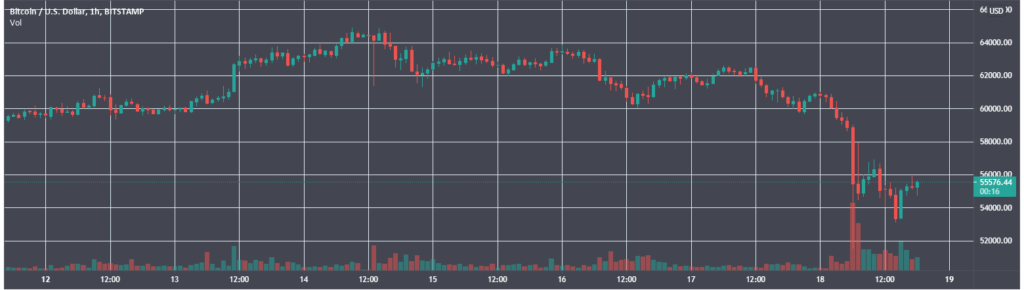
The sell-off dragged the market lower; Dogecoin did not rally, having already endured a substantial correction.
Some analysts, including Willy Woo and Tone Vays, linked the Bitcoin drop to a sharp decline in hash rate, prompted by electricity outages in parts of China.
Larry Cermak, head of research at The Block, did not share the view, arguing the decline reflected natural market exhaustion.
LOL if you think the hashrate drop was the reason for the dump you’re ngmi. https://t.co/Xx1R8xQY1n
— Larry Cermak (@lawmaster) April 18, 2021
“On weekends there is low liquidity, markets have been rising for weeks, many players are over-leveraged, and many negative narratives converge,” he said.
The market drop led to the largest daily liquidation by volume in history, totaling over $10 billion, according to bybt. More than a million traders were affected.


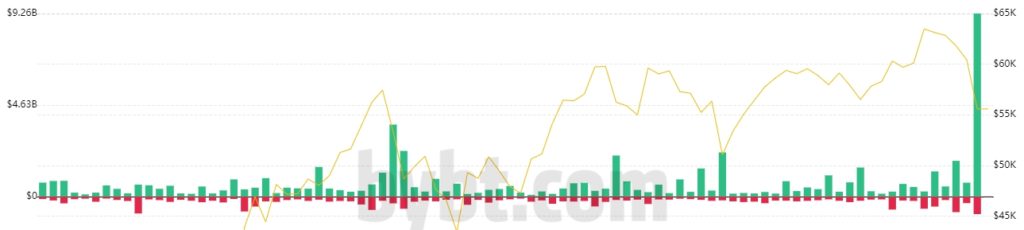
As of writing, Bitcoin was trading around $55,000.
By week’s end, virtually all leading cryptocurrencies were in the red or near it. Dogecoin and Bitcoin Cash stood out (per CoinGecko).


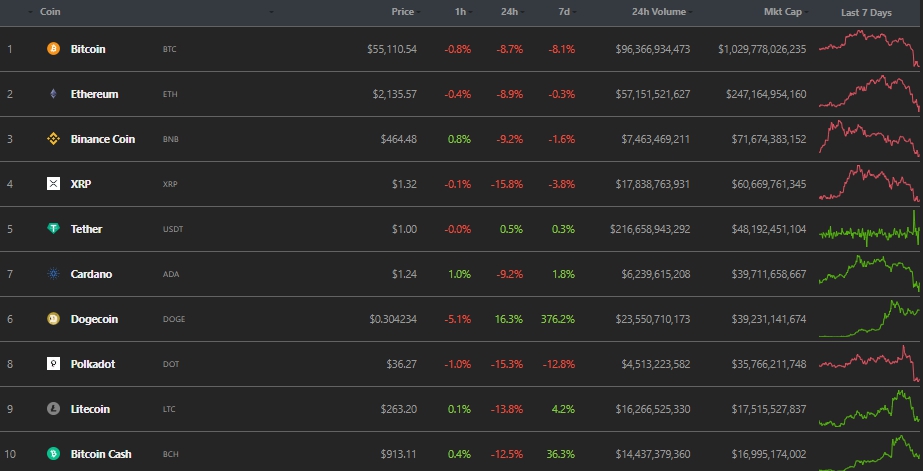
Total market capitalisation fell to near $2 trillion, with Bitcoin’s dominance at 50.3%.
Coinbase lists on Nasdaq with a $100 billion valuation
On 14 April, a direct listing of Coinbase shares on Nasdaq took place. The opening price was $381.
At the open, COIN traded up to $429.54. The exchange’s market capitalisation surpassed $100 billion, making it the most valuable exchange in the world — larger than the New York Stock Exchange and even Nasdaq itself.
Trading closed at $328.28, down 13.9% from the open. The session’s low was $310, the high $429.54. Market capitalisation fell to around $85.7 billion.
The day before, Nasdaq had set a reference price for Coinbase at $250, implying a valuation of about $66 billion. On FTX, COIN was priced at more than $620.
The listing was immortalised on the Bitcoin blockchain. The mining pool F2Pool included in block #679187 the headline “House Gives Final Approval to Biden’s $1.9T Pandemic Relief Bill Mine” from The New York Times dated March 10, 2021. This is a nod to the genesis block.
On the first day COIN traded on Nasdaq, Binance announced the addition of Coinbase stock tokens to its listing. But due to high volatility, the launch of Coinbase Stock Token trading was postponed by a day to April 15.
After the listing, many Coinbase executives sold large blocks of stock.
Ark Invest, on the first day of trading COIN, purchased 749,205 shares for $246 million, and a day later bought an additional 341,186 shares for $110 million.
According to Forbes, the stake rose to $565 million.
On 16 April, Coinbase announced that as part of the listing it would award $1.5 million in Bitcoin to users.
Under the terms, users must register on the trading platform by 22 April and complete verification by 29 April. Only U.S. residents are eligible.
More than 12,000 BTC from the Bitfinex hack moved
On 14 April, as Coinbase listed and Bitcoin hit new highs, coins stolen in 2016 from Bitfinex began moving.
In total, hackers moved about 12,200 BTC (~$770 million), in more than 65 transactions.
The Berlin hard fork in Ethereum. After that, a network glitch was recorded
On 15 April, in Ethereum’s mainnet at block #12 244 000 the Berlin hard fork occurred, implementing four proposals:
- EIP-2565;
- EIP-2929;
- EIP-2930;
- EIP-2718.
After block #12 244 294 the network recorded issues with syncing nodes using OpenEthereum 3.2.1. The majority of the network remained functional.
The OpenEthereum bug affected data providers such as Etherscan and Coin Metrics. The issue was resolved after a few hours.
Gary Gensler named SEC chair
The U.S. Senate confirmed Gary Gensler, President Joe Biden’s nominee, to head the U.S. Securities and Exchange Commission (SEC).
Gensler — a former CFTC chair — has previously spoken positively about blockchain, Bitcoin and cryptoassets. He called digital gold “a catalyst for change” and pledged to work on “driving innovation” if confirmed.
Hashrate of leading mining pools fell after Chinese mine outages
The hashrate of leading Bitcoin mining pools fell sharply amid electricity supply problems following explosions and flooding at coal mines in several Chinese provinces.
According to Xinhua, the first incident occurred at the end of March at a coal mine in Shanxi; a methane explosion occurred. On 9 April a gas leak occurred at a mine in Guizhou, and on 10 April a mine in the Xinjiang region was flooded.
Primitive Ventures’ managing partner Dovey Wan reported a roughly 30% decline in hashrate as outages persisted amid comprehensive safety checks.
Russian banks will create the first blockchain operator in Russia
Several large Russian banks agreed to create the country’s first blockchain operator to advance distributed-ledger technology.
Documents establishing LLC “Distributed Ledger Systems” were signed by Gazprombank, VTB, PSB, the National Payment Card System (NSPK), Moscow Exchange and AFK.
Participants in the AFТ decided to carve out a blockchain division in a separate legal entity to develop Russian IT services and blockchain technologies.
Binance conducted a BNB token burn of almost $600 million
The Binance exchange carried out the fifteenth quarterly burn of Binance Coin (BNB). 1 099 888 BNB were removed from circulation.
At the time of the operation this equated to $595 million — a record in fiat terms.
Bitmain unveils Ethereum mining ASIC
The Bitmain mining hardware maker will release a new model of device designed to mine Ethereum, the second-largest cryptocurrency by market cap.
The AntMiner E9 is compatible with the Ethash algorithm. The company did not disclose full technical specifications or the device price.
According to journalist Colin Wu, the AntMiner E9’s hashrate could be around 1500 MH/s.
Edward Snowden sells his own NFT for $5.5 million
Former NSA and CIA contractor Edward Snowden sold his first non-fungible token (NFT) for 2224 ETH — about $5.5 million at the time of the sale.
The NFT Snowden sold via Foundation entitled Stay Free depicts a digitally edited portrait of Snowden formed from documents in a lawsuit against the NSA.
Among other news in the rapidly growing field:
- The anonymous artist Murat Pak sold his work “The Pixel” as an NFT for $1.36 million.
- YouTuber Stas Davydov tokenised the cult phrase “And that’s good” from the YouTube show “This is Хорошо.”
- Filmmaker Kevin Smith will auction his new horror film “Killroy Was Here” as an NFT.
- NYSE released its first NFT collection to mark IPOs by high-tech US firms.
- Topps will release the first official MLB trading-card series as NFTs.
- Participants in Kyiv’s art collective INTROVADERS created a video featuring journalist Dmitry Gordon and put it up for sale as an NFT.
Developers implemented the Taproot activation method in Bitcoin Core
Developers implemented in the May release of Bitcoin Core the Speedy Trial activation method, which will allow miners to approve or reject the upgrade quickly.
The mechanism provides a three-month window during which 90% of mined blocks must signal support for the upgrade. If the threshold is reached, Taproot will activate within the following three months; otherwise the upgrade will not proceed.
Ukraine proposes reporting Bitcoin-wallet addresses in declarations
The Public Association “Virtual Assets of Ukraine” and the cross-faction Blockchain4Ukraine group proposed to the head of the National Agency on Corruption Prevention Alexey Novikov to change the declaration of cryptocurrencies.
The authors advocate replacing the term “cryptocurrency” with “virtual assets,” as enshrined in the law regulating their circulation. This would cover a wider range of digital assets including cryptocurrencies, tokens, stablecoins, NFTs, DeFi-tokens and gaming currencies.
Also, they propose including in declarations non-custodial crypto-wallet addresses where assets are held, and verification data for custodial-wallet owners.
Meanwhile, the Verkhovna Rada adopted in the first reading a bill proposing prison terms for officials who hide crypto holdings worth more than $40 500.
Ukrainian MP David Arakhamia commented on the situation with the declared 46 000 BTC. He believes those who declare cryptocurrency will face legal proceedings concerning the origin of the digital assets. He also explained how he lost access to a wallet with 400 BTC.
ForkLog also wrote:
- The Central Bank of Turkey banned crypto payments, while the Turkish lira collapsed and the price of Bitcoin in the country surged.
- CNBC’s Jim Cramer sold half of his bitcoins to pay off a mortgage.
- A 1982-era computer was forced to mine Bitcoin.
- Addresses linked to the “Troll Farm” were placed under U.S. sanctions .
- Changpeng Zhao: the crypto industry is not ready to operate without government intervention.
- A study shows Bitcoin’s energy use has risen 66-fold since 2015.
What else to read and watch
Coinbase’s Nasdaq listing was one of the defining events for the industry. In a new feature ForkLog revisited the exchange’s history, studied its ecosystem and analysed its financials.
On Monday, 12 April, Max Bit hosted a discussion with analyst Maxim Onegin about the Filecoin ecosystem and other crypto assets.