




Despite macro headwinds and military conflicts, the crypto market held key price levels; the Moscow Exchange launched a bitcoin index; the SEC scrapped past DeFi and custody proposals—and more from the week.
Bitcoin holds firm amid instability
On Monday the leading cryptocurrency opened with a climb to $107,000, even as ETFs saw sizeable outflows and mass protests erupted in the U.S.
According to Ryan Lee, chief analyst at Bitget Research, the positive momentum reflected macro developments, including talks between the U.S. and China and signs of deflation in the latter’s economy.


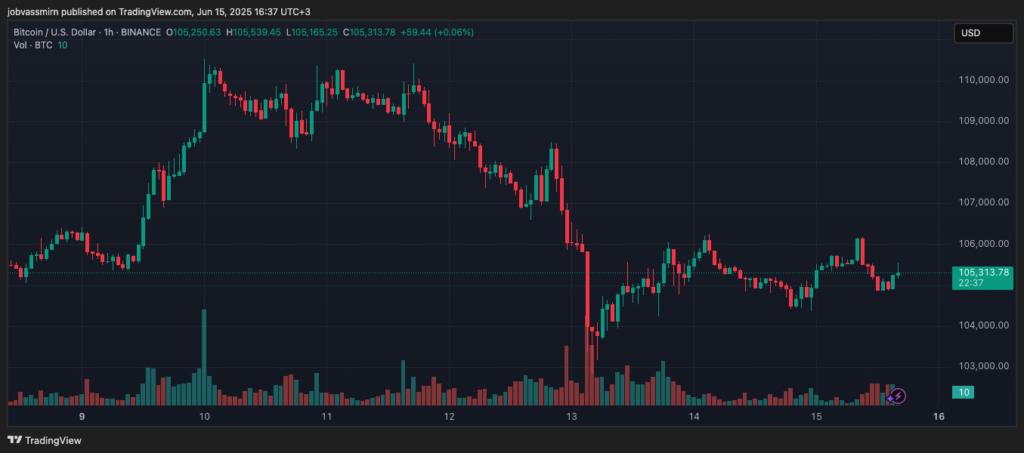
On Tuesday, June 10th, bitcoin neared $110,000. At the same time, the Coinbase premium reached February levels, pointing to interest from U.S. buyers.
After the release of U.S. CPI on June 11th, the price of digital gold barely moved. May CPI rose 0.1% versus 0.2% in April; year on year, without seasonal adjustment, it ticked up to 2.4%.
The print came in below analysts’ expectations of 2.5%.
On June 12th bitcoin plunged from $108,000 to $103,000 following Israel’s attack on Iran. Ethereum was hit harder, sliding 9.2% to $2500.
Markets later retraced part of the drop and remain stable for now. At the time of writing, the leading cryptocurrency trades at $105,050.
The broader crypto market largely followed suit. Over the week, however, Ethereum gained 0.8% versus -0.2% for bitcoin.


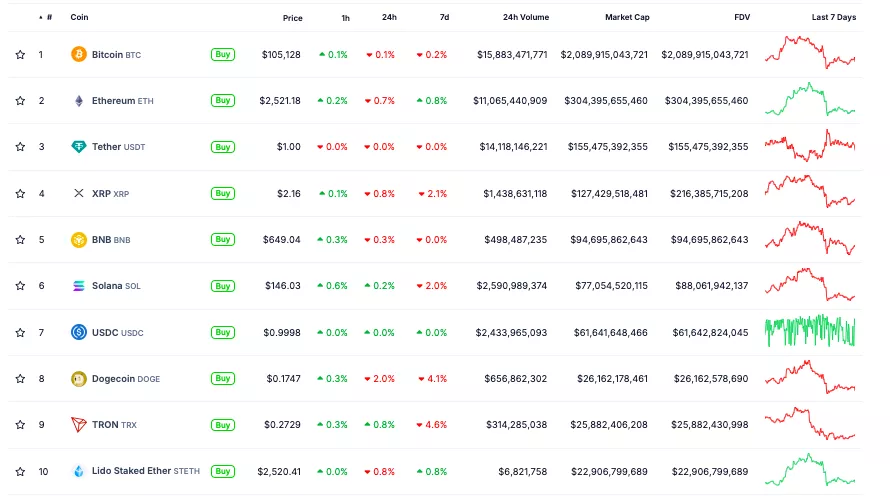
Among the top ten by market value, TRX (-4.6%), DOGE (-4.1%) and XRP (-2.1%) fell the most.
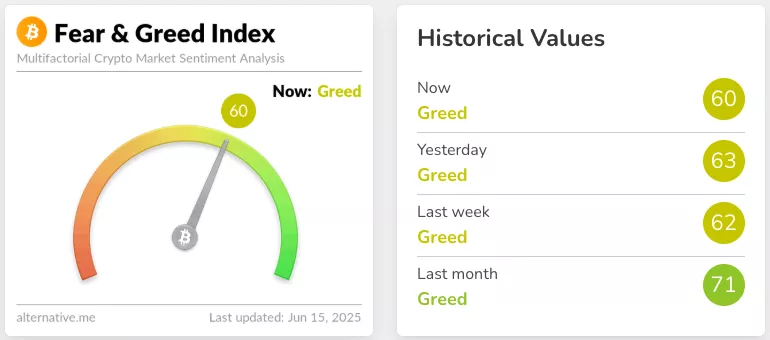
The crypto Fear & Greed Index sits at 60, indicating investor “greed”.

A Moscow index
From June 10th, the Moscow Exchange started publishing a bitcoin index under the ticker MOEXBTC.

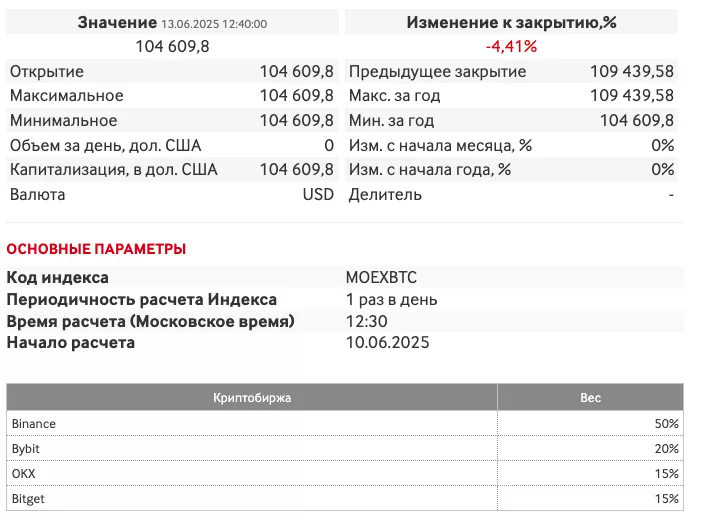
“The [MOEXBTC] index is a price indicator reflecting the value of derivatives linked to the BTCUSDT pair on the largest crypto exchanges. The index is calculated as a weighted average of prices, taking into account weighting coefficients for the selected trading venues,” the platform’s website says.
The index weight is split across four exchanges: Binance (50%), Bybit (20%), OKX (15%) and Bitget (15%).
In time, the index could become the underlying for new financial instruments, paving the way for exchange-traded products tied to the price of the leading cryptocurrency on Russia’s traditional market.
Roman Nekrasov, co-founder of ENCRY Foundation, sees the launch as largely symbolic “in terms of direct impact” at this stage. The index is a reference point for professionals and can be used in calculations, but its practical value will emerge only once derivatives arrive.
Technobit CEO Alexander Peresichan likewise views the index as a foundation for future products. In his view, it could serve as a base for derivatives.
What to discuss with friends?
- On-chain activity on the Bitcoin network fell to October 2023 levels.
- Coinbase: 60% of Fortune 500 companies are adopting blockchain.
- OpenAI services experienced a global outage.
- A researcher identified rampant bot activity on Pump.fun.
An SEC reset
This week the U.S. Securities and Exchange Commission officially withdrew rules proposed by former chair Gary Gensler concerning DeFi and crypto-asset custody.
Among them was a draft amendment to Exchange Act Rule 3b-16 that would have broadened the definition of an “exchange” to bring decentralized platforms under “traditional” oversight.
Also withdrawn was a proposal to tighten crypto-asset custody requirements. It would have forced investment advisers to use only qualified custodians and introduced additional safeguards.
Other canceled initiatives included tougher cybersecurity requirements and disclosures on ESG practices for investment companies.
Earlier, the current SEC chair Paul Atkins announced a new approach to non-custodial holding of cryptocurrencies. He called the right in question “a fundamental American value”.
Atkins added that he supports giving market participants more flexibility to self-custody cryptoassets. In his view, this is especially important where intermediation creates “unnecessary fees” or limits participation in staking and other on-chain activities.
Ripple’s expansion
Ripple’s ecosystem saw several notable launches and announcements. At the Apex 2025 event in Singapore, Ripple CTO David Schwartz said the team is working on an EVM-compatible sidechain slated for release in the second quarter of 2025.
The new solution will combine XRPL’s low transaction costs with Ethereum smart-contract functionality. It is being developed by Ripple and Peersyst using the evmOS software stack.
The sidechain will connect to the XRP Ledger (XPRL) mainnet via a cross-chain bridge. The Axelar protocol will be used as the exclusive solution, enabling asset transfers, including wrapped XRP (wXRP), which will become the native token for gas payments.
Investment firm Guggenheim Treasury Services also launched digital commercial paper on the XPRL network.
The product comprises tokenized notes issued by fintech startup Zeconomy and backed by U.S. Treasury bonds.
The XRPL launch marked an expansion for Guggenheim; previously, the firm had rolled out trading instruments on Ethereum.
By week’s end, Circle launched the USDC stablecoin on Ripple’s network. According to a joint statement, the initiative aims to “increase the utility of the ledger, expand on-chain liquidity, and unlock new avenues for innovation.”
Meanwhile, Ripple CEO Brad Garlinghouse voiced an ambition to compete with SWIFT. In his view, within five years the XRP token could account for up to 14% of global cross-border payment volumes processed by the interbank messaging network.
Also on ForkLog:
- Bernstein outlined Ethereum’s key advantages.
- Ukraine registered a bill on cryptoassets in state reserves.
- An analyst predicted an “altcoin-ETF summer”.
- A Bitcoin Core update included removing the data limit for OP_RETURN.
The “bitcoin family’s” security
Amid a wave of offline crimes against crypto holders, Didi Taihuttu—head of the so-called “bitcoin family”—has completely overhauled how he stores assets.
Over the past eight months, he and his relatives ditched hardware wallets. The family now uses a hybrid system: seed phrases are encrypted, split into parts and hidden across four continents.
Some data are stored in encrypted form on a blockchain; others are engraved on metal plates in physical caches. Taihuttu also applied personal encryption by replacing certain words in the phrase.
“Even if a gun is held to my head, I can’t hand over more than what’s on the wallet in my phone. And that’s not much,” Taihuttu said.
Roughly 65% of their assets are now held in such vaults. The patriarch plans to tap the capital only if bitcoin reaches $1m—a milestone he thinks could arrive by 2033.
Before this change, the Taihuttus had repeatedly received threats. The family had to move and conceal their address.
Speaking to ForkLog, NoOnes P2P platform CEO Ray Youssef said distributing keys across four continents can be justified in some cases, especially for preserving generational wealth or protecting assets from hostile actors. For most people, including industry newcomers, however, it is “overkill”.
“It is far more important to understand why self-custody is paramount. Security does not always mean complexity. Today there are tools and platforms that make secure, self-sovereign storage accessible to regular people—even those operating in difficult environments. And this is where we must go next: build solutions secure enough for a whale but simple enough for a street vendor,” Youssef added.
He noted that Taihuttu’s decision shows “the importance of security on a global scale,” but the approach is not for everyone.
Youssef also reminded readers of the need for self-custody:
“Today the most reliable model for retail investors is one that combines personal control with multi-layered protection: where possible, multiple signatures, backups and perhaps even geographic distribution if the stakes are high. But it all starts with education and accessibility.”
What else to read?
As part of the new “Silicon Tanks” series on the most influential philosophers and visionaries of the digital age, we explored the career of the Briton Nick Land.
Learn how mass adoption is unfolding in the black economy, the money-laundering schemes of drug cartels, and how the U.S. might add to its bitcoin reserve.