




A hacker siphoned assets worth $611 million from the Poly Network protocol, but later returned them all; the SEC demanded terabytes of Slack messages from Ripple employees; in the US Senate, no agreement was reached on amendments to the crypto taxation section in the infrastructure bill, and other developments of the week.
Bitcoin tops $48,000 for the first time since May; Ethereum at $3,300
The first cryptocurrency started the week higher. On Monday, August 9, prices rose nearly 6%, at one point breaching the $46,000 level. Throughout the week the asset traded in a range of roughly $43,600 to $46,800. On Friday the price approached the $48,000 mark, and on Saturday it managed to breach it.
As of writing, bitcoin is trading near $46,000.


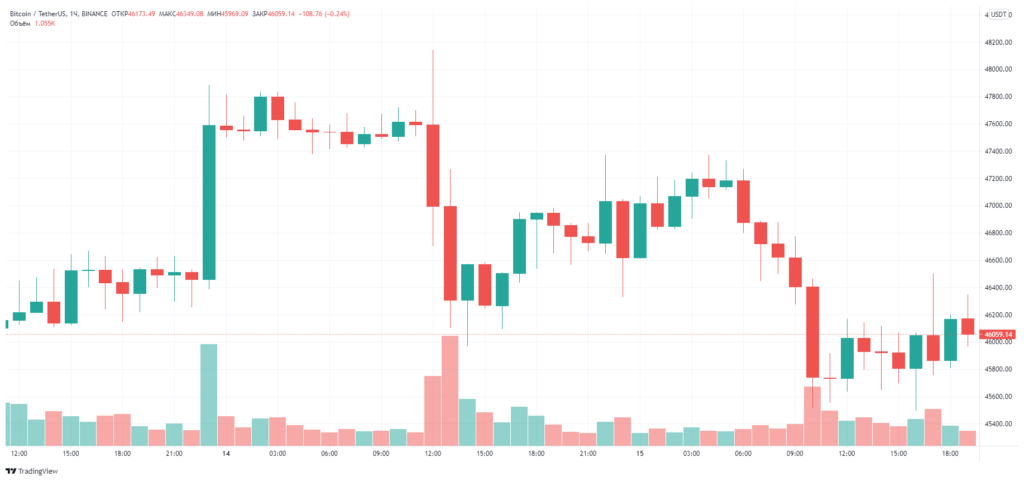
Earlier, Bloomberg Intelligence senior commodities strategist Mike McGlone, in a new report, forecast Bitcoin to reach the $100,000 mark.
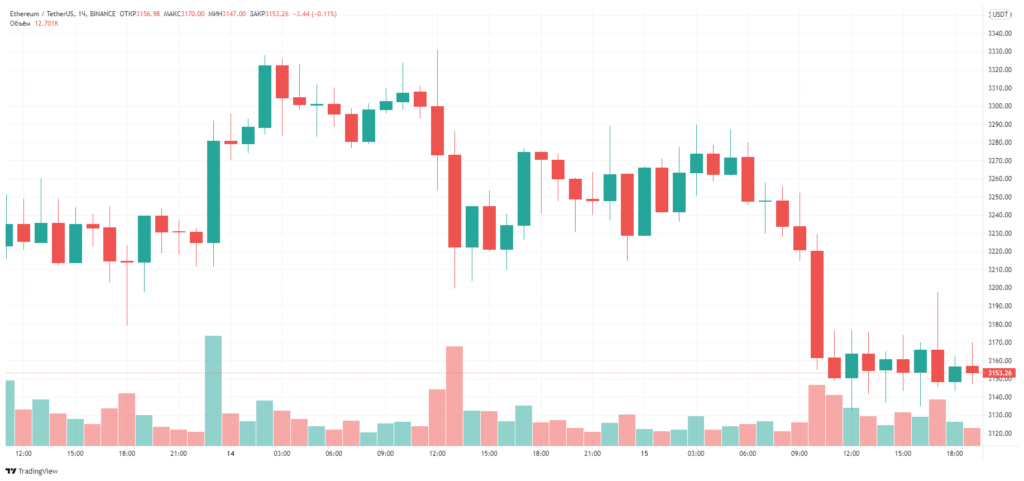
Ethereum’s price this week topped the $3,300 level for the first time since May, but failed to hold above this level. As of writing, the second-largest cryptocurrency trades near $3,150.
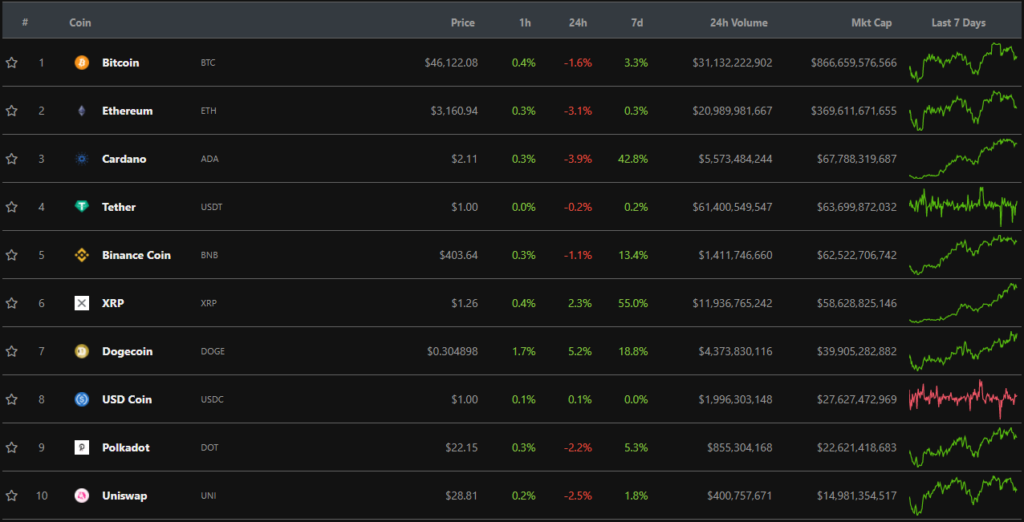
Over the last seven days, Bitcoin rose 3.3%, Ethereum — only 0.3%, according to CoinGecko. All top-10 assets by market cap also finished green. Cardano rose nearly 43%, and the cryptocurrency climbed to third place in the rankings.


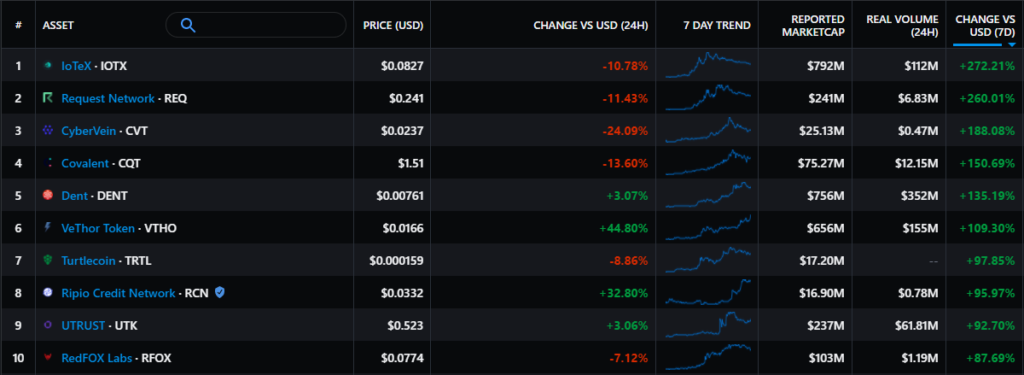
According to Messari, among digital assets last week the strongest gainer was the token of the IoTeX platform, which on August 12 joined the Coinbase listing. The price of IOTX rose 272%, and its market capitalization surpassed $798 million.


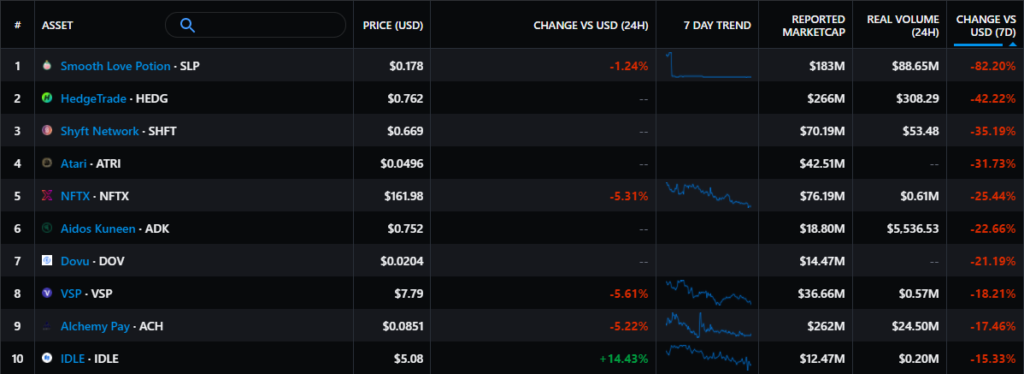
The biggest drop among in-game tokens was for the NFT game Axie Infinity’s Smooth Love Potion (SLP). Its price fell by more than 82%, and its market cap declined to $88.6 million.


The cryptocurrency market capitalization stood at $2.02 trillion, with Bitcoin’s dominance index dipping to 42.8%.
Hacker siphons $611 million from Poly Network “for fun,” then changes mind and returns the funds
On August 10, an unknown attacked the Poly Network protocol and withdrew assets totaling $611 million. This was the largest breach in DeFi and the industry at large.
The attacker carried out the attack across three networks: Ethereum, Binance Smart Chain and Polygon. Part of the funds, in USDT, was quickly frozen by the issuer, Tether, after a warning from user hanashiro.eth. The latter immediately received a reward equivalent to 13.37 ETH.
Security researchers from Slowmist said they traced the hacker’s email address, IP address and device fingerprint.
But the next day the attacker decided to return the stolen funds, and then explained his motives. By evening Thursday he had returned all assets except for USDT, which had been frozen by Tether.
From the $500,000 bounty, the hacker refused the reward.
Ethereum founder explains why gas consumption rose after the London hard fork
Vitalik Buterin explained why gas consumption on the Ethereum blockchain rose by about 9% after the London hard fork. He said this was due to the shorter average block interval, underutilization of blocks before the update, and imperfections in the mechanism that adjusts the base fee.
Audit confirms USDT reserves
Moore Cayman confirmed that as of July 30, 2021, the stablecoin USDT was 100% backed by reserves of Tether Holdings Limited. The value of the company’s assets exceeded $62.7 billion, against an overall issuance of $62.6 billion at the time of the audit.
Forty-nine percent of the reserves consisted of corporate securities worth $30.8 billion. The average maturity of corporate debt obligations is 150 days.
The share of cash and bank deposits that can be withdrawn within two days or less accounted for 10%—roughly $6.28 billion.
A substantial portion of the reserves consists of U.S. Treasury notes with maturities of less than 90 days. They accounted for more than 22.5% of the total value, or about $15.3 billion.
Coinbase reports second-quarter results
Coinbase’s total revenue for the second quarter totaled $2.2 billion, of which $1.9 billion came from fees. Most of the revenue ($1.8 billion) came from retail traders.
During the period, the exchange’s trading volume amounted to $462 billion, with Ethereum’s share of the turnover topping Bitcoin’s for the first time. The number of monthly active traders reached 8.8 million, and the total number of users stood at 68 million.
Coinbase serves more than 9,000 organisations, including “10 of the 100 largest hedge funds by assets under management.”
BitMEX settles with CFTC and receives a $100 million penalty
BitMEX settled with the U.S. Commodity Futures Trading Commission (CFTC) and FinCEN. The company agreed to pay a $100 million fine.
Last year the CFTC charged BitMEX with breaches of KYC/AML rules and operating an unregistered commodity exchange.
Criminal charges against founder Arthur Hayes and former top executives, which were brought by the U.S. Department of Justice, remain in force.
In the US Senate no consensus on cryptocurrencies
The bill, aimed at raising more than $1 trillion for the budget to finance a wide infrastructure upgrade in the United States, was sent from the Senate to the House of Representatives for approval, but heated debate did not proceed. A sticking point was a small section touching on the taxation of the crypto industry.
The original wording would have broadened the broker definition so much that, under certain interpretations, miners, node operators, PoS validators, wallet developers, and DeFi liquidity providers would be brought under it. This would have forced all non-custodial market participants listed above to report user activity to the IRS and implement KYC procedures. Even if technically feasible, such requirements would be impractical; for example, miners do not know whose transactions they include in blocks and cannot determine whether a transaction is a trade.
A group of senators led by Cynthia Lummis proposed an amendment excluding the activities above from the broker definition. It was supported by industry participants in the US. An alternative was proposed by a group led by Rob Portman, which agreed to drop miners, software and hardware developers, but ignored the existence of other consensus mechanisms.
These two groups did not manage to reach a compromise within a couple of days, and the Senate decided to pause debates; however, both groups did eventually reach a compromise amendment. Because of procedural rules, any changes to the bill would require the unanimous support of all senators. Former presidential candidate Ted Cruz backed the amendment, chiding colleagues for their crypto incompetence.
Representatives from both parties agreed and even secured White House backing, but one senator opposed. 87-year-old Richard Shelby refused to back the amendment unless his colleagues consider his proposal to increase defence spending.
Industry lobbyists are now preparing for a vote in the House of Representatives, as the current wording threatens a mass exodus of crypto business and development from the United States.
The U.S. Treasury regards some concerns as justified. To calm them, the Treasury will clarify the tax reporting requirements for crypto firms in guidance that could be issued as early as next week, according to Bloomberg.
SEC requests access to Ripple Slack messages
The U.S. Securities and Exchange Commission (SEC) has filed a court motion seeking access to Ripple employees’ Slack correspondence. The matter concerns terabytes of data — terabytes of data.
The commission says the information could help refresh witnesses’ recollections who were unable to answer questions during testimony.
The SEC also fined the crypto exchange Poloniex $10 million for operating unregistered securities trading in digital assets. Commissioner Hester Peirce criticized the decision, blaming the lack of a clear regulatory framework.
Chair Gary Gensler told Senator Elizabeth Warren that his agency probably lacks sufficient authority and resources to regulate the crypto industry.
BitRiver founder-backed financing of LDPR campaign
A portion of funds for LDPR’s participation in the upcoming elections to the State Duma was transferred by the “Fox Group,” founder of the BitRiver mining data-centre operator.
In a ForkLog interview, BitRiver’s Romаn Zabuga did not confirm but did not deny involvement of the “Fox Group” in financing the LDPR campaign.
“We do not comment on any election-related political activity. It is outside the scope of BitRiver’s corporate communications policy,” said Zabuga.
Also on ForkLog:
- Polygon absorbed the Hermez Network platform — deal value $250 million.
- Ukraine’s Nova Poshta proposed $7 compensation for a burned-out ASIC miner worth $4,000.
- Unknown buyer paid $135,000 for a rock NFT.
- Bitcoin exchange FalconX attracted $210 million at a $3.75 billion valuation.
- TaxBit reached unicorn status after a $130 million funding round.
- PSG paid Messi part of his welcome bonus in fan tokens.
- Robinhood bought a platform for connecting investors with companies for $140 million.
- Bitcoin exchange Gemini acquired the decentralized prediction platform Guesser.
- Vocalist of Rammstein and the Hermitage had a dispute over an NFT.
- Developer Kelvin Fichter detailed the Poly Network attack mechanism.
What else to read and watch
On August 5, 2021, the London hard fork occurred on the Ethereum mainnet, marking another step toward Ethereum 2.0. Investors expected that with London’s activation, ETH’s tokenomics would become deflationary, potentially driving up prices. Miners, however, feared a 20–30% drop in revenue.
ForkLog explores whether these expectations and concerns were borne out.
In traditional digests we have gathered the week’s key events in cybersecurity and artificial intelligence.
For the most significant venture capital news we invite you to recall our “The Institutional Investor”.
On August 9, ForkLog discussed the current agenda live with Alexander Momot, Anton Kravchenko and Vladimir Koen.

Читайте биткоин-новости ForkLog в нашем Telegram — новости криптовалют, курсы и аналитика.