



In early May Bloomberg reported on an investigation by the U.S. Department of Justice’s National Security Division into Binance Holdings Ltd. The parent company of the world’s largest cryptocurrency exchange by trading volume, Binance, is suspected of breaching sanctions against Russia.
The agency intends to determine whether Binance officials or entities allowed Russians to evade U.S. sanctions and move funds through its trading platform. According to available information, at the time of writing neither the exchange nor its executives had been charged with wrongdoing.
Separately, the U.S. Internal Revenue Service, together with the analytics firm Chainalysis and Ukrainian law enforcement, has taken up tracking cryptocurrency transactions of Russian citizens.
Binance, in official statements, has repeatedly said that it fully complies with all U.S. and other international sanctions. The exchange, however, operates with a complex corporate structure comprising many legal entities in various countries, and the location of its offices and the entity responsible for safeguarding user funds are not known.
Although user services are provided on a single domain binance.com, registrations for Russians and Bahrainis are processed through different legal entities. Thus Russians continue to use the exchange’s services, presumably via jurisdictions that have not joined the sanctions.
Although from the perspective of Ukrainian, U.S. and EU law this cannot be considered a violation, interviewed experts told ForkLog of a potential threat of secondary sanctions being imposed on the exchange by these states.
What restrictions apply to Binance for Russian nationals?
Since 2022, a number of countries have imposed sanctions on Russian citizens. In particular, U.S. authorities prohibited American crypto firms from conducting transactions with individuals and entities on the sanctions list.
Furthermore, the U.S. House of Representatives approved a bill enabling the Treasury to block cryptocurrency exchanges’ transactions with addresses of sanctioned individuals.
Japan ordered crypto exchanges to observe sanctions against Russia. Also, legislation was amended to prevent transfers of funds by sanctioned individuals to third parties.
The United Kingdom’s financial regulator issued a notice that using crypto assets to violate or evade economic sanctions is a criminal offence.
Singapore’s financial institutions stopped conducting any crypto transactions for Russian entities. The authorities also obliged licensed Bitcoin exchanges to comply with sanctions against Russia.
The EU banned crypto firms from providing crypto-asset services to Russian residents whose deposits exceed €10,000. Later, the European Parliament introduced a full ban on servicing their crypto wallets in the euro area and on holding any amount of such assets.
In addition, the U.S. and the EU imposed sanctions on a number of Russian banks, effectively prohibiting transfers from their issued cards.
In March 2022, Binance ceased support for card transactions with Visa and Mastercard cards issued by Russian financial institutions.
Later, under EU sanctions, the exchange announced restrictions for accounts of Russian residents whose total crypto assets exceed €10,000, allowing only withdrawals. Support staff clarified that access would be restricted even for users abroad who verified with Russian documents.
Since March 2023, Binance forbidden Russian users from P2P operations in dollars and euros.
In April, media citing Binance support reported the repeal of restrictions on €10,000 deposits for Russian accounts. However, a Binance spokesperson said at the time that all current sanctions-related restrictions affecting Russian citizens were being applied by the platform and its EU-registered entities in full.
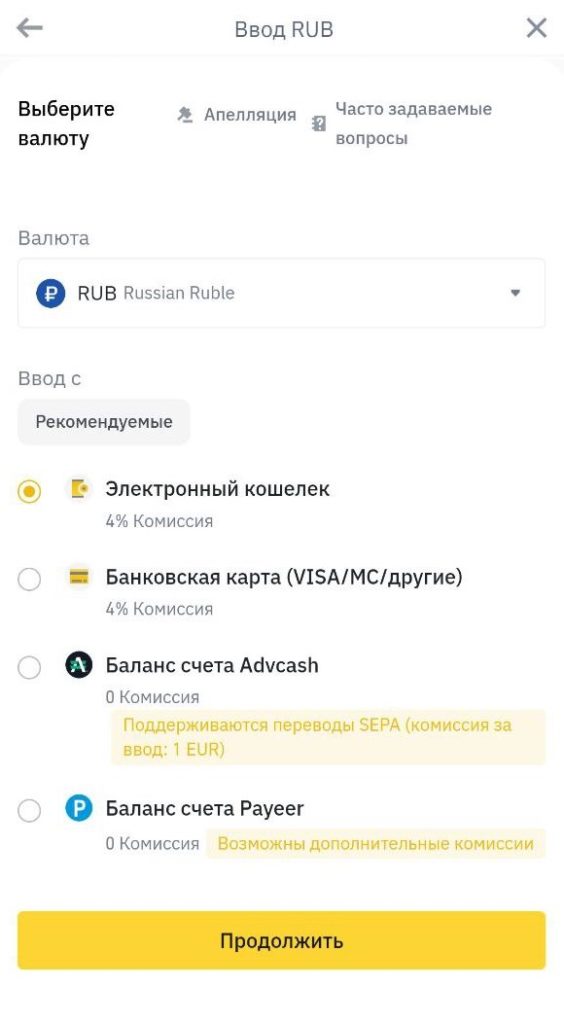
At the same time, Binance provides different information to customers from different regions. For users verified with Russian documents, operations with ruble-denominated cards are available, including Visa and Mastercard branded cards, unlike Ukrainians and unregistered customers from other countries.
According to “Kod Durova”, top‑ups were implemented via the Qiwi payment gateway. The publication reports that withdrawals are subject to a limit ranging from 4,300 to 200,000 rubles.
Commenting on this, ForkLog quoted a Qiwi spokesperson who stressed that the group of companies “has no contracts with the Binance platform, including regarding providing a payment gateway.” Nevertheless, he noted that “much like Visa, Mastercard and Mir cards, the Qiwi Wallet service is used by individuals as a payment instrument at their own discretion.”
At least as of January 2023, deposits in rubles were available via Qiwi Wallet. This is evidenced by one user review and the payment company’s support response.
On Binance’s fiat deposits page, top-ups in rubles are also available via Advcash and Payeer.


Complex corporate structure
The existing Binance since 2017 has an opaque and sprawling corporate structure. In particular, the company does not disclose the location of its offices or the legal entity responsible for safeguarding client funds.
ForkLog examined this issue in detail in a dedicated piece.
Currently, Binance holds licenses and registrations in 17 jurisdictions: France, Spain, Italy, Poland, Lithuania, Sweden, Cyprus, Dubai and Abu Dhabi (UAE), Bahrain, Kazakhstan, South Africa, Colombia, New Zealand, Australia, Indonesia and Thailand.
In each of these countries one or more local entities have been established. For example, in Kazakhstan the company opened a subsidiary BN KZ Technologies. In addition, the exchange planned to launch a local Bitcoin exchange in the country by mid-2023.
In the United Kingdom, according to the public registry, 15 legal entities are registered under the Binance brand; in Ireland — eight.
The American subsidiary Binance.US, through BAM Trading Services Inc., has approvals in 42 U.S. states. The subsidiary is a separate legal entity and operates independently of binance.com.
The company also opened a customer service centre in Turkey.
In Hong Kong, Binance has no special licenses, but three companies are registered there. Meanwhile, in the platform’s Terms of Use, the governing law for legally motivated disputes is the law of this jurisdiction.
In several countries Binance provides services via registrations through third-party entities:
- Bmex Techfin, S. de R.L. de C.V. in Mexico;
- PT. ASET DIGITAL BERKAT (TokoCrypto) in Indonesia;
- Sakura Exchange BitCoin in Japan.
All these firms form a tangled and complex structure. Mapping it and exposing its “map” is virtually impossible, in part due to the closed nature of state registries in several relevant jurisdictions. Yet data from open sources allows a sense of how closely linked the various entities are within the group.
Thus, the sole owner of the aforementioned BN KZ Technologies is the Ireland-registered Binance (AP) Holdings Limited. The latter is fully controlled by the Binance co-founder and head of the group, Changpeng Zhao.
Another example is Cyprus-based Binance Cyprus Limited. Its director is Jonathan Stuart Farnell, who also was listed as a director of the UK-registered Binance Europe Ltd.
In addition, Farnell is named as the head of Binance’s UK-registered payments company Bifinity and also registered in the UK Binance Europe LTD.
Bifinity’s headquarters are in Lithuania, as evidenced by documents submitted to the regulator there. Until recently, Zhao was the sole holder of shares in the mentioned companies.
In February 2022, Binance Europe LTD notified British regulators that the group’s head had ceased to be a “person with significant control.” Around the same time, this entity was designated Binance (Services) Holdings Limited — one of the companies named in the U.S. CFTC’s suit.
The main customer service is conducted via the binance.com domain. In the U.S. and Bahrain, the exchange offers services from separate domains: binance.us and binance.bh respectively.
In ForkLog’s comments, a Binance spokesperson noted that the group’s structure is currently undergoing restructuring in light of “business growth.” He said further statements would follow in the near future.
Can Russian citizens use Binance to dodge sanctions?
Russian nationals with residency in the EEA or Switzerland can use Binance through local entities. In all other cases, according to experts, the exchange uses entities outside the EU and the U.S. to service Russian clients.
In particular, the head of Binance KZ, Zhaslan Madiev, told ForkLog that Russians with a residence permit in Kazakhstan and a confirmed place of residence can trade on the platform without restrictions. However, if sanctions-related questions arise, the exchange will necessarily follow the required procedures.
Sergey Ostrovsky, a partner at Aurum, suggested that Binance uses its Russian structure and offshore entities to transact with Russians.
«For P2P transactions, it doesn’t require a separate structure at all, since fiat operations — bank transfers — occur directly between users, and cryptocurrency transactions are processed by the exchange itself», — he explained.
Senior lawyer Daniil Voloshchuk of Juscutum noted that, at present, many Russian users of crypto exchanges have not felt substantial pressure from sanctions.
«Unfortunately, there have been casualties. For example, owners of crypto wallets on EU-listed platforms lost access. In most cases, access was restored by using a VPN or by presenting non-Russian residency», — he said.
What consequences for Binance would follow if EU sanctions were breached, and what would this mean for users?
Sanctions could be applied to the Binance group at least on the grounds that it participates in or facilitates evading sanctions against Russia, argues Sergei Ostrovsky.
Potentially, this could lead to asset freezes for the group or certain entities, as well as financial and other consequences, including a ban on operation in a particular territory or against a certain category of persons, closing bank accounts and fines.
Companies registered outside the EU and not offering services to EU citizens are not liable. The consequences for EU-based entities of the exchange may differ depending on the country of registration and local law.
«For example, in Lithuania, where Binance holds a license, the law “On International Sanctions” applies. Violators face criminal (imprisonment) and administrative (fines and license revocation) penalties», — explained Anna Voevodina.
In different EU countries prison terms and fines also vary.
Meanwhile, as Daniil Voloshchuk notes, on 2 December 2022 the European Parliament received a proposal for implementing an EU directive. It would introduce a single standard for European residents on sanctions compliance and liability for breaches.
The main challenge, he adds, is that unlike the U.S., EU practice of holding non-residents accountable for breaches of European sanctions is not widely applied, according to Sergei Ostrovsky.
However, the lawyer reminded that on 6 October 2022 the EU Council adopted a regulation widening the criteria for applying European sanctions. It included individuals and entities that facilitate evading the “Ukraine package” sanctions, and those associated with them.
He also cited the EU Council Regulation from 2014, which prescribes freezing of funds (including crypto assets) and economic resources owned by or held for sanctioned persons. Those persons are also prohibited from providing any funds or economic resources.
«There is a view that this provision could become a formal basis for EU secondary sanctions. It should be noted that, unlike the U.S., the practice of imposing secondary sanctions in the EU is also practically non-existent, so it is hard to assess how this rule will be applied to non-residents or whether it will be applied at all», — said Ostrovsky.
Daniil Voloshchuk believes that pursuing accountability of an EU-registered Binance legal entity would have a reputational impact on other companies within the ecosystem.
«Although legally such entities may be separate, they operate under one brand. When we say Binance faced restrictive measures, a typical user won’t wonder which specific Binance legal entity was held to account», — he explained.
Moreover, depending on the level and scope of accountability, the company could incur financial losses.
«Arguably, if Binance is barred from operating in the EU, this would significantly affect the platform’s overall cash flow, as these countries can generate a large share of the revenue that funds other units across the platform», — Voloshuk contends.
Note that beyond Binance, sanctions breaches could possibly have been committed by Huobi and Kucoin, as they accepted debit cards issued by Russian banks. The crypto company Bittrex was fined $29 million for repeatedly violating U.S. sanctions by providing services to individuals in Crimea.
Regulatory friction and authorities
In October 2020, Forbes reported on a leak of a 2018 presentation said to be “for senior Binance Holdings Limited executives,” detailing a “complex corporate structure designed to mislead regulators and secretly profit from crypto investors in the United States.”
According to sources, the document was created by former Binance employee Gary Zhou, a serial entrepreneur who is a co-founder of the Koi Trading crypto exchange in San Francisco, partly owned by Binance.
Forbes concluded that Binance.US built operations in the United States, showing commitment to regulatory compliance while simultaneously moving revenues to the parent Binance through licensing fees and other means, and training potential clients in bypassing geographic restrictions.
After publication, Changpeng Zhao posted a series of tweets denying the story and saying “Binance always acted within the law.”
Subsequently the exchange filed a lawsuit against the authors, which was later withdrawn.
In January 2022 Reuters accused Binance of withholding information from regulators. The agency noted that the exchange repeatedly neglected Know Your Customer procedures and acted against the recommendations of its own compliance department.
According to journalists, in at least three countries, including Russia and Ukraine, Binance acted contrary to its own risk scoring. The latter was given an “extreme” level for the last two countries. Such a rating means the company should not serve customers from those jurisdictions.
Reuters, citing documents, asserted that the ratings were “manually adjusted” and the risk level for those countries was changed to “high.”
When asked about the veracity of the information, Binance said it does not comment on press articles. A spokesperson said its internal risk ratings are not static and continually evolve. The scoring depends on a range of variables, including outcomes of meetings with government officials, new regulations, actions by competitors and others.
In October of that year Reuters published a story that in 2018 Zhao approved a plan to “isolate” Binance from U.S. regulatory oversight by creating a new U.S. exchange.
The investigation was based on interviews with around 30 former employees, consultants and business partners, as well as thousands of messages, emails and documents dating from 2017 to early 2022.
The agency found that, according to the CEO’s proposal, the new exchange would distract regulators from the main platform by acting as a “coordination hub for regulator requests.” Executives began to implement the plan, as company communications show.
Publicly Zhao said the new U.S. exchange, Binance.US, is a “fully independent organization.” In reality Zhao controlled Binance.US, running its operations from abroad, according to regulator filings from 2020, company statements, and interviews with former team members consulted by the agency. An adviser to Binance’s management described the U.S. exchange as a de facto subsidiary.
In March 2023, members of the U.S. Senate Banking Committee — Elizabeth Warren, Chris Van Hollen and Roger Marshall — sent Binance a letter asking for detailed information about KYC/AML policies and procedures for anti-money-laundering controls.
Meanwhile, politicians accused the platform of evading regulators and of links to criminals, calling it a “hotbed of illicit financial activity.”
Zhao denied the accusations, noting that the platform’s primary priority is protecting users’ interests. He said the letter had been received and that Binance had provided a response, though it scarcely touched on the financial aspect.
That same month the CFTC filed a case against Binance and Zhao . The regulator argued the platform traded derivatives without proper registration.
In a press release, the CFTC described the actions as “willful evasion of U.S. law,” and said its statements about compliance were “fiction.” The regulator asserts Binance knew its customers included sanctioned individuals.
The CFTC said it had records of conversations and other documents from Zhao, and that more than 300 accounts were directly or indirectly linked to him. The regulator intends to seek penalties and prohibitions for the company and its CEO.
Zhao responded with a tweet containing the number “4.” In his tweet, the figure is meant to signify “ignore FUD and fake news.”
Commenting on the CFTC complaint, Sergei Ostrovsky called it “an excellent example of American enforcement against non-residents, since none of the defendants is a U.S. resident or U.S. company.”
In May, the U.S. Treasury began a probe into possible sanctions violations against Russia.
That same month Reuters, citing sources reported, that Binance had combined client funds with company revenues in 2020 and 2021 in contravention of U.S. financial rules requiring client money to be held separately.
According to the agency, the exchange moved billions of dollars almost daily to its accounts at the now-defunct Silvergate Bank.
Sources said that to open a euro-denominated bank account, in May 2020 Binance established a Lithuanian company initially named Binance UAB. It was later renamed to Bifinity and presented as “the official payments provider in cryptocurrency.”
According to a financial report, in 2021 Bifinity’s revenue was €680 million, and it paid more than €420 million to one unnamed related party. An informed source identified the latter as Binance Holdings.
Binance rejected the agency’s reporting, saying it holds “user and corporate funds in completely separate ledgers.”
In early June, the SEC filed suit against Binance and Changpeng Zhao. The regulator brought 13 counts, including unregistered token offerings and sales of BNB and BUSD, the Simple Earn and BNB Vault products, and staking. The Commission also noted the lack of registration as an exchange, broker-dealer or clearing agency for Binance.com and its U.S. arm.
The SEC sought to freeze digital assets held by Binance.US.
The exchange said it would vigorously resist regulatory pressure.
Binance’s position
In response to ForkLog’s request, a Binance spokesperson referred to the company’s previously stated official position.
«Binance adheres to global sanctions rules and applies sanctions to individuals, organisations, juridical persons and countries blacklisted by the international community, denying such entities access to the Binance platform», the exchange’s spokesperson said.
He added that all current sanctions-related restrictions affecting Russian citizens are being applied by the platform and its EU-registered entities in full.
«EU-registered legal entities of Binance are prohibited from providing services in the EU/EEA to individuals and legal persons from Russia, except for residents of the EEA or Switzerland. Access to the platform is also prohibited for residents of Crimea, the Donetsk People’s Republic and the Luhansk People’s Republic. The purchase and sale of U.S. dollars and euros on the Binance P2P platform by Russian citizens and residents is not allowed, irrespective of nationality», the company clarified.
Conclusion
The global Binance business operates through entities registered in various jurisdictions. This affords the group operational flexibility and, without directly violating sanctions imposed on Russia, continues to serve Russian users.
At the same time, the opaque legal structure has already drawn regulator scrutiny. Potential investigations could expose the group to secondary sanctions if Binance is found to have aided evasion of restrictions.
Ultimately, the consequences for the exchange will depend on regulator findings and local law. Experts say the complex corporate structure could weaken Binance’s position in forthcoming litigation.
Impact on Binance’s users should also be considered in the context of each case. Possible actions include asset freezes, a ban on operating in a given jurisdiction or against a particular category of persons, bank account closures and fines.
Moreover, the opaque structure that allows Russian citizens to use the exchange creates proportional risks. If a ban were imposed on serving them or freezing their funds, there would be no legal remedies against the jurisdictions serving them. Those jurisdictions do not provide protections comparable to those in, for example, the European Union.
In any case, holding any Binance entity to account would have reputational repercussions for other companies within the exchange ecosystem. It could potentially trigger a flight of funds from the platform and a decline in liquidity.