




The year 2021 posed new challenges for the cryptocurrency industry—from the tightening of regulation in China to the NFT boom and new record highs.
Calls for proportionate regulation grew louder. The active development of new sectors drew in players who had previously shunned digital assets: auction houses, major brands and participants from traditional markets.
Overall, 2021 proved a successful year for the industry, strengthening its position. Here are the main events and trends of the year just ended.
Events
Solana, Terra and Avalanche Reach the Olympus
Over the past year, notable changes occurred in the ranking of the largest crypto assets by market capitalisation.
As of January 1, XRP (excluding USDT) was in the top three, followed by Litecoin (LTC), Polkadot (DOT), Bitcoin Cash (BCH) and Binance Coin (BNB). The top ten was closed by Cardano (ADA) and Chainlink (LINK). The total market capitalisation stood at around $783 billion.
During the year the composition of the top ten shifted — newcomers joined. Solana (SOL) established itself in the upper tier — on its way to Olympus the coin hit a new high above $250. Terra also joined the race, pushing Polkadot down.


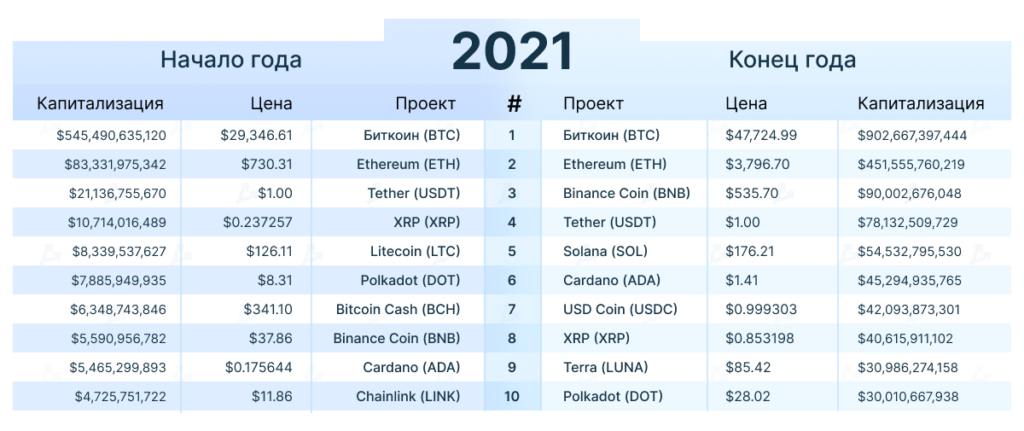
In November, total market capitalisation surpassed $3 trillion. Bitcoin also hit a new high at $69,000. This was helped by a range of positive factors, one of which was the approval of digital gold as legal tender in El Salvador.
El Salvador Recognised Bitcoin as Legal Tender
In early June the crypto industry turned its attention to El Salvador. At the Bitcoin 2021 conference, President Nayib Bukele announced the legalisation of Bitcoin.
In the same month the Legislative Assembly approved the relevant bill. The initiative did not win universal endorsement. Skepticism was expressed by the IMF, and residents of San Salvador took to the streets in protest and destroyed one of the crypto ATMs.
Nevertheless in September Bitcoin became a legal means of payment in El Salvador. This benefited the growth of the Lightning Network, as did its integration with Twitter.
Another Bukele initiative was mining the first cryptocurrency on geothermal energy. In a test mode mining began in October.
The move also drew mixed reactions. Experts noted that the country faces water shortages, and using volcanic energy may prove more costly than burning oil. This continued the environmental debate around mining, which was amplified by Elon Musk.
Elon Musk Becomes the Mouthpiece for Meme Cryptos and Raises Environmental Concerns
The person of the year for the industry was Elon Musk, whose tweets directly influenced markets and investor sentiment. Globally the entrepreneur was also named Man of the Year — in TIME and Financial Times.
His active support turned meme cryptocurrency Dogecoin into the phenomenon of the year: it surged into the top 10 assets by market capitalisation and appeared on major exchange listings.


Musk also breathed life into Dogecoin’s clones—Shiba Floki and Shiba Inu. The latter reached the top 10 by market cap.
However Musk’s clear support was for Dogecoin. In particular, he stated that DOGE could “easily” beat Bitcoin.
Digital gold, by contrast, faced Musk’s criticism, though earlier in the year the situation had looked favorable. In February, Tesla disclosed Bitcoin investments of $1.5 billion, and in March Musk announced the start of selling electric cars in the United States for BTC.
Whether anyone took up the offer is unclear, but by May the company backed away from the initiative amid concerns about mining’s environmental impact.
Musk’s criticisms affected investors’ sentiment. In May, 23 mining companies from North America joined to form the Bitcoin Mining Council (BMC), aiming to reduce CO₂ emissions. Musk attended the first meeting, but his involvement with the organisation ended there.
In the first report, the BMC put the share of green energy in the global BTC mining mix at 56% for the second quarter. The community criticised the work, noting bias, a small sample and questionable methodology.
From that point the environmental argument gained prominence. It was utilised effectively in Beijing, where by 2060 they aim to reach carbon neutrality.
China Expels Miners from the Country
Miners’ problems in the PRC began in spring with accidents at coal mines in several provinces. This triggered a sharp drop in hashrate: if at the start of the year the country dominated BTC mining (53.3%), by April its share had declined to 46%.


Experts disagreed on the correlation between hashrate and Bitcoin’s price. Yet there was no doubt about the impact of Beijing’s crackdown on the industry.
From May, authorities methodically “tightened the screws”. The main arguments in the battle against digital assets were:
- the lack of inherent money-like properties of digital assets;
- the negative impact of Bitcoin mining on the environment;
- threats to the traditional financial system.
Local officials began pushing industry players out of the country. The intensifying regulatory squeeze in China forced miners to rethink their jurisdictions and led to mass migration. The main destinations were the United States, Kazakhstan and Canada. Russia also strengthened its positions, despite regulatory uncertainty.
However not all players could leave the country. The largest Ethereum mining pool SparkPool, the exchange Biki and the mining pool BeePool had to announce closures. Some companies, including Binance and Huobi, KuCoin, BitMart and BTC.com, halted registration of users from mainland China.
Cybersecurity firm Qihoo 360 found that some participants went underground, using home internet, dedicated corporate lines and data centres for operations.
According to Qihoo 360, in November mining used an average of 109,000 IP addresses. Hotspots included Guangdong, Jiangsu, Zhejiang and Shandong. The company developed a solution for government agencies to identify miners’ IP addresses, their locations, connection types and frequency, and proposed methods to suppress them.
Alongside the crackdown, Beijing advanced the digital yuan (e-CNY or DCEP), taking another step toward total societal control.
China Tests Programmable Money
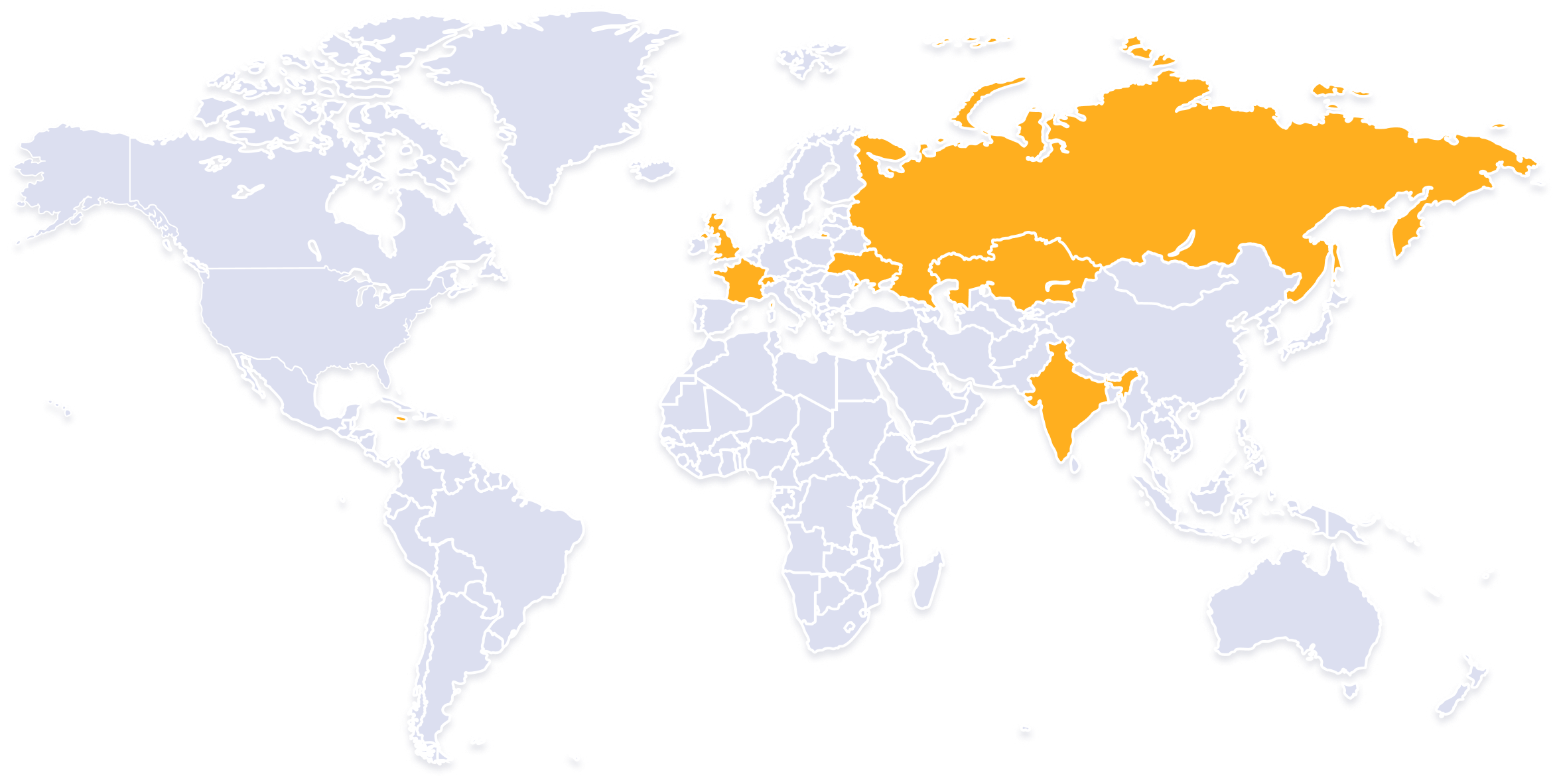
In 2021 China held the lead in CBDC development. The digital yuan endured several tests in a number of provinces and cities, and the central bank published a white paper.
Notably, the distribution of 12 million e-CNY ($1.85 million) among residents of Chengdu, the capital of Sichuan, drew attention. During testing authorities restricted usage: the digital yuan could be used only to pay for metro or bus fares, or to rent bicycles via the Tianfutong and Meituan apps.
Progress elsewhere in CBDC development and testing was more modest:


Taproot Activation on the Bitcoin Network
A key milestone for Bitcoin was the activation of the Taproot upgrade, designed to enhance privacy, efficiency and scalability.
The soft fork occurred on 14 November at block #709,632 — mined by the mining pool F2Pool.
Two Ethereum Hard Forks — Berlin and London
On 15 April, in the Ethereum mainnet at block #12,244,000 the Berlin hard fork was implemented, introducing four improvement proposals:
- changes to the gas cost calculation (EIP-2565 and EIP-2929);
- new transaction types (EIP-2930 and EIP-2718).
The activation of EIP-1559, which entails burning a portion of transaction fees, was planned for the London hard fork — which occurred on 5 August at block #12,965,000.
As of December 29, more than 1.29 million ETH had been burned, according to Ultrasound Money.
By analogy with Ethereum, the token-burn mechanism was activated on the Binance Smart Chain (BSC) during the Bruno hard fork. The same solution was rolled out by Polygon (MATIC) in the Mumbai testnet.
Coinbase and Robinhood Debut on Nasdaq
On 14 April, Coinbase’s direct listing on Nasdaq took place. The opening price was $381, and the price surged to $429.54, but by year-end it had fallen to around $260.

Coinbase’s market capitalisation briefly exceeded $100 billion, making it the most valuable exchange in the world — larger than the NYSE and the Nasdaq itself.
Another high-profile exchange debut was Robinhood listing on Nasdaq on 29 June.


US Approves Futures Bitcoin ETFs
In October the US Securities and Exchange Commission (SEC) issued a muted but long-awaited blessing: approved ProShares to launch a Bitcoin Strategy ETF futures-based fund.
The regulator also approved similar instruments from VanEck and Valkyrie Investments.
However spot Bitcoin ETFs continued to be rejected, or their decisions delayed.
Binance Abandons Decentralised Model
For the cryptocurrency exchange Binance, 2021 was spent under pressure from financial regulators in a number of countries. Warnings were issued by authorities in the Netherlands, Italy and Malta, Poland, Japan, Thailand, Hong Kong, Singapore, South Africa and Malaysia.
Against this backdrop, CEO Changpeng Zhao published an open letter. He explained how the exchange plans to ensure regulatory compliance and customer protection.
In August Binance introduced mandatory user verification. A month later Zhao announced the transformation of the exchange into a licensed, centrally managed enterprise, acknowledging that the idea of a decentralised organisation hindered regulatory engagement.
Jury Verdict in the Kleiman vs. Wright Case
On 6 December in Miami, a jury delivered a verdict in the case of the self-proclaimed Bitcoin founder Craig Wright and the family of his former partner Dave Kleiman.
The suit had run since 2018, when Kleiman’s brother accused Wright of misappropriating 1.1 million BTC. Under the ruling, Wright was ordered to pay $100 million in compensation to W&K Info Defense Research for the conversion of the “misappropriated” bitcoins. Other claims were dismissed.
John McAfee Committed Suicide
On 23 June the crypto community learned of the death of John McAfee in Spain. The renowned 75-year-old entrepreneur was found dead in his prison cell—apparently a suicide. This occurred hours after the country’s Supreme Court allowed his extradition to the United States.
The court decision drew criticism from Edward Snowden, and McAfee’s widow Janice doubted the suicide version.
Trends
The Metaverse Boom and GameFi
One of 2021’s trends was the metaverse and GameFi projects. The surge in gaming tokens peaked in the summer, led by Axie Infinity’s AXS.
The sector received a strong boost from Mark Zuckerberg—on 28 October he announced a pivot of the company to build its own metaverse and rebrand to Meta.
Against this backdrop, the prices of tokens from GameFi and virtual worlds rose:
- Axie Infinity (AXS);
- Enjin (ENJ);
- The Sandbox (SAND);
- Decentraland (MANA).
Bank of America did not rule out that metaverses could become a growth driver for the crypto industry and promote the adoption of digital assets, and Grayscale projected potential annual revenue growth for Web3 metaverses up to $1 trillion.
The NFT Boom
Another 2021 trend—the NFT boom—opened doors to the industry for those who had not previously engaged with cryptocurrencies. Non-fungible tokens were issued by musicians, athletes, football clubs, museums, fashion houses, automotive brands, artists and content creators.
Works by Banksy and Pak, and Hermitage Museum artworks, Steve Jobs’ résumé and the 118-year archive of the South China Morning Post were among NFT offerings.
However interest in the sector was driven not merely by the possibility of joining the digital space or engaging with fans, but by the sums spent on NFTs. Memes, rocks, tweets, magazine covers and music albums traded for thousands and millions of dollars.
In March Christie’s set a record by selling Beeple’s work “Everydays: The First 5000 Days” as an NFT for $69.3 million.
Sotheby’s was also active. The Bored Ape Yacht Club NFT by Yuga Labs sold for $24.4 million. The sale also featured works by digital artist Murat Pak and Quantum’s Kevin McCoy — one of the oldest NFTs.
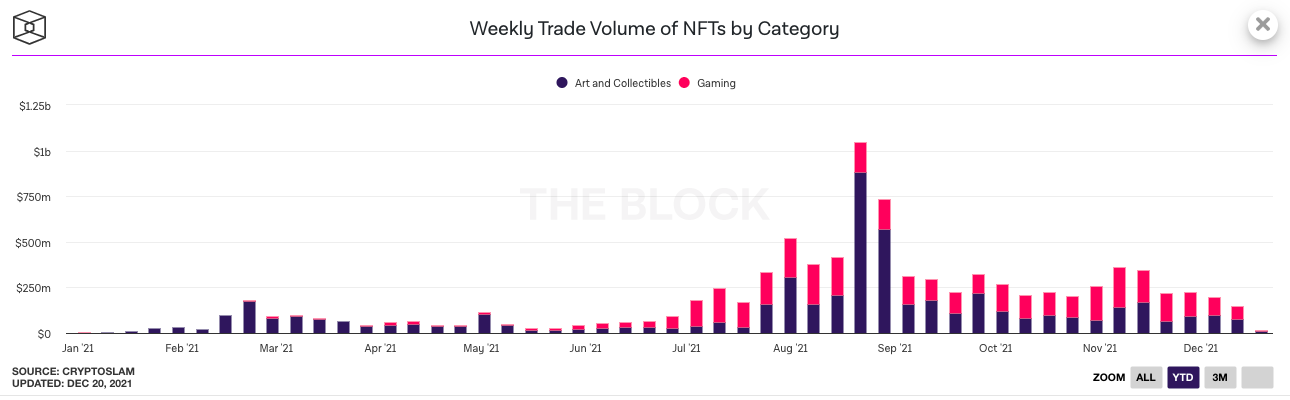
In January NFT trading volumes were barely $32 million, but by August the figure rose to a record $1.5 billion. For the same month the NFT marketplace OpenSea’s trading volume exceeded $3 billion.

Among the drivers of growth was the hype around CryptoPunk — a collection of 10,000 NFT images released in 2017. In March an unknown buyer purchased one of the nine alien punk #7804 for 4200 ETH ($7.5 million at the time).
In August, Visa amplified interest in the project. CryptoPunk #7610 was purchased for 49.5 ETH (almost $150,000).
At Christie’s, nine NFTs from the collection were sold. Including fees, the purchase total was $16.96 million.
The rare, “COVID-era” CryptoPunk #7523 was the most expensive token in the collection’s history. In June, Sotheby’s sold it for 4520 ETH — $11.8 million at the time of sale.
ForkLog also participated with its own NFT auction in celebration of the magazine’s seven-year anniversary. They sold for 6.74 ETH.
The NFT boom spurred a rise in fraud within the sector. The near-zero regulation and the peculiarities of the art world made it an easy vehicle for money laundering.
Rise of DAOs
2021 proved transformative for decentralized autonomous organisations (DAOs). In July The American CryptoFed became the first DAO to obtain legal entity status in the United States and applied with the SEC to register its tokens.
The DeFi project 1inch announced its full transition to a DAO, and crypto enthusiasts formed decentralised groups to buy a rare copy of the US Constitution or a printed version of the unreleased film “Dune.”
L2 Solutions for Ethereum
In late November Vitalik Buterin presented a roadmap for Layer 2 scaling solutions based on Rollups. He described the technology as the “only reliable solution for scaling Ethereum,” proposing limiting the data per block and a phased rollout of sharding.
Following the release of v3 of Uniswap, it launched on the mainnet in Optimistic Ethereum (OΞ) and Polygon, and by the end of summer the mainnet release of Arbitrum (L2 solution) from Offchain Labs occurred.
By the end of December, Arbitrum accounted for 44% of TVL in L2 protocols ($2.43 billion). Optimism sits in fifth with 7.93% ($437 million).


Rise of Ransomware
2021 is remembered for a series of high-profile hacker attacks. Among the ransomware victims:
- computer giant Acer — $50 million in Monero;
- industrial enterprises in Europe — 2 BTC;
- Kaseya software — $70 million in BTC;
- retailer MediaMarkt — $50 million in BTC;
- meat processor JBS — $11 million in BTC;
- pipeline operator Colonial Pipeline — 75 BTC (FBI later returned 63.7 BTC).
The hackers’ activity drew the attention of the US government. In June it was announced that investigations into ransomware attacks in the United States had attained the same level of priority as terrorism cases. The Biden administration did not stop there and prepared a series of measures to curb cryptocurrency payments to hackers.
***
Despite significant barriers, the industry strengthened its position across the board in 2021. This is evidenced by numerous developments noted in this wrap-up.
The foundation for mass adoption has been laid — retail and institutional investors, corporations and governments are investing in Bitcoin (so far only one government, but this is just the beginning).
The road ahead is long, with new ups and downs, yet it is clear that the cryptocurrency industry is one of the most dynamic and interesting sectors in the digital economy today.
Stay with ForkLog. Happy New Year!
Subscribe to ForkLog’s news on Facebook!