


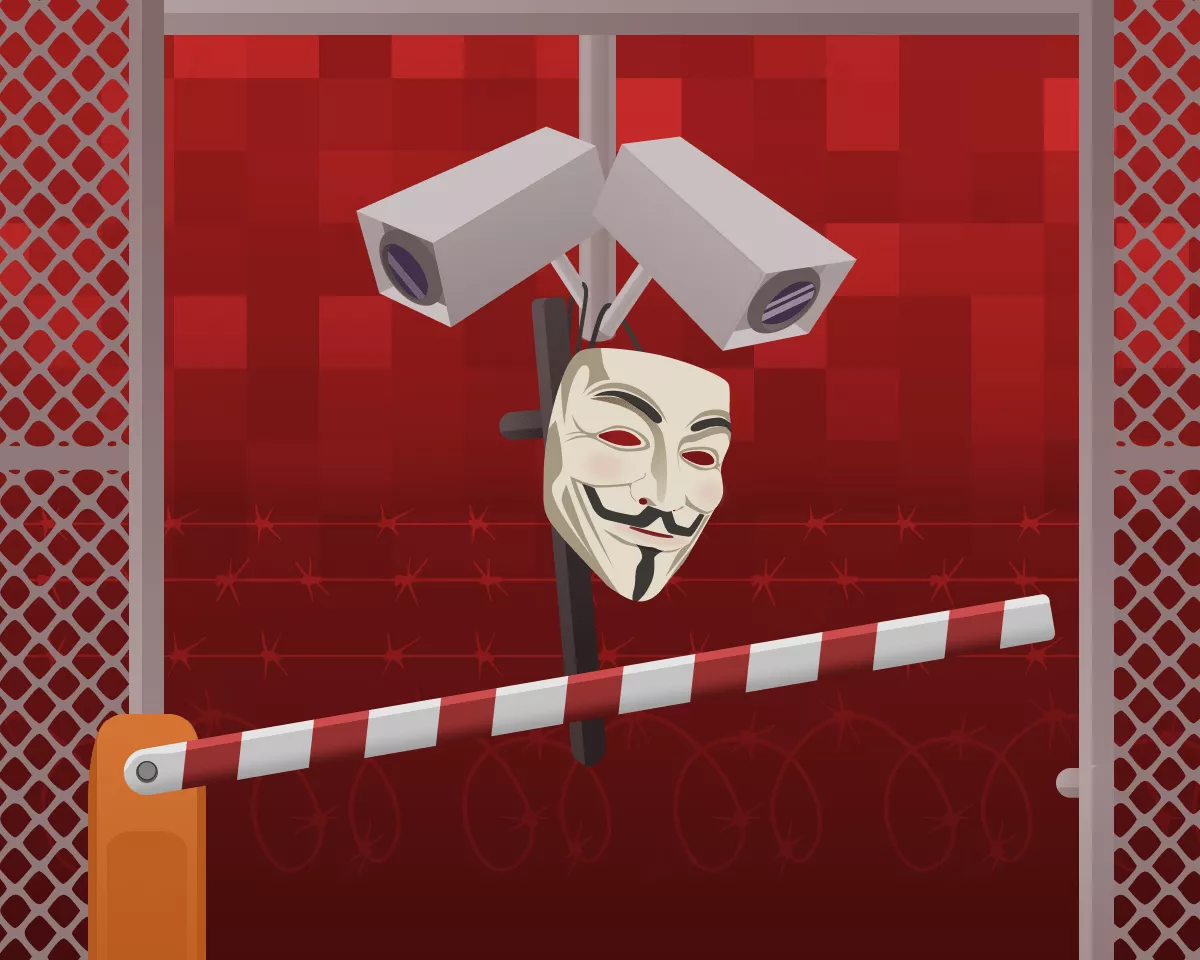
Freedom and security on the internet: a review of the main trends of 2021
Mass adoption of QR codes, ransomware attacks, blockages and debates over regulating social networks — this is how 2021 will be remembered.
Researchers note that internet freedom is deteriorating worldwide. Cybercriminals are sharpening attack tools and pose an increasing threat to ordinary users, companies and even states, due to rapid digitalisation of life and the growing dependence of many aspects of life on online connectivity.
ForkLog has examined the main events and trends of 2021 related to human rights in the digital world, cybersecurity and privacy.
- Global internet freedom has declined for the 11th consecutive year.
- Experts say the era of self-regulation of social networks is ending — authorities are drafting more rules to regulate their operations.
- Pandemic-era restrictions and citizen-tracking tools are unlikely to be rolled back anytime soon.
- Cybercrime also continued to grow in 2021. Analysts note that the scale of attacks and attacker techniques will continue to evolve as technologies advance and permeate daily life.
\n
\n\n
Governments and the Internet: pressure on social networks and blockages
\n\n
Global internet freedom has declined for the 11th consecutive year, and conditions for protecting human rights online worsened in 30 countries this year, according to Freedom on the Net 2021, published in September.
\n\n
\n\n
The project assessed internet freedom in 70 countries, home to 88% of global internet users. Iceland topped the ranking, according to analysts at Freedom House, which prepared the report. China had the lowest level of internet freedom.
\n\n
A notable feature of 2021, highlighted by experts, was the clash between governments and tech giants, particularly social networks. Governments in at least 48 countries over the past year introduced new rules to regulate the activities of such companies.
\n\n

\n\n
The adoption of such measures is controversial, as is the policy of social networks themselves.
\n\n
It has long been clear that giants such as Facebook or Twitter are no longer mere platforms where people share their thoughts, achievements and photos. They have become platforms that play a major role in shaping political agendas, and thus can influence processes in individual countries and the world as a whole.
\n\n
Early in 2021, the question of content moderation and censorship on self-styled open social networks rekindled the debate about freedom of speech on the internet. It arose from the case of the blocking of former US President Donald Trump by major platforms.
\n\n
In January after a series of controversial posts by Trump, his supporters, disagreeing with the results of the presidential election, headed for the Capitol. During the protests violence began, and several people died.
\n\n
Due to public-safety concerns, Trump’s and his supporters’ accounts were blocked by many social networks, including Facebook and Twitter. Jack Dorsey, then CEO of Twitter, said he was confident that banning the former president was the right decision, but acknowledged that the ban created a dangerous precedent and may have \”real and significant consequences\”.
\n\n
Later that year, fuel for the Facebook censorship scandal came from former Facebook employee Frances Haugen, who provided media with internal company documents — the so-called Facebook Papers.
\n\n
Among the many details revealed about how the platform operates, it showed that Mark Zuckerberg personally ordered to strengthen censorship of anti-government posts in Vietnam. According to sources, this happened after the ruling party of the country threatened to block the social network.
\n\n
Zuckerberg himself called the Facebook Papers a coordinated attempt to smear the company. He stated that in decision-making one must balance competing aspects, such as freedom of speech and reducing harmful content, protecting privacy through encryption and supporting law enforcement and others:
\n\n
\”These issues are, first and foremost, not about our business, but about balancing complex social values. And I have repeatedly called for regulation to introduce clarity, because I do not think companies should make many of these decisions themselves\”.
\n\n
Against this backdrop, journalists and experts have increasingly spoken of the end of the era of self-regulation by large platforms.
\n\n
In the EU, UK, Australia laws are being developed that tighten oversight of social networks’ activities. The United States is also urged for oversight. In the USA. Strict rules for social platforms were introduced in India in 2021.
\n\n
According to a ProtonVPN study, as of November fewer than 60% of countries have \”full\” freedom of social networks, i.e. hardly restrict content.
\n\n
Russian authorities also turned their attention to large social platforms. From 1 February in the RF the law came into force, obliging internet resources with more than 500,000 daily Russian users to identify and block illegal content themselves.
\n\n
Later in Russia the so-called landing law was adopted, forcing foreign large internet platforms to open representative offices in the country.
\n\n
Partly this focus on social networks stems from authorities realising their influence on the spread of information, in particular its speed, and sometimes greater trust than traditional media, says Nikita Istomin, a lawyer at the Digital Rights Center and a RosKomSvoboda expert.
\n\n
\”States have become interested in regulation not in the context of private relationships (protection of individuals), but public-law. For this reason, social networks are forced to adopt tighter restrictions on information dissemination, as risks to their business model increase due to heightened government attention,\” said Istomin to ForkLog.
\n\n
Russian courts over the year issued multi-million fines to companies, including Twitter, TikTok, Facebook, \u00abVKontakte\u00bb and the Telegram messenger, for not removing content banned in the RF. However, this measure, which was ineffective, proved not to be the only instrument of pressure on social networks by the state.
\n\n
In March Roskomnadzor began slowing Twitter’s operations on the territory of the RF. Experts claim that for this authorities used the TSPU units installed by telecoms under the \”sovereign Internet\” law. The incident with Twitter was effectively the first large-scale case where the service’s operation was slowed rather than blocked directly.
\n\n
Later the agency threatened to slow traffic to Google services, and in early December TSPU applied for blocking access to the Tor network. To prevent circumvention of restrictions Roskomnadzor also blocked several VPN services.
\n\n
In some cases governments took more radical measures against internet platforms, resources and services. According to Internet Society Pulse, in 2021 governments worldwide restricted access more than 40 times. In Belarus, a law was passed allowing authorities to restrict access to internet resources.
\n\n
Additionally, in 2021 debates around end-to-end encryption in messaging apps continued. Meta (formerly Facebook) was forced to delay its default implementation in Messenger and Instagram until 2023 due to concerns from child rights advocates that the measure would hinder finding wrongdoing. Nevertheless, the company does not intend to drop its plans and clarified that machine learning would be used to detect malicious accounts.
\n\n
Pandemic and restrictions — a story with no end
\n\n
Against the backdrop of the coronavirus pandemic, governments worldwide started deploying various citizen-tracking tools — CCTV and facial recognition, apps to monitor the location of infected people and their contacts, digital vaccination certificates and QR codes.
\n\n
In 2020, when almost half the world went into lockdown and tracking technologies were beginning to spread as temporary measures, many rights advocates warned that authorities would not roll back the surveillance systems after the pandemic ends.
\n\n
What at the outset of the COVID-19 outbreak seemed a rather alarming but expected innovation, implemented in China (such as QR codes for movement), became almost routine in many states in 2021. In many countries, almost all aspects of public life were accessible only with a vaccination passport, proof of past infection, or a PCR test.
\n\n
In Germany, at the end of November it was decided that such certificates are required to use public transport; in Italy, the \”green passes\” were made mandatory for all workers; and in France, the extension of the summer \”health passes\” with QR codes was approved for 2022.
\n\n
In Ukraine, to visit cafes, gyms, cinemas and other public places it is also necessary to present a vaccination certificate or test results. Since December, businesses were required to read QR codes from visitors. Such QR codes can be obtained only through the state service \”Diia,\” which automatically loads many other data about residents.
\n\n
In December the Russian State Duma approved in first reading a bill on QR codes in public places. The document is to be refined, but QR codes are already used in many Russian regions.
\n\n
At the end of 2021 there was no talk of lifting restrictions, let alone ending the pandemic. With new variants and rising infections, governments again announce lockdowns and close borders.
\n\n
\u201cWe see governments around the world clinging firmly to the possibilities of digital technology to track their citizens, and apparently they have no intention of giving them up,\u201d says Alena Ryzhikova, project coordinator for Pandemic Big Brother.
\n\n
The project team regularly monitors restrictions on citizens’ rights implemented with digital technologies. By the end of 2021 such measures were in force in the vast majority of countries worldwide.
\n\n

\n\n
Hackers never sleep: ransomware, fraud and attacks on bitcoin holders
\n\n
Digitisation and the infiltration of technology into daily life began long ago, but the pandemic significantly accelerated this trend. Remote work, the development of online payments, and corporate processes increasingly dependent on the network — the world is changing, and so is cybercrime.
\n\n
According to Group-IB, online fraud became the leading crime online — in the first half of the year it accounted for 74.5% of all cybercrime activity.
\n\n

\n\n
\u201cThe year\u2019s theme was ransomware. High-profile attacks, such as the Colonial Pipeline breach in the United States, disrupted operations of companies, hospitals, banks and government systems, and malware operators demanded multi-significant dollar ransoms for decrypting files.\u201d
\n\n
In a bid to curb ransomware, governments decided to fight not only hackers, but also cryptocurrencies, on which attackers often demand payment. For this, for example, American authorities intend to track cryptocurrency transactions.
\n\n
Cryptocurrency holders themselves attract increasing attention from criminals. Hackers in various ways gain access to bitcoin wallets, attack cryptocurrency platforms, and, as in the previous year, exploit vulnerabilities in DeFi protocols.
\n\n
Analysts counted that the number of cybercrimes in the crypto market rose by 81% compared with 2020, and they forecast a further increase in hacker activity.
\n\n
What lies ahead?
\n\n
Most cybersecurity experts agree on one point — the trends we observed in 2021 will continue into the next year. Rising cyberattacks, tougher internet regulation, and a search for a balance between privacy and security.
\n\n
Yet there is good news too. As these problems arise, solutions are evolving as well.
\n\n
More rights advocates and experts are raising questions about privacy and giving users control over their data; cybersecurity standards are being developed and promoted. For example, according to the State of the Auth study, 79% of respondents in 2021 used 2FA. By comparison, 28% in 2017 and 53% in 2019.
\n\n
Likely, AI and machine learning will play a larger role in solving many issues. Experts propose using AI to scan systems for vulnerabilities and detect anomalous activity, as well as to identify criminals (as Meta plans to do in its messengers).
\n\n
\u201cAs the world of information technology changes rapidly, artificial intelligence is not yet fully embedded and the bioethics debate continues; privacy will develop alongside the IT sector as a whole,\u201d says Stanislav Shakirov, Chief Technology Officer of Roskomsvoboda and founder of Privacy Accelerator.
\n\n
Questions of privacy and data governance by large corporations will also be addressed gradually. Today, as information about people has become a new gold, more attention is paid to what happens to it and how it is protected — regulators and experts are developing new standards to meet cybersecurity requirements and privacy controls for users.
\n\n
Nevertheless, for all this to work, a balance of power and decentralisation of the process are needed. If governments gain powerful leverage over social networks or messaging apps, both freedom of expression and user privacy could be at risk.
\n\n
Under the guise of protection or convenience, ambiguous tools can be introduced. The pandemic demonstrated how quickly mass surveillance tools can spread, leaving little room for privacy.
\n\n
In 2022, another threat to freedoms — this time economic — will be the introduction of central bank digital currencies.
\n\n
Predicting the challenges ahead is difficult. Yet one thing is certain: the world has changed and is unlikely to return to its previous state, and we must decide whether to be passive observers of these transformations or to strive to defend our (internet) freedoms.
\n\n
Author: Alina Saganskaya.
\n\n
Read ForkLog’s bitcoin news in our Telegram — cryptocurrency news, prices and analysis.
“
Рассылки ForkLog: держите руку на пульсе биткоин-индустрии!