



Just a few months ago it would have been hard to imagine that the sprawling and fast-growing business empire of FTX will collapse, and its founder — Sam Bankman-Fried (SBF) — in record time lose his multi-billion-dollar fortune.
ForkLog has analysed the causes of the collapse of one of the largest cryptocurrency exchanges and assessed the potential consequences for the industry.
- The primary cause of the collapse of the SBF empire was the high-risk trading activities of Alameda Research, conducted using client funds on the FTX exchange.
- Lack of transparency in accounting, poor risk management and dubious investments created a vast balance-sheet hole and the subsequent bankruptcy of the once-prosperous firms.
- The collapse of FTX and Alameda has had a negative impact on many other companies in the industry and on the overall state of the market, which is unlikely to recover soon from what happened.
The illusion of meteoric success
The founder of the FTX exchange and Alameda Research Sam Bankman-Fried, at his 30 years entered the TIME Top 100 influential people list and took the second spot in Forbes’ ranking of the wealthiest figures in the blockchain and crypto industry.
In the summer of 2021 FTX raised $900 million in funding, later increased to $1 billion. In January 2022 the exchange raised $400 million in a Series C round, valuing the company at $32 billion.
At the time, SBF’s wealth was estimated at $24 billion, and his plans were genuinely far-reaching. For example, Bankman-Fried did not rule out the possibility of acquiring Goldman Sachs and CME Group. But only after the exchange he led would overtake its rivals — Coinbase and Binance.
The head of FTX promoted the platform as a trusted custody not only among external users but also within the staff. As a result, many employees deposited their salaries onto the exchange immediately after payment.
Employee bonuses usually consisted of FTX stock and the exchange’s utility tokens (FTT), which were also listed on one of the world’s largest crypto platforms.
In October 2021 the company bought out a stake belonging to Binance. According to an insider, Bankman-Fried and the product chief Ramnik Arora proposed employees purchase shares at a 50% discount.
The management presented these investments as a “stunning opportunity” that would grow 4-5 times in the coming years.
Indeed, who could doubt the resilience of a company hiring new staff amid widespread layoffs?
1) Zig Zag and hiring:
why FTX is going to keep growing as others cut jobs
— SBF (@SBF_FTX) June 6, 2022
The empire grew rapidly also through acquisitions and portfolio investments.
Notable deals in recent months include:
- In May, Emergent Fidelity Technologies became the owner of 7.6% of Robinhood. The online broker’s share price jumped on the news;
- In the following month FTX acquired Canadian regulated crypto platform Bitvo;
- The US arm — FTX US — in July agreed with BlockFi to provide a $400 million revolving credit facility with an option to acquire the lending platform. Just before, an agreement on a $250 million credit line had been reached with FTX;
- In September, the investment fund FTX Ventures announced the acquisition of 30% of SkyBridge Capital, founded by Anthony Scaramucci.
In August, Bloomberg sources reported that Sam Bankman-Fried was considering buying the Huobi crypto exchange. He later disputed this report.
Bankman-Fried and the top managers of his empire were characterised by a drive to “help” troubled companies. For example, in June SBF stated that Alameda Research would be ready to support market participants “even if it comes at the expense of the firm.”
In September the head of FTX made a hint that he was prepared to spend “roughly a billion dollars” on crypto companies and projects. In the summer, entities linked to him directed a similar amount to support the industry.
At the end of that month FTX US won the auction to sell Voyager Digital’s assets, offering around $1.4 billion. Then the US unit decided to return to creditors 72% of the value of their assets.
Distributing money left and right, SBF lamented that other giants in the digital-asset space are indifferent to failing companies and do not save them.
The SBF empire grew not only through expansion—its platforms gained functionality and new capabilities:
- In July 2022, FTX US customers gained access to trading traditional stocks;
- In August, FTX announced the launch of one‑click futures spreads trading;
- In October the company announced a phased rollout of a Visa debit card in more than 40 countries;
- In the same month SBF disclosed work on a stablecoin;
- Also in October SBF announced a major upgrade to FTX, including a new order-matching mechanism.
Significant attention was also given to international expansion:
- In June the launch of the Japanese subsidiary—FTX Japan—took place based on the previously acquired Liquid exchange;
- In July FTX obtained a full crypto-exchange license in Dubai;
- In August the South Korean city of Busan signed an agreement with FTX to develop the blockchain industry and build an infrastructure for digital-asset trading, envisaging the launch of a local exchange.
Financials were also impressive. In 2021 FTX revenues exceeded $1 billion — about ten times higher than the year before ($90 million).
In September there were reports that the exchange planned to raise $1 billion and confirm the valuation from the previous funding round at $32 billion.
Warning signs
The future of the empire seemed cloudless to many, but warning signs had sounded for some time.
In August the FDIC sent FTX US a letter demanding immediate actions to correct misleading statements about deposit insurance.
In response, Bankman-Fried explained that the exchange is not part of the Federal Deposit Insurance Corporation-insured regime, but that status applies to its partner banks.
In September Bloomberg analysts found that 22% of all deposits and withdrawals from FTX wallets were tied to Alameda Research. Researchers noted a potential conflict of interest.
In the same month the FCA issued a warning about FTX’s operations. The regulator said the Bahamas-registered platform conducts unlicensed activity in the UK.
Also in September the head of FTX US Brett Harrison stepped down.
In October the financial regulator and the Texas attorney general alleged the US arm of the exchange violated securities laws.
The enforcement director of the Texas Securities Board, Joseph Jason Rotunda, said his agency is investigating FTX Trading, FTX US and their executives, including SBF. Regulators are interested in products offering interest on deposits that have the characteristics of an investment contract.
On the brink of collapse
A powerful driver of volatility was the tweets by Binance chief executive Changpeng Zhao. He stated that he intended to shed FTT, which together with BUSD totaled about $2.1 billion as a result of exiting the portfolio investment in FTX.
Zhao pledged to minimise the market impact and said he was prepared to complete the process within a few months. He emphasised that the decision was not aimed at a rival, as Binance must support industry resilience.
The reason cited was the “recent disclosures,” which Zhao may have meant CoinDesk’s investigation. The latter showed the close intertwinement of FTX and Alameda Research.
«Most of the net capital in Alameda’s business is an FTX token minted from thin air and centrally controlled,» commented Swan Bitcoin CEO Cory Klippsten to the publication.
In response to the article, Alameda Research CEO Caroline Ellison explained that the figures cited do not reveal the full picture — the firm supposedly also has assets exceeding $10 billion.
Moreover, Ellison told Zhao she was ready to buy FTT from Binance at $22 per token.
Following the above tweets, market events accelerated. But before diving into the SBF empire’s collapse chronicle, let’s look at some details about Caroline Ellison.
From her investment experience, the 29-year-old Potterhead fan had only an internship as a junior trader right after college. Ellison said that her first job at Jane Street, she did not want to trade financial assets, but “simply didn’t know what to do with her life.”
Some video fragments featuring Caroline went viral. For example, on risk approaches and the skills of a “successful analyst.”
Or on the “use” of questionable substances:
According to Bankman-Fried, he had previously been romantically involved with Ellison, but that is in the past.
According to sources The New York Times , SBF participated in decisions on major deals. At the same time, the boundaries between FTX and the trading firm effectively did not exist. Ellison sat beside monitors displaying the exchange’s trading data.
Soon after Zhao’s tweets about divesting from FTT, the token’s price plunged. Against a backdrop of market turbulence Bitcoin fell through the $20,000 psychological level.
Within a day the founder’s net worth fell by 94% — from $15.6 billion to $992 million. Bloomberg removed him from its billionaire list. The agency said this was the largest wealth drop in the history of the index.
News of a strategic partnership between SBF and Zhao unexpectedly stirred the market. It was meant to resolve the liquidity crisis and suggested a possible takeover of FTX by Binance.
Nevertheless the market reacted negatively — Bitcoin’s price, which briefly rallied, quickly fell below $19,000.
Bloomberg analysts speculated that because of Alameda’s problems, FTX investors, including Bankman-Fried, faced a total loss after a potential Binance purchase.
Well-known players began to distance themselves from anything tied to SBF. For instance Brian Armstrong excluded the impact of the FTX crisis on Coinbase he runs. Kraken reported no dealings with Alameda Research.
Also, the Future Fund team stated that it would cease operations—an entity intended to invest up to $1 billion in ambitious projects to improve humanity’s long-term prospects.
Circle CEO Jeremy Allaire compared the looming collapse to the Lehman Brothers failure, which sparked the 2008 crisis. He assured that current turbulence has not affected USDC, of which Circle is a co‑issuer.
Surprising findings
Many analysts questioned the causes of the sudden crisis. Coin Metrics head of R&D Lucas Nucci put forward a theory of “significant financial support” from FTX to Alameda Research.
According to his observations, on September 28 the largest daily move in the FTX utility token in its history was recorded — over $8.6 billion. After analysis Nucci found that the recipient of $4.19 billion of FTT was the Alameda Research tied to the exchange.
Glassnode analysts also weighed in. They observed that over the past year Alameda Research’s Ethereum wallets interacted mainly with FTX (~90% by weighted average volume) and Binance (~9%).
Since November 8, 2021 the company had deposited on exchange addresses crypto assets worth more than $49 billion.
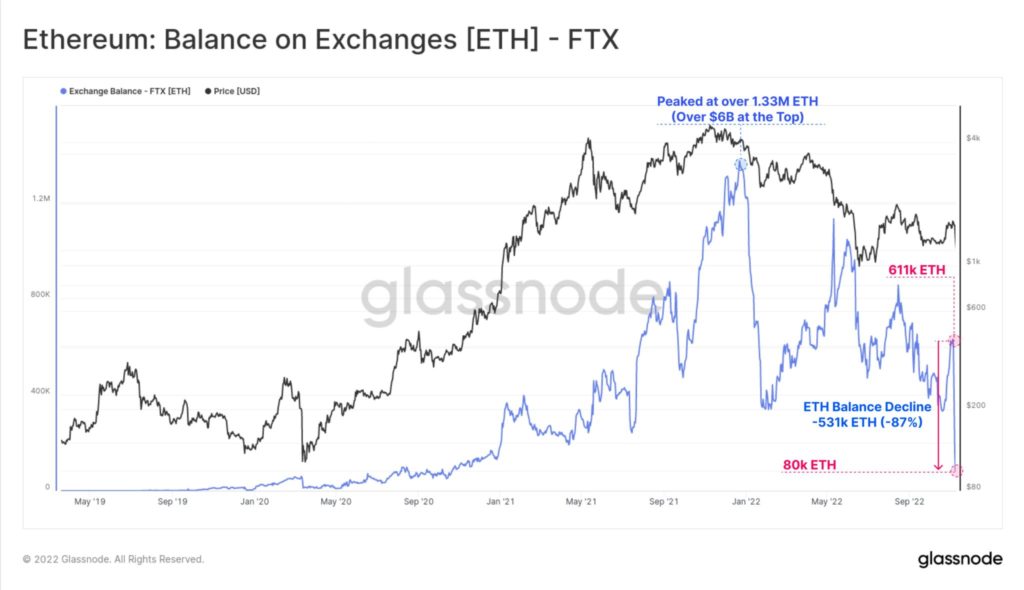
Over the course of two days by the time of the study, FTX’s Ethereum reserves had almost been wiped to zero. The balance fell from more than 611,000 ETH to 80,000 ETH.


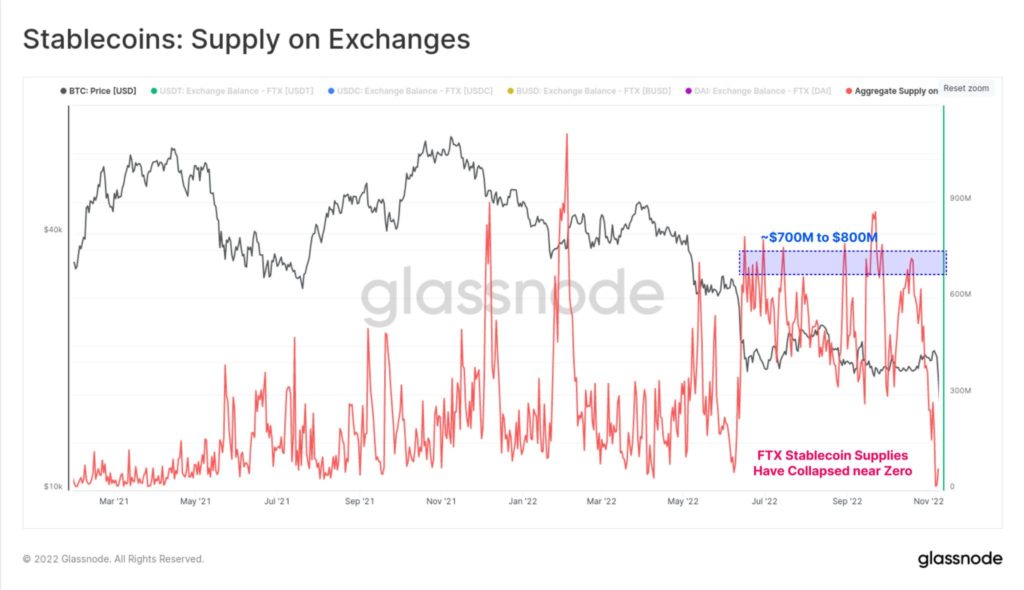
Applied to stablecoins, the metric also collapsed to near zero from around $700-800 million observed in mid-October.
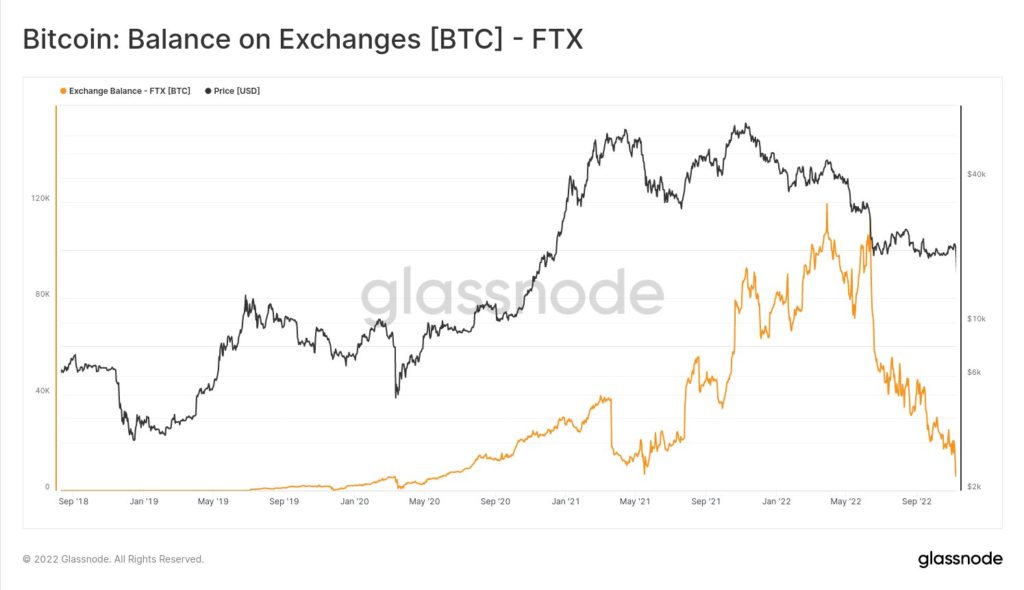
In reference to the first cryptocurrency, the reserves were similar in dynamics — from 108,000 BTC at the end of March, the balance dropped nearly to zero. The trend formed right after Terra’s collapse ( Terra collapse ).
Against the backdrop of the FTX collapse there was a record outflow of Bitcoin from exchange balances to cold wallets. The monthly pace reached 106,000 BTC.
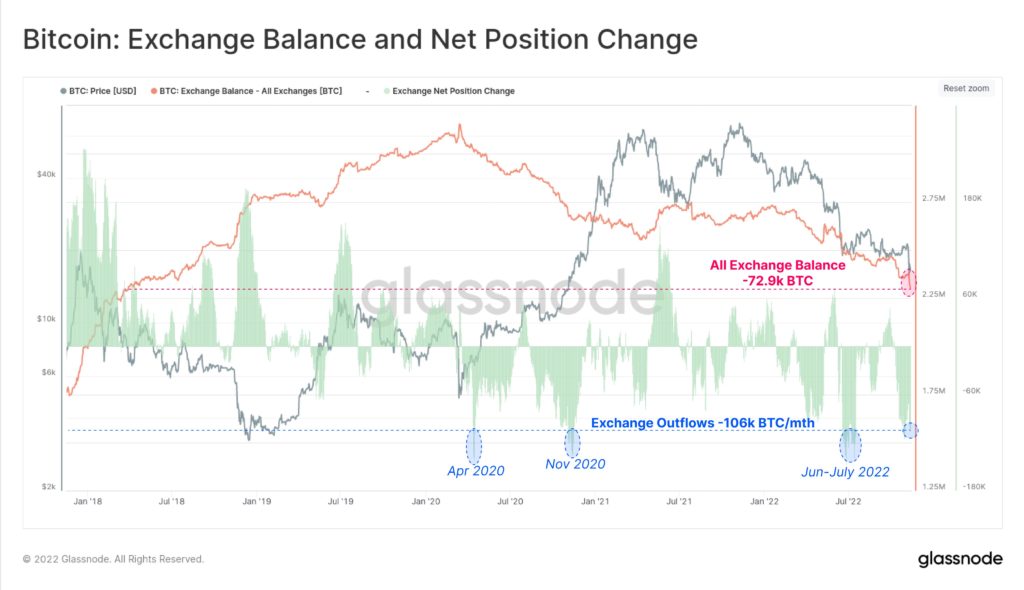
Typically moving coins from exchanges to non-custodial wallets signals investor confidence in the long-term prospects of digital gold. This time the process is driven by a loss of trust in storing Bitcoin on centralized exchanges. The trend is confirmed by a spike in sales of Ledger and Trezor hardware wallets.
«The problems with FTX became an extremely complex event for the market, hitting quotes, investor confidence and consequences yet to be evaluated»,
the Glassnode specialists concluded.
Later, on-chain data from Nansen showed that about 86% of FTT (280 million of the initial 350 million) was initially controlled by the exchange itself and Alameda Research. The latter served as one of the first liquidity providers for FTX in May 2019.
All exchange tokens, including most unsold, were deposited into an address with a three-year vesting for the trading firm as the sole beneficiary.
Analysts believe this led to a liquidity constraint for the tokens, making them susceptible to manipulation.
In the 2021 bull run when FTT surged from $0.1 to $84, affiliated entities chose not to sell on the market, instead using the tokens as collateral for borrowings.
The trading firm was using the proceeds to pump the utility token and, as a result, increase leverage potential.


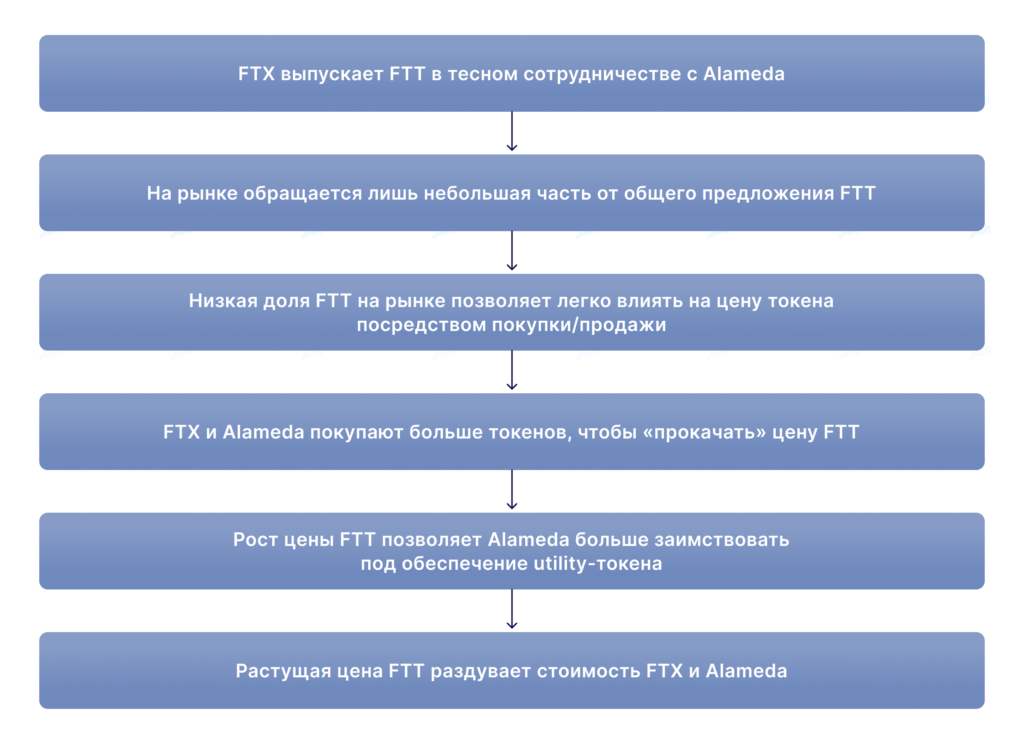
That scheme held until Terra’s collapse in June 2022. With the shutdown of firms such as Three Arrows Capital and Celsius, which had ties to Genesis Global Capital, Alameda likely faced deleveraging and a liquidity crisis.
Problems could have been solved by selling FTT for cash. The side effect would have been a fall in the asset’s price and a contagion to FTX.
On‑chain data showed Alameda tokens moved to the exchange wallet worth about $4 billion in May–June with a possible loan of a similar amount, confirmed by The Wall Street Journal sources.
Experts suggested that the emergency financing obtained by the trading firm could have consisted of customer funds from FTX.
WSJ, citing the exchange’s financial documents, reported that Bankman-Fried sold a $300 million stake in the company to buy back Binance shares.
In October 2021 FTX raised $420 million in a Series B-1 round. It was reported that the capital would go to business development, strategic investments and expanding licensing.
According to WSJ, three-quarters of the funds were received by Bankman-Fried himself, who used part of his stake in the company. The publication noted that then the founder called the transaction a partial reimbursement of his costs for the Binance stock buyback. The corresponding deal was done in July 2021.
Problems emerged on November 6, 2022. It was then that Binance CEO Changpeng Zhao decided to divest from FTT, exiting the exchange’s portfolio investment in FTX.
Hack VC managing partner and Dragonfly Capital co-founder Alexander Pak recalled that SBF’s “catastrophic” risk propensity manifested even before the platform’s inception.
«This was clear four years ago — the guy hid serious things and took big risks with other people’s money. Now he seems to have done the same on a larger, more catastrophic scale»,
the Dragonfly co-founder said.
Also, according to Pak, SBF never showed potential investors the books where “all the bad things” took place.
Illiquid asset
Soon Zhao published a letter to employees urging them to refrain from trading FTT.
«A fall of FTX is bad for everyone in the industry. Do not treat this as a “win” for us. User trust has been severely shaken. Regulators will scrutinise exchanges even more closely. Getting licences around the world will be harder»,
Then FTX declined to buy. Binance representatives said they could not resolve the platform’s problems.
«As a result of the comprehensive corporate review, as well as recent news about improper handling of customer funds and alleged investigations by US agencies, we have decided to forgo the potential acquisition of FTX.com»,
the company said.
By then FTT had fallen about 90% since Zhao’s tweets about the downfall of the competitor’s utility token; just three days had passed.
After Binance’s rejection of buying the platform, Tron Foundation founder Justin Sun said he would “work with FTX on a solution to move forward.”
In a Bloomberg interview, TRON advocate Tom Mackenzie emphasized that he was prepared to offer “a billion-dollar” aid to the sinking crypto exchange.
Amid the turmoil there emerged news of SEC and CFTC investigations into FTX’s links with its US unit and Alameda Research. The regulators are interested in whether customer funds were pumped into the business, the investor base, the degree of account segregation, ownership structures, their financial relationships, and the overlap of management and the board on personnel.
SBF sought to soothe market participants. He wrote that the value of FTX’s assets allegedly exceeds client liabilities, and that the liquidity crisis did not affect the US arm of the crypto exchange.
SBF also admitted that he is haunted by guilt over the situation.
«I regret it, that is the most important thing. I messed up and should have acted better. […] I was constrained by a possible deal with Binance; I wasn’t really allowed to speak publicly. But, of course, it is on my conscience that we got here»,
Bankman-Fried added that the exchange is not insolvent. However, due to misjudging client margin, it faced difficulties.
But WSJ sources found that the collapse was caused by FTX providing customer funds to Alameda Research to finance risky trades.
According to them, in investor meetings SBF said that Alameda Research had an outstanding debt to FTX of $10 billion.
The publication recalled SBF’s November 7 statement. He claimed that FTX did not invest client funds even in safe assets such as US Treasuries. The tweet was later deleted.
WSJ added that Alameda Research earned from arbitrage, market making and yield farming.
Regulators’ fury
Not surprisingly, regulators across jurisdictions kept a close eye and prepared to take decisive action.
On November 11 the Bahamas Securities Commission blocked assets of the subsidiary FTX Digital Markets (FDM) and affiliated entities, and suspended the company’s licence in the country.
Japan’s Financial Services Agency ordered the local unit of FTX to halt operations and switch to a close-only mode, where users can close positions but cannot open new ones.
Turkey’s unit reported plans to convert user balances in lira at a 1:1 ratio for eventual transfer to bank accounts.
CySEC suspended the licence of FTX EU Ltd, allowing the platform to service the European Economic Area.
By order of law enforcement, Tether Limited frozen 46,370,701 USDT on the Tron blockchain belonging to FTX.
«We were ordered to freeze the assets during the investigation»,
commented CoinDesk representatives, the issuer of the stablecoin.
This was the first time a freeze touched the funds of a crypto exchange.
Against the backdrop of the FTX crisis, US Treasury Secretary Janet Yellen called for very careful regulation of the crypto industry, which is not yet as tightly intertwined with the traditional financial system.
Representative Patrick McHenry said Congress is examining Binance’s role in the sudden collapse of its competitor. In his words, Zhao’s public statements’ impact on the situation will be the focus of hearings in December.
«This is a serious and major event»,
The head of Binance announced a joint effort of crypto giants with policymakers and regulators.
«The association will provide a link to regulators and support best practices in the industry, including ensuring transparency and reserve verification»,
Representatives of the exchange confirmed discussions about its role in FTX’s collapse with institutions from several countries.
Collapse
Bankruptcy
The logical outcome of the saga was FTX Group filing for bankruptcy protection under Chapter 11 of the US Bankruptcy Code and the resignation of Bankman-Fried. He was replaced by John Ray III, who previously oversaw the restructuring of the infamous energy company Enron.
Bitcoin fell to around $16,300.
Judicial documents revealed that the number of FTX creditors could exceed a million. The estate proposed treating claims for all 130 affiliated entities, including Alameda Research, in a single proceeding rather than individually.
Below is an infographic showing part of SBF’s empire investments. The full list of companies is provided in Blockworks’ tweets.


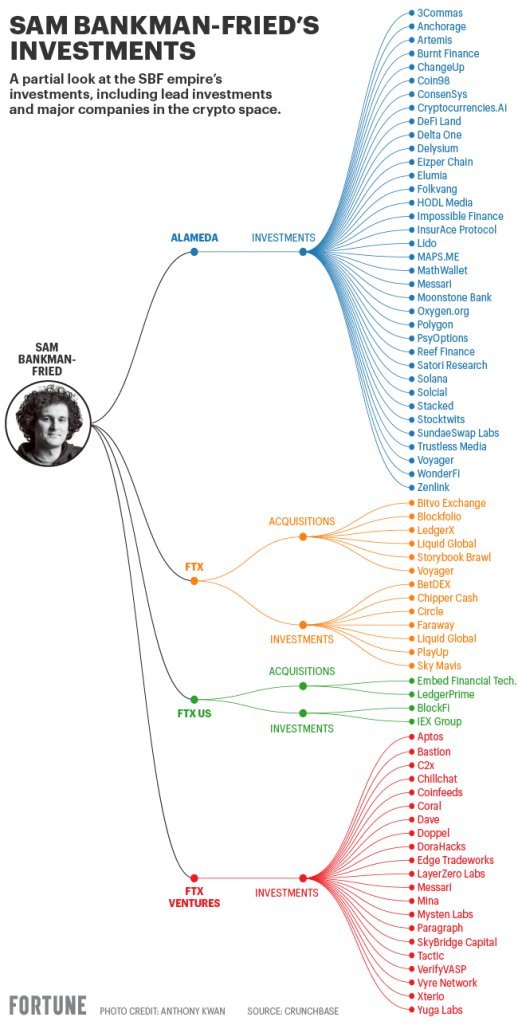
The Alameda Research portfolio and rounds in which it participated can be viewed on the service Cryptorank.
Investors in FTX include SoftBank, Temasek Holdings, BlackRock, Ontario Pension Fund, Paradigm, Tiger Global and others.
Funding overview pic.twitter.com/wZP6If6OtK
— Frank Chaparro (@fintechfrank) November 9, 2022
Meanwhile the Bahamian court approved temporary liquidators for FTX Digital Markets. The local securities regulator transferred all FDM assets to a regulator-controlled wallet.
In turn, FTX subsidiary filed in the Southern District of New York for Chapter 15 bankruptcy.
Under the law, such a step eases cross-border bankruptcy proceedings involving assets and entities in more than one jurisdiction.
Chapter 15 can protect FDM from asset seizure in the United States during liquidation on the Bahamas.
Amid the confusion, the new FTX CEO accused SBF and other former executives of hiding improper use of client funds and “secretly releasing” Alameda Research from certain aspects of the platform’s auto‑liquidation protocol.
«Never in my career have I seen such a complete failure of corporate governance and an absolute lack of reliable financial information»,
described John Ray the state of affairs.
He noted that the large crypto-industry business lacked a centralized cash-management department. These services were outsourced.
«FTX Group lacked centralized control of cash. Procedural missteps in money management included the absence of an exact list of bank accounts and signatories»,
added Ray.
Court documents revealed further, even more interesting details. For example, the Alameda-controlled Euclid Way Ltd lent $2.3 billion to Paper Bird Inc., which Bankman-Fried owns. The venture firm itself also lent:
- $1 billion — to the head of the group;
- $543 million — to Nishad Singh, co-founder of FTX;
- $55 million — to co-CEO Ryan Salame.
Corporate funds were also used to purchase Bahamian real estate for the residence of leadership and advisors.
There was no corporate governance within the company’s divisions — boards met rarely. All decisions were made by a small circle led by Bankman-Fried and two co-founders, Ray stated.
Hack for $477 million
To make a difficult situation worse, the badly timed withdrawal of more than $400 million from exchange wallets to external addresses occurred.
The administrator of the official FTX Telegram channel wrote that the exchange was hacked and all assets stolen. He later deleted the message, clarifying that only a portion of the funds were stolen.
IBC Group founder Mario Naufal noted that the hacker also used Kraken to cash out the coins. The platform’s security chief Nick Percoco wrote that the team knows the identity of the user.
We know the identity of the user.
— Nick Percoco (@c7five) November 12, 2022
A few days later the FTX Accounts Drainer address, linked to the alleged hack, resumed activity. The account labeled Heist [robbery] carried out numerous DAI-to-ETH swaps, swaps in the BNB Chain ecosystem, and transfers to Ethereum via a cross‑chain bridge.
Once again in the Ethereum whales list, FTX Accounts Drainer subsequently exchanged 50,000 ETH for wrapped Bitcoin (Ren Protocol) and connected the assets to a cross‑chain bridge to move them to the mainnet of the first cryptocurrency .
Elliptic estimates the total damage from the hacker’s actions at $477 million.
Cointelegraph interviewed experts who at the time suggested the hack could have been an insider job.
Isolation
Unsurprisingly, after these events FTX has sunk deeper into isolation. Various companies and institutions took the following steps:
- Binance stopped deposits in FTT, arguing the unlock schedule for additional utility tokens had been breached. However the exchange soon resumed deposits;
- Kraken blocked accounts linked to FTX and Alameda upon law-enforcement request;
- Paxos, at the request of US authorities froze 11,184.38 PAXG, previously held on FTX.com;
- Visa ceased cooperation with FTX on issuing debit cards.
- FTX’s Japanese Bitcoin exchange Liquid froze withdrawals in crypto assets and fiat currencies;
- Australian regulator suspended the licence of the local FTX entity.
Facing possible criminal charges, SBF’s prospects loomed. In an interview with Fortune, an anonymous lawyer cited a federal statute covering fraud involving electronic funds. The maximum punishment is up to 20 years in prison.
A seasoned crypto-industry expert added that prosecutors could use platform terms of service, investor presentations, and public statements by Bankman-Fried as evidence of intent. The lawyer is convinced that the exchange’s business practices and the head’s conduct demonstrated fraud.
Consequences for the crypto industry
Balance-sheet hole
During a conference call Bankman-Fried stated that liquidity constraints left the company with a shortfall of up to $8 billion. FTX needs $4 billion to stay solvent, the exchange’s founder said.
The Wall Street Journal also cited similar figures. The paper’s sources confirmed that the platform needed cash injections to satisfy client withdrawal requests.
Reuters reported that, in an effort to aid Alameda Research, Bankman-Fried transferred no less than $4 billion to the company. The amount comprised FTT tokens, customer funds and Robinhood shares.
Bloomberg journalists also learned of efforts to secure emergency financing in the form of debt, equity or a combination thereof.
According to Reuters, Bankman-Fried discussed fundraising with Tron Foundation founder Justin Sun and with leaders at Sequoia Capital, OKX and Tether Limited. The agency reported the “hole” in the balance sheet at $9.4 billion.
Ripple CEO Brad Garlinghouse said SBF had called him when trying to raise funds to save the business. They discussed whether the exchange had units it would want to acquire.
Harm to firms
Many market participants in one way or another interacted with FTX and Alameda. Companies reported losses one after another. Some paused operations wholly or in part.
Examples include:
- Sequoia Capital acknowledged a loss of $213.5 million on FTX investments;
- Sino Global Capital, in a letter to investors reported that the value of assets in FTX custody “runs into seven figures”;
- Circle, co‑emitter of USDC, said it owned an equity stake in FTX Group worth about $10.6 million;
- Paradigm did not disclose the exact amount but emphasised that it deeply regrets investing in the troubled company;
- Singapore’s Temasek Holdings wrote off investments in FTX and its US unit. The holding estimated total losses at $275 million;
- Pantera Capital was affected, though its representatives said losses were minor;
- NFT marketplace Metaplex on Solana fired part of the team amid deteriorating market conditions;
- Vauld, undergoing restructuring, held $10 million on FTX’s accounts;
- Canada’s Ontario Teachers’ Pension Plan will write off investments of $95 million in FTX and its US arm;
- Jump Trading Group denied rumors of (closing) due to the collapse, though the community remained skeptical;
- BlockFi halted withdrawals amid the FTX crisis. WSJ reports the lending platform is preparing a bankruptcy filing;
- Genesis Global Capital froze withdrawals and new loans.
Crypto Fund Research estimates that the crisis affected 25–40% of sectoral investment structures that had placed funds in FTX or its utility token. That represents about 7–12% of assets under management.
Judicial materials indicate FTX and affiliated entities owe $3.1 billion to the 50 largest creditors in total.
The collapse also hit the Solana ecosystem, since Alameda Research held $1.2 billion in SOL on its books (as of June 30).
The asset’s price fell by more than 60%. Solana’s price fell more than any other top-20 coin by market cap.
Referring to recent industry events, Crypto.com published that its reserves include 20% SHIB.
There was also a mass withdrawal of SOL from staking.
Proof-of-Reserves
A new market trend emerged — Proof-of-Reserves. It was pioneered by Binance.
«All crypto exchanges should prove their reserves [via] a Merkle tree. … Binance will soon start proving reserves. Full transparency»,
The initiative was supported by KuCoin CEO Johnny Lyu. He said the company would publish the relevant document “in about a month.”
Similar steps were taken by OKX, Gate.io and Huobi.
literally the day after Zhao’s statement, Binance published a page listing its crypto reserves.
Crypto.com also published relevant information. It emerged that 20% of the platform’s reserves are held in the meme token SHIB.
The estimated value of crypto assets on Huobi’s wallets stood at $3.5 billion. Bitfinex’ figure exceeded $5 billion (>), while Bybit stood at around $1.9 billion (}}aclose_117}}).
Ethereum founder Vitalik Buterin proposed using zk-SNARKs to verify crypto exchanges’ reserve data. He argued the technology would enhance the effectiveness of the Proof-of-Reserves procedure.
Buterin also expressed hope that a system would eventually emerge preventing exchanges from operating customer funds without consent.
Beyond reserve verification, exchanges have begun forming industry-recovery funds to help projects facing liquidity crunches. The trend was led by Binance, and OKX later announced a similar vehicle with assets of $100 million . Zhao drafted a list of what he sees as the essential requirements for centralized exchanges.
Revelations by SBF
In an interview with The New York Times Sam Bankman-Fried expressed remorse about the collapse of the Bitcoin exchange and stressed that events could have unfolded more dramatically.
He said that the marginal position had been “much larger than he imagined.” SBF admitted that he expanded his business interests too quickly and missed signs of trouble.
He also called the criticism of Changpeng Zhao in conversations with regulators a “strategically wrong move.”
In a recent tweet SBF wrote that the net assets of FTX and Alameda Research are valued at $1 billion — liabilities total $8 billion. The ex-CEO also said he would try to “increase liquidity, return assets to clients and restart” the business.
However, the new FTX head and restructuring chief John Ray emphasised that Bankman-Fried does not have a permanent role and does not speak for the crypto exchange and affiliated entities.
On November 16 it emerged that a group of US investors filed a lawsuit against SBF.
Opinions
Many experts agree that the events will prolong the bear market and the bottom will not be reached anytime soon. For instance, crypto Telegram channel CryptoEssay’s founder Stepnen Gershuni is convinced that crypto-winter “will wash out all the people who got into crypto for the wrong reasons.”

Bloomberg called it unlikely that clients will regain their funds, as FTX’s liquidity reserves amount to only $900 million against liabilities of about $9 billion.
Changpeng Zhao warned of cascading effects. He argued that the crypto industry’s current situation mirrors the 2008 financial crisis, and in the coming weeks even more firms may fail.
Coinbase forecasted a crypto winter through the end of 2023, as FTX’s collapse shattered investor confidence, triggered a massive deleveraging and drove away large players.
Multicoin Capital’s analysts also believe the contagion will manifest in the future. Many players may cease to exist, exerting pressure on liquidity.
Yet the venture-capital leadership remains confident about the long-term prospects of crypto.
«As deleveraging continues, we expect green shoots next year»,
Most surveyed by BDC Consulting experts are confident in further declines in Bitcoin’s price. On average, respondents expect the first cryptocurrency’s price to stop falling around $11,479.
More than half of top executives plan to increase investments in crypto and do not intend to cut them.
«The development of the FTX saga could lead to further declines in Bitcoin to strong supports in the range of $11,000 to $13,500»,
shared Bitfrost managing partner Anton Chashin.
On the prospects of criminal liability for SBF GMT Legal’s managing partner Andrey Tugarin noted:
«The SEC’s focus is on improper use of client funds. It is believed Sam Bankman-Fried transferred money from FTX to Alameda Research to fund risky bets by the latter. Such actions with client funds directly contradict the terms of service and violate the law».
According to Tugarin, the most likely charge would be wire fraud under 18 U.S.C. §1343 — up to 20 years in prison. Citing the Howey test’s third prong, the expert also did not rule out the possibility that FTX’s utility token could be deemed a security:
«If a court decides that investors’ profit expectations were based on FTX’s statements and actions, nothing would prevent classifying the tokens as securities and holding the exchange liable for their offer without SEC registration».
As for restitution to investors, Tugarin said the process will take a long time.
«Even partial refunds in the near term should not be expected. Mt. Gox — the largest exchange — collapsed in 2014 and only this summer began preparations for creditor payouts»,
A lawyer using the handle wassielawyer argued that SBF should go to prison.
9/ I don’t say this lightly — SBF should be in prison.
Do Kwon was reckless. Voyager had poor risk management. Celsius was mismanagement. 3AC was incredibly reckless with investor funds.
Not that we should forgive any of the above but this… this is straight up criminal.
— wassielawyer (@wassielawyer) November 15, 2022
«Do Kwon was reckless. Voyager had poor risk management. Celsius exhibited poor governance. 3AC was incredibly irresponsible with investor funds.
Not that we should forgive any of the above. But this… this is pure crime»,
emphasised wassielawyer.
Conclusions
The collapse of SBF’s empire stands as one of the crypto industry’s greatest shocks, eclipsing Terra’s collapse and the Mt. Gox hack in scale and potential consequences. The market is unlikely to recover quickly from the event.
Opacity, reckless use of client funds, reckless staffing and extravagant approaches to risk management have bitten once-thriving companies and their founder.
Excessive leverage may pay off only in the short term. The market’s volatile nature can wipe out multi‑billion-dollar digital stock in an instant, creating a “death spiral.”
Regulators are already tightening their scrutiny of the industry. That means more restrictions are likely.
It remains unclear how venture investing will unfold. In coming months, funding will likely go only to the best, most promising products and after rigorous due diligence.
Nevertheless the market keeps going — there are no signs of a wholesale loss of confidence in its prospects, especially among hodlers. The drumbeat will continue, but it will take longer.
Read ForkLog’s bitcoin news in our Telegram — crypto news, rates and analysis.