




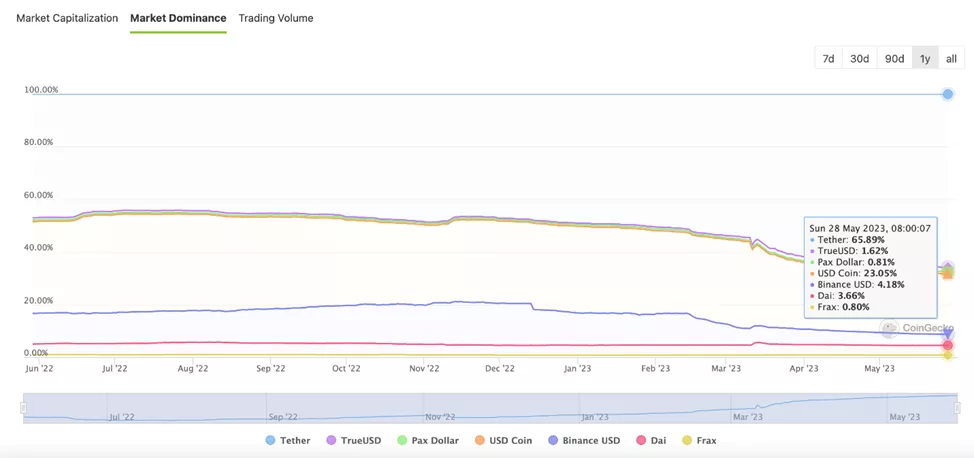
The share of USD Coin (USDC) over the past year fell from 34.9% to 23.1%, while the metric Tether (USDT) over the same period rose from 47% to 65.9%. Such data is provided by CoinGecko.
Market capitalization of the first declined to $29 billion, the second to $83.1 billion.
The market share of Binance USD (BUSD) fell from 11.68% to 4.18%, while Dai (DAI) accounted for 3.66% versus 4.05% in May 2022.


In April 2023, Circle’s chief executive Jeremy Allaire described enforcement actions against crypto firms as the primary factor behind the decline in the stablecoin’s capitalization.
Beyond regulators’ harsh measures, the banking crisis weighed in — Circle’s exposure to the failed SVB accounted for about 8% ($3.3 billion) of the total cash reserves underpinning USDC.
On March 11, amid the collapse of the institution, the stablecoin’s peg briefly broke the peg to the US dollar. Because of the USDC depeg, algorithmic stablecoins, including DAI, also deviated from parity with the dollar. Later, Circle said it had resolved issues with the asset’s banking support.
Another factor behind the growing popularity of the Tether-issued coin could be regulatory problems surrounding BUSD.
In February 2023, the New York State Department of Financial Services initiated an investigation into Paxos, the Paxos-issued partner behind BUSD. The firm said it would halt the stablecoin’s issuance and end its cooperation with Binance.
In the first quarter, the issuer of USDT earned $1.48 billion in net profit — twice what it earned in the previous period.
Earlier, amid the uncertainty around raising the US debt ceiling, Circle and Tether Limited revised their reserve structure in favour of repos and shorter-term T-Bill.