




The price of the leading cryptocurrency slipped below the $104,000 level amid capitulation by new buyers. The next target could be $92,000, according to crypto analyst Ted Pillows.
$BTC is in absolute free fall right now.
There’s no strong support until the $100,000 level, which means it’ll most likely get retested.
If Bitcoin loses the $100,000 zone, expect a correction towards the $92,000 level, which has a CME gap. pic.twitter.com/Cyaz1gKzjv
— Ted (@TedPillows) November 4, 2025
“Bitcoin is in absolute free fall. There’s no strong support until the $100,000 level, which means the coin will soon test it,” he noted.
The expert pointed to an unfilled price gap in CME Group futures around $92,000 — slightly below the opening price of 2025. If $100,000 is lost, a correction towards that area is possible.
The trader known as Daan Crypto Trades warned that the BTC/USD pair has lost the main support that had held for the past few weeks. He said the price is now nearing the lower boundary of the range, “where the initial higher low formed after the rebound from the October 11 crash.”
$BTC Main support lost that was holding price up for the past few weeks.
Now nearing the bottom of the range where price made its initial higher low after the bounce post 10/10 liquidation event.
Personally been playing very defensive with minimal exposure. Would be happy… https://t.co/8Pt23XZTEi pic.twitter.com/BhySqwot6b
— Daan Crypto Trades (@DaanCrypto) November 4, 2025
“There are massive whale sell-offs every day — such volume is hard to absorb. Equities are also showing instability amid a strengthening dollar. Overall, the current combination of factors looks unconvincing for growth,” he added.
The trader Ardi considers a test of the October 11 lows around $102,000 likely. Notably, this level coincides with the 50-week EMA — a key threshold that has not been touched for seven months.
Markus Thielen, founder of 10x Research, said the drop in bitcoin has shifted focus to the $100,000–101,000 zone, according to CoinDesk. A decline to those marks could open the way to $85,000.
“Although such a development would be an extreme measure, downside risks remain limited as long as bitcoin holds above the key downward trendline,” the expert explained.
Capitulation of new buyers
The slide has intensified pressure on recent bitcoin buyers, whose investments are now in the red. According to Glassnode, the NUPL indicator for short-term holders has entered the capitulation zone.
Short-Term Holders are facing renewed pressure as recent buyers move into a loss.
Historically, such periods of STH stress and capitulation have marked attractive accumulation opportunities for patient investors.
🔗https://t.co/k6nRVZJY5H pic.twitter.com/Nf50bX0jZb— glassnode (@glassnode) November 3, 2025
“Historically, such periods created favourable opportunities for accumulation by patient market participants,” the experts noted.
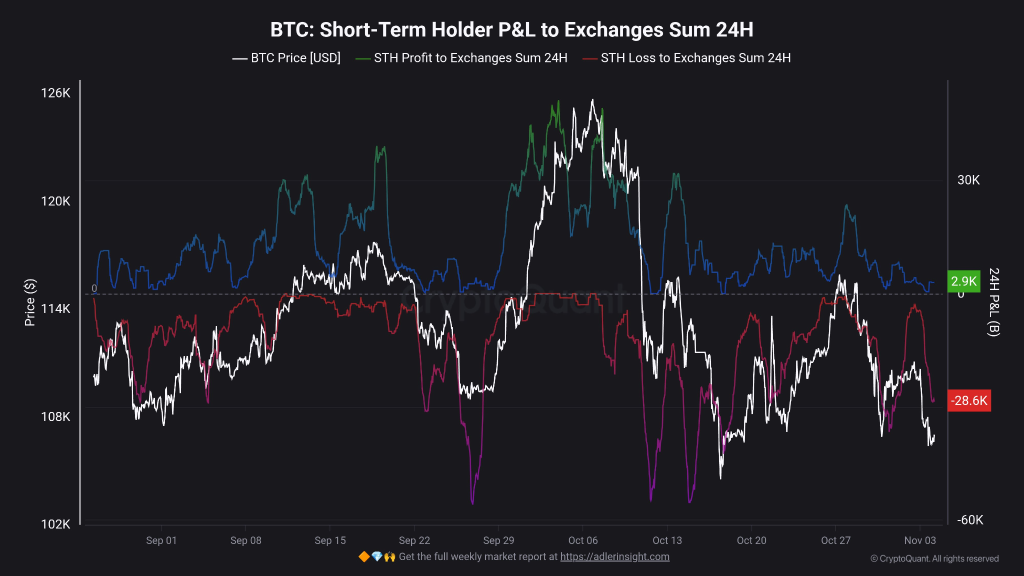
CryptoQuant analyst Maartuun emphasised that over the past 24 hours short-term holders sold 28,600 BTC worth $2.9 billion at a loss.


Structural weakness
According to analyst Axel Adler Jr, over the past week the market has experienced “two distinct periods of elevated stress”.
Bitcoin Local Stress Index (LSI)
Over the past week, the Bitcoin market has gone through two distinct periods of elevated stress. The first wave occurred between October 28–30, when the LSI reached extreme levels of 74–75% amid a price decline from $113K to $106K, accompanied by… pic.twitter.com/z8tNTIFBBl
— Axel 💎🙌 Adler Jr (@AxelAdlerJr) November 4, 2025
The first wave came on October 28–30, when the Bitcoin Local Stress Index (LSI) reached 74–75% amid a slide from $113,000 to $106,000, accompanied by high realised volatility and aggressive selling.
“A lull arrived on October 31, when the metric fell to 30–40% and the price recovered to $110,000, but the pause proved temporary before a new wave of offloading,” the expert noted.
The second wave began on November 2. The LSI rose to 67–73%, coinciding with stronger bearish signals. Bitcoin now trades below the six-hour moving average, and the aggressive selling ratio exceeds 0.51.
“The market is showing structural weakness, characterised by rising leverage and a negative liquidity flow, which points to persistent selling pressure,” Adler Jr explained.
Contributors to CryptoQuant from XWIN Research Japan say additional pressure on bitcoin is coming from the US government shutdown, now in its second month.
Bitcoin Under Pressure as U.S. Government Shutdown Disrupts Liquidity Flows
“While the CBO expects a temporary rebound once the shutdown ends, the on-chain data suggests confidence and capital will take longer to recover.” – By @xwinfinance pic.twitter.com/maMGrD0ks3
— CryptoQuant.com (@cryptoquant_com) November 4, 2025
“According to the Congressional Budget Office, a reduction in federal spending could reduce annual US GDP growth by 1–2% in the fourth quarter. […] This is not just a rise in fiscal uncertainty but a freeze in liquidity, and the blockchain is beginning to react to it,” the experts noted.
Reserves of the leading cryptocurrency on exchanges have risen for the first time in six months. This suggests coins are moving to trading venues — a classic sign of preparing to take profits or reduce risk.
“Traditionally, this points to a defensive stance by traders in anticipation of rising volatility,” XWIN Research Japan added.
In parallel, miners’ reserves have fallen to their lowest since mid-year, indicating forced sales to cover operating costs. Such measures are attributed to the suspension of government support — energy subsidies and tax breaks — amid the ongoing shutdown.
At the same time, a record outflow of stablecoins from exchanges is being recorded, indicating a shift of capital from risk assets into dollar instruments. Liquidity is migrating from open trading venues into safe-haven assets, the analysts said.
“The combination of three key metrics forms a cohesive picture: capital is actively leaving the risk zone, and on-chain liquidity continues to contract. […] For bitcoin, the current phase is not just a correction for accumulation but a fundamental test of the resilience of investor conviction, the liquidity base and the market’s ability to remain patient amid institutional dysfunction,” XWIN Research Japan concluded.
Earlier, the trader known as CrypNuevo suggested that digital gold could form a bottom at $101,000. Sigma Capital CEO Vinit Budki said there is a high probability that the leading cryptocurrency could fall by 70%.