



In 2025 Bitget ranked second by spot-market liquidity depth. According to the exchange, this result reflects its dynamic development; it has become the fastest-growing among the top ten trading venues.
According to the 2024 Bitget transparency report, the platform rose to second place among CEX ecosystems by number of users. In this article, we, together with the exchange’s team, examine Bitget’s competitive advantages and main products.
Who founded Bitget, and when
The exchange was founded in 2018 by Sandra Lou. In May 2024 Gracy Chen became the trading platform’s CEO, known in the Web3 industry for initiatives promoting diversity and inclusion. In 2024 she addressed the UN Commission on the Status of Women, launched the Blockchain4Her ambassador programme and the Blockchain4Youth education project.
Beyond Chen, the company’s key figures include:
- Vugar Usi Zade — chief operating officer. He previously served as CMO at Beincrypto and Sony, and also held senior roles at Facebook, Danone and Carlsberg;
- Hon Ng — head of legal, included in a list of the industry’s 20 top executives by the Financial Times;
- Min Lin — chief business officer. He plays a key role in building relationships with partners and regulators, and leads initiatives to expand Bitget’s presence in key markets. Before entering the crypto industry, Min spent more than five years as an executive director at Goldman Sachs.
“In 2018, having studied Bitcoin’s white paper and the Ethereum ecosystem, we saw the future in cryptocurrencies. The market collapse weeded out speculators — fewer than 10% of participants remained and managed to adapt. That same year we founded the company. Forged in a bear market, Bitget bet on users, innovation and long-term development,” the exchange’s website says.
Bitget is registered in the Seychelles. The company operates as a virtual asset service provider (VASP) in Poland, Lithuania and Bulgaria, and in El Salvador as a bitcoin-services provider.
The Bitget ecosystem
The Bitget ecosystem includes:
- a namesake centralised exchange;
- the Bitget Wallet Web3 wallet;
- the native Bitget Token (BGB).
Previously, the wallet used a separate asset — Bitget Wallet Token (BWB). However, in late 2024 developers announced its merger with BGB.
Below we examine each product in more detail.
Bitget CEX
Access to deposits, the P2P platform, and spot and futures markets requires mandatory KYC. Registration is available on the website and in the mobile app (Android and iOS). Clients must provide a passport or driver’s licence and confirm its authenticity. The entire process takes no more than an hour.
After verification, the exchange recommends strengthening account security. Users can set up one or several two-factor authentication methods (Passkey, Google Authenticator, email, phone number). Additional protections are also available: a withdrawal whitelist and an anti-phishing code.
After setting up an account, users can top up their balance. Bitget offers several options:
- P2P trading — buying bitcoin, Ethereum (ETH), USDT or USDC from other users with payment by bank card or other available methods;
- credit/debit card — fast purchase via Visa/Mastercard;
- bank transfer — euro funding via SEPA;
- crypto deposit — transfer cryptoassets from another exchange or wallet via the “Assets” section (“Deposit” button).
Users can then trade on spot and futures markets, and use Bitget Earn products or copy-trading services. The exchange offers:
- more than 800 cryptoassets and over 900 spot trading pairs;
- perpetual futures settled in USDT, USDC and other cryptocurrencies;
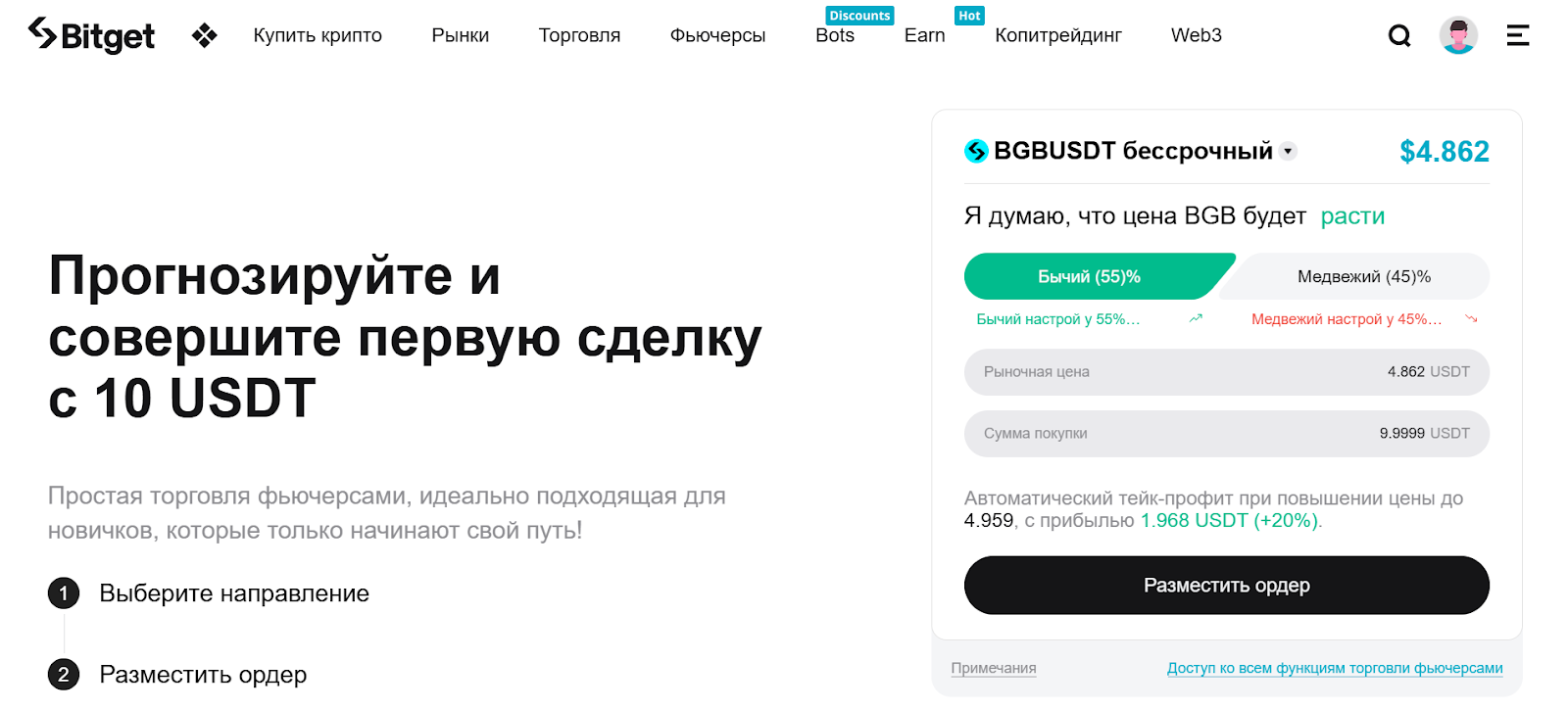
- Futures Kickoff — a simplified interface for trading futures, designed especially for beginners.


On the Earn platform, users can earn additional income on their investments. The product list includes:
- savings — fixed- or flexible-term deposits with daily interest accrual;
- on-chain elite — Bitget’s restaking service. At the time of publication the exchange offers swapping Solana (SOL) and bitcoin (BTC) for LRT BGSOL and BGBTC;
- on-chain earn — staking PoS cryptocurrencies such as Ethereum and Solana;
- crypto loans — loans of stablecoins and cryptocurrencies secured by other assets;
- wealth management — users with capital from 50,000 USDT/0.5 BTC can entrust funds to the Bitget team for “stable” or “enhanced” yields.
The exchange also offers structured products: dual-currency investments, Shark Fin and Smart Trend. They have a lock-up period of one to seven days and an APR of up to 20% per year.
In 2020 Bitget was the first on the market to add copy-trading — a strategy in which users (copy traders) replicate the trades of leading traders (lead traders). Since then, the exchange has remained one of the leading platforms in this segment. Users can subscribe to lead traders on spot and futures markets or copy a trading-bot strategy.
Bitget regularly offers new clients bonuses and rewards for taking part in various activities. For example, at the time of writing, newcomers can receive up to 777% APR on USDT for a first deposit and an airdrop of up to 20 USDT for a first trade. The promotion runs until 24 March 2025.
Bitget Wallet
Bitget Wallet (formerly BitKeep) is a non-custodial Web3 wallet supporting more than 100 blockchains and L2 solutions. The app is available for iOS and Android, as well as a Chrome extension.
Wallet users can swap assets via the built-in DEX aggregator Bitget Swap. It runs on the BitKeep Swap protocol for order-splitting in EVM networks.
“BitKeep Swap integrates 1inch, dodo, uniswap, 0x and other order-splitting protocols, facilitating users’ access to liquidity of hundreds of DEXs. At the same time, it provides users with the best swap price and saves fees,” the project’s Github says.
Wallet users can place market and limit orders, trade meme tokens on the MemeX platform, and trade futures with leverage of up to 125x.
For additional protection of funds, the Bitget Wallet team has created a Protection Fund — a $300m insurance pool. According to information on the website, it is intended to compensate potential user losses due to mistakes when using the wallet.
Bitget Token
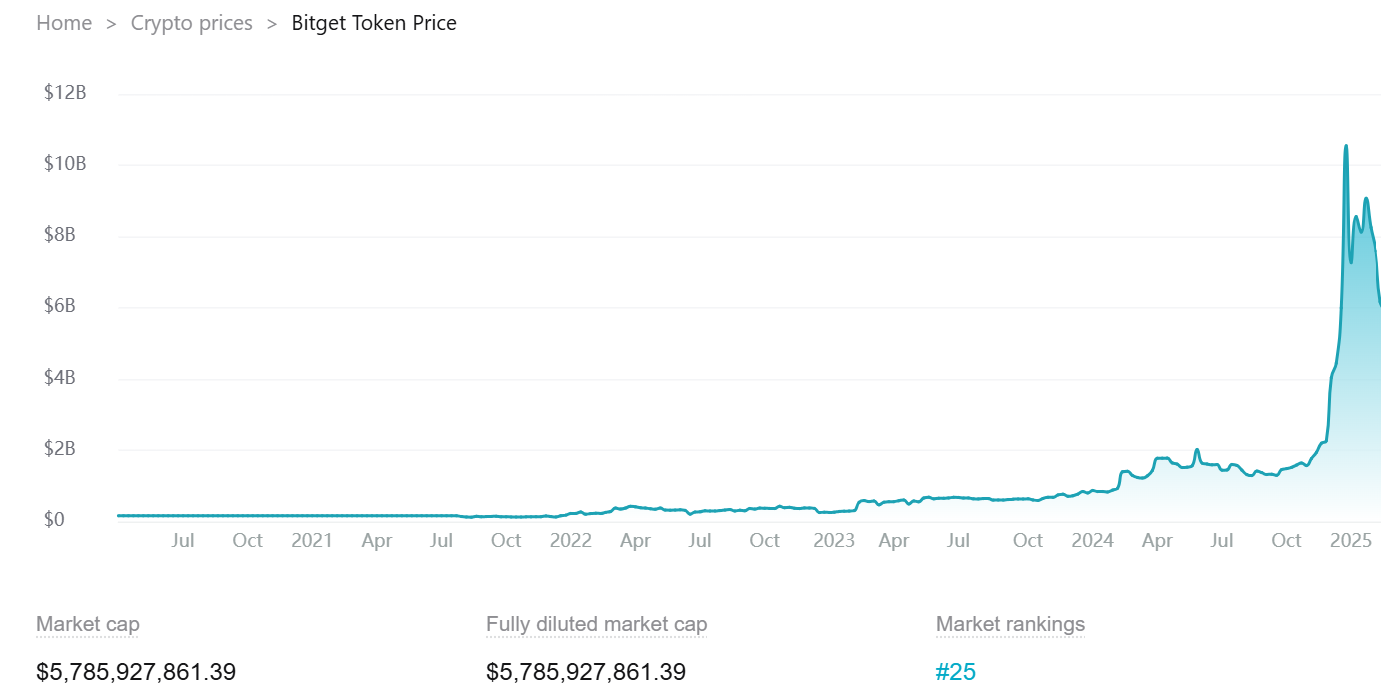
The BGB exchange token was launched on Ethereum in July 2021 with a total supply of 2bn units.
In December 2024 the platform presented an updated white paper, announcing the burn of 40% of supply (800m BGB) and the launch of a quarterly buyback mechanism. Twenty percent of revenues from the exchange (spot, futures and margin trading) and the wallet (swaps, futures and NFT trading) will be directed to this initiative.
“On 26 July 2021, BGB was launched at an initial price of 0.0585 USDT. A little over three years later, its value exceeded 7.9 USDT, showing growth of more than 100 times. This allowed BGB to enter the top 30 cryptocurrencies by market capitalisation,” the white paper says.

Together with the merger of BGB with Bitget Wallet Token (BWB), the exchange announced the integration of centralised and decentralised services into a single ecosystem. BGB holders receive several benefits:
- token farming — staking BGB in Bitget Launchpool and PoolX to receive new coins and airdrops via Fair Launchpool in Bitget Wallet;
- access to token launches — the ability to subscribe to early-stage projects via Bitget Launchpad and invest in Web3 via Bitget LaunchX;
- fee discounts — a 20% discount when paying spot trading fees with BGB.
Conclusion
Since its launch in 2018, Bitget has become one of the most recognisable companies in the crypto industry. Partnerships with Lionel Messi and the football clubs Juventus and Galatasaray not only bolstered trust in the exchange, but also helped draw a wider audience into crypto.
Bitget also actively develops educational initiatives such as Bitget Graduate Program and Bitget Builders Program, which introduce young people to Web3.
The exchange has paid particular attention to popularising copy-trading, becoming one of the first platforms to emphasise the social aspects of crypto trading.