



The year 2022 proved a stern test for the cryptocurrency industry, from the collapse of leading assets to the downfall of major projects and entire empires.
On one hand, the new shocks sparked calls for tougher regulation, on the other, they underscored the need for greater transparency and adequate risk assessment.
Nevertheless, despite the protracted crypto-winter, the industry did not stand still. Here are the most important events and trends of 2022 that have already entered history.
Events
The Fed and Bitcoin’s Price
One of the main drivers of the decline in the price of the leading cryptocurrency emerged early in the year: the hawkish policy of the US Federal Reserve (the Fed).
On January 6, Bitcoin hit a local low at $42,500, dragging the rest of the market. The plunge occurred amid the regulator’s decision to unwind the quantitative easing program.
In March the Fed, for the first time since 2018 raised its policy rate to 0.25–0.5%. Yet the news spurred a sharp rally in Bitcoin and Ethereum as traders reacted. The start of a protracted correction came with the May rate hike of 50 basis points.
Further Fed moves drove Bitcoin to below $18,000. Over the year, digital gold lost 64.4% (GoinGecko), and the market cap ended 2022 at $826.8 billion.
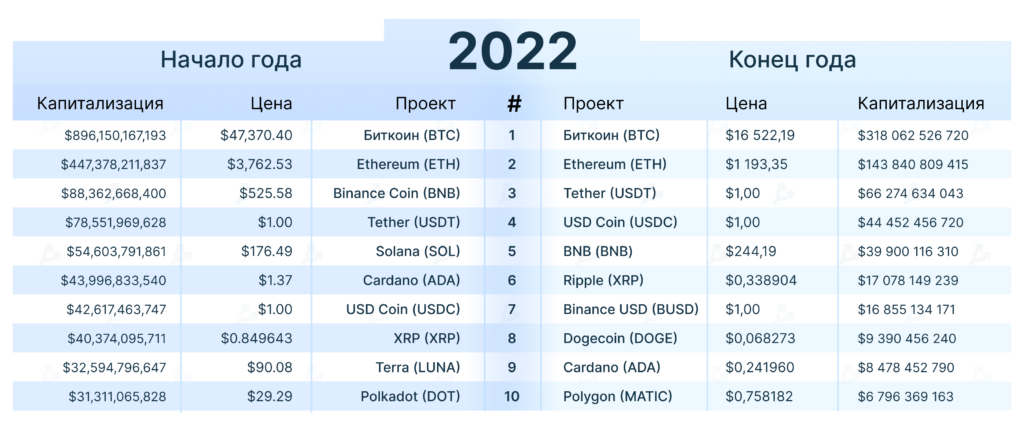
Over the 12 months the lineup in the top ten crypto assets changed notably. The USD Coin (USDC) strengthened its position, while Cardano (ADA) fell to the lower ranks. Solana (SOL) and Terra (LUNA) fell out of the top 10.


The DeFi sector also suffered. In this case the Fed’s policy did not have a direct effect; causes included Terra’s collapse and the bankruptcy of Sam Bankman-Fried (SBF) structures, and the ensuing crypto price crash.
According to TVL, the decentralized applications (span data-descr=”decentralized applications” class=”old_tooltip”>dapps demonstrated the largest drop since June — down 22%, to $64.71 billion.
In the penultimate month of the year, Ethereum’s TVL fell 21%, to $40.41 billion. Solana’s figure plunged 70%, to $497 million. The price crash of the latter and the outflow of crypto from smart contracts were driven by the fact that SOL on Alameda Research’s accounts totaled $1.2 billion (as of June 30).
As of December 30, the amount of funds locked in DeFi protocols stood at $38.8 billion.


Against the backdrop of the crypto-winter, the community began seeking reasons for optimism. The main one was Ethereum’s transition from Proof-of-Work to Proof-of-Stake.
The Merge
The upgrade was awaited by both supporters and opponents. The former anticipated a market reset to restart the market, the latter prepared for a PoW fork.
Some in the community placed bets on Ethereum Classic (ETC) as a refuge for miners leaving Ethereum. But the latter did not deliver — ETC prices never surged sharply, despite the increase in hash rate.
On September 15, Ethereum developers activated The Merge. Analysts predicted a threefold rise in ETH’s price, but the second-largest cryptocurrency went along a different path.
By year end, ETH had lost 67.2%. Since mid-September the asset had not risen above $1,700.


Probably, with different developments, Ethereum would have pleased analysts betting on its growth. But what happened in spring and summer 2022 left little room for positivity.
Terra Collapse
In January 2022 the Terra blockchain entity Terraform Labs (TFL) created the non-profit Luna Foundation Guard (LFG). Its aim was to develop the project ecosystem and bolster the resilience of the algorithmic stablecoin Terra USD (UST).
The new organization received initial funding of 50 million LUNA. In March TFL directed 12 million LUNA, in April — an additional 10 million LUNA.
LFG also invested more than $1 billion in Bitcoin to back UST and invested $200 million in AVAX tokens from the Avalanche project. By mid-April, UST’s market capitalization exceeded $17.53 billion, allowing the algorithmic stablecoin to surpass Binance USD (BUSD).

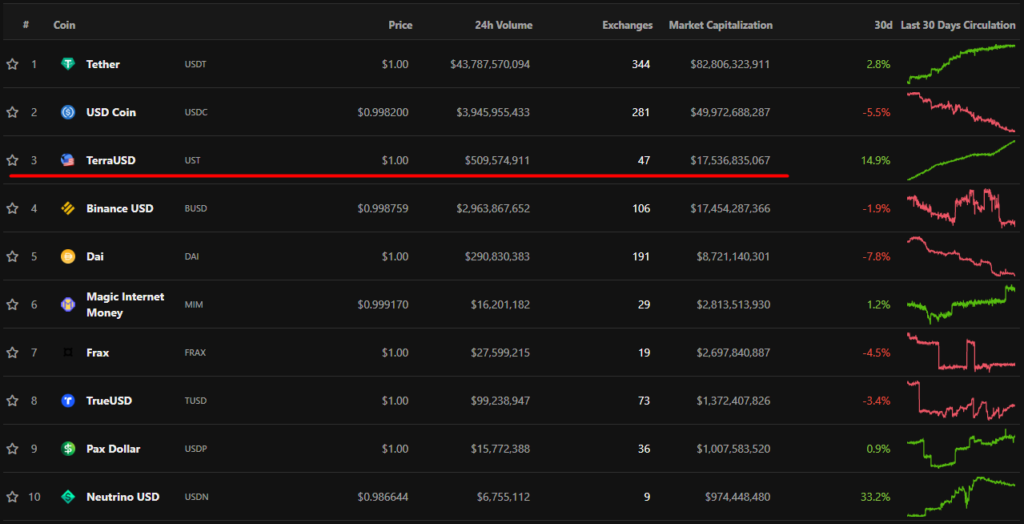
At that time the Terra ecosystem trailed only Ethereum in TVL. Everything changed in early May: as deposit yields fell, users began withdrawing assets from the Anchor protocol, UST lost its dollar peg, and the associated LUNA nearly collapsed.
Subsequently, developers launched Terra 2.0 mainnet, but this did not fix the situation. The Terra collapse had consequences for Terraform Labs’ CEO Do Kwon and co-founder Daniel Shin.
The Terra collapse rippled through the rest of the market. Losses were borne by Hodlnaut, Venus, Anchor, Mirror Protocol, Avalanche Foundation, Hashed and even Binance.
Bankruptcies of Three Arrows Capital and Celsius
Next in the spotlight were the crypto hedge fund Three Arrows Capital (3AC) and the lending platform Celsius.

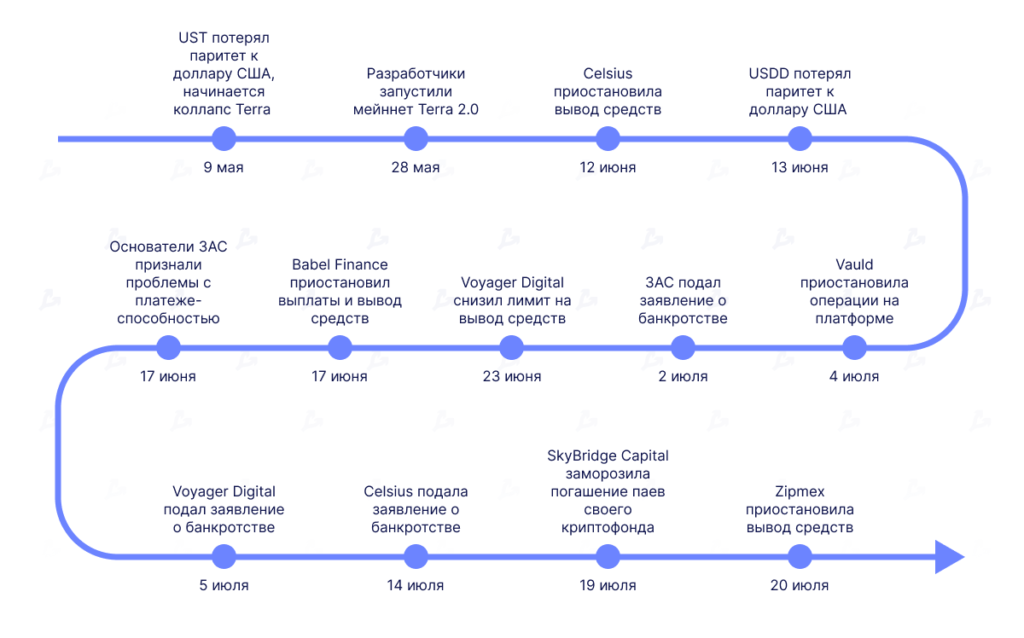
“Contagion” spread rapidly. In July it emerged that one of Asia’s largest crypto lenders Babel Finance engaged a law firm Kirkland & Ellis for restructuring counsel.
Thailand’s Bitcoin exchange Zipmex {{a href=”https://forklog.news/bitkoin-birzha-zipmex-obratilas-v-sud-dlya-zashhity-ot-kreditorov/”}}sought creditor protection in an effort to secure funding for a rescue. In late November, venture firm V Ventures — a current investor in the platform — allegedly made an offer.
Insolvency was declared by German crypto bank Nuri — operations ceased in November. The CoinFLEX crypto-derivatives platform began restructuring, facing bankruptcy risk at BlockFi.
Lastly, as with a number of other troubled projects , the exchange FTX run by Sam Bankman-Fried tried to “save” them. Yet by November, it itself needed help.
The Collapse of Sam Bankman-Fried’s Business Empire
Throughout spring and summer the entities tied to Bankman-Fried conducted several notable deals—from acquiring 7.6% of Robinhood to announcing the acquisition of 30% of SkyBridge Capital.
The entrepreneur repeatedly spoke of a desire to “help” troubled projects.
On November 6, Binance chief Changpeng Zhao announced plans to exit the FTX utility token FTT. By November 11 FTX Group filed for bankruptcy under Chapter 11 of the U.S. Bankruptcy Code, and Bankman-Fried stepped down as CEO.
On December 12 Bahamian authorities arrested the founder of the exchange at the request of the U.S. government.
SEC brought charges against SBF for defrauding FTX investors and misusing customer funds. CFTC filed a lawsuit against him for violations of the Commodity Exchange Act.
According to court filings in the Southern District of New York, the founder of FTX was charged with eight criminal offenses. Among them:
- conspiracy to commit fraud, illegal appropriation of customer funds and their use to cover Alameda Research’s expenses and debts;
- money laundering;
- violations of U.S. campaign-finance laws.
According to US Attorney’s Office spokesperson Nicolas Biase, Bankman-Fried faces up to 115 years in prison on the aggregate of all charges.
Many market participants interacted with FTX and Alameda Research to varying degrees. Companies began reporting losses one after another. Some partially or fully suspended operations.
According to court filings, the obligations of FTX and related entities to the 50 largest creditors totaled $3.1 billion. One of them had claims worth $226 million.


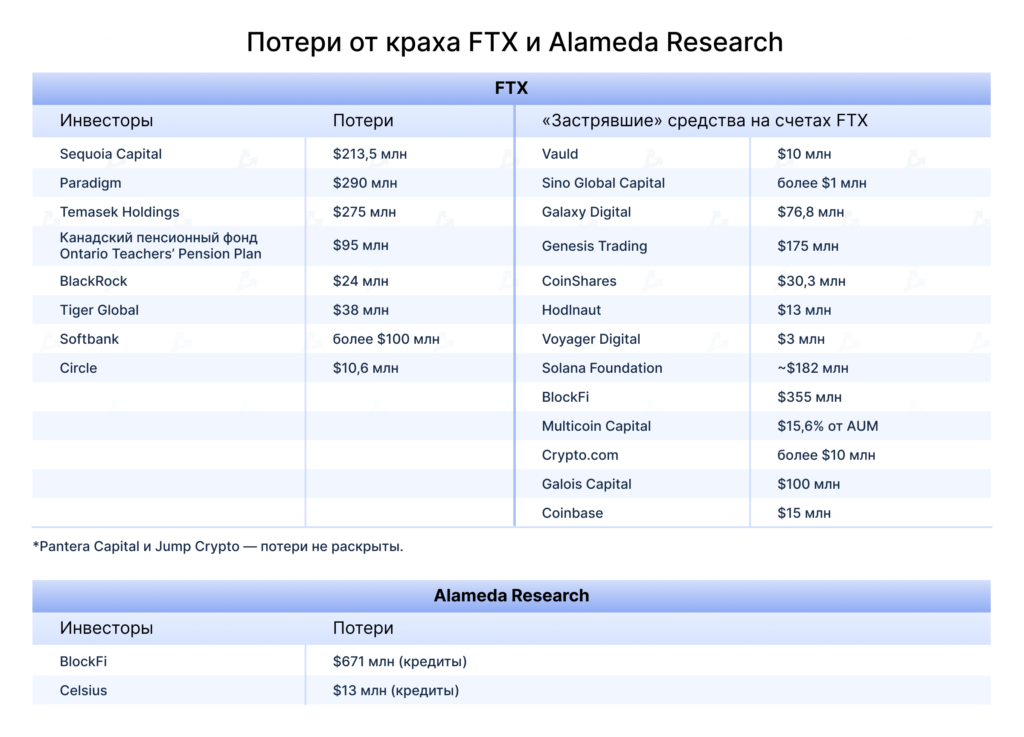
Data: ForkLog, Colin Wu.
John Ray, who had taken over as CEO of the FTX debtors, accused the former leadership of concealing the improper use of customer funds and giving preferential treatment to Alameda Research.
Regulators also reacted. US Representative Tom Emmer called the Bitcoin exchange crisis a “regulatory failure of the crypto industry”, while the US Department of Justice urged to investigate potential fraud in the FTX case.
Separate investigations into the exchange’s activities and affiliated entities were allegedly initiated by the CFTC and SEC.
Barry Silbert’s Problems
On November 16, Barry Silbert’s Digital Currency Group (DCG) saw Genesis Global Capital freeze withdrawals and new lending as clients issued requests after the FTX collapse.
Media did not rule out the possibility of bankruptcy of the entity and reported Genesisurgent financing of $1 billion. The attempt proved unsuccessful.
Amid this, the community grew concerned about the stability of the entire DCG group. Rumors of trouble were fueled by Grayscale Investments’ refusal to disclose reserves. The company’s position worsened as the discount of GBTC to net asset value widened from February, reaching a record 48.5% in December.
Bernstein analysts concluded that DCG could raise capital, sell non-core assets and either preserve Grayscale or liquidate GBTC. They described the latter as a “nuclear option” and a less desirable path for restructuring.
Crypto Fund Research estimates that the FTX collapse affected 25-40% of industry investment structures that had exposure to FTX or FTT. Yet some experts argued that alongside the crises in the industry, new, useful trends are emerging.
Trends
Proof-of-Reserves
The FTX collapse underscored the importance of exchange reserve verification and transparency. Binance chief Changpeng Zhao was among the first to conclude; similar moves were adopted by OKX, Gate.io and Huobi.


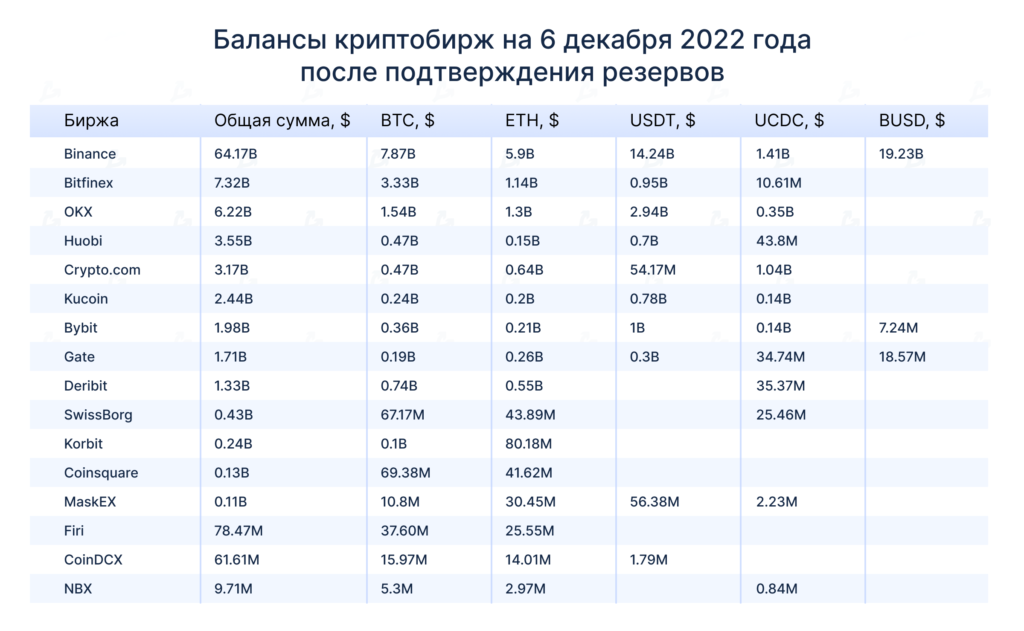
The Ethereum founder Vitalik Buterin proposed using zk-SNARKs to verify exchange reserve data. In his view, the technology would improve the efficiency of the Proof-of-Reserve procedure.
In November, exchanges began to pursue a trend of establishing industry-recovery funds to aid projects facing liquidity crises. The trend was led once again by Binance, with OKX announcing the creation of a similar vehicle with assets of $100 million.
But not all trends in 2022 were positive. Increasing Bitcoin mining difficulty, higher energy prices and price stagnation spelled trouble for miners.
Mining Difficulty and Miners’ Struggles
In June, Arcane Research noted that miners’ cash flow had fallen by 80% from the November 2021 peak, returning to levels seen two years earlier.
In the same month, publicly traded industry companies sold more cryptocurrency than they mined for the first time. In July the trend continued, its reversal occurred in August.
Throughout the year, key players in the sector faced problems. In November, Iris Energy informed the SEC that two of its units received a default notice on aggregate debt of $103 million. It had to shut down much of its equipment.
A bankruptcy filing was made by mining company Compute North, with a similar threat faced by Core Scientific. New York authorities added to the woes by introducing a two-year moratorium on mining cryptocurrency using power generated from carbon-based sources .
In November, miners’ aggregate revenue stood at $473.2 million — down 20% from October. The overall drop in revenue was driven by lower prices and rising mining difficulty; on November 21 the indicator reached a new high of 36.95 TH/s.
In December, mining difficulty for Bitcoin reached 35.36 T.

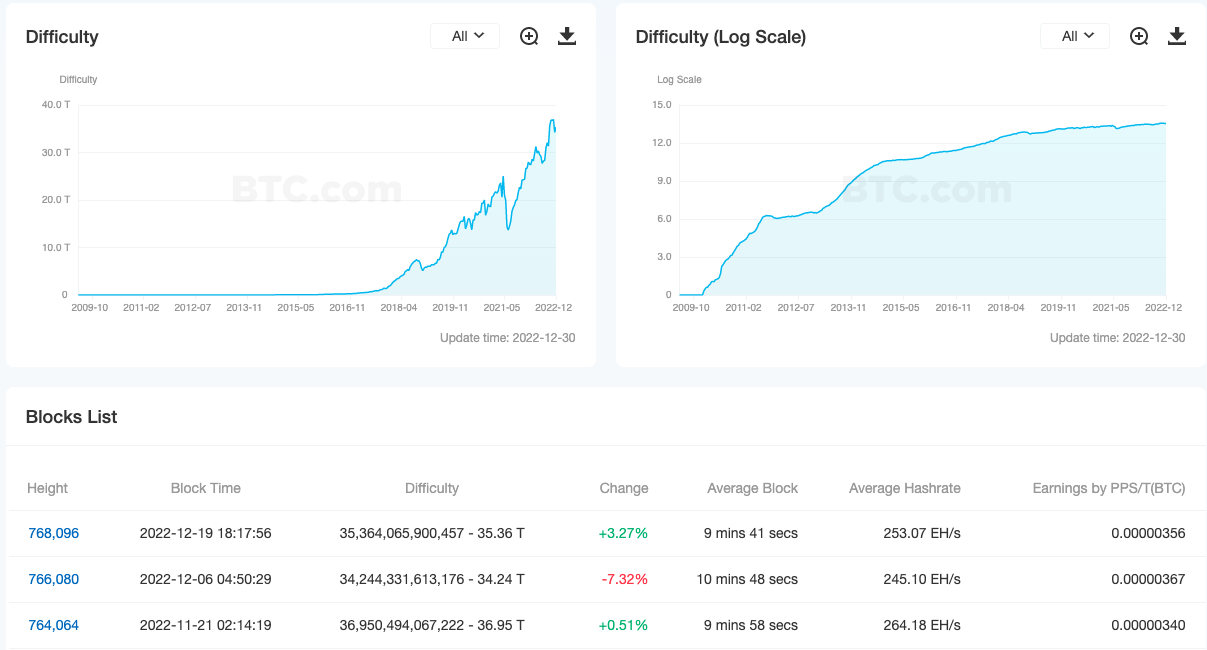
According to Glassnode, the network’s computing power reached a record on November 1 at 272.4 EH/s. On November 12 the metric approached a new high, surpassing 272 EH/s; by December it fell to 243 EH/s.
In September, Arcane Research found that the vast majority of public mining companies suffered losses due to the crypto-winter. It also launched another trend of the year — mass layoffs.
Cuts in Crypto Companies
Since spring 2022, many players have faced the hard choice of trimming staff amid adverse market conditions.


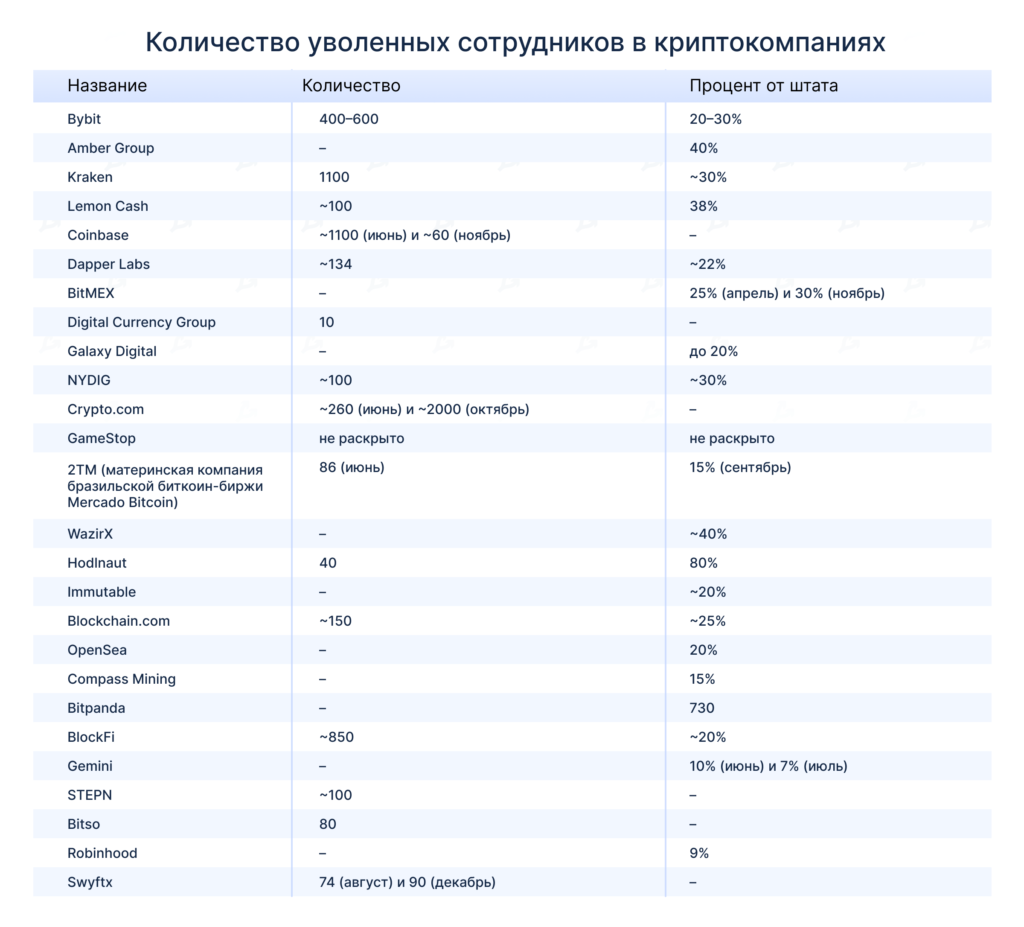
As of early December, more than 10,000 people were out of work, according to journalist Colin Wu. He notes that the cuts also affected teams at Valkyrie Investment, Mythical Games, Stripe, Genesis, Core Scientific and Celsius.
The crypto-winter affected nearly all sectors of the industry, including the non-fungible token (NFT) segment.
Loss of Interest in NFTs and Rise of Web3
One trend in 2022 was a decline in interest in the NFT segment. After a sharp rise in January, trade volume on the leading marketplace OpenSea showed volatility and began a steady decline from April.


Web3, by contrast, drew attention. Targeted funds were announced by:
- Animoca Brands — $2 billion;
- Pantera Capital — $1.3 billion;
- Andreessen Horowitz — $600 million;
- Binance Labs — $500 million;
- Immutable — $500 million;
- Konvoy Ventures — $150 million;
- NEAR Foundation — $100 million;
- Solana — $100 million;
- Alchemy — $25 million.
In addition to investments, the segment received positive feedback from various media figures and community members. Musician and producer Pharrell Williams named the blockchain and the internet of the new generation “the key to a revolution” in the financial system, and mobile game developer Aeria Canada Studio announced a transition to Web3.
Ethereum founder Vitalik Buterin proposed using zk-SNARKs to verify exchange reserve data. In his view, the technology would improve the efficiency of the Proof-of-Reserve process.
In November, among exchanges a trend emerged toward creating industry-recovery funds to assist projects facing liquidity crises. The trend was led by Binance, with OKX announcing the creation of a similar structure with assets of $100 million.
However not all 2022 trends were positive. The rise in Bitcoin mining difficulty, higher electricity tariffs and price stagnation created problems for miners.
Mining Difficulty and Miners’ Troubles
In June, Arcane Research noted that miners’ cash flow had fallen by 80% from the November 2021 peak to levels seen two years earlier.
In the same month, publicly traded industry companies sold more cryptocurrency than they mined for the first time. In July the trend continued, its reversal occurred in August.
During the year, key players faced problems. In November, Iris Energy informed the SEC that two of its subsidiaries received a default notice on aggregate debt of $103 million. It had to shut down much of its equipment.
A bankruptcy filing was made by mining company Compute North, with a similar threat faced by Core Scientific. New York authorities added to the woes by introducing a two-year moratorium on mining cryptocurrency using electricity generated from carbon-based sources .
In November, miners’ aggregate revenue stood at $473.2 million — down 20% from October. The overall decline was driven by lower prices and rising mining difficulty; on November 21 the metric reached a new high of 36.95 T.
In December, mining difficulty for Bitcoin reached 35.36 T.
According to Glassnode, the record level of network computing power (7-day smoothed moving average) was logged on November 1 at 272.4 EH/s. On November 12 the metric approached a new high, surpassing 272 EH/s; by December it fell to 243 EH/s.
In September, Arcane Research found that the vast majority of public mining companies suffered losses due to the crypto-winter. It also launched another trend of the year — mass layoffs.
Cuts in Crypto Companies
Since spring 2022, many players have faced the hard choice of trimming staff amid adverse market conditions.
As of early December, more than 10,000 people were out of work, according to journalist Colin Wu. He notes that the cuts also affected teams at Valkyrie Investment, Mythical Games, Stripe, Genesis, Core Scientific and Celsius.
The crypto-winter affected nearly all sectors of the industry, including the non-fungible token (NFT) segment.
Loss of Interest in NFT and Web3 Boom
One trend in 2022 was a decline in interest in the NFT segment. After a sharp rise in January, trading on the leading marketplace OpenSea showed volatility and began to decline steadily from April.
Web3, however, drew attention. The sector announced a number of funds such as:
- Animoca Brands — $2 billion;
- Pantera Capital — $1.3 billion;
- Andreessen Horowitz — $600 million;
- Binance Labs — $500 million;
- Immutable — $500 million;
- Konvoy Ventures — $150 million;
- NEAR Foundation — $100 million;
- Solana — $100 million;
- Alchemy — $25 million.
Beyond funds, the sector drew positive attention from a range of media figures and community members. Musican and producer Pharrell Williams named the blockchain and the internet of the new generation as the “key to a revolution” in the financial system, and mobile game developer Aeria Canada Studio announced a move to Web3.
Ethereum founder Joseph Lubin suggested the Web3 sector could challenge business models worldwide, reshaping profits and power toward communities and content creators.
Yet this trend was not enough to blunt the impact of the troubles surrounding sector leaders and a falling market. Hackers’ activity added to the industry’s pressures.
Attacks on Cross-Chain Bridges
October became the record month for crypto stolen by hackers in 2022. According to Chainalysis, losses across DeFi protocols from October 1 due to 11 attacks reached $718 million.
According to Immunefi, third-quarter 2022 ecosystem losses from hacks and fraud amounted to $428.7 million.
Cross-chain bridges suffered large losses. In June unknown hackers breached the Harmony-linked cross-chain Horizon protocol for $100 million.
In October, three similar projects were breached, totaling $600 million. This accounted for 82% of October’s cumulative total and 64% of the year’s total.
Of the total, $399 million was from two major incidents — the Nomad cross-chain protocol ($190 million) and market-maker Wintermute ($160 million).
Vitalik Buterin previously stated that he is “pessimistic” about bridges. He argued they are vulnerable to 51% attacks.
In November, losses from hacks in crypto projects totaled $391.6 million, according to PeckShield. Most of the sum stemmed from the hack of the bankrupt FTX (~$340 million) and the Deribit hot wallet hack ($28 million).
Hackers’ activity, along with the industry-wide crisis, understandably drew the attention of global regulators.
Regulatory Reactions
A major development of the year was the EU’s MiCA legislation. In October it was signed by members of the European Council, later supported by the Economic and Monetary Affairs Committee of the European Parliament. Final vote on the document is expected in February 2023.
As in most crises, calls for tougher regulation grew louder. Immediately after the FTX collapse, US Senator Elizabeth Warren, member of the Senate Banking Committee, voiced her views on this, though her stance did not find broad support in the community.
The industry also flagged “weak spots”. US Treasury Secretary Janet Yellen described these weaknesses, while Representative Brad Sherman blamed crypto billionaires for lobbying Washington to curb regulation of the digital-asset sector.
However, in the past year criticism also targeted the SEC. The lengthy and seemingly out-of-control Ripple case , the rejection of requests for launching Bitcoin futures ETFs and the agency’s rigid overall stance drew criticism from both industry supporters and lawmakers .
US Treasury also drew its share of criticism.
Sanctions on Tornado Cash
On August 8, OFAC added Tornado Cash’s website and 39 Ethereum addresses and 6 USDC addresses linked to it to the sanctions list on suspicion of laundering more than $7 billion.
Kraken CEO Jesse Powell called the mixer restrictions unconstitutional, while TRM Labs analysts called them a compliance challenge.
Representative Tom Emmer criticized the restrictions as well, arguing they threaten privacy and innovation. He demanded Janet Yellen to explain OFAC’s actions.
Six Ethereum users and Tornado Cash filed a lawsuit in the Western District of Texas against the U.S. Treasury. The move was supported by Coinbase.
On August 12, Dutch authorities arrested Tornado Cash developer Alexey Pertsev. A rally in his support was held, but this did not prevent the court from keeping him in custody until February 20, 2023.
***
Despite a difficult year, the cryptocurrency industry continued to develop. Many experts, as well as community members, agree that the current crisis will, in the long run, benefit the sector by weeding out problematic and weak projects.
Leading players are strengthening their positions and pursuing greater transparency. This, in turn, should bolster trust in the industry and provide an extra incentive for broad adoption.
The crypto-winter is not over yet, and a challenging road lies ahead. Yet the entire history of digital assets shows that every downturn is followed by a new upturn.
Stay with ForkLog. Happy New Year!
Read ForkLog’s Bitcoin news in our Telegram — cryptocurrency news, prices and analysis.