



Non-fungible tokens (NFTs) became one of the main trends of 2021. The technology was discussed at every corner, and many celebrities tried to cash in on the hype.
We gathered expert opinions and unusual success stories, and also analysed the prospects for the sector’s development in 2022.
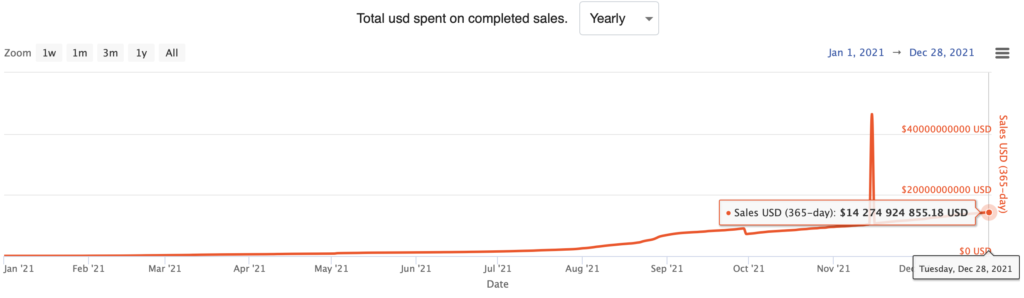
- In 2021, NFT trading volume exceeded $14.2 billion.
- The artist Beeple sold an NFT painting for a record $69.7 million.
- Celebrities and brands drew attention to the segment.
What NFTs offer
The technology confirms ownership of a digital object. If cryptocurrencies and fiat money are interchangeable, one NFT representing a painting is not equal to another user’s NFT, because they may be different paintings by different artists with different values.
Each NFT is unique and exists in a one-of-a-kind form. Even if a digital object is released in several copies, each will have its own non-fungible token.
More on the technology, its development and applications we discuss in educational cards.
NFT trading volume surpassed $14 billion
Although the first NFTs appeared a few years ago, the technology gained real popularity only in 2021. The annual trading volume exceeded $14.2 billion, according to Nonfungible.


The most popular blockchain for creating NFTs was unsurprisingly Ethereum.
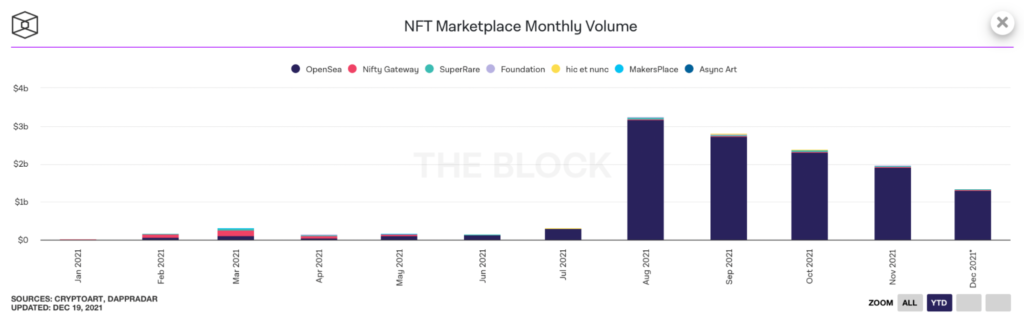
In terms of trading volume, the leader among marketplaces was OpenSea with a figure of $3 bn in August. The segment grew so quickly that OpenSea was even attributed a theoretical valuation of $10 bn.


Analysts at Morgan Stanley expect that by 2030 the NFT market could reach $300 billion. Of this, $56 billion would be attributed to the luxury goods industry.
Christie’s sells Beeple NFT for a record $69.3 million
The living legend of the NFT space is digital artist Mike Winkelmann, better known as Beeple.
He sold the NFT artwork Everydays: The First 5000 Days for a record $69.3 million through the British auction house Christie’s.
A total of 353 bids were placed. With an opening price of $100 the final bid was $60.3 million, and a further $9 million in fees.
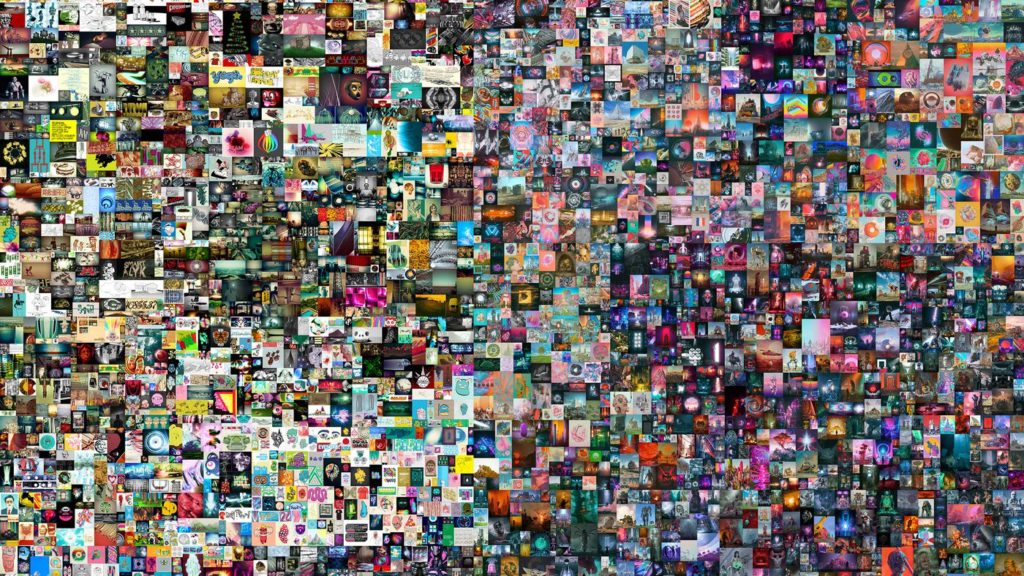
Everydays: The First 5000 Days is a collage of thousands of Winkelmann’s works published online since 2007.


Not even two weeks after the sale, Beeple compared the NFT sector to the bursting of the dot-com bubble. Yet, in his words, the technology is strong enough to endure that period.
Winkelmann also converted the proceeds of $53 million after auction-house fees and taxes into USD, fearing Ethereum’s volatility.
«I’m not even remotely a crypto zealot. I’ve been involved in digital art long before all this hype. If NFTs disappear tomorrow, I’ll keep doing this», — summed up the artist.
Although Beeple does not back the crypto industry, he engages in philanthropy. At the end of March, the artist sold the NFT artwork OCEAN FRONT for $6 million to Tron founder Justin Sun and donated the proceeds to fight climate change.
Experts bullish about NFT-sector prospects
Vitalik Buterin, co-founder of Ethereum, confirmed the potential of non-fungible tokens in financing public goods.
To this end he proposed creating a DAO whose members could collectively approve certain NFTs with the guarantee that a portion of sale proceeds would go to charity. And to draw attention to social-value-backed tokens, Buterin urged linking them to social-media profiles.
«If everyone agrees that one token is more interesting than the others, it will have greater value in the eyes of its holder. This will also hold for those who are willing to pay more for it», — he added.
Buterin welcomed Jack Dorsey’s decision to donate $2.9 million—the proceeds from selling the first tweet NFT. At the same time, he warned that the technology’s potential may not unfold if the focus remains on celebrities.
Billionaire Mark Cuban believes NFTs have enormous potential over the next ten years. He was joined by Galaxy Digital founder Mike Novogratz, who called the technology “expensive for the future”.
«NFT isn’t even kindergarten yet; we are at the dawn of a new, exciting era. I’m absolutely convinced that in ten years the NFT sector will be bigger than many think», — noted he.
FTX exchange chief Sam Bankman-Fried added that the adoption of NFTs is happening faster than other crypto segments.
He noted that people have made a lot of money selling NFTs because it was “one way to get into the game”.
Former American broker Jordan Belfort, the “Wolf of Wall Street,” argues that the value of these digital assets lies not only in “making money”, but also in the sense of belonging to a community.
Popular NFTs
The most popular NFT collections of 2021 were CryptoPunks by Larva Labs and Bored Ape Yacht Club by Yuga Labs, though others profited from non-fungible tokens as well.
For example, athletes Tyson Fury, Floyd Mayweather, Mike Tyson, LeBron James, Shaquille O’Neal, Khabib Nurmagomedov, Oleksandr Usyk, Alexander Ovechkin, Garry Kasparov and artists Tina Karol, DOROFEEVA and Grimes.
NFT fever did not spare meme creators Nyan Cat, Bad Luck Brian, “I don’t want to, I won’t”, “Confused Chloe”, “Pepe the Frog” and “Disaster Girl”.
In such a market, it’s no surprise that schoolchildren found a way to monetise non-fungible tokens. For example, 12-year-old Londoner Benjamin Ahmed earned about $350,000 on CryptoPunks-style NFTs.
The mint cost him $300. In July the boy’s collection of 3,350 NFTs was snapped up in nine hours, earning him more than 80 ETH. In subsequent resales, Benjamin earned an additional 30 ETH in royalties.
In November, 14-year-old Abigail from the USA earned more than $1 million in a day on NFTs. She released a collection of 8,000 whale pictures as non-fungible tokens.
The animals are adorned with sunglasses, caps, coats and other elements. The young artist created most of them on an iPhone 8. And her 25-year-old brother Adam, who trades, helped explain the technology.
The minting cost $5,300. From each sale the girl donated 10% to Sunshine Kids, an organisation for children with cancer, and another 10% to non-profits that help beluga whales. Donations topped $200,000.
There were also those who used others’ work. Since 2013, the Art Wars project creators produced Stormtrooper helmets from Star Wars as art objects. Without their consent, the works were sold as NFTs for 1600 ETH.
Curator Ben Moor photographed some and put them up for sale on OpenSea. The marketplace received a copyright-infringement notice. The Art Wars NFT page on the platform is currently unavailable.
Moor does not deny creating tokens without the artists’ permission. He says he sent them emails with information about the collection. Around 12 artists are preparing to sue.
The primary driver of NFT popularity has been speculation, which helped token holders earn millions. But some industry players saw other benefits in the movement.
Morgan Creek Digital co-founder Anthony Pompliano said that interest in NFTs is driven by a desire to «recreate the collecting industry» in the digital realm.
«Anyone who typically spends from $50,000 to $1 million on buying a car, a watch, a house, a boat, etc., can now spend the same amount on a digital item and show it off to a wide online audience», — he wrote.
Pompliano recalled that in September 2020 he predicted a 6000-fold rise for the digital art market, and stressed that he had underestimated the sector. He is sure the technology “will absorb not only digital art but also collectibles, luxury items and much more”.
Other NFT owners highlighted the possibility of building communities around different collections. In October, CryptoPunk #6046 owner Richerd refused to part with his non-fungible token even for $9.5 million.
He wrote that if 10,000 owners of 10,000 NFTs do not want to sell them, each will become priceless. He was told that “everything has a price,” but Richerd refused to sell his “Punk” regardless of offer.



Then one user placed a bid of 2,500 ETH for CryptoPunk #6046, and the token holder indeed declined it.
«My identity, along with that of other iconic punks and apes, has a value that goes beyond the NFT. We have our own brands, […] and that has value. Because I value personal brand and identity, it was easy to decline», — wrote Richerd.
Had the deal gone through, it would have been the largest sale in the CryptoPunks NFT collection’s history at the time. But even in a market built on speculation, there were those who entered the game not for profit.
Conclusion
In 2021, NFTs exploded the crypto markets. Some users simply wanted to profit; others aimed to steer the trend for good. There were also those who sought primarily to develop the technology.
Even if you regard NFTs as “jpegs for millions”, they will undoubtedly go down in the history of the industry and continue to develop in 2022.
Judging by expert forecasts, we can expect higher trading volumes, new collections and expansion of the sector into other industries.
Celebrities, collectives and teams will continue to earn from their fans, but whether NFTs will become something more than a mere speculation object remains to be seen.
Read ForkLog’s Bitcoin news on our Telegram — cryptocurrency news, rates and analysis.