



The year 2022 was full of upheavals for the DeFi sector and the crypto industry as a whole. Bold forecasts by optimistic analysts did not materialize, and the laser-eyes meme failed to help the market.
The Terra collapse and the unraveling of Sam Bankman-Fried’s (SBF) business empire weighed heavily on the industry. These events had far-reaching consequences for the decentralised finance segment .
ForkLog recalls the important DeFi events of 2022, and considers the sector’s key development metrics .
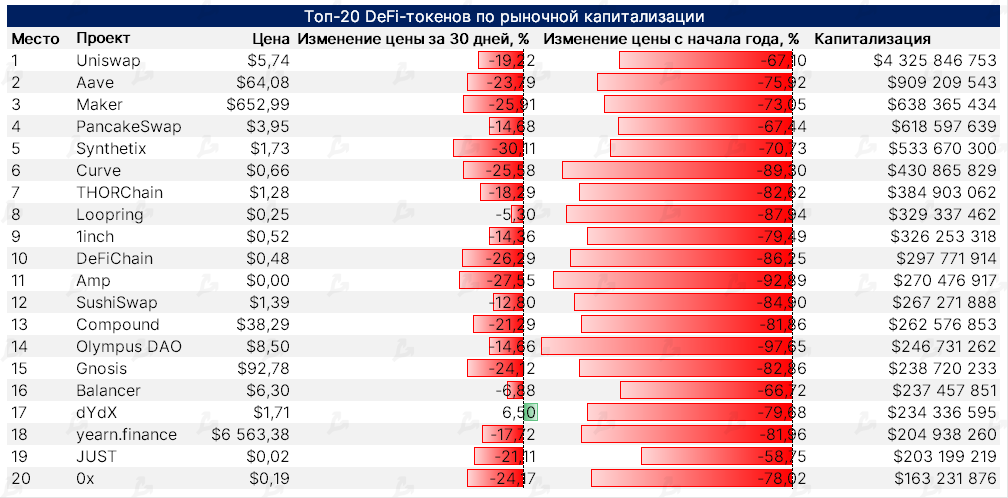
- Prices of many utility tokens of decentralized applications fell by 80-90% over the year. TVL of the sector collapsed to levels seen at the start of 2021.
- Despite the bear market, developers are working on promising projects, and venture-capital investors are showing noticeable activity.
- A tendency emerged to move coins from centralized exchanges to non-custodial platforms.
Slowing Activity
A string of negative events weighed on the sector’s overall TVL — from the start of the year the figure fell from about $260 billion to about $58.7 billion at the time of writing (a drop of around 77.4%).


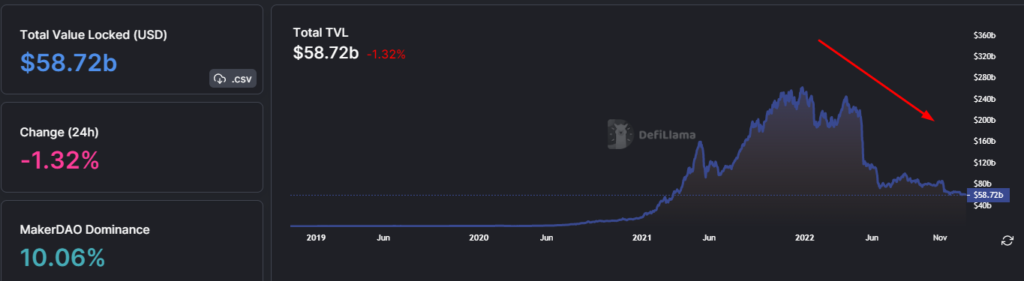
The steepest pace of decline came in early May, amid the sudden collapse of the multi‑billion Terra ecosystem.
Shortly after the collapse of the algorithmic stablecoin UST and the once-highly capitalised token LUNA, serious problems began for well-known firms such as the crypto lender Celsius and the hedge fund Three Arrows Capital. The latter was among the major buyers of the Terra ecosystem’s native token.
The ensuing months saw a period of stagnation. Many thought the cycle had bottomed and that consolidation with a recovery and a new bull run was near. Yet in early November another “black swan” — the collapse of Sam Bankman-Fried’s vast business empire.
This time, Bitcoin traded firmly below the psychological threshold of $20,000, dragging the rest of the market lower. The TVL of the DeFi sector again began to fall.
The Fear and Greed Index consistently indicated exceptionally pessimistic investor sentiment. Many companies laid off staff, and miners faced acute financial pressures, often resulting in exits or acquisitions by other market participants.
Even hodlers, once famed for their resilience, recorded losses. A mass move to a “safe haven” was reflected in a surge of on-chain activity among stablecoins.
The situation hit relatively illiquid DeFi assets hard. The collapse of SBF’s empire also affected the Solana ecosystem, as Alameda Research held sizeable SOL on balance sheets.
Solana’s price fell more than 70%, and its quotes, amid the renewed crisis, fell more than any other top-20 by market cap, Solana.
On the other hand, the November market crash triggered a spike in trading volume on decentralized exchanges (DEXs). Evidently, many investors began gravitating toward non-custodial platforms.


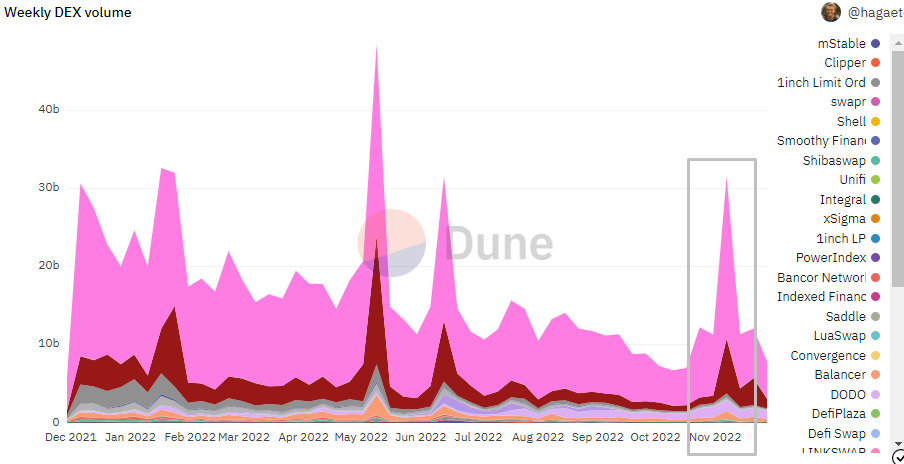
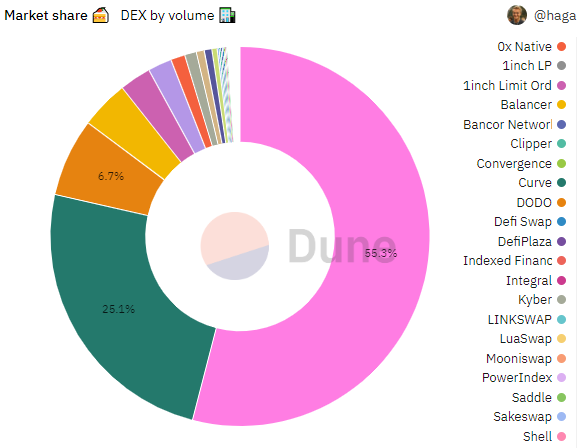
Uniswap remains the undisputed leader among Ethereum-exchanges. Its share of total DEX turnover is disproportionately higher than that of other platforms.


Uniswap continues to attract substantial investments, despite the bear market. The project team is focusing on the integration of new protocols and 2nd-layer solutions such as zkSync, and is actively expanding into the NFT space. This further solidifies the platform’s position.
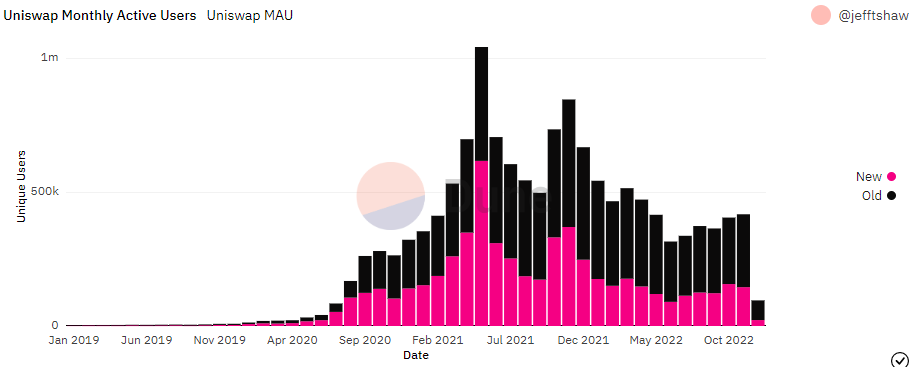
The diagram below shows the recovery in the number of Uniswap’s active users after the May shock from the Terra collapse.


Ethereum remains the leader by share of total TVL.


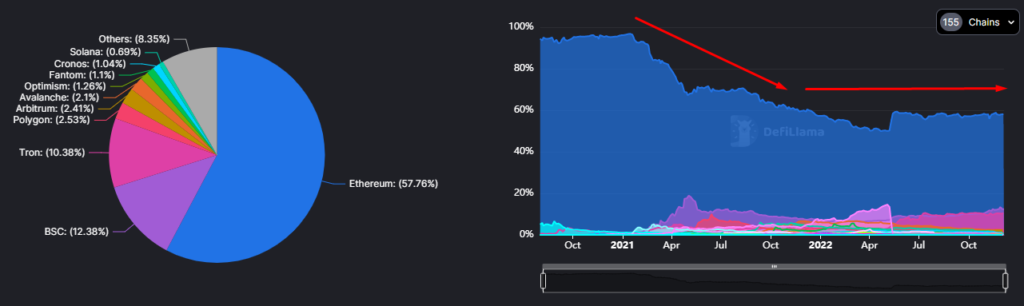
In 2021, Ether’s share declined as newer blockchains gained traction, yet by May the downtrend was halted and the flagship partially regained ground. In recent months, the ecosystem’s share in total TVL has hovered around 58%.
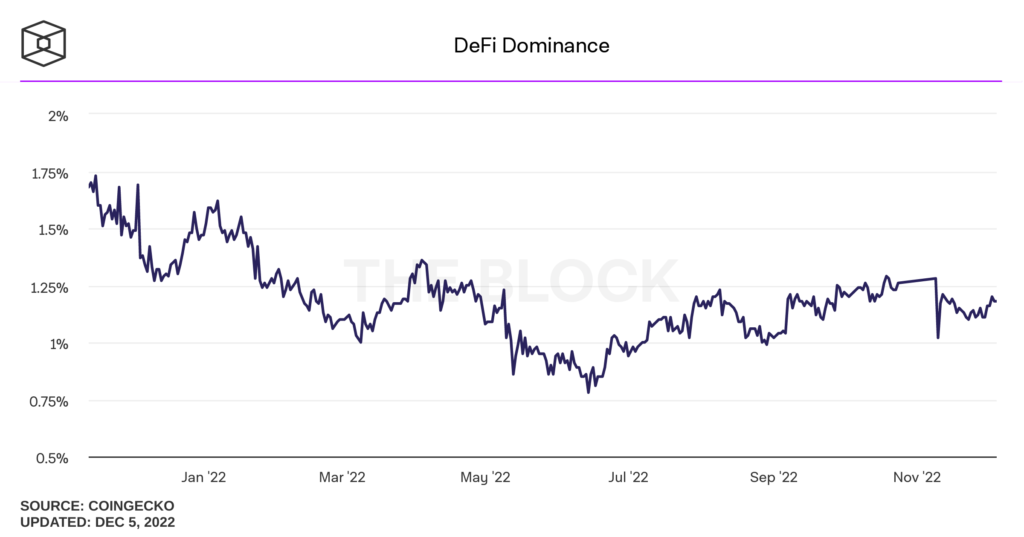
Despite ongoing development, DeFi Dominance remained below 1.5% for the year, which could signal substantial growth potential for decentralised finance, NFT and Web3 more broadly.


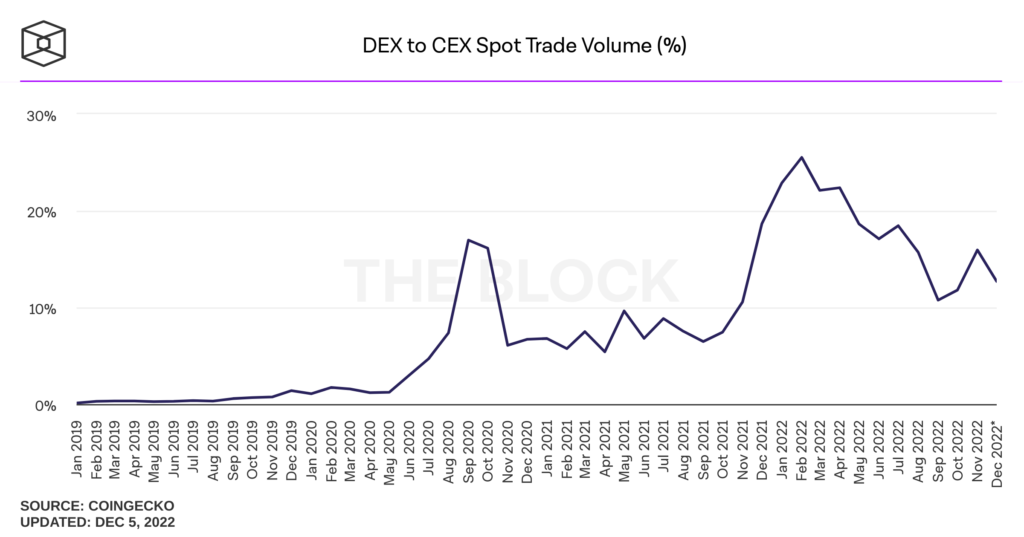
The ratio of DEX turnover to centralised-exchange turnover showed a downtrend from February to September. Some rebound in November was driven by investors migrating to non-custodial platforms amid the FTX collapse.
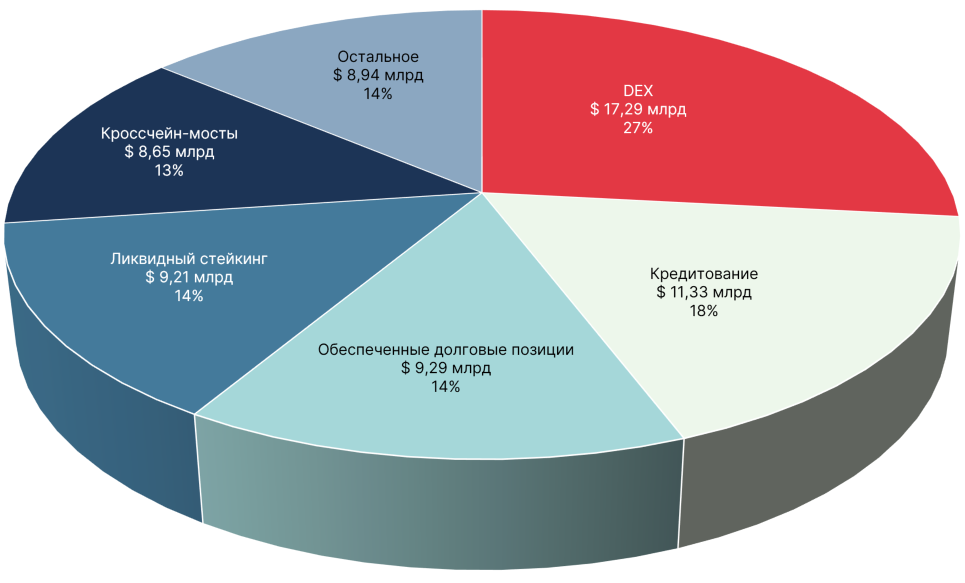
Decentralised exchanges continue to dominate the DeFi sector’s total TVL — accounts for about 27% of the overall figure.


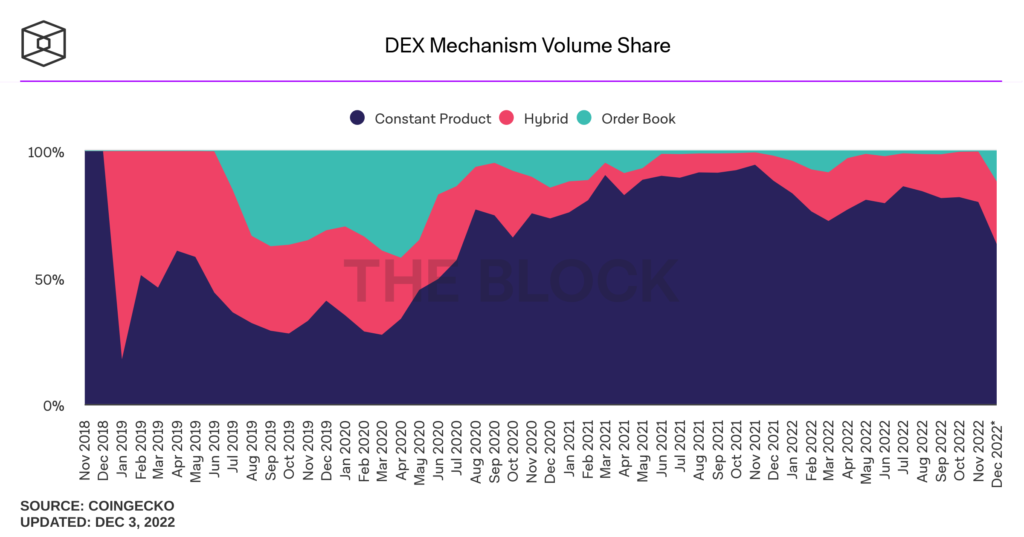
Among DEXs, AMM-based platforms prevail, accounting for about 80% of turnover. Hybrid trading models are relatively popular as well. The share of non-custodial order-book exchanges is small — around 12%.
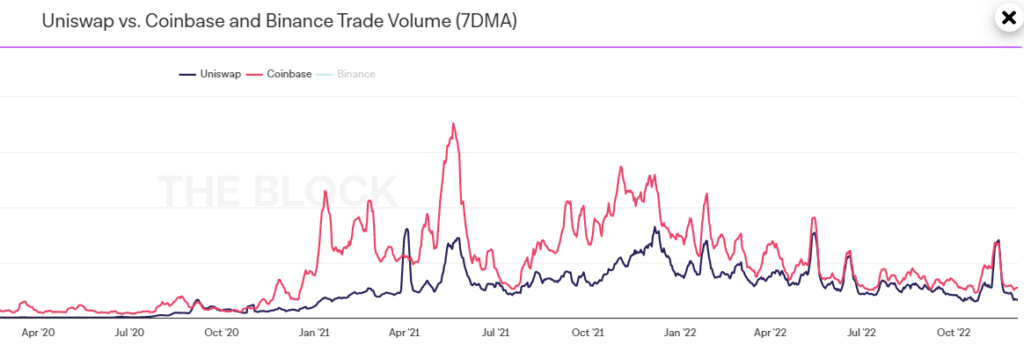
As before, the largest AMM platform Uniswap occasionally surpasses the Coinbase exchange in trading volume.


Notably, there was a marked decline in the supply of the “Bitcoin on Ethereum” token — the metric had been rising until the Terra crash.
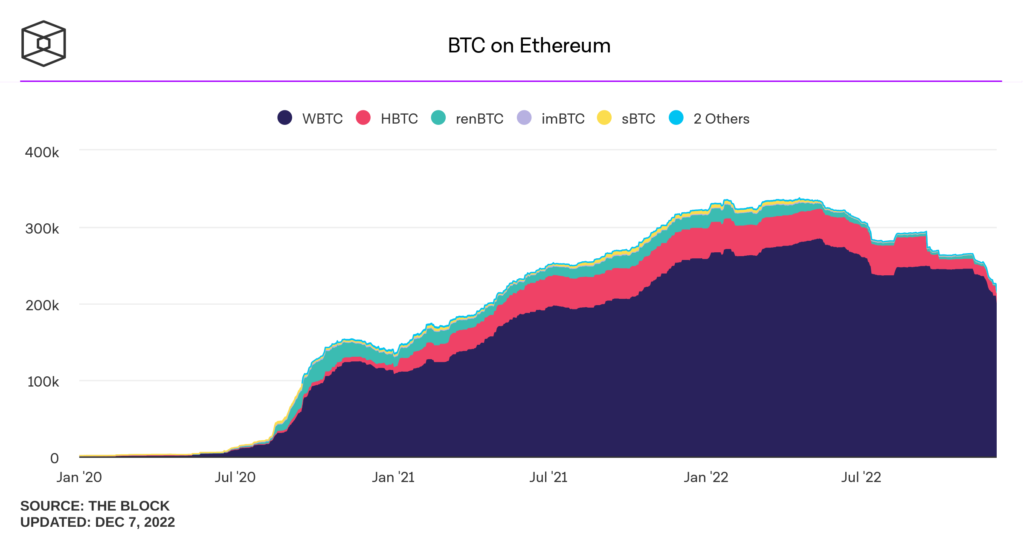
In the segment, Wrapped Bitcoin (WBTC) dominates — its share exceeds 90%.
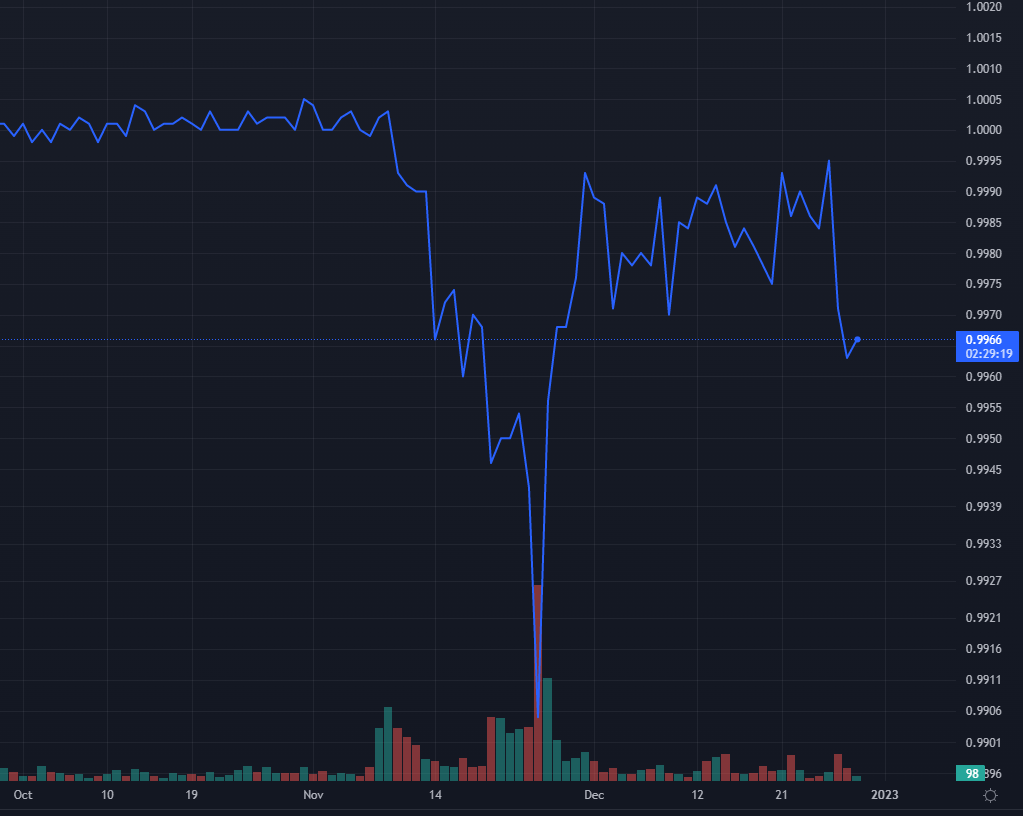
In the wake of the FTX and Alameda collapse, the wrapped token WBTC, as well as Lido’s stETH, lost parity with Bitcoin and Ethereum respectively.


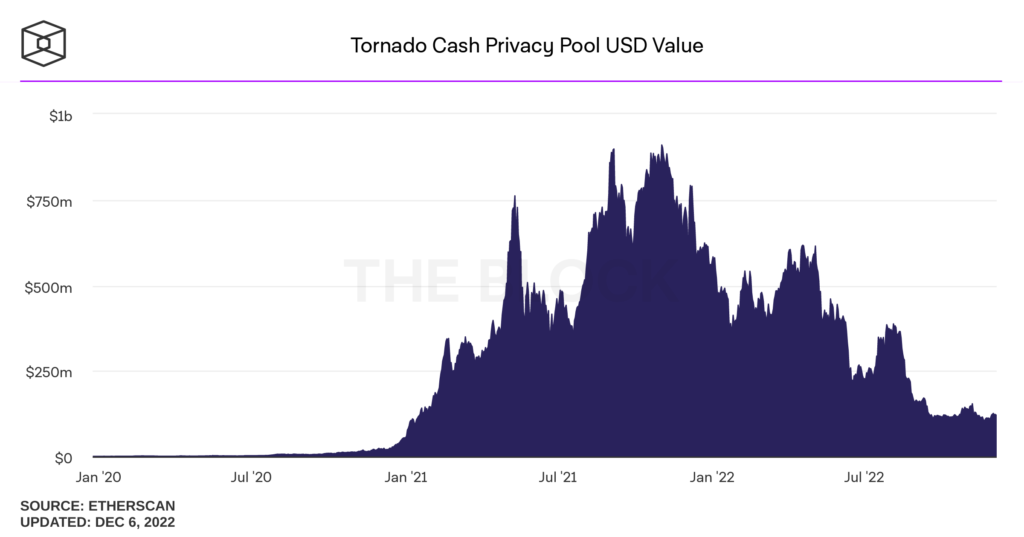
2022 also saw the blocking of the largest transaction mixer — Tornado Cash.
In August 2022 the platform was placed under U.S. sanctions, and in the Netherlands its co-founder Alexey Pertsev was arrested.
As a result of regulatory actions, all assets, user funds and the source code were blocked, and residents were barred from using the service.
Apart from the cryptocurrency, Tornado Cash repositories and their founders on GitHub, RPC Infura and Alchemy Platform, and some domains were blocked. Because of this, the mixer site and related services stopped functioning. Uniswap blocked more than 250 frontend addresses.
The amount of funds engaged in the service accordingly plummeted.
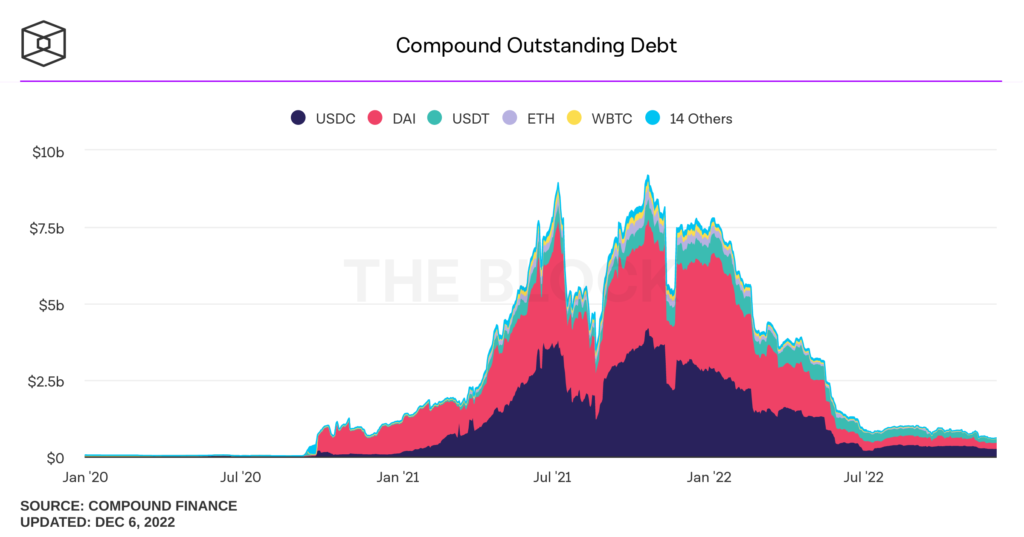
In 2022 activity in lending services declined significantly as well. For example, outstanding debt on Compound and Aave fell markedly.
Worries in 2022 took a heavy toll on the DeFi sector. Even the once-competitor to Uniswap, SushiSwap, faced a liquidity squeeze threatening its operations. To address the issue, the project head Jared Gray proposed temporarily directing all fee revenues to the treasury.
Hacks and Scams
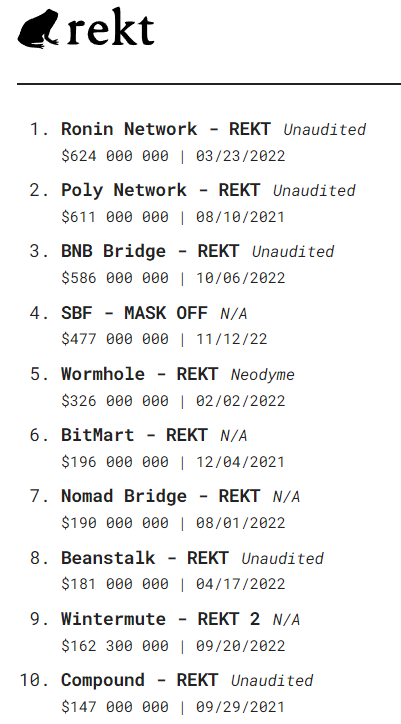
In March 2022 the oldest hack in the sector’s history occurred. Exploiting a vulnerability, the attacker theft of Axie Infinity’s Ronin sidechain assets totaling about $625 million took place. The network was down for several months. The sidechain re-launch took place in late June.
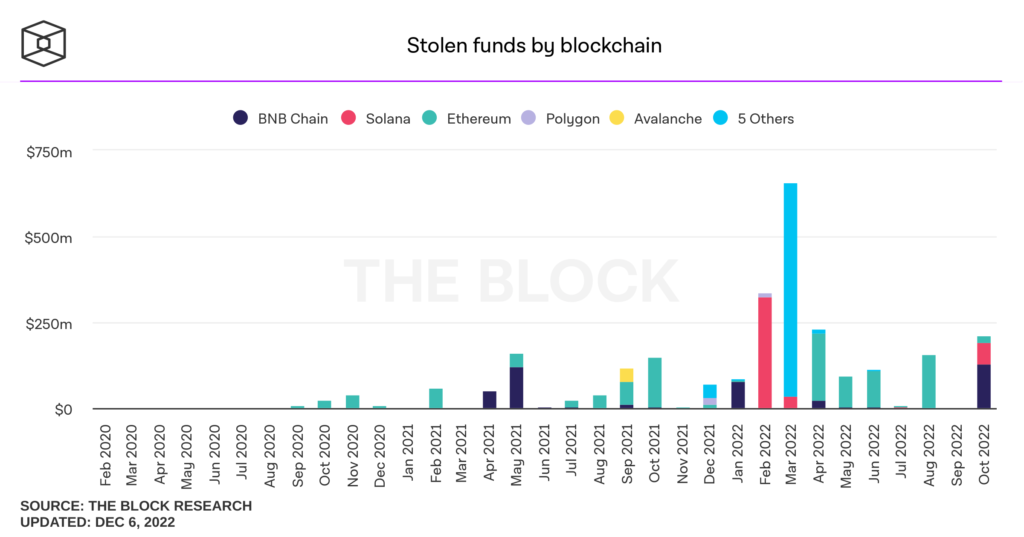
In early October, hackers breached the BSC Token Hub bridge of the BNB Chain ecosystem. The network had to be halted for a period.
The attackers stole digital assets worth more than $544 million, but only about $100 million was moved out.
The February Wormhole cross-chain protocol hack on Solana was the third on the leaderboard. Attackers exploited a vulnerability and drained 120,000 WETH (over $319 million at the time).
On 2 August 2022 a hack hit another cross-chain protocol — Nomad. The damage exceeded $190 million.
The incident contributed significantly to the total Web3 losses from hacks and scams in Q3 — $482.7 million, according to Immunefi’s bounty platform researchers.
Rounding out the top five is the Beanstalk Farms hack. The Ethereum protocol lost $181 million due to the attacker’s actions. On the platform Rekt there is a list of the biggest hacks in recent years. In addition to DeFi projects, it includes centralised platforms such as FTX and Wintermute.


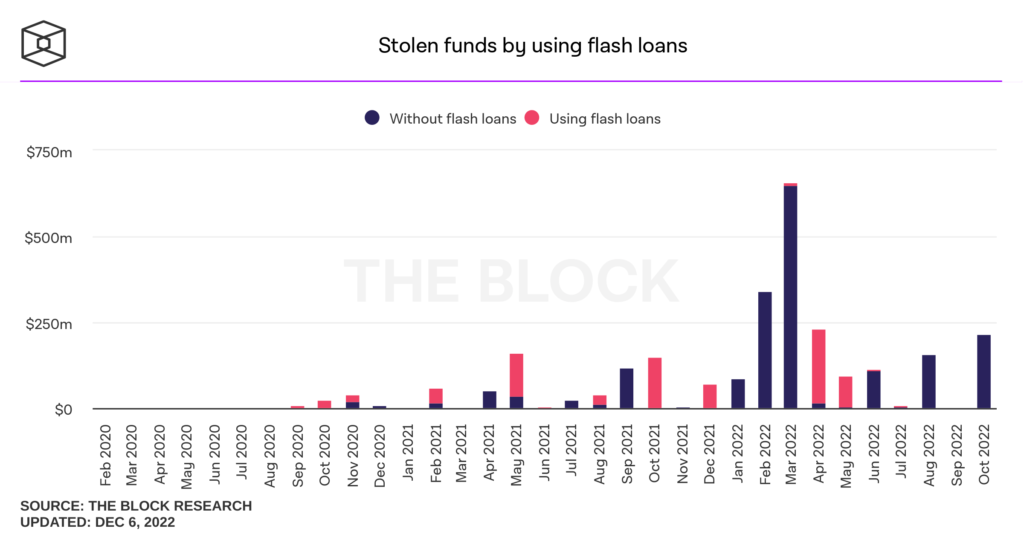
Hacks of DeFi projects often rely on flash loans.
From the start of 2022 to December 1, the market saw 117,629 fraudulent tokens tied to rug pulls. This roughly equates to 15 scam projects per hour, according to Solidus Labs.


Among networks, the highest share of scammers is on BNB Chain: roughly 12% of BEP-20 token issuances are scams. Ethereum sits at about 8%.
Over this period, rug-pull victims numbered almost 2 million investors. This compares with roughly 2.3 million people affected by four major industry bankruptcies — FTX, BlockFi, Celsius and Voyager.


The cumulative value of funds stolen by hackers from DeFi protocols is approaching $3 billion.
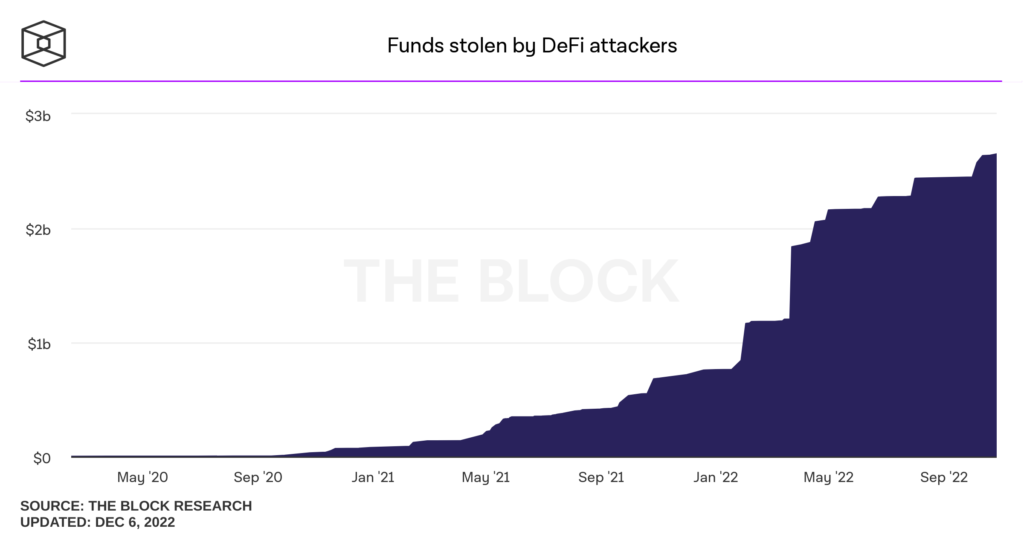
The sum looks enormous and invites reflection on the sector’s future prospects. A number of questions arise:
- Are there solutions being developed to make platforms safer?
- When will Web3 finally become more user-friendly?
- Is there a future for NFTs, metaverses and Layer-2 solutions?
Sector Outlook
Indeed, in the bear market DeFi tokens have lost much of their value. But that does not mean projects have halted their work, and liquidity inflows from venture capital have not dried up.


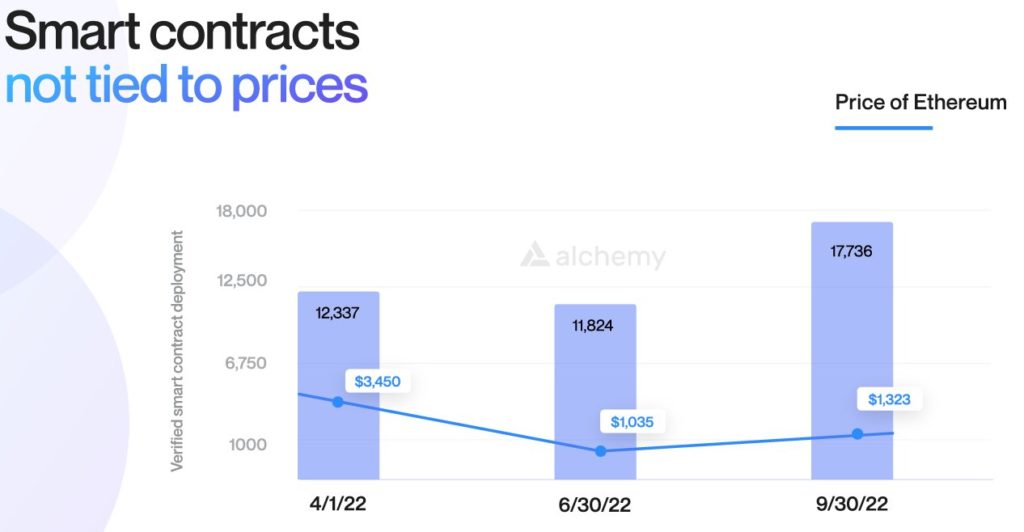
Developers are at work, regardless of price movements.


Despite the colossal losses at Meta and mass layoffs, the firm remains committed to developing metaverses, seeing them as humanity’s future.
Partnerships and NFT launches are being pursued by Porsche, Starbucks and even the developers of the Winamp media player Winamp.
The sportswear brand Nike announced the creation of the Web3 platform .Swoosh. It aims to promote virtual footwear.
Even Interpol unveiled its own metaverse.
The Web3 world is highly diverse. For its rapid development, Layer-2 scaling solutions are essential. The fate of mass adoption largely hinges on their progress.
Ethereum co‑founder Vitalik Buterin is convinced that in the future the second-largest cryptocurrency will rely heavily on ZK-Rollups.
«You don’t need to wait seven days to transfer assets. I expect that in about ten years all Rollups will be largely based on cryptographic proofs», said he.
In early November Buterin published an updated Ethereum roadmap. The document states the team intends to tackle MEV problems and fully integrate zk-SNARKs, without using sharding. According to Erik Wall of Arcane Assets, the latter is less efficient.
«L2 scaling is undoubtedly one of the biggest changes. It can dramatically accelerate DeFi mass adoption by reducing costs and increasing transaction speeds»,
«L2-scale is undoubtedly one of the biggest changes. It can dramatically accelerate DeFi mass adoption by reducing costs and increasing transaction speeds», — explained Jakub, founder of Finematics.
In 2022 Ethereum delivered the most significant upgrade in its history — The Merge, which successfully moved the network to a Proof-of-Stake consensus. Ether’s energy consumption also fell by more than 90% as miners were removed from the equation.
Thanks to this upgrade and the earlier implementation of EIP-1559, inflation of the second-largest cryptocurrency diminished substantially. In October the amount of ETH burned surpassed new issuance.
A new token standard — EIP-4626 — is gaining traction, designed to improve interaction for dapps and expand yield-farming capabilities for yield farming.
The community also looks forward to EIP-4488. It aims to make Rollups more accessible by reducing the cost of transferring one byte of calldata on the Ethereum blockchain by about 80% — from 16 to 3 gas units.
Venture investments propel DeFi and the crypto industry forward. Their volume in the first half of the year exceeded $30 billion.
More than a third of all funds across 1,199 investment rounds went to CeFi — $10.2 billion.
The remainder was allocated to:
- infrastructure companies ($9.7 billion);
- NFT projects ($6.7 billion);
- Web3 developers and DeFi protocols (about $1.8 billion each).
The FTX crash certainly dampened but did not fully shut off funding to promising projects. For example, in recent months:
- Web3 games publisher Fenix Games raised $150 million for a fund to finance blockchain games;
- staking platform Kiln raised more than $17 million from Kraken, ConsenSys and other notable players;
- cybersecurity-focused startup Cyvers attracted $8 million;
- NFT platform Shibuya received seed funding of $6.9 million from a16z and other market participants;
- the Uniswap-based protocol Panoptic attracted $4.5 million.
Most likely, the projects listed above passed stringent due diligence. The funds raised in new rounds are likely to be deployed effectively to create market-ready products.
Conclusions
The DeFi segment remains relatively small and is still highly dependent on overall market conditions. Prices and TVL figures react sharply to headline events such as bankruptcies, hacks, and scams.
Nonetheless, the DeFi sector continues to develop despite the headwinds and shocks of the bear market. Developers are building new platforms, and investors are funding startups, albeit with greater caution.
Drawing a parallel with the dot-com crash or the ICO era’s end, one could argue that in the long run only the highest-quality projects will survive — as Amazon and Uniswap did.
The DeFi sector remains young and promising, and there is much to come: new products, scams and hacks, bankruptcies and takeovers, booms and busts.
Follow ForkLog’s bitcoin news in our Telegram — cryptocurrency news, prices and analysis.