



2024’s key crypto events and trends: new highs and institutionalisation
In 2024 the crypto industry finally shook off its bear-market torpor. Many factors signalled the thaw, the most telling being bitcoin’s fresh all-time highs.
New institutional players joined the rally alongside the old guard, helped by the launch of exchange-traded funds backed by the largest digital assets.
Regulatory temperatures also rose above freezing. The US government softened its rhetoric, adding to optimism about the sector’s prospects.
Events
ATHs and the halving
In 2024 the first cryptocurrency proved to sceptics that even spectacular corporate collapses and a grinding bear market could not derail its ascent.
Bitcoin began January near $42,000 and traded between $40,000 and $45,000 until mid-February. It then surged to its first all-time high (ATH) of the year, reaching around $73,000 on March 13, according to CoinGecko.
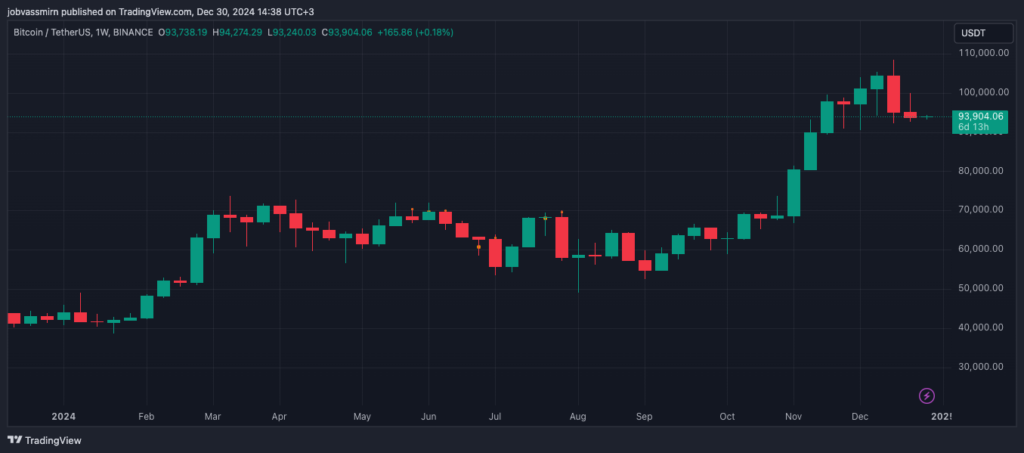
Digital gold set its ATH ahead of the halving, defying expectations. The fourth halving of miners’ rewards took place on April 20 at block height #840,000, cutting the payout per block from 6.25 BTC to 3.125 BTC.
By the halving, bitcoin had slipped to $63,000 and showed little reaction afterwards. Based on prior cycles, experts had forecast a bull phase to begin about 100 days after the cut, yet through summer and the first half of autumn the coin ranged between $50,000 and $65,000.
The price action prompted analysts to question whether bitcoin’s halving-driven cycle had “died”, as previous periods saw rapid gains soon after the event.
With block rewards halved but prices not rising in tandem, miners’ revenues were hit hard, stoking worries about potential capitulation by some operators.
By early September investor sentiment hovered near fear territory, but as the US Federal Reserve began to ease monetary policy, bitcoin gradually climbed back above $65,000.
Uncertainty over America’s next leader lingered all year. Democrat Kamala Harris was expected to take a more cautious line on bitcoin; her rival—and eventual winner—Donald Trump pledged to make the country the world’s “crypto capital”.
Trump’s victory unleashed a run of record highs. In November bitcoin raced towards $100,000, and on the night of December 4th–5th it finally cleared the psychological threshold. On December 17th the price peaked around $108,000 on Binance—more than 140% up on the year.
By month-end bitcoin fell back below $100,000 and stalled near $95,000.
Other digital assets largely followed the flagship, though many have yet to set new highs. Total crypto market capitalisation grew from $1.73trn to $3.43trn—up 98%.

By year-end Ethereum hovered around $3400, up 70% over 12 months. The coin was still roughly 30% below its all-time high of $4878 on November 10, 2021 (as of December 30, 2024).

In November Solana (SOL) tested a new ATH at $261, not far above its previous peak. On December 4 BNB set a high at $788, and TRX at $0.43.
XRP also put in a strong showing, climbing from $0.5 to nearly $3 in a month. Its previous ATH of $3.4 was set in January 2018.
Most analysts expect the bull market to continue in 2025 and foresee new bitcoin highs, albeit with differing targets. They also anticipate fresh records in major coins including ETH and SOL.
Whether an altcoin season has arrived is disputed. Some argue it has already ended; others insist it has yet to begin.
ETF launches
Throughout 2023 asset managers battled America’s Securities and Exchange Commission (SEC) to launch spot bitcoin ETFs. On January 10, 2024 the regulator ultimately approved all 11 applications; trading began the next day.
The authorised issuers included Bitwise, Grayscale, Hashdex, BlackRock, Valkyrie, BZX, Invesco, VanEck, WisdomTree, Fidelity and Franklin Templeton, ARK Invest and 21Shares.

“Although today we approved the listing and trading of certain spot bitcoin ETPs, we are not approving, and have not approved, bitcoin itself. Investors should remain cautious about the myriad risks associated with it and products whose value is tied to the asset,” the SEC chair Gary Gensler said at the time.
Interest was almost immediate: more than $800m flowed into the new funds in the first week. Most saw inflows, though the converted Grayscale trust (GBTC) recorded hefty outflows as its discount to NAV narrowed.
Since launch, net inflows into the ETFs have exceeded 500,000 BTC, according to SoSoValue.
Managers now hold 5.68% of bitcoin’s total supply—about $112.5bn at current prices.

Several analysts reckon the hefty ETF volumes drove bitcoin’s first ATH of the year.
For now the largest spot product is BlackRock’s IBIT with $53.44bn in assets, followed by GBTC with $21.1bn and Fidelity’s FBTC with $20.7bn.
Summer brought the turn of the second-largest cryptocurrency. On July 23 spot Ethereum ETFs in the US began trading.
Early on, they proved less impressive than their bitcoin cousins. Over time, however, outflows—largely from Grayscale’s product—gave way to a run of inflows.
Net inflows to ETH ETFs now total $2.24bn. Issuers control roughly 2.9% of circulating ETH worth $13.6bn.

Grayscale’s ETHE is the largest product in the segment, but the converted trust still shows negative flows—investors have withdrawn $3.52bn since launch.
BlackRock’s ETHA ranks second with $3.81bn in assets under management.
Stock-market players now await products tied to other coins. In November the CBOE filed 19b‑4 forms for four spot Solana ETF applications from VanEck, 21Shares, Canary and Bitwise. A fifth request from Grayscale was submitted on December 3.
Yet the SEC has notified at least two of the five issuers that it intends to reject their filings.
XRP from Ripple may also have a shot at a spot fund. 21Shares filed the paperwork in November. Bloomberg’s Eric Balchunas has also floated the prospect of Dogecoin ETF applications landing at the SEC.
Trump’s win
On November 5 Donald Trump, known for his pro-crypto pledges, won America’s presidential election. His Republican party also secured a commanding Senate majority.

Buoyed by the result, bitcoin punched through $100,000—a milestone the president‑elect duly saluted.
Trump, whose inauguration is slated for January 20, 2025, cast himself as a defender of digital assets, chastised Democrats’ botched regulatory forays and aimed to become the “crypto president”.
On the trail he outlined plans to cement America’s leadership in digital assets and make the country the “cryptocurrency capital of the world”.
One of the community’s most anticipated promises has already been realised—if not by decree then by influence—via the departure of Gary Gensler, one of the most criticised officials, from the helm of the SEC.
The president‑elect has formally nominated Paul Atkins to chair the regulator, praising the nominee’s grasp of digital assets and calling him “a proven leader in common‑sense rules”.
Trump has also proposed David Sacks, co‑founder and general partner of the venture firm Craft Ventures, as “czar” for AI and digital assets. One task will be to help craft a regulatory framework for crypto.
The change of guard has boosted the odds of a US strategic bitcoin reserve. After the election, Senator Cynthia Lummis introduced a bill to buy 1m BTC (no more than 200,000 per year over five years) funded by the Fed’s gold reserves.
Earlier, Trump proposed using bitcoin to help pay down the national debt.
Among other pledges:
- free Ross Ulbricht, founder of the Silk Road dark‑web marketplace;
- block the creation of a US CBDC;
- protect the country’s bitcoin‑mining sector and the industry globally;
- not impede the use of digital gold or other cryptocurrencies.
The Trump family waded in too. In September his sons unveiled World Liberty Financial and a forthcoming WLFI token sale. Presales began in mid‑October.
The largest investor was Tron’s founder Justin Sun, who bought 2bn WLFI for $30m. The platform aims to raise $300m by selling 100bn coins. In December World Liberty Financial converted 12m USDC into Ethereum, Chainlink and Aave.
As Trump builds an administration stacked with crypto‑friendly figures, the true impact of his policies on bitcoin and the wider industry will become clear next year.
Dencun
On March 13 the Ethereum team activated the long‑awaited Dencun (Deneb‑Cancún) upgrade on mainnet.
At its core is EIP‑4844, which introduces Proto‑Danksharding to scale the network by creating a new transaction type for large binary data blobs (BLOBs).
These blobs temporarily store large volumes of data, enabling a dramatic reduction in fees across L2 ecosystems, especially those using rollups.
Gas on Base fell from $0.7 (pre‑hard fork) to $0.0024 (post‑launch). Optimism’s transaction costs dropped from $0.66 to $0.0055, and ZKsync’s from $0.32 to $0.097.
While Dencun made L2 transactions cheaper by tens or even hundreds of times, it also exposed some mainnet side‑effects.
Daily ETH burn has declined, hitting its lowest levels since the London hard fork in 2022.

On July 7, 2024 Etherscan recorded a daily burn low of just 183 ETH.
Per Ultra Sound Money, since The Merge the supply has shrunk by 76,988 ETH out of a total of 120.4m coins—an emission change of just −0.028%.

L2 fee revenue plunged after Dencun, though it recovered somewhat by year‑end.

The upgrade also spurred more bot activity and failed transactions on L2s.
Next up for Ethereum is the major Pectra upgrade to make the system more flexible, efficient and user‑friendly, combining Prague and Electra to expand wallet capabilities and improve network efficiency.
As an ecosystem, 2024 was not Ethereum’s finest hour: critics grumbled about slow progress. In December blockchain developer Max Resnick announced he was leaving ConsenSys for Anza, focused on Solana.
His move followed large‑scale layoffs at the company and personal disillusionment with Ethereum. In one essay he argued the network’s original vision as “the public financial substrate for a new world” had been “ground to dust”.
Even so, expectations for Ethereum run high amid growing institutional uptake. Bitwise hopes to see ETH at $7000 in 2025.
Mt.Gox distributions
In May the exchange Mt.Gox, which collapsed a decade ago, began moving coins for the first time in years.
Across several batches, wallets sent more than 140,000 BTC in total, kicking off long‑awaited user reimbursements.
Mt.Gox confirmed creditors’ addresses for compensation back in January, and in April some clients reported fiat payouts.
Over 2024 the exchange moved bitcoin worth $9bn, $6bn, $2.85bn, $2.47bn, $2.25bn and $784m. Such hefty sums unnerved the market and at times triggered corrections.
Meanwhile Kraken, Bitstamp and other venues reported receiving and distributing assets.
Mt.Gox was expected to finish compensation by October 31, 2024, but the deadline was pushed to the same date in 2025. According to Arkham Intelligence, the platform still holds 24,052 BTC worth $2.44bn.
In September former owner and CEO Mark Karpelès also announced a new exchange, EllipX, in Poland, touting “transparency” and user friendliness.
Tornado Cash rehabilitated
On November 26 America’s Fifth Circuit Court of Appeals ruled that the OFAC exceeded its authority when it sanctioned the crypto mixer Tornado Cash in August 2022.
The blacklisting was prompted by suspicions of ties to North Korea’s nuclear programme. The agency said that since Tornado Cash’s launch in 2019, criminals had laundered more than $7bn through it.
The decision stemmed from a lawsuit by six Ethereum and Tornado Cash users against the US Treasury after the site was added to the blacklist. They argued the measures were excessive because the mixer is software, not a person or organisation.
“Tornado Cash’s immutable smart contracts (lines of code that provide privacy) are not the ‘property’ of a foreign national or entity, which means they cannot be blocked under [the law] and that OFAC exceeded the authority granted to it by Congress,” the panel held.
The ruling also noted that even under sanctions the platform remains available “to any person with an internet connection”.
Bill Hughes, senior counsel at ConsenSys, called the ruling “a good win that the Supreme Court is unlikely to overturn”. Coinbase’s chief legal officer Paul Grewal said it was historic “for crypto and for everyone who cares about protecting liberty”.
Even so, the fate of Tornado Cash’s developers is unchanged. In late November 2024 a court extended the pre‑trial detention of developer Alexey Pertsev. In May Dutch authorities found him guilty of laundering $1.2bn via the mixer and sentenced him to 64 months. In July he was denied bail pending appeal.
Co‑founders Roman Storm and Roman Semenov also face US charges of money laundering and sanctions violations. There is no word of any cases being dropped.
Trends
Institutionalisation and bitcoin accumulation
With spot ETFs and other stock‑market products now wrapped around crypto, TradFi players gained a full‑fledged route into digital assets.
According to a PwC and AIMA study, by October 2024 some 47% of traditional hedge funds had invested in crypto, up from 29% in 2023. Regulatory clarity in the US and Asia, plus ETF launches, were key drivers.
River’s experts reckon that over the coming year 10% of US firms will convert 1.5% of their reserves—about $10.35trn—into bitcoin.
It was also reported that 15,000 Morgan Stanley financial advisers will offer clients bitcoin ETFs, and that BNY Mellon will expand custody to spot products.
Analysts at Sygnum estimate that each $1bn of inflows into BTC ETFs lifts the underlying by 3–6%.

Rising institutional interest could set up a 2025 “demand shock”. Analysts also see room for greater state and public‑sector buying.
In November an unnamed UK pension fund allocated 3% of its £50m (~$64.9m) in assets to direct bitcoin purchases. That month Michigan’s state pension fund disclosed buying 460,000 ETHE shares worth over $10m and 460,000 Grayscale Ethereum Mini Trust ETF (ETH) shares worth about $1.1m.
MicroStrategy, led by Michael Saylor, accelerated its accumulation and remains the largest public‑company holder, with 423,650 BTC (~$43bn).

Saylor kept announcing purchases throughout the year and in late November pitched a bitcoin strategy to Microsoft’s board to add $4.9trn to its market cap. With just 0.55% of shareholders in favour, the idea was rejected.
That did not dent MicroStrategy’s prospects. In December its shares (MSTR) were added to the Nasdaq‑100 index of the 100 largest non‑financial firms on the exchange.
Bloomberg’s James Seyffart estimated at least $2.1bn of ETF buying would follow inclusion.
Over the year MSTR rose nearly six‑fold; bitcoin gained about 130%.

A shareholder group also urged Amazon to create a bitcoin reserve, investing “at least 5% of assets”. The proposal will be considered at the 2025 AGM.
Japan’s public firm Metaplanet followed Saylor’s lead, lifting its reserves to 1,142 BTC. CEO Simon Gerovich urged investors to “always accumulate the first cryptocurrency”.
Miner MARA likewise implemented a full‑blown bitcoin strategy, amassing 40,435 BTC.
Even so, just 0.01% of public companies worldwide presently hold bitcoin, per OKG Research.
The rise and fall of tap‑to‑earn clickers
Hardly had 2024 begun when Web3 gaming entered a new phase. On January 1 a Telegram mini‑app called Notcoin launched on The Open Network (TON).
The clicker let users “mine” the NOT token by tapping their screens. It quickly drew crowds with the promise of an airdrop. From the outset the team warned players not to expect profit: the token “is worth nothing”.
The airdrop was first slated for bitcoin’s halving, then pushed to May. From February, pre‑launch futures on NOT began trading on Storm Trade. In March, P2P pre‑markets opened on Getgems and Bybit.
On May 16 the coin was listed by all major exchanges; its price fell about 60% on day one. It now trades near $0.007, down from $0.012 at the start.
By June Notcoin’s user base had hit 40m; some countries even introduced criminal penalties for selling NOT. The team later announced it was abandoning the clicker concept.
Others rushed to copy the playbook. “Tap‑to‑earn” clones appeared, notably Hamster Kombat and the Elon Musk‑inspired X Empire.
Hamster Kombat’s user base rocketed to 100m. Pavel Durov, who endorsed the game, said 4–5m new users joined daily, making it “the fastest‑growing digital service in the world”.
Telegram itself saw users surge past 950m amid the craze.
But the end of Hamster Kombat’s first season disappointed many with mass bans and a weak HMSTR price. The project shed 260m users and the token plunged.
Tap‑to‑earn looks like the one big fad that did not survive 2024. Notcoin’s creator Alexander Plotvinov argued such apps won’t achieve long‑term success or generate sustainable revenue.
Hamster Kombat’s developers have promised to woo users back ahead of season two, but a return to peak popularity looks unlikely—and no new headline‑grabbing projects have emerged.
Fast memes
Meme coins have long been part of crypto. Until 2024, though, creating them required technical know‑how.
That changed in March with Pump.fun on Solana. The “meme‑coin factory” lets any X user mint a token via a simple tweet with a name, image and description.
An automated bot does the heavy lifting, including seeding DEX liquidity pools once a market‑cap threshold is reached.
According to Dune, more than 4.6m meme tokens were created in ten months. Pump.fun took in over $310m in fees.

The frenzy lured waves of new traders and spawned rivals—Ethervista on Ethereum, Springboard on BNB Chain, SunPump on Tron and Moonshot from DEX Screener (on Solana).
Even so, Pump.fun drew flak. By September only 0.0045% of auto‑created tokens had exceeded $1m in market cap.
Another backlash followed the platform’s streaming feature. Users balked at livestreams where token creators used questionable methods to grab attention.
In November Pump.fun’s developers shut streaming, citing too few moderators amid surging demand—a blow to revenue.
In December access to the platform was restricted for UK users after the regulator cited a lack of licensing.
Despite the criticism, the team announced plans for a token and unveiled Pump Advanced, a trading terminal for power users.
The meme‑coin sector is hard to gauge in a broad bull market. But former bitcoin maximalist and meme‑coin maven Murad Mahmudov flagged a slowdown, while on‑chain data showed interest shifting to DeFi.
The segment’s total market cap now stands at $107bn—about 3% of crypto.
Prediction markets
Prediction platforms are not new, but 2024—supercharged by America’s election and other headline events—brought them into the mainstream.
Such services let users bet on almost anything. In “cryptocurrency” categories, they wager on bitcoin and Ethereum price milestones and airdrop schedules.
Polymarket emerged as the leader. In January its traders staked $8.23m on spot bitcoin ETF approvals.
Alternatives include BET on Solana and leveraged perpetual binary futures on dYdX.
Throughout the year Polymarket users punted on everything from bitcoin at $100,000 to the Middle East conflict and the next SEC chair.
Regulatory headwinds did not stop the surge—growth accelerated from May. That month the project raised $70m across two rounds from General Catalyst, DragonFly Capital, ParaFi Capital, Vitalik Buterin and others.
In October monthly volumes hit a peak of $2.5bn, easing after the US presidential race ended.

The stats are sobering: only 13.6% of Polymarket traders made money, most less than $100. Despite that—and ethical debates over some markets—usage stayed brisk.
Access was not universal. In November France’s regulator blocked the site for locals.
The ban followed an investigation by the national gambling authority into a French trader, “Theo4”, who wagered more than $30m on Trump’s victory and netted about $19m.
Before that, the FBI searched the Manhattan apartment of Polymarket CEO Shayne Coplan; he has stressed the platform’s “strict non‑partisanship”. Media reported authorities seized his phone and other electronics.
***
One thing is clear: the past year revived crypto and stiffened investor confidence. Much remains uncertain, but positive signals—from a new US administration to fresh records—point to the bull cycle rolling into 2025.
Participants will keep a close eye on upgrades and moments to act. With luck the next 12 months will bring few shocks; and if challenges come, the market will be ready.
Stay with ForkLog. Happy New Year!
Рассылки ForkLog: держите руку на пульсе биткоин-индустрии!